
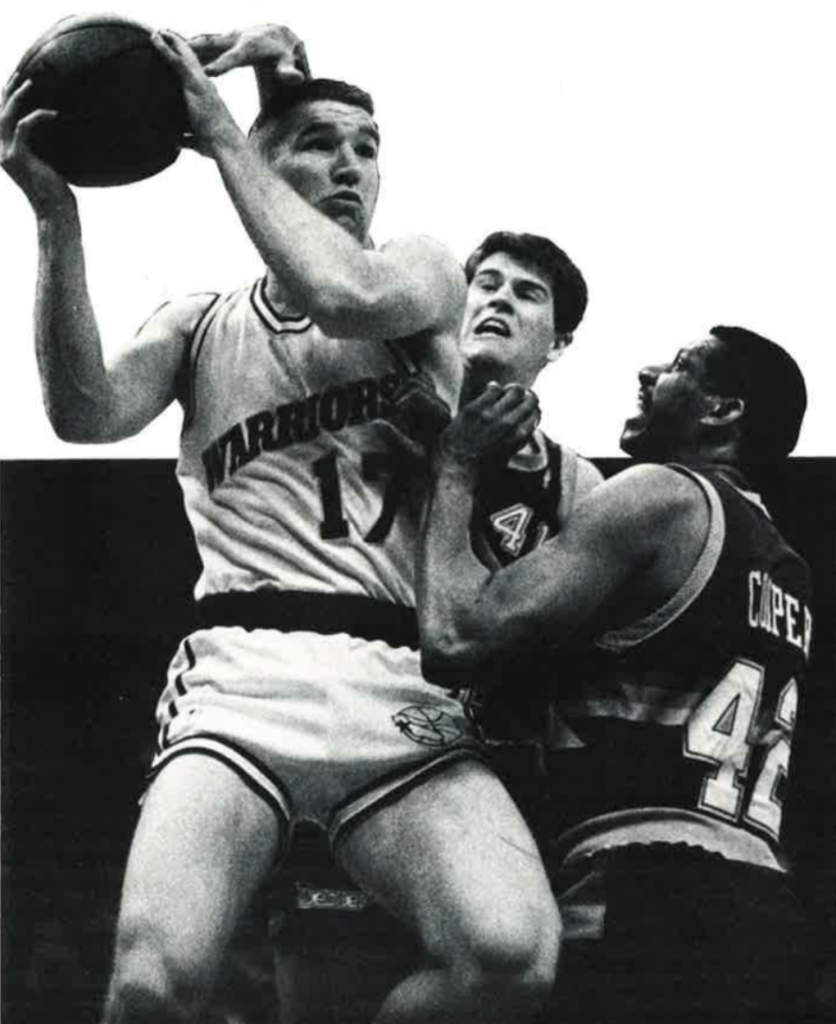
In January of 1988, at 11 p.m., less than 20 hours before the Golden State Warriors professional basketball team were to play a home game, their flashy 6’7″ forward, Chris Mullin, could most likely be found sitting in a local tavern gulping down one beer after another. Yes, he was fully aware that he had a game to play.
Yes, he was fully aware that he should be sober instead of near intoxication. And yes, Chris Mullin knew that what he was doing was wrong. Wrong not only because he was potentially a superstar in the National Basketball Association, a world where only 300 awesomely talented human beings are paid lavishly to dribble and shoot basketballs-but also because he desperately wanted to stop drinking, yet lacked the willpower to do so.
“I was trying to be a great drinker and a great basketball player, and I couldn’t do both. I gave up one, and now I’m pretty good at the other,” says Mullin in an interview before a recent 1991 NBA playoff contest.
Today Mullin, an NBA all-star and routinely one of the league’s highest scorers (ranking 5th in 1989 with a scorching 26.5 points per game) as well as one of the most accurate free-throw leaders in NBA history, at near 90 percent, prefers to knock down 20-foot jumpshots rather than chugs of foamy alcohol.
Says Mullin, “Now, when someone asks me if I want a drink, I say, ‘Sure, give me a soda.'”
Number 17 for the Warriors feels he’s conquered his drinking problem since those depressing tavern days and nights back in the late 1980’s. “I will never drink again! To say that,” Mullin says, “is scary, yet I know I can do it. I have to just take it nice and easy, face each day as it comes and not be in a big hurry.”
Six years ago, Mullin, a 220-pound southpaw, was in a huge hurry. He was the 7th pick in the first round of the 1985 NBA draft and desperately wanted to prove that being a two-time all-American at St. John’s University (New York) was no fluke.
After leading the 1984 U.S. Olympic basketball team to glory and being named the Collegiate Player of the Year, the Brooklyn, New York denizen found the NBA to be a very difficult adjustment.
Mullin suffered from loneliness. His family was on the other coast. There were talks of a trade to New York.
“Here I was, this blue-collar jock, this highly-touted basketball player, and when I got to the pros, it was like, what the hell am I doing here? I quickly realized that I just wasn’t as good as I thought I was. I realized it was gonna be one helluva an effort to make it in this league. It wasn’t easy.” Mullin adds, “That’s when I first began to drink a lot. It was more enjoyable for me to drink all night than practice and stay in shape.
“I thought I was indestructible. That I could do anything and everything like I did in college.”
It might have been easier for Mullin to hide his drinking from his teammates and coach than if he had been using cocaine, since the NBA has no such strict policy with alcohol as it does with drug abuse.
The Irish American rookie was asked point-blank by head coach Don Nelson if he indeed had some type of drinking problem. “It was the first time anyone had asked me point-blank. He threw me off-guard. I said something like, ‘No, I don’t. Do you?’ I mean, it was the start of the summer and I was going back home to drink with my hometown buddies. What was this guy doing? I thought. Trying to ruin my summer?”
Now 27, a clean and sober Mullin can look back at those days with a gleam of maturity in his eyes. Nelson kept after his budding star, knowing full well the signs of such a disease. The Warriors coach said, “I’ve dealt with a number of players who’ve had addictions, and all but one have slid back again. I told Chris he had to realize that this was a day-to-day battle.” One of the first things you notice about the deft shooting Warrior is his muscular legs. Very pale with extremely wide calves.
Christopher Paul Mullin glides gracefully about the court. While not known as a great leaper, the easy-going and self-effacing All-Pro is a pleasure to watch while he’s playing in the Warrior line-up. He catches the ball effortlessly and easily with either hand. Graceful and very athletic, he makes crisp passes to open teammates that many other players would not see. Perhaps the result of his family’s hurling and rugby background.
His best traits seem to be an uncanny shooting touch, superb hand-eye coordination, brilliant court awareness, and a ridiculous command of every fundamental skill-passing, dribbling, free-throw shooting, rebounding, and defensive positioning. His game is utterly flawless. No faults. No mistakes on the court. Many experts feel his all-round game bears comparison with Larry Bird’s, and makes him a sure bet for future Hall of Fame Status.
In his first few NBA seasons, the versatile swingman has had scoring averages of 14.0 (1986 rookie); 15.1 (1987); 20.2 (1988); 26.5 (in 1989) and better than 25 per contest last season, to rank 7th in the entire league.
Last season, Mullin also ranked 8th in free-throw-percentage (.889 percent) and 11th in field goal percentage (with a healthy 536 percent remarkable, considering most of his shots are from 15-20 feet out!). He also led his team in rebounding with 5.9 per game. The silky-smooth Warrior Brooklynite Mullin only missed four games in 1990 as well—a testament to the success of his alcohol rehabilitation at Centinela Hospital three years ago.
“[Coach] Nelson probably saved my life,” Mullin says. His coach, after realizing that his missing team practices and planes was not something he wanted to tolerate, suggested that he enter the clinic under the care of renowned sports-rehabilitation physician Dr. Jerry Rozanski.
Chris spent the Christmas and New Year holidays in the hospital crying but knowing it had to be done. That it was the best thing for him.
“I was surprised how relieved I was once I admitted I had this problem.” He adds, “When I came out of there, it was like learning to walk again. For the first time, basketball was second in my life.
Taking care of myself had to be first.” At the hospital, Mullin also lost more than 20 pounds of excess fat. When he returned home, he became obsessed with the game, often working out in the gym for hours-way into the early morning of the next day. He’d shoot jump shot after jump shot, dribble up and down the court with either hand, sweating, pushing himself, knowing he’d be letting many people down who believed in him-especially himself.
“I lifted weights at home on Long Island, where I bought a house for my family,” Mullin declares. He refused to give up, working out for up to six hours a day, running and sprinting to build up his endurance.
The hard work paid off. When Mullin returned to training camp the following season, coach Nelson saw a drastic change in his player. Says Nelson, “Before, he hadn’t shown me the skills he was touted to have. I put him in a position to get the ball a lot in our offense. I soon realized how gifted a passer he was. With great court vision too. He isn’t a patsy anymore down low. They don’t push him around like they did before.”
The hangover-free Mullin led his Warriors to their best record in years (43-39 in 1989). His scoring soared as did his self-esteem. Insiders knew that this Mullin kid was about to become one of the best basketball player, in the entire NBA! The 1990-91 season proved them right! Mullin became an All-Pro, and in the first round of the playoffs, he led Golden State to a huge upset of San Antonio and mighty David Robinson.
“I worked to get it,” Mullin beams. “And what’s nice is that it wasn’t given to me. I busted my behind to be here. I feel l’ve been on the other side of the fence, and I like this side better. I want to stay here.” Chris’s younger brother, John, is a star in his own right these days at his brother’s alma mater, St. John’s. Says John, “Have you seen the movie, It’s a Wonderful Life? That’s how I look at what happened to Chris. He was on the edge and saw how life was without basketball and he didn’t like it. He saved himself, but I tell you, there were millions of prayers for him too.”
Chris now channels his restlessness into exercise and basketball. But just in case something comes up that he can’t handle, if it gets to be too much for him, Chris says, as any ex-drinker who’s been “rehabili-tated” would, “I keep the name of my alcohol abuse counselor right near the telephone. I’m not afraid. It’s a just-in-case thing, you know?”
Mullin exclaims, “Now I am the happiest that I’ve been in my life. It takes time and patience, but it can be done.” Rod Mullin, his proud father, adds, “Chris had a supercharged engine. Always had. It just wasn’t tuned up right. Chris supplied the will and the heart to tum himself around.” The 6’7″ swingman now serves as a role model to other troubled youths. Says Don Nelson, whom many consider to be the best coach in the NBA, “He’s an inspiration to us all.”
Editor’s Note: This article was originally published in the June 1991 issue of Irish America. ♦
Leave a Reply