
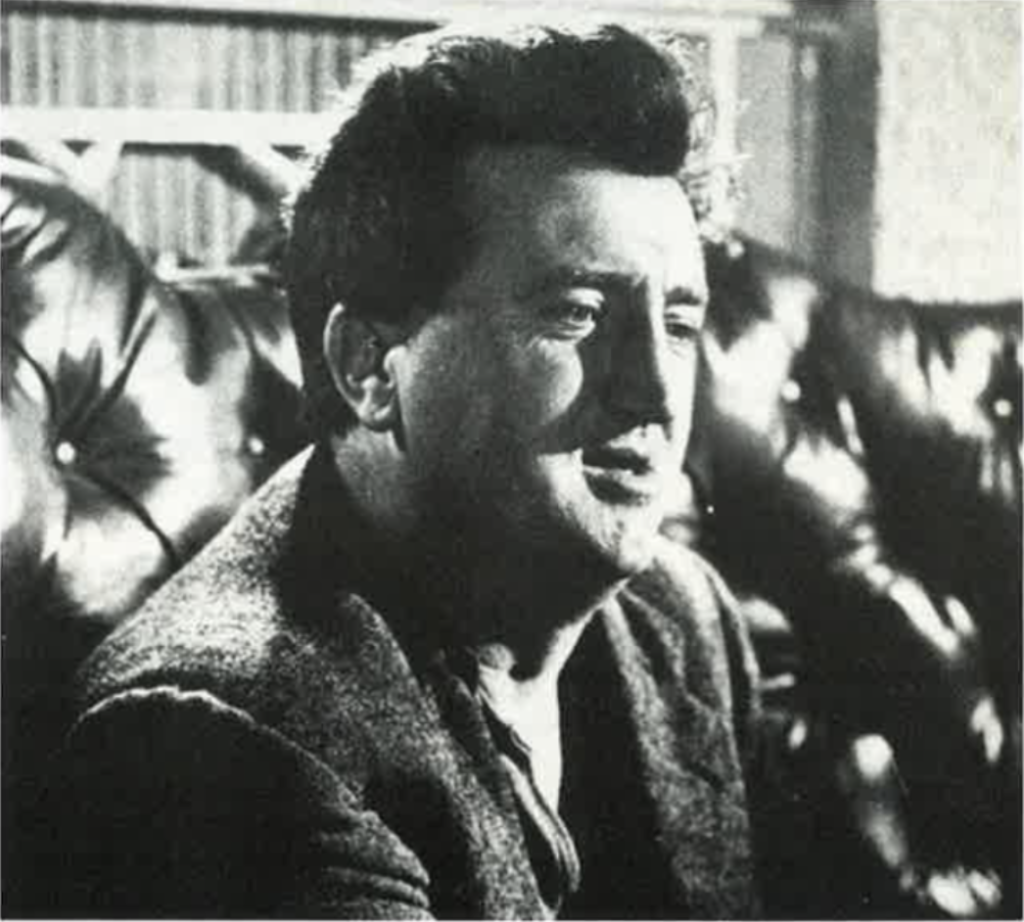
With daughter Blanaid now working for Sky Television and son Paudge at London’s Royal Academy of Dramatic Arts and preparing for his first film part, Beatrice Behan for the first time in her life has time to sit back and take stock and indulge for a change in her own favorite activities.
The widow of playwright Brendan Behan says, “I miss the children of course, just as I have always missed Brendan, but it’s great to have time to myself. I can walk the dogs, cycle around Dublin, see the latest good film and, in particular, go to the theatre once a week. Without my culture fix, I’d be sunk!”
In the years since Brendan’s untimely death at the age of 41 in March 1964, Beatrice has had the pleasure of seeing the continued international interest in his work.
The Hostage has been playing for over a year now in Berlin, while at home his writings are part of the school curriculum and his books, including Borstal Boy, once banned in Ireland, adorn every bookshop in Dublin.
“Brendan would have enjoyed hearing that some of his work is now being taught in the schools,” says Beatrice. “But I’m not surprised that his plays are so popular. To my mind, The Quare Fella, the anti-capital punishment play, and The Hostage, about the cruelty and absurdity of war, are among the best modern Irish plays, while Borstal Boy is also a great book. It was Brendan’s favorite and he was very angry and sad when it was banned in Ireland on account of its alleged anti-clericalism.”
Beatrice Behan’s grandmother was the poet Blanaid Salkeld and her father Cecil Salkeld, was a well-known pre-war artist in Dublin. He was christened the Dalai Lama by Brendan Behan because he had been born near Tibet. Beatrice grew up in the company of artists and writers including Liam O’Flaherty, Joseph Campbell and even Padraic O Conaire, who occasionally pitched his tent in the valley near their first home, a cottage in Glencree in the Wicklow mountains. “I was very sad when we moved down to Morehampton Road in Dublin,” she remembers, “but my father loved the pubs and the company and it was in a pub in Donnybrook that he first met Brendan who was painting a house there. He brought him home to tea. I was very shy then and didn’t take much notice but Brendan said afterwards that he had thought I was very stuck-up.”
We met later on the Aran Islands which we both loved, but it was only after the first night of The Quare Fella at Alan Simpson’s Pike Theatre that he asked me out for a drink. I was working as a botany technician with the Natural History Museum while I studied art by night. We didn’t have much money but we got on very well.
In fact, I was overwhelmed by his wit and humanity and his love for life. When in 1955 he asked me to marry him, I had no hesitation in accepting. We spent our honeymoon in Paris, where he showed me all the sights, including the hotel where Oscar Wilde had died. He had worked in Paris and he seemed to know everyone there. He also spoke French very well.
“Our first home was in Waterloo Road in Dublin. But then we moved to Herbert Street, just off Baggot Street. That was our happiest time I think. We were just across the road from Parsons Bookshop and the place was full of artists and writers and interesting people. Every morning at eight, Brendan would be up, pounding away at the typewriter. It was in Herbert Street that he did his Irish Press column which was later published with my illustrations as Hold Your Hour and Have Another, a very funny book.”
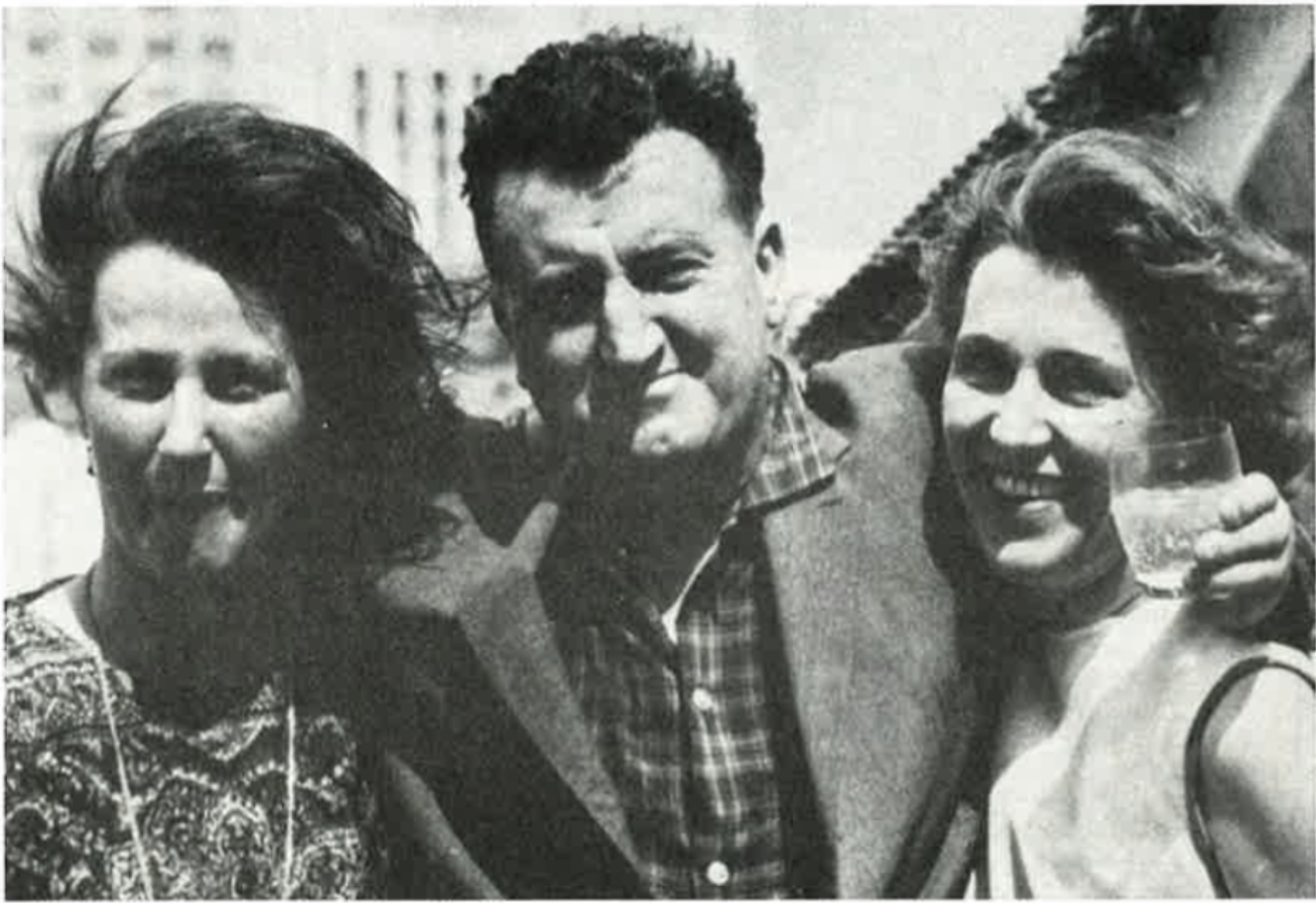
A year after their marriage, Beatrice and Brendan travelled to England. Brendan took her to Hollosley Bay in Suffolk where he had been at Borstal but the real purpose of the visit was to attend Joan Littlewood’s spirited production of The Quare Fella at her Theatre Royal in Stratford East. The play was a resounding success and following its transfer to the West End, Brendan Behan became a household name. Beatrice says, Joan Littlewood was a terrific person and she and Brendan got on splendidly. But it annoys me when people say incorrectly, that she wrote some of the songs. I typed Brendan’s translation from the original Irish so I should know. Sadly, I believe that some words and songs were changed for a recent Dublin production, which even included four-letter words, which were never in Brendan’s original.”
As Brendan Behan’s fame grew, the couple were feted and feasted at opening nights from London to Paris, Berlin to New York. Beatrice recalls, “We both loved the peace and reality of Connemara but I also enjoyed the travelling. We had some great nights in London, where we met up with old friends like the sculptor Des McNamara and Joe and Kathleen McGill. It was great to go back to Paris where The Hostage won an award. I also enjoyed New York, though I felt a bit like Brendan did about the more orthodox Irish Americans who were as impressed with him as he was with them. His described them as being like a bike with a broken saddle, they each gave you a pain somewhere!”
Apart from favorable reviews for his book Borstal Boy and his play, The Hostage, which was staged at the Cort Theatre in 1960, one writer who was particularly impressed was Norman Mailer who wrote that the appearance of The Hostage on Broadway was a landmark – “New York was dead in those days. It was the end of the Eisenhower regime, a puritan period. Brendan’s Hostage broke the ice. It was a Catholic Hellzapoppin. It made the Beatnik movement-Kerouac, Ginsberg, myself and others respectable, uptown. The Hostage was adored because of its outrageousness and its obscenity, and because of Brendan’s captivating humor and personality. He was an ice-breaker and the times needed an ice-breaker.”
Brendan appeared on numerous television chat shows including David Susskind’s “Open Ends” with Tennessee Williams and Jack Lemmon. When the subject of religion was raised, he brought the studio down when he quoted from Monsignor Brown’s translation of an old Gaelic verse: “Don’t speak of your Protestant Minister/Nor of his Church without meaning or faith/For the foundation stone of his temple/Was the bollocks of Henry the Eighth.”
Apart from well-publicized visits to Sardi’s, most of the Irish bars on Third Avenue and McSorley’s and Jim Downey’s Steak Bar, Brendan also made time to visit the museum-home of one of his few political heroes, Teddy Roosevelt. He subsequently wrote, “New York is the greatest show on earth.” This was despite being cut off on one chat show when, not for the first time, he was over the top with liquid nourishment.
Brendan and Beatrice also visited San Francisco and the West Coast and Hollywood. Beatrice remembers, “Like Brendan, I thought Hollywood was a bit strange and sinister and we were both glad to get back to New York. We stayed at the Chelsea Hotel, which now boasts a plaque in his memory, with his quotation “To America, my new-found land; the man that hates you, hates the human race.”
Sadly, Brendan’s final visit to New York included some particularly heavy drinking sessions and he had a seizure which necessitated hospitalization. He had been on the dry for various periods and when he returned to Dublin, he tried again but without much success. By this time his fame had ensured that he was continually surrounded by “friends,” who encouraged his boozing and pub entertaining. It was a hard time for Beatrice.
Brendan enjoyed the fame-he said that everyone should be famous for a month. But, eventually, the fame took over as did the drink, which for him as a diabetic was disastrous. Entertaining in the pubs became a substitute for the writing, which was a terrible pity, as he was such a spontaneous and creative writer.
He didn’t have as much regard for his last two books, which he dictated, as he had for his earlier work.
“One thing that many people don’t realize is that he also wrote some beautiful poems in Irish which have now been translated. He also had a magnificent voice. He sang regularly on ‘The Balladmakers Saturday Night,’ and John Beckett said that if he had his voice trained, he would have made a fine opera singer.”
Beatrice and Brendan never mixed much with the so-called Dublin literary set.
Though they had many friends who wrote, the relationships were always uneasy in a city where artistry was so competitive and so ill-rewarded at the time. Even Dominic and Brendan couldn’t be together for too long-there could only be one star on the stage,” she said.
Brendan’s larger-than-life parents made a great impression on Beatrice. “Stephen was very funny and a well-read man. Though Kathleen could be a formidable matriarch, she was a very animated woman and she had a prodigious memory. Even in her nineties, she could sing for hours, word-perfect and without repeating herself. It was from her that Brendan got his voice. With parents like Stephen and Kathleen, it’s little wonder that Dominic and Brian also took to the writing.” The Behan family lived in Russell Street, which is where Brendan spent his youth.
The family home has now been replaced by a block of apartments for senior citizens which is called after the street’s most famous inhabitant. According to Beatrice, “That’s something which would have given him particular pride and joy.”
Asked once for his personal philosophy, Brendan replied, “I respect kindness to human beings, first of all, and kindness to animals. I don’t respect the law. I have a total irreverence for anything connected with society, except that which makes the road safer, the beer stronger, the food cheaper, and old men and old women warmer in the winter and happier in the summer.”
The Dublin lad who enjoyed the magic of first nights in capitals across the world found himself virtually alone in the world when he died in the city’s Meath Hospital.
She remembers, “It was a tough time. Blanaid was so young and then of course, I had the tax man after me. I rented out half the house in Anglesea Road but even then, it took years to sort it all out. But now, at last, the children are out in the big world with their own careers so I can take a breather.”
Beatrice has no regrets about the dramatic course her life took the day she agreed to spend the rest of it with Brendan.
“People sometimes ask me if I wish I had married a civil servant instead. I’m afraid I always have to disappoint them. I married the most entertaining and interesting man I ever met, I think I was a very fortunate woman….”
Editor’s Note: This article was originally published in the September 1991 issue of Irish America. ♦
Leave a Reply