
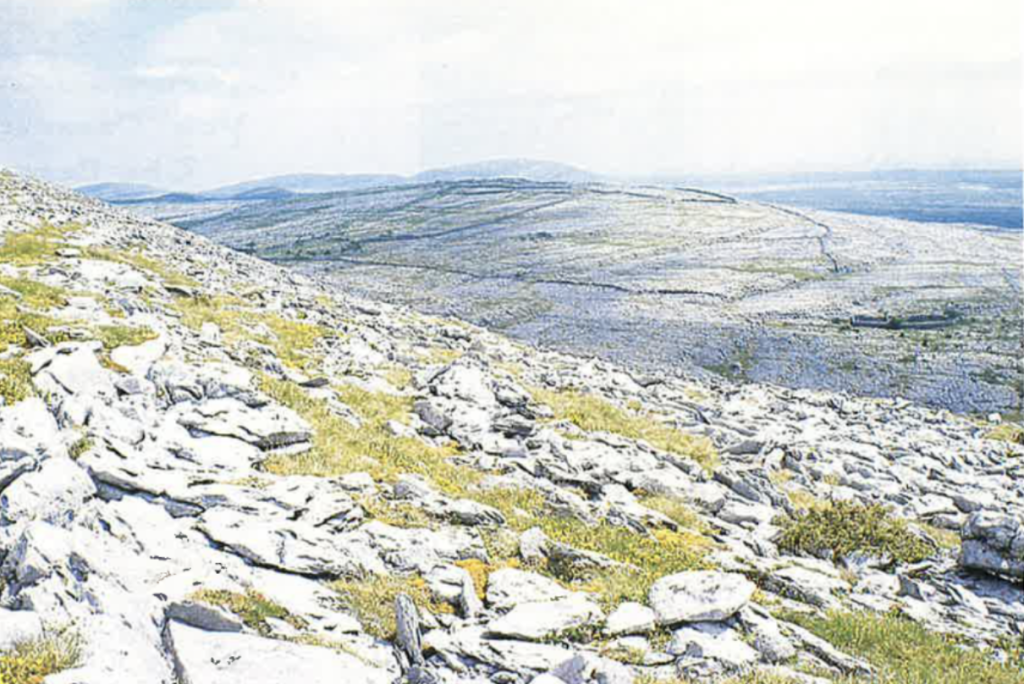
The Burren in northwest Clare, a wild region of bare limestone, vanishing lakes, and surprising wildflowers, is one of Europe’s most remarkable habitats. Yet the most diverse and fragile part of it is under threat from the very government body charged with its protection.
Controversy over the siting of a visitors’ center has ranged from threats to a local resident’s life to the lodging of a formal complaint against the Irish government at the European Parliament.
Hundreds of ruins—megalithic tombs, Iron Age hillforts, early Christian churches, famine-deserted villages—attest to human occupation for at least four thousand years.
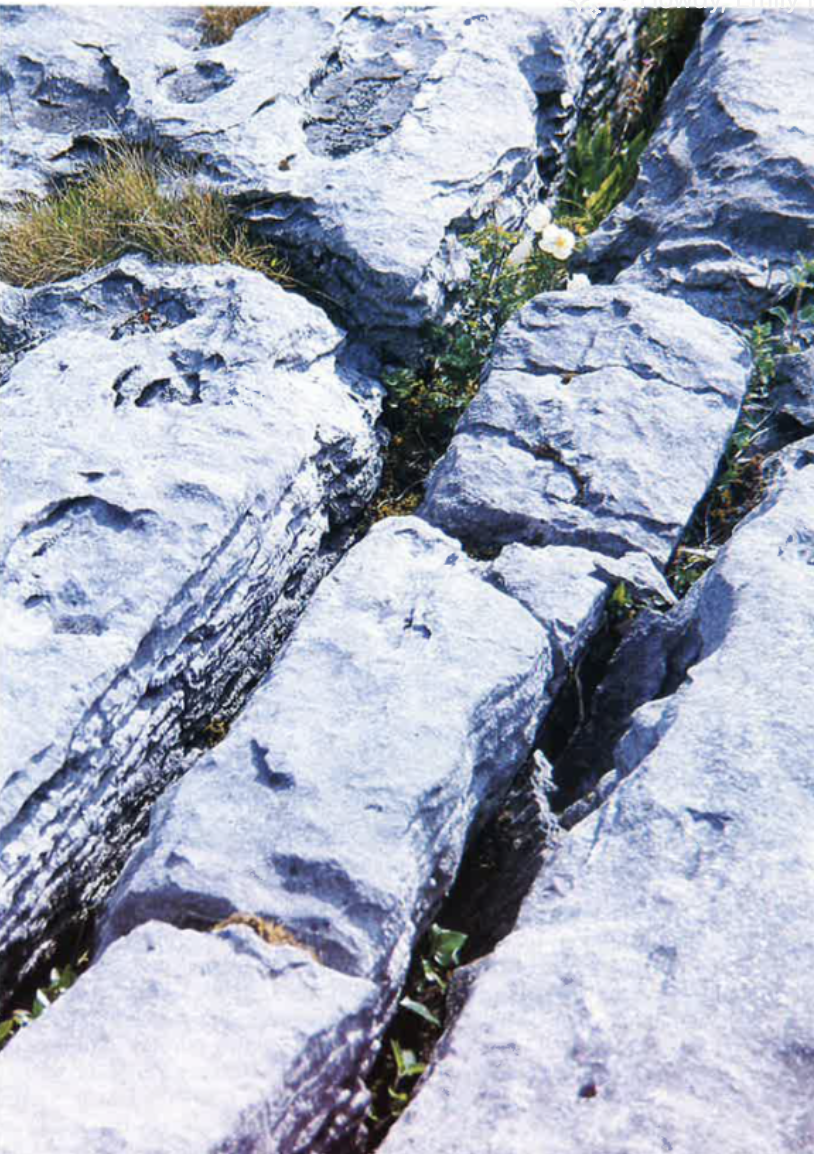
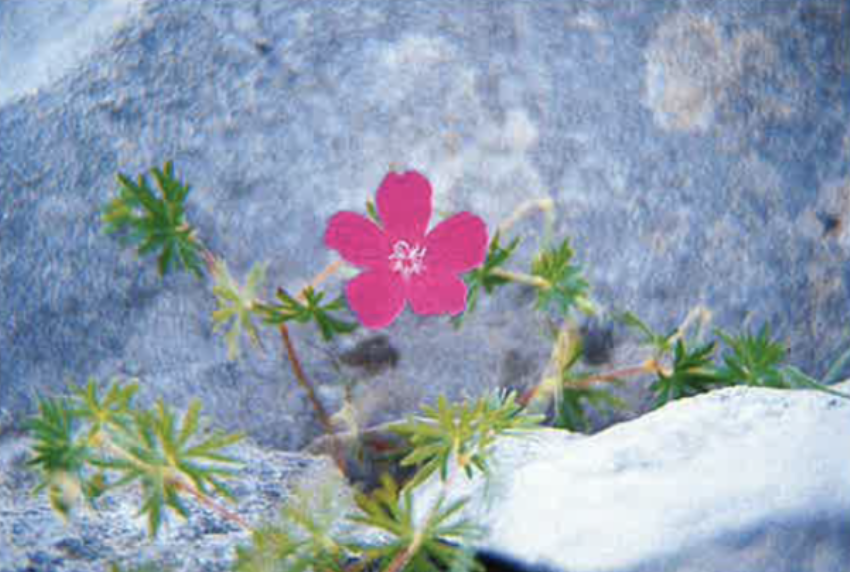
Yet even in Cromwell’s time, the Burren was described as having “not enough earth to bury a man, not enough timber to hang him, or enough water to drown him.” Vast limestone pavements cleft by deep crevices, swirling terraced mountains, glacially deposited boulders, caverns, and fugitive lakes (turloughs) that are filled by and vanish into subterranean rivers create the Burren’s unique ecology as well as its character. Sheltered by the heat-and-water- absorbing limestone and nourished by the Gulf Stream, plants from opposite ends of the ecological spectrum flourish side by side: Mediterranean with Arctic-Alpine species; lime-loving alongside acid-loving plants.
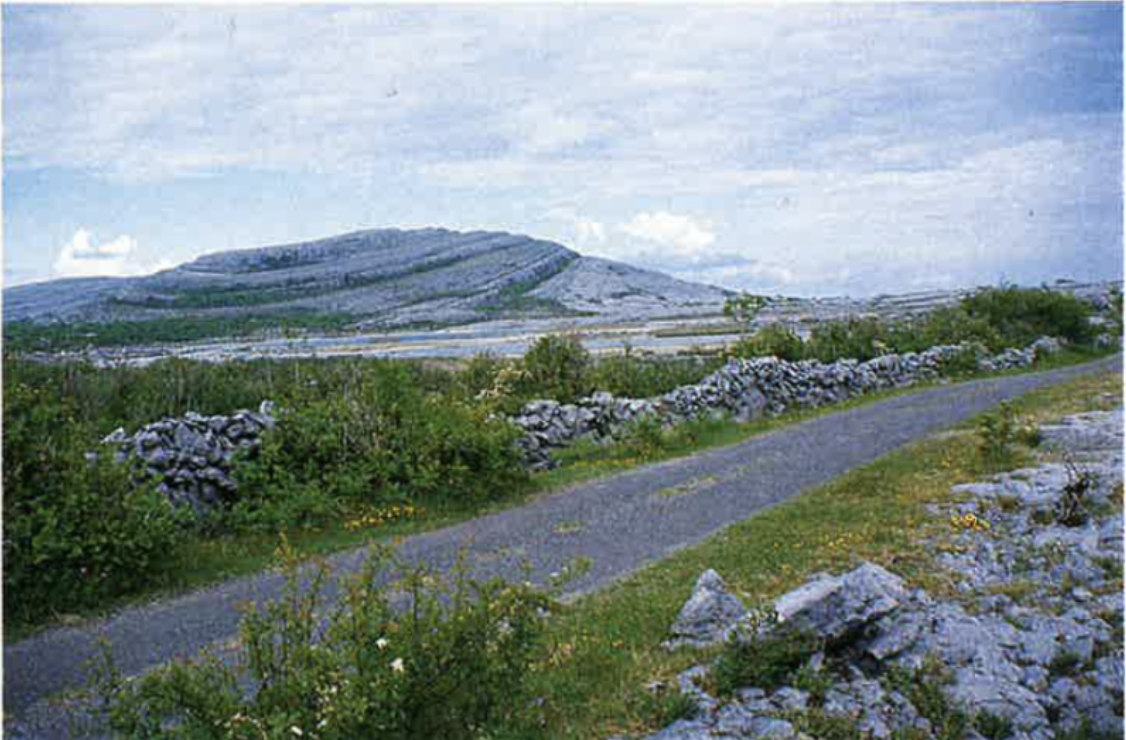
The Office of Public Works (OPW), caretaker for Ireland’s natural and historical heritage, plans a Burren National Park northeast of the village of Kilnaboy. Its interpretive center, funded by £3 million from the European Community (EC), is to include 1,200 square meters of parking lots and buildings (exhibits, shop, restaurant, audio-visual theater, nature study room, toilets).
Thirty-forty acres of walk-ways. And widening of much of the one-lane road from Kilnaboy to accommodate large tour buses. The site claims a spectacular view of Mullaghmore Mountain and proximity to both limestone pavements and soil wherein to install sewage disposal facilities (one of the factors in the site’s selection).
The National Trust for Ireland (An Taisce), the local Burren Action Group, the World Wide Fund for Nature (WWF), and the conservation organization Plant-life, have requested the European Community to withhold funds until the OPW commissions a full Environmental Impact Assessment under EC and Irish law, including assessment of alternative sites.
Their concerns include:
- the potential impact of an anticipated 60,000 visitors per year on the area’s fragile ecosystem;
- impact of sewage effluent and other pollutants, including run-off from roads, on surrounding surface and underground water system, particularly the turloughs;
impact of services provision: water, electricity, waste collection, etc.
impact of road widening (already taking place) to accommodate large volumes of traffic; - possible precedent-setting for subsequent development in an area of a highly sensitive nature;
- despite claims that the center would help the economy, only six new permanent jobs would be created and these possibly filled from outside the region; new local businesses would hardly be helped by package tours going to and from the Mullaghmore center, miles from any village;
- a large facility at remote, mysterious Mullaghmore would forever alter its spiritual quality.
- The EC’s Environment Division requested specific documentation of European and Irish legislation relevant to the issue. Within the week, An Taisce submitted fifty pages of relevant legislation concerning water abstraction, ground water pollution, sewage treatment, service provision, litter, and impact on fauna.
The section on road-widening and flora impact, is exemplified by the case of a listed species of violet; under the Wildlife Act, it is illegal to “alter, damage, destroy or interfere with the habitat” of a listed species; this violet grows in crevices on both sides of the road southwest of Mullaghmore. The WWF’s complaint states, “the Irish Government’s failure to provide a full EIA is in conflict with the spirit of (European Commission) Directive 85/335/ EC, to which Ireland is party.”
Why is the EC being bombarded with complaints on this issue? Why are the OPW and An Taisce in opposition, when their statements of purpose (“protection and management of Ireland’s natural and built heritage” including “sites of importance to wild plants and animals”) are identical? Why did the OPW use Section 84 of the Planning Act (“urgent government use”) to bypass an EIA in the first place? Why was there no local consultation or input in the planning stages? Why is the OPW determined to build the center at Mullaghmore despite the environmental, economic and legal concerns? Questions of hidden agendas or vested interests are almost inevitable.
The Burren Action Group and An Taisce acknowledge the region’s desperate need for economic development through tourism. They support creating plans to enhance each neighboring community and preserve remote areas; perhaps a European-style national park, with local farmer’s management participation, throughout the entire Burren. The Mullaghmore center, they contend, would demolish the area’s sensitive character while failing to meet the region’s economic needs.
Focusing tourists in one place will facilitate control of visitors and protection of the rest of the park, says Chris Flynn of the OPW. He rejects the idea of a visitors’ center in a town: “If people don’t think they’re seeing the real thing at a center in some outlying community, they’ll go in on their own and potentially do more damage. Visitors have a right to get close to the features and have the option of having a cup of tea and going to the loo.” He maintains that the normal traveler-package tourist or family—won’t climb around and damage the site: “The only people who will do that are specialists-botanists, archaeologists; they’re the ones who will be hard to control. The ordinary Joe or Josephine Soap who is in any way conservation-inclined won’t be pulling up flowers.” Besides, the center is “not being built primarily for tourists,” adds Mr. Flynn.
The theater will be available for local communities and the center will provide educational and research facilities.
At Letterfrack, the interpretive center for Connemara National Park in Galway, community and educational uses have been negligible, according to educator Leo Hallissey. He charges that relations with local farmers are disastrous, no efforts have been made to integrate the park with the community, information was suppressed regarding sewage leakage and resulting fish kills, and “the original proposers have publicly expressed displeasure with the way it is, and question the value of the park.”
Tony Killeen, head of the Clare County Council and principal of the Kilnaboy School, welcomes the Mullaghmore center but sees it as intended for tourists: “If it were for locals, it would be a different design.” Asked about its use for education, he is “not clear on what would be involved…access to exotic environmental stuff comes down to the teacher’s presence; a great deal of latitude is available.” Teachers at a Burren Action Group meeting claim, however, that they aren’t allowed to bring “political issues” like environmental activities or recycling into the classroom. Mr. Killeen foresees no problem for the schoolchildren with increased traffic on the Mullaghmore road that passes the school. In fact, the school is negotiating with a neighboring landowner to buy additional parking space.
Some locals conjecture, however, that the neighbor’s recent heart attack was due in part to these negotiations. A member of the Burren Action Group was beaten up; another, P.J. Curtis, a Kilnaboy native whose home was built by his ancestors in 1798, was told, “there’s no place here for people like you.” Father John O’Donoghue of Carron, north of Kilnaboy, declares, “It is a shame and a disgrace, that a government body like OPW has split the local community.” He states that a community meeting in nearby Corofin that indicated overwhelming local support of the center, “was, frankly, rigged. Names were taken and people were told to be there.” That such controversy should arise over the Office of Public Works is lamentable; their past record of preservation, restoration, and wildlife conservation is exemplary. Is the EC grant, intended to assist OPW programs, unintentionally creating an ethos of development for its own sake?
In America, the Bureau of Reclamation was once the government body that “made the desert bloom” recently it has been dubbed the “Bureau of Wrecklamation” for its construction policies. It would be infinitely sad to see Ireland make the same kinds of mistakes in developing its pristine areas that the U.S. made in the past: the Yosemite Valley is one example.
“The OPW’s property is just 2.5 percent of the whole Burren, ” observes An Taisce’s Emer Colleran, “but it’s the best. The diversity-flora, fauna, turloughs, mountains; the habitat variety—the Mullaghmore area should be a nature reserve; it’s too diverse and unspoiled to ruin.” Irish Times columnist Nuala O Faolain writes, “The fact is that the center will sterilize – urbanize – this part of the Burren forever.” Father O’Donoghue urges, “Now that 1992 (full European Community implementation) is approaching, it’s essential for Ireland to hold onto its own sense of itself and it uniqueness. There’s a need for us to have a certain pride and dignity and not be willing to give ourselves away totally.”
W.B. Yeats found, in the turloughs and subterranean rivers of Coole Park not far from Mullaghmore, a meaning and metaphor in this mysterious topography far removed from that of Cromwell’s general: “Under my window-ledge the waters race … Run for a mile undimmed in Heaven’s face… Run underground, rise in a rocky place … Spread to a lake and drop into a hole. What’s water but the generated soul?”
The Mullaghmore issue is no longer one simply of tourist amenities but, with all concomitant reflections on pride, dignity, and Faustian dilemmas, a virtual archetypal struggle within Ireland’s soul, Pat Musick is a writer from Colorado Springs who has spent much time exploring Ireland’s archaeological and historic treasures.
Comments on the Mullaghmore issue can be sent to Taoiseach, Charles Haughey, Leinster House, Dublin, Ireland.
Editor’s Note: This article was originally published in the September 1991 issue of Irish America. ♦
Leave a Reply