
Easter 1916 and the Annals of Irish History
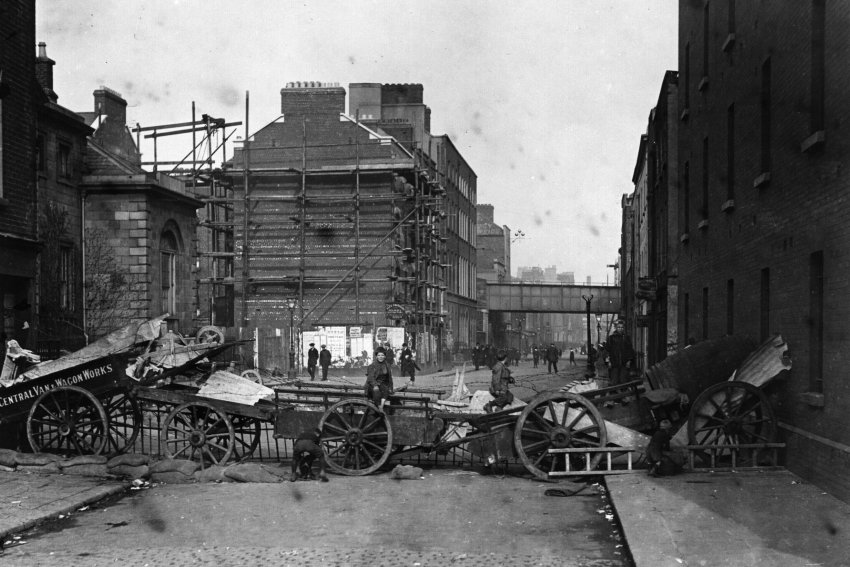
Few events in Irish history have been as momentous as the 1916 Easter Rising.
What started out as a minor and unpopular rebellion by about 1,200 men and women became the spark which led to three years of full-scale war with Britain.
And the Treaty which ended the War of Independence in 1922 created its own monster: civil war and partition, the effects of which are cruelly apparent today.
In fact, the civil war and the creation of a Northern border overshadowed and, to some extent, denigrated the memory of the Easter Rising. And unfairly so.
Many Irish people who would wish to honor the 1916 rebels today feel their salutation would be wrongly construed as support for the IRA. As a result, there is disagreement and a good deal of confusion on how to commemorate the armed insurrection of 1916 without it being interpreted as tacit approval of the motives and strategy of the Provisional IRA.
As a general consequence of the Dublin Government’s inertia about the IRA, plans for a large official 75th anniversary commemoration this year-such as there was for its 50th anniversary in 1966-were notoriously indecisive. Finally it was decided that the Taoiseach, Charles Haughey, will read the Proclamation of the Irish Republic on Easter Monday, from the steps of the General Post Office, in a re-enactment of Padraig Pearse’s declaration 75 years ago.
While public support-fickle as it may be-for Easter commemorative services in Ireland has certainly waned since the 1960’s, there is however some indication of a renewed interest, if not pride, in what is colloquially known as “The Rising.” At the time of writing for example, a novel called Rebels by Peter de Rosa, which chronicles events before and after The Rising in the form of popular fiction, has been the number one bestseller in Ireland for three weeks. In describing the Rising, English author Cyril Connolly says, “There is nothing to equal it as a drama, except the first months of the Spanish civil war.”
And now on its 75th anniversary Rego Records’ presentation of The Irish Uprising 1916-1922, is a timely recollection of events that led up to and followed the rebellion which “changed utterly,” as W.B. Yeats wrote, the course of Irish history.
The 73-minute recording includes familiar rebel songs, mostly sung by Tommy Makem and the Clancy Brothers, interspersed with some fascinating historical excerpts from archive recordings.
Eamonn de Valera, who led the 1916 garrison at Boland’s Mill in Dublin and would later lead republicans into civil war, is featured here with his 1956 commemorative speech. De Valera, or “Dev” as he was generally known, became one of the central figures in Irish political life and served as Taoiseach (Prime Minister) of Ireland in 1932 and Uachtaran (President) from 1959 almost until his death in 1975.
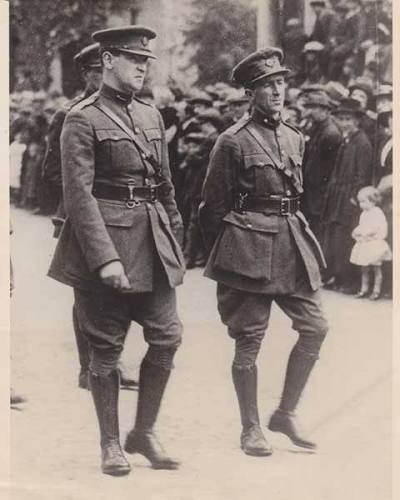
In his speech of 1966 at the 50th anniversary of the Rising he says in unmistakably mellow nasal tones: “This Easter we bring back to our minds the Easter of fifty years ago. And would seek to honor the men at that time who gave or risked their lives that Ireland might be free. Their single-mindedness and un-selfishness, their sacrifices and the sacrifices of others who gave their lives in the Uprising, inspired the national resurgence which followed. May the good God have them all in his keeping. Let us then confidently place the destiny of our nation under God’s high providence. And like the men of 1916, implore his blessing upon our aims and upon our work.”
Symbolically on the same day March 8, Nelson’s Pillar, a famous landmark outside the General Post Office in Dublin, honoring Admiral Nelson, was blown up.
No one claimed the job but it was assumed to have been the work of the IRA. Half of the pillar remained intact. The Irish Government later completed the removal.
There are a number of interviews with old IRA soldiers, including Frank Sherwin and Sean Mooney as well as Joseph Clarke, who fought at the historic battle of Mount Street Bridge during Easter Week.
There are also excerpts from an interview with Sean Harland, who was sent home during the Rising because he was only 16 at the time. Harland later served as a courier to De Valera and Michael Collins during the War of Independence.
The Irish Uprising 1916-1922 also illustrates the Irish tradition of recording famous incidents and events in poetry and song. A number of almost standard rebel songs are played heartily by Makem
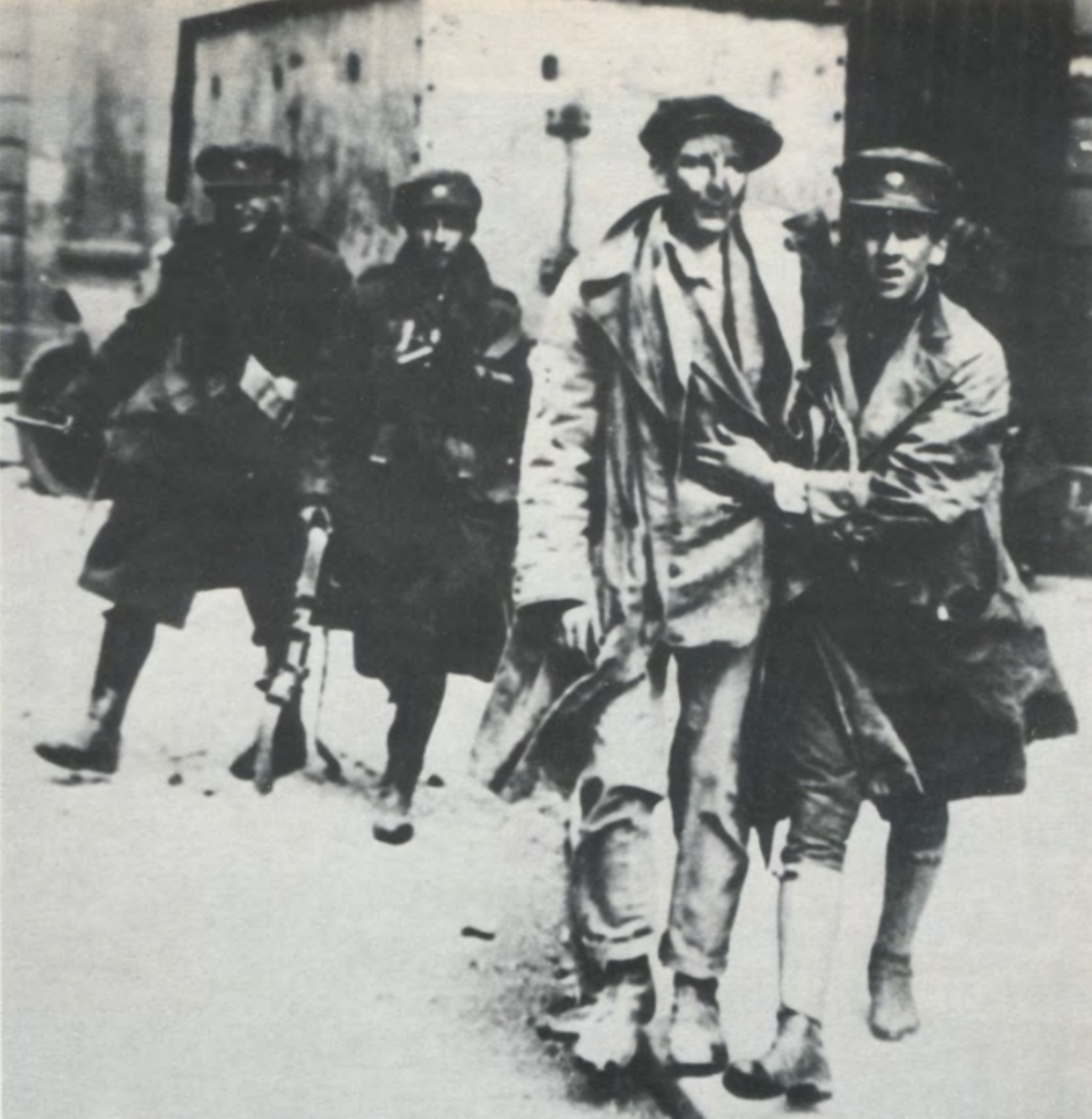
and the Clancy Brothers, such as “A Nation Once Again,” “The Foggy Dew,” “Green in the Green,” “Kevin Barry” (who was executed at 18 after being taken prisoner by British soldiers following an ambush in County Cork, in November, 1920), “The Rising of the Moon” (a ballad about the failed rebellion led by Theobald Wolfe Tone in 1798) and, of course, “The Soldier’s Song,” which was written in 1907 by Peadar Kearney (an uncle of Brendan Behan) and is now Ireland’s national anthem.
Padraig Pearse, who in addition to being commander-in-chief during Easter Week was headmaster of St. Enda’s School, Ballyboden, County Dublin. Pearse was also a poet and three of his works – “The Mother,” “The Fool” and “The Rebel” – are excellently rendered by Deirdre O’Meara, Donal Donnelly and Tommy Makem. He wrote “The Mother’ in Arbour Hill Jail two days before his transfer to Richmond Barracks for court-martial and execution by firing squad at Kilmainham Jail.
Famous poems by William Butler Yeats (“Easter 1916,” “The Rose Tree,” “Sixteen Dead Men”) and a selection from O’Casey’s “Drums Under the Window” also embellish the production.
O words are lightly spoken, said Pearse to Connolly
Maybe a breath of politic words that has withered our rose tree
Or maybe that wind that blows across the bitter sea
It needs but to be watered, James Connolly replied to make the green come out again
And spread on every side And shake the blossom from the bud to be the garden’s pride But where can we draw water,
Said Pearse to Connolly.
When all the wells are
parched away?
O plain as plain can be
There’s nothing but our own red blood
Can make a right Rose Tree.
– W.B. Yeats, “The Rose Tree”
There is much to savor on The Irish Uprising 1916-1922. Important public speeches, such as Pearse’s oration at the graveside of Fenian hero Jeremiah O’Donovan Rossa (who died in a hospital on Staten Island, New York in June, 1915), the Proclamation of the Provisional Government of the Irish Republic-announced by Pearse to a somewhat mystified crowd outside the General Post Office on Easter Monday, 1916, and the Surrender order six days later, are superbly replicated.
The sound production throughout is first class, with clear editing; and a magnificent photographic booklet-with several misspellings-goes with the record set (now unfortunately out of print).
While public commemoration of the Easter Rising continues to suffer from the vagaries of a contentious association with the Provisional IRA, administrative indecision in Dublin cannot be relied upon to accord it due recognition.
Until this changes, The Irish Uprising. 1916-1922 is a historically valuable record which expresses sentiment without mawkishness and declares its pride without shame.
The Irish Uprising, 1916-1922 is available from Rego Records.
Editor’s Note: This article was originally published in the April 1991 issue of Irish America. ♦
Leave a Reply