
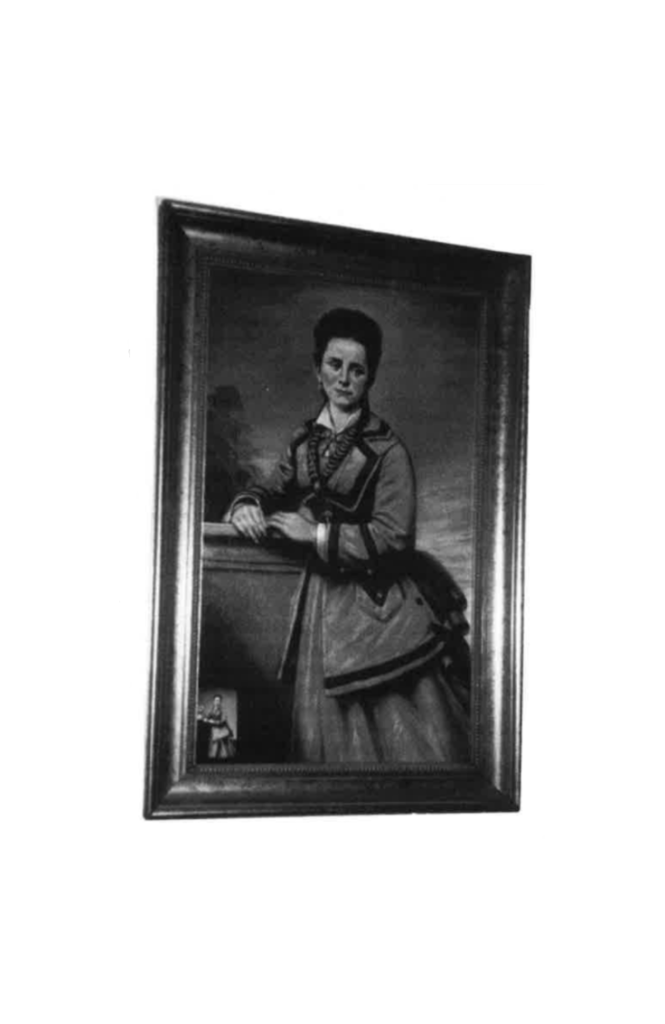
1875 was a year of hardship for the Michael Noonans of County Tipperary. The small farm house near Strough in Lattin Parish harbored Michael, his wife, Ann Power, and the eight youngest of their twelve children. The four eldest, quite mature, had migrated to Australia and America. The eight young Noonans heard many tales from across the seas sent to the parents from their brother Thomas and sister Mary in Australia, where Mary had married a man with the name of Barrow.
Letters came from brothers Daniel Noonan and Patrick Noonan whose address in Waterbury, Connecticut, U.S.A. excited the young people at home to dream of adventure across the sea.
Joanna, the eldest daughter at home, had dreams of her own often hidden in the pocket of her pinafore. A neighboring farmer’s son, John Leahy, had emigrated to America some years before and wrote to Joanna, who kept his letters hidden from the prying eyes of the younger siblings.
Lately John’s letters contained gentle pleas for the eighteen-year-old Joanna to consider marriage to him. If only she would come to him, half a world away, to San Francisco in California, where he was engaged as a carpenter and builder of houses. She would be welcome to stay with his sister Johanna Donaghue, until the marriage in St. Mary’s Church. He would send her the passage money as soon as he received her consent.
With a houseful of little ones at home, Michael and Ann had no alternative but to relent. And so it was March 17, the feast day of the Saint himself, when Joanna dressed in her woolen skirt and blouse with a warm overcoat and a hat, bid a last farewell to her parents and brothers and sister, and caught the train to Queenstown where she would embark on a steamer bound for New York City.
Joanna’s small trunk and two-handled bag were her only possessions for the journey, and a long one it was to be, for only a distance of two days out in the Atlantic the ship became disabled and was forced to return to Queenstown. Many of the passengers decided not to attempt the journey in a repaired vessel, but intrepid Joanna Noonan was very determined to fulfill her commitment. She remained with the ship and finally, two weeks from her farewell to her family, reached the port of New York. Brother Daniel was there to greet her and to escort her to his home in Waterbury, Connecticut, a short train ride away.
The Noonans of Waterbury entertained Joanna “the likes of which she had never seen.” It was most difficult for her to refuse their kind persuasions to remain in Waterbury. But she had made a promise to John Leahy and she meant to keep it.
Brother Daniel and wife, Margaret, gave Joanna a wedding gift of a fine pair of gold earrings with a matching locket, the first real jewelry she would have of her very own.
The Atlantic Ocean was stormy and rough that March of 1875 and the sailing to Panama was unsettling for most of the women passengers, who moaned and complained the whole way. In Panama the humid trip across the isthmus by train caused many cries of discouragement, but Joanna never wavered in her determination to go on. Later she was to remark that the complaining women were “a source of embarrassment to her.”
The climate of this strange country was the most difficult part of the journey for Joanna. Finally a ship bound for San Francisco arrived at the Balboa docks and the final stretch of the journey was at hand.
Unhappily, just before arrival in California, Joanna suffered an infected tooth which caused a swelling of her left jaw, painful and worse still, noticeable for her meeting with John.
It wasn’t a meeting of two old friends at the dock in San Francisco for it had been almost four years since John had last seen the little Noonan girl, then a child of fourteen years. Joanna shyly smiled trying to cover the painfully swollen jaw with one hand while lugging the bulky handbag close to her side.
John lifted the sturdy trunk to his shoulders and led Joanna to the horse-drawn cable car which would soon carry them to the Donaghue home on Orinda Street.
For Joanna, everything about the city of San Francisco was new and exciting. She wrote to the folks at home of the strange, foreign section of town called Chinatown and of seeing the Pacific Ocean and the broad, clean, white beaches west of the city.
Then the wedding at St. Mary’s Church. Her new sister-in-law insisted on a photograph of Joanna to send home to the parents. The troublesome tooth had been removed by the dentist only a day before and her jaw was still swollen. Joanna’s one good dress, when taken from her trunk, was still slightly wrinkled, but don it she did and posed most seriously for the photographer, standing beside a bouquet of artificial studio flowers. The picture sent home was not the impression Joanna would have liked her Mother to see.
John and Joanna began married life in one of the houses built by John and his brother Jim, who had moved his family from the East Coast to San Francisco.
Jim’s wife, Catherine Hannan (“Kate”) and Joanna became best friends and she soon adjusted to life in the West.
During the next four years in San Francisco, John and Joanna had two children. First-born was a son, Timothy Aloysius. named for John’s father, followed by wee “Annie with the red hair.” Jim and Kate Leahy also had two children, Timothy and Catherine. It was to be a family custom to name the first-born after grandparents.
The future of both families would be spent on Oregon homesteads in a spot called Olney, where John and Jim’s young brother, Michael, had found land available and had written for them to join him.
“It’s so much like home in Tipperary,” he wrote, “and there is land for the asking.” John and Joanna with small Tim and Annie and Joanna, pregnant with number three child, arrived by ship from San Francisco on the docks of Astoria, Oregon, on a rainy March day in 1879. The little family spent the next two nights in a squalid boarding house, where the cries of little Annie were not accepted pleasantly by other clientele.
The family was rescued by the kindly parish priest, Fr. Leopold Dieleman, who had heard of their arrival. He found a place for them with a parish family, the Dealys, until their own homestead could be purchased. Joanna and Maggie Dealy were to become lifelong “dearest friends.”
But this is Joanna’s story and the tale of life on the Olney homesteads is another chapter at another time. I am part of Joanna’s story because I am the eldest of her granddaughters and she knew me for eight years of my life. Joanna raised nine children on that homestead farm while John, who was not really a farmer, continued to pursue his carpenter career in nearby Astoria, coming by boat and then afoot the twelve miles from town, on weekends. My father, John Joseph Leahy, called Joe, was the seventh child and the one who remained in Astoria all of his life.
Joanna finally was moved into town with the youngest children, into a house built by John, in 1898. The children needed broader education than the little one-room school which was built on the homestead and had big brother Tim as teacher. The three Leahy brothers in adjoining homesteads of 160 acres raised their families together. John and Joanna had nine little ones, losing daughter Catherine, the number three child, to meningitis in 1888.
They buried her on the farm on a low hillside until she was taken into the Pioneer Cemetery when the family moved into town. Jim and Kate Leahy had twelve children, losing little Joey, a two-year-old, who was also buried on the acreage. The Jim Leahy family moved to the larger city of Portland, Oregon, in the early 1920s for better job opportunities for their young people. Their homestead was sold. Young Michael was a bachelor on his 160 acres, living in a small cabin. Joanna persuaded him to write to her young sister Ann, at home in Tipperary. Soon Ann took the long trip out to San Francisco and by ship up to Astoria, Oregon, where she was met by Michael.
Joanna prepared the wedding feast for Ann and Michael. She arranged with her friend, Fr. Leopold Dieleman, to ride out on horseback, as he did monthly, for the Mass in the small parlor. The altar had been made by John and painted white. It remains a treasure to the family this day.
The wedding gift from the families was a fine new farmhouse up on Green Mountain on Michael’s acreage built by the three Leahy men before Ann’s arrival.
The Michael Leahys raised nine children to long lives. Marian, the third child, lived to the age of one hundred and two years with most of the others reaching age ninety.
After the last Leahy left the green valley “that was so like Tipperary” to meet again in their final reward, Joanna’s portrait came into being.
I had fortunately located her grand-nephew, grandson of her brother Daniel Noonan, in Waterbury, Connecticut. Neither knew of the other’s existence until 1986. This Daniel Noonan II was most pleased to find his relatives in the West. When he visited the summer of 1989, one hundred and twenty nine cousins, once and twice removed, greeted him in Oregon on John and Joanna’s homestead.
Daniel looked upon the small photo of Joanna, with the swollen jaw and the wrinkled dress, and remarked, “What a remarkable, courageous, little woman, and to think that she was my great-aunt.” He asked if he might take the old photo back to Waterbury to have a copy made from it.
He could.
Christmas season of 1989 arrived and with it a very large wooden box addressed to me from Connecticut. With forced composure, though a rapidly beating heart, I pried open the sturdy carton to gaze on the beautiful full-length portrait of my grandmother, Joanna Leahy. She was wearing the earrings and locket, given to her by her brother Daniel. (Which came to me as eldest granddaughter). Her gold colored gown with brown velvet trim shone as a sun ray with nary a wrinkle, and behold, no swollen jaw to be seen, only a ghost of a smile about her pretty mouth.
Daniel had taken the faded photo to his friend, famous portrait artist Ronald Anderson, of Litchfield, Connecticut, and the result, a wonderful, almost-life-size portrait of Joanna for all her descendants to enjoy.
The portrait was given to me as keeper but is for all the Noonan-Leahy clan, now and for the future.
There is a natal cord of attachment from those two family farmhouses near Ardevil-lane, Tipperary, to the Noonan-Leahy descendants in far-off Australia and throughout the USA which calls them back periodically to renew old family relationships.
The story of Joanna is never finished and her portrait will always serve as a reminder that the roots of the Noonan-Leahy clan lie in far away Tipperary.
Readers are invited to submit their own personal “Immigrant Trail” stories for which our regular rates will be paid on acceptance. Unfortunately, we cannot correspond about or return submissions.
Editor’s Note: This article was originally published in the July August 1992 issue of Irish America. ♦
Leave a Reply