
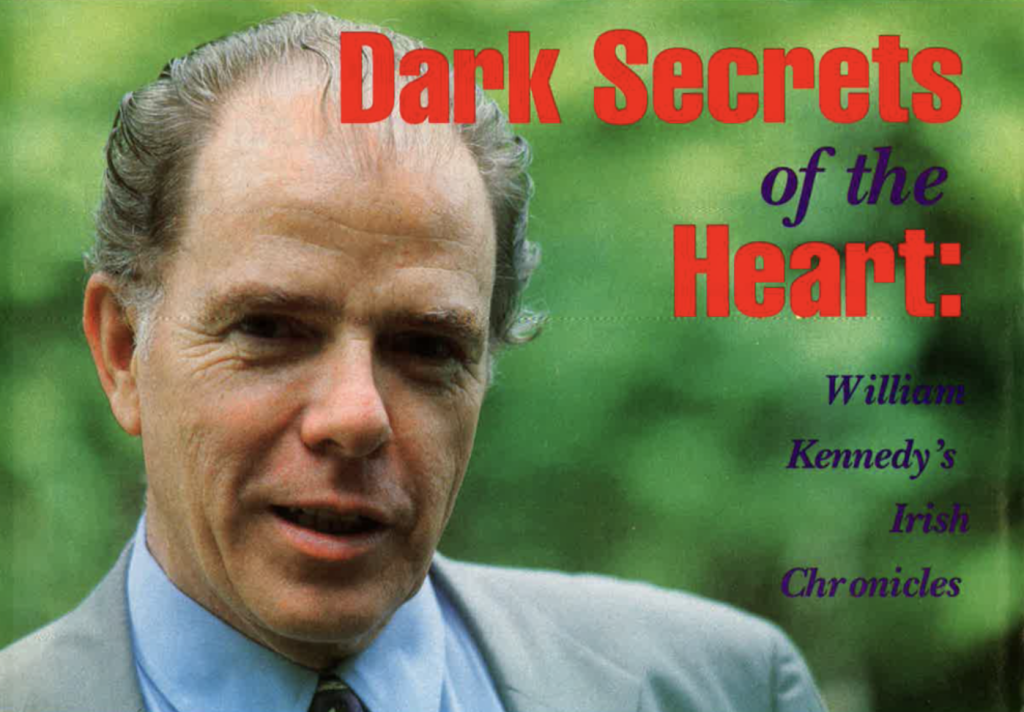
The Irish of Albany, New York, have proved to be rich and fertile literary material for native son William Kennedy as is evident in Legs, Billy Phelan’s Greatest Game, Ironweed, and Quinn’s Book. Now a fifth novel, Very Old Bones joins the distinguished Albany Cycle.
Patrick Farrelly talked to the Pulitizer Prize-winning author at his home.
In his white clapboard house in the village of Averill Park, just outside Albany, William Kennedy was answering yet another question about the ethnic/historical inspiration for his work. Kennedy had just returned from a multi-city tour to promote his latest novel, Very Old Bones. He was
“totally exhausted,” an arthritic hip was giving him grief, and he was having problems sleeping.
With an edge to his voice he explained, “The history and the ethnicism and the religion tend to become dominant when you are talking about the books, but that’s not really what the books are all about.” He paused. “The books are about the people.” We moved on.
And he might have added, family. Because in Very Old Bones and the other parts of the great Albany Cycle (Legs, Billy Phelan’s Greatest Game, Ironweed, and Quinn’s Book) that feature the Phelans, Quinns, Mcllhennys, and Daughertys, it is that irresistible genetic burden of family, and its specifically Irish baggage of religious piety, that bears down on the extraordinary cast of characters, producing cycles of hate, madness, frustration, and wasted lives.
With the Albany Cycle of novels Kennedy has carved out for himself a unique place in modern American literature. The finely stylized, lyrical writing, with its mixture of the gritty realism of James T. Farrell and the fantastic, magic realism of Gabriel García Marquez, won Kennedy comparisons with Faulkner and Joyce. And the critics wrote that what Joyce had done for Dublin and Faulkner for Yoknapatawpha County, Kennedy had achieved likewise for his beloved Albany.
Now the 64-year-old author is Albany’s favorite son. All kinds of “William Kennedy’s Albany-type” events have been held over the years. The PBS will soon air a documentary with that very title. But those who know Kennedy say that while fame and fortune have improved his bank balance and his life comforts, it has not affected his dedicated attitude to his work.
Kennedy’s brown hair is receding but his face has strong lines that frame a direct, if not intense, gaze. He speaks both softly and deliberately in measured sentences, and displays a reticence that does not seem given to tangential conversation or easy repartee. He is courteous but there is the strong impression that he would prefer to be doing something else.
William Kennedy burst onto the literary scene in 1984 with the publication of Ironweed, a novel which earned him the Pulitzer Prize. Its central character is Francis Phelan, a one-time ball-player, grave-digger, bum, and drunk who returns to his native Albany to wander its underworld after an absence of a couple of decades; an absence prompted by the accidental and fatal dropping of his two-week-old baby son, Gerald, on the kitchen floor. Francis comes back to search for explanations of his failures and tragedies, and ultimately to make peace with his soul, and his abandoned family.
The town of Albany provides Kennedy with the perfect backdrop to examine the journey of the struggling generations of the Irish family. In the mid-nineteenth century this provincial capital experienced an influx of famine Irish, who, as Daniel Quinn explains in one of Kennedy’s later novels, Quinn’s Book, were “viewed not only as carriers of the cholera plague but as a plague themselves, such is their number: several thousand setting up life here in only a few years, living in hovels, shanties, ten families to a small house, some unable to speak anything but the Irish tongue, their wretchedness so fierce and relentless that not only does the city shun them but the constabulary and the posses meet them at the docks and on the turnpikes to herd them together in encampments on the city’s great western plain.”
Later, as in so many cities, the Irish would take hold of the politics of Albany and shape it to their own needs. The requirements of the Irish working class were for a job and a place to live, and they fashioned a political machine to provide for those needs. By taking hold of public life they would displace their WASP oppressors and create a city in their own image. Kennedy’s own life in Albany, where his family have lived for generations, has furnished him with plenty of raw material for his art.
Leaning back in a leather armchair sipping a glass of orange juice, Kennedy chatted about his own family origins in Ireland. “My mother’s family came from Monaghan, they were McDonalds, and my father’s people on both sides came from around Tipperary.” However, he emphasized that his novels are in no way autobiographical.
“I have never seen a family like the Phelans, but I draw on my knowledge of individual characters and families I have watched develop over the years; for example, the professional virgins who pervade Irish life, who live in church and make all the novenas and all the First Fridays, and who are appalled by anything that smacks of modernism.” Kennedy paused briefly before going on to explain, “But I think the Phelans stand for a lot of us and not just for the Irish, obviously — chastity is not just the province of the Celts,” he said.
In Very Old Bones, we find Francis Phelan’s 12-year-old sister Sarah receiving her life sentence of chaste piety at her father’s deathbed, who “grasped her hand and said to all in the room, ‘I don’t care who gets married as long as Sarah stays home with her mother.’”
All the Phelan siblings suffer from Sarah’s unrelenting acceptance of her legacy. But they also fight back, with varying degrees of success, against this and other tyrannical inheritances, and from it Kennedy extracts the kind of unforgettable and heartbreaking portraits that have won the novel almost universal critical praise as a great literary work.
William Kennedy’s own writing career is itself the stuff of fiction. Kennedy returned home from his military service in 1952 and got a job with the Albany Times-Union. Four years later he moved to Puerto Rico to take up a position with a new English-language newspaper. In San Juan he worked on an early version of the Phelan saga called The Angels and the Sparrows. It was here that he met his wife, Dana Sosa, an actress and a dancer.
In 1961 Kennedy moved back to Albany with Dana and their two daughters. He started work again with the Times-Union as a part-time writer with a free rein to write what he wanted. He also began writing stories and started getting plenty of rejection slips.
In 1968 at age forty, Kennedy saw the publication of his first novel, The Ink Truck, about a newspaper strike in Albany. That was followed by the first two parts of the Albany Cycle: Legs, the life of Legs Diamond, as narrated by Diamond’s Albany attorney, Marcus Gorman, and Billy Phelan’s Greatest Game, the first real introduction to the Phelan family. Both were well received by the critics but sold poorly.
When Kennedy submitted Ironweed to his publishers, Viking, there was little enthusiasm for it. He was told that a downbeat tale of Depression-era bums would have little resonance with the reading public. That opinion was confirmed by 13 other publishers to whom he submitted the manuscript.
One of his friends, Tom Smith, would later tell The New York Times about this period in Kennedy’s life, “This was a man who felt deeply rejected, but he had an energetic stubbornness which is at the bottom of all his characters.. When I think of it objectively I’m awed by it. Rejection at the age of 50 and dragging his family down with him. In his mind he had become like one of his characters, a bum, a literary bum.”
Kennedy’s break came in a most unusual way. In 1981 Esquire asked him to write a profile of Saul Bellow. During his time in Puerto Rico Kennedy had shown The Angels and the Sparrows to Bellow who had come down there to teach. Back then Bellow had been impressed with what he had read.
“He came to me with his sad story.” Bellow said later. He read Ironweed and pronounced it “terrific.” Bellow wrote to Viking. “That the author of Billy Phelan should have a manuscript kicking around looking for a publisher is disgraceful, ” he declared. He also offered to provide a jacket quote: “These Albany novels will be memorable, a distinguished group of books.”
So with Nobel Prize-winner Bellow on board, Viking published Ironweed and re-issued Billy Phelan and Legs simultaneously. Bellow’s assessment was confirmed when Ironweed won Kennedy the Pulitzer Prize. Later a MacArthur Foundation “genius” grant came along.
Then there were the movies. Kennedy teamed up with Francis Ford Coppola to write the screenplay for The Cotton Club, a movie based on the famous Harlem night club. He also wrote the screenplay for the movie version of Ironweed, which was directed by Hector Babenco and starred Jack Nicholson and Meryl Streep.
William Kennedy has lived for nearly 30 years in the comfortable nineteenth century farmhouse that sits near Burden Lake. He bought the house from a waitress in a nearby deli. It is not a fancy neighborhood.
As his writing career began to produce a substantial income, he added to the house and bought a bit of adjoining land. He built a swimming pool at the back, and added a bar and a pool table to the living room. The house is a hive of activity and the telephone is constantly busy. During our visit he held a number of mini-conferences with his wife Dana and son Brendan — with whom he has written a book for children.
Kennedy’s only other notable purchase was a yellow-bricked rooming-house on Dove Street in Albany. In one of its second-floor bedrooms Legs Diamond was fatally shot, three times in the head, while he lay sleeping.
Very Old Bones was published last May and is the latest episode in the Albany saga of the intersecting Phelan/Quinn and Mell-henny families. In it, Orson, the unacknowledged son of artist Peter Phelan. tells of his life and role in the tortured Phelan family. Along the way he fills in many of the gaps in the family history, stretching back to the arrival in Albany of his forebears as refugees from poverty and famine in Ireland.
Characters from the other parts of the Albany Cycle, Ironweed, Billy Phelan’s Greatest Game, and Quinn’s Book, are here too: Peter’s brothers: the ghostlike Francis Phelan; the idiot Tommy; the failed seminarian, Chick; and Francis’ son, the now middle-aged Billy. Peter’s sisters, the female members of the Phelan clan, are also here, in much greater detail than before: the pious and bitter Sarah, the warm and loving Molly, and the dead Julia.
Very Old Bones, as the title tells us, is a relentless excavation of the Phelan family whose dark secrets of heartbreak, murder, piety, and redemption tumble out on these pages in a structure that effortlessly moves back and forth through time and place. We more fully understand previous episodes and see possibilities of future developments, new chapters in the Phelan saga.
There is an inevitable logic about it all that seems to make Kennedy as much a prisoner of this family as any of its characters. “The Quinns and the Phelans have become so real that I feel I have a responsibility to tell what happens to all of them,” he said, leaning forward tensely in his armchair as the evening sun slanted in through the windows of his Averill Park home.
“After creating the family in Billy and Ironweed I knew I had these left-over people who were very important in understanding what was going on in the family,” he continued. “What I had in mind when I first set out to write this was the decline of the family, but that’s not how it evolved ultimately,” he added with a smile.
Warming more to the details of the book, Kennedy paused and rolled the remaining ice cubes in his glass. ”’The province of the human heart,” was the unforgettable phrase Faulkner used. The human heart in conflict with itself is the work of the writer and the one thing that keeps me afloat. It’s bringing the poetry of your unconscious into play.”
You are reminded of the breathtaking scene Orson describes in Very Old Bones where, after the death of Sarah, he and his aunt Molly descend into the basement of the Phelan house on Colonie Street to find the buried product of Molly’s lost love – her fetus that was stillborn after numerous attempts to induce an abortion.
“I scraped the dirt away, exposing the box and a small, decayed fragment of cloth no longer recognizable as anything in particular. ‘No towel here anymore,’ I said. The light disappeared and I turned and saw Molly facing away, shining the light on the far wall. ‘I need the light, Moll,’ I said. She focused it on the dig but again looked away. ‘I don’t want to see it,’ she said…. What to do with it? Hallowed ground where? And how? Climb the cemetery fence at night… But Molly had already thought it through. ‘We’ll put the baby in the coffin with Sarah, ” she said.”
Kennedy’s stories are always, as he has said, “…at the level of harsh reality — its wit, anger, sexuality, deviousness,” and with the added “surreal dimension that goes with any society in which religion plays such a dominant role.”
He has emerged consciously from a potent line of Irish American writers of the early decades of the twentieth century, novelists who chronicled aspects of the Irish experience in the United States like Jim Tully, F. Scott Fitzgerald, James T. Farrell, Finley Peter Dunne, John O’Hara and Edwin O’Connor. But Kennedy’s work represents a transcendence, a confident departure from those who depicted various aspects of the uncertainty of Irish “arrival” in this country.
In an interview with Peter Quinn, in 1985, Kennedy explained where he situated himself and his writing. “I always thought Edwin O’Connor’s The Last Hurrah was a marvellous book. I fell off the chair reading those great lines about the Curley days and I could see he understood the tension between the Church and politics extremely well. But I also felt that was leaving out things either to be polite to the Church or to Irish society, or perhaps out of squeamishness. I felt at times that he didn’t reflect Irish American life as I knew it.
“I felt I had to bring in the cat houses and the gambling and the violence, for if you left those out you had only a part of Albany. The idealized Irish life of the country club and the Catholic colleges was true enough, but that didn’t have anything to do with what was going on down on Broadway among all those raffish Irishmen. They were tough sons of bitches, dirty-minded and foul mouthed gamblers and bigots, and also wonderful, generous, funny, curiously honest and very complex people.”
Restless now, Kennedy took down a pool cue and started to chalk it for a little run around the table. He has been playing pool, he claims, since he was tall enough to look over the table. He still maintains many of his old friends in Albany and visits his regular hang outs where he is on first-name terms with the waiters and bartenders. He still marches in the Albany St.
Patrick’s Day Parade. It is said that he likes to gather with his friends, play the banjo, and sing Irish songs.
Before his cue touched the white ball he went over to the hi-fi and lined up another of his passions, a Frank Sinatra album. Expertly cleaning up the table, he talked reverentially about meeting the great man after a Carnegie Hall concert.
Next year Viking will produce a collection of Kennedy’s nonfiction work called Riding the Yellow Trolley Car, which will give an indication of the breadth of his other interests, from popular music through baseball and jazz to politics.
His nonfiction history of his home town, O Albany! dealt in depth with the Irish political machine that has ruled the city for so long. It is a subject he became acquainted with on his father’s knee. Indeed his family has had a lot of city connections.
His father eventually became a deputy sheriff. His mother’s first cousin drove a prisoner transportation wagon, the Black Maria. Later when he got too fat, they made him a guard.
Standing out in the garden beside the gravestones of Michael Phelan and Kathryn McIlhenny —mementoes from the movie version of Ironweed—Kennedy said, “I’m thinking of writing a book about the Irish political bosses. It keeps leaping out at me. I’ll have to do it though I’m not sure when.”
Editor’s Note: This article was originally published in the October 1992 issue of Irish America. ♦
Leave a Reply