
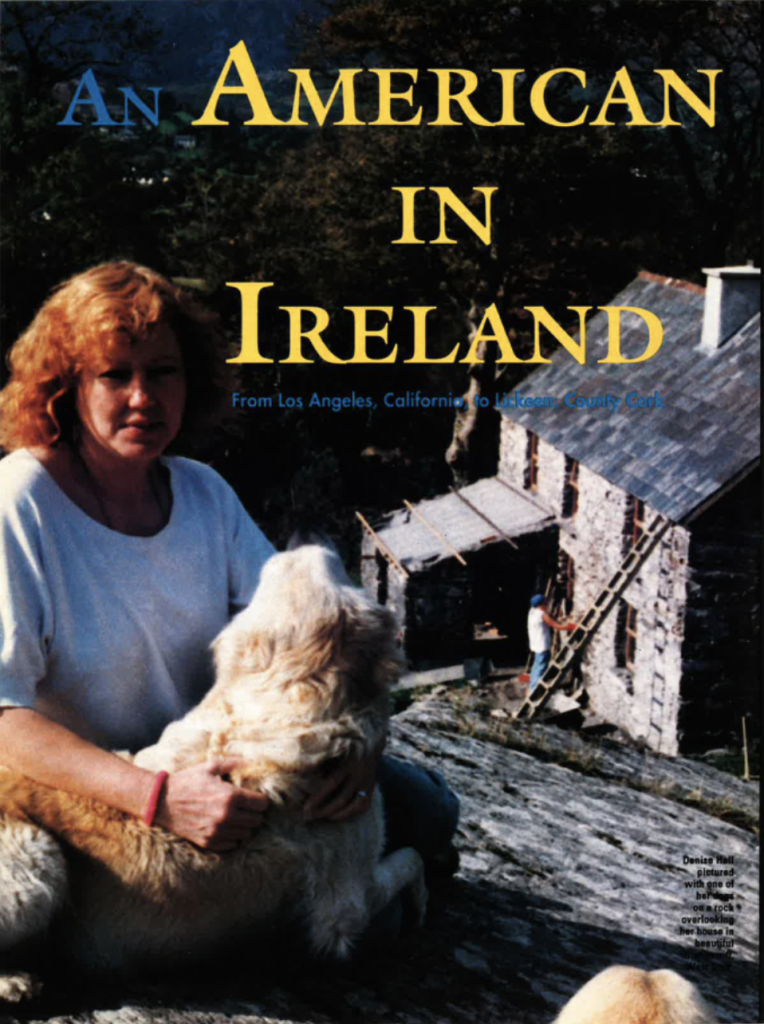
Denise Hall, an American journalist, gave up the fast-track for the briar paths in a remote corner of Ireland.
I lived in Los Angeles for ten years. For three of those years, I worked for the legendary National Enquirer, and I was definitely ready for a change.
It wasn’t just the lurking behind palm trees in expensive Beverly Hills restaurants that eventually got to me. I had begun to hate cities. I loathed crowds and longed to walk, widely and freely, without looking over my shoulder or feeling like some sort of social deviant for being on foot.
Los Angeles is the sort of place you have to believe in, for fear that if you didn’t, all the gilt-edged trappings would simply disappear, as if it were just another movie set. And I had ceased to believe. Not that Los Angeles wasn’t good to me.
I had worked steadily, with varying degrees of success, made friendships that will last a lifetime, and my daughter received her education there. Nevertheless, two days after she graduated from high school, we wound up the last ten years of our lives, and I was on a plane, heading for England. The idea was that I would buy an old cottage for next to no money, and we would do it up. My daughter, quite sensibly, had decided to spend the summer with friends in Hawaii, and would join me when I had accomplished this impossible task.
Cornwall was beautiful, but had become very upwardly mobile since my last visit. A white, chauffeur-driven Rolls-Royce, barreling down the narrow lane we lived on, horn blaring angrily at a meandering herd of cows, finally convinced me that this was not quite what I had in mind.
My father was from Kerry, and I had visited Ireland often. I could go and live there. Once I got the idea, I couldn’t understand why I hadn’t thought of it sooner. It had so many of the things I craved an unspoilt beauty that at times would make you weep, a small population, largely indigenous in the rural areas I was attracted to, unlike Cornwall, where the Cornish now have no hopes of buying property in their own place. And the craic was mighty. I had the vague idea that I might try Kerry, but in the event, I got as far as Glengarriff in West Cork, and could see no good reason for traveling further.
Then a family friend, who lives in Los Angeles and visits us often, asked me to keep my eye open for a small piece of land, something she could build a modest cottage on. I happened to mention this to our local auctioneer in passing one day. He looked at me speculatively for a moment. “What you should do,” he said finally, “is buy Lickeen.” Lickeen, as everyone in the glen knew, was a beautiful but wild place, with a derelict farmhouse and 70 acres of mountain land. Like many such farms in rural Ireland, it had gone into steady decline over the last thirty years as men left the land for America or England, and their womenfolk became disenchanted with a way of life that, despite its quiet beauty, meant hard work and isolation.
Once, Lickeen had been known for its prize-winning cattle, famous as far afield as Kerry. Its pastures had been well-tended and productive, and its buildings neat and orderly. Today, however, it was a different story. Lickeen would demand a lot from its new owners in terms of time and money, and I had little of either.
It certainly wasn’t what my friend from Los Angeles had in mind either.
I explained all this to the auctioneer, who listened politely, a familiar gleam in his eye. I had seen that look before and should have been warned. It meant he knew he was onto something, even if I, as yet, did not. When I had finished, he said again, “What you should do is buy Lickeen.”
It was nearly Christmas and family and friends from Los Angeles were all gathered at my small cottage. No one had mentioned Lickeen in weeks but then on Christmas Eve, we decided to go for a long walk. The destination was to be Lickeen.
I don’t know who was the first to mention buying the place. My daughter swears it was me, but I find that hard to believe. Anyway, once the idea was released into the crisp winter’s air, it just wouldn’t go away again.
Even in the first flush of enthusiasm, akin to a love affair, when the loved one’s faults are all seen as endearing eccentricities, we knew there were problems. Most of the viable land was crisscrossed by drains dug when the previous owners had gone into forestry. They looked like motorways to nowhere–hard, straight lines that cut right through the old pastures.
And even by my fairly flexible standards, the old farmhouse was uninhabitable. The chimney was cracked right down the middle and looked in imminent danger of plunging through the roof at any moment. Window frames and doors clung tenaciously onto crumbling plaster, like rotting teeth.
But all the years of neglect could not affect the view. Even with waste-high weeds and giant sycamores that draped sinuous branches about the house, it was sublime. Endless, rolling mountains with mist hanging on their peaks, and at their feet, the many-variegated shades of green that is Glengarriff Forest. And not too far away, the cave where O’Sullivan Beara’s wife and son had hidden, waiting for him all winter, while he made the fateful march to Leitrim.
There had to be a way to make this work.
It simply hadn’t occurred to me that buying Lickeen would not, in fact, solve my grazing problems. Sometime before, I had bought a horse, although I had no intentions of doing any such thing, particularly an animal of Kitty’s awe-inspiring proportions. Trying to carve a living as a freelance journalist, based, as many editors seemed to think, on the furthest reaches of nowhere, had made my breeding pair of golden retrievers seem like livestock enough.
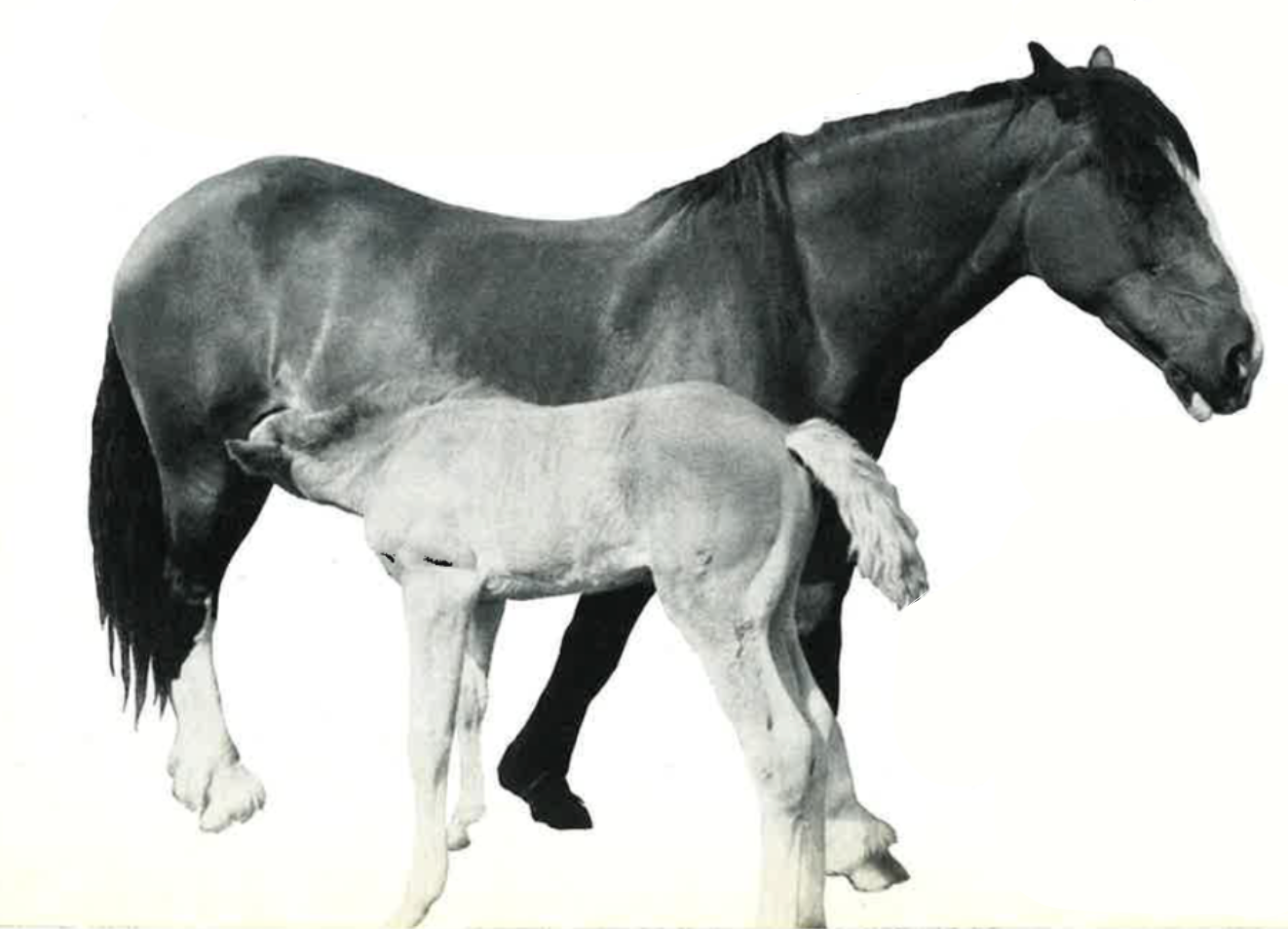
But Kitty was special, an Irish Draught/Clydesdale cross of gentle and willing disposition.
After 15 years of hard work hauling timber out of the forest, she had become redundant in what was fast becoming a modernized industry. Rumor had it that she was going to go for dog meat.
Resolutely ignoring such practicalities as finances and grazing, I bought her, and we managed somehow. But when she gave birth to a strapping colt foal, her first, at twenty, it became obvious that something had to be done. His appetite almost instantly rivaled her own, and the kindness of neighbors and the odd piece of rented land was not enough any more.
I had somehow overlooked the fact that Anlon, Kitty’s foal, could not be grazed at Lickeen owing to his giddy and coltish temperament. In one of his periodic mad gallops, he could have broken a leg in one of the cursed drains.
It was on a not-too-promising summer’s day when I first trudged the quarter of a mile up the rough boreen to my new home, and the first day’s work. I was leading Kitty, who came to do her part in grazing down some of the abundant vegetation, and I was carrying a small hatchet. This, I had been assured, was the only tool for the job that lay ahead of me – knocking several tons of decaying plaster off the old house.
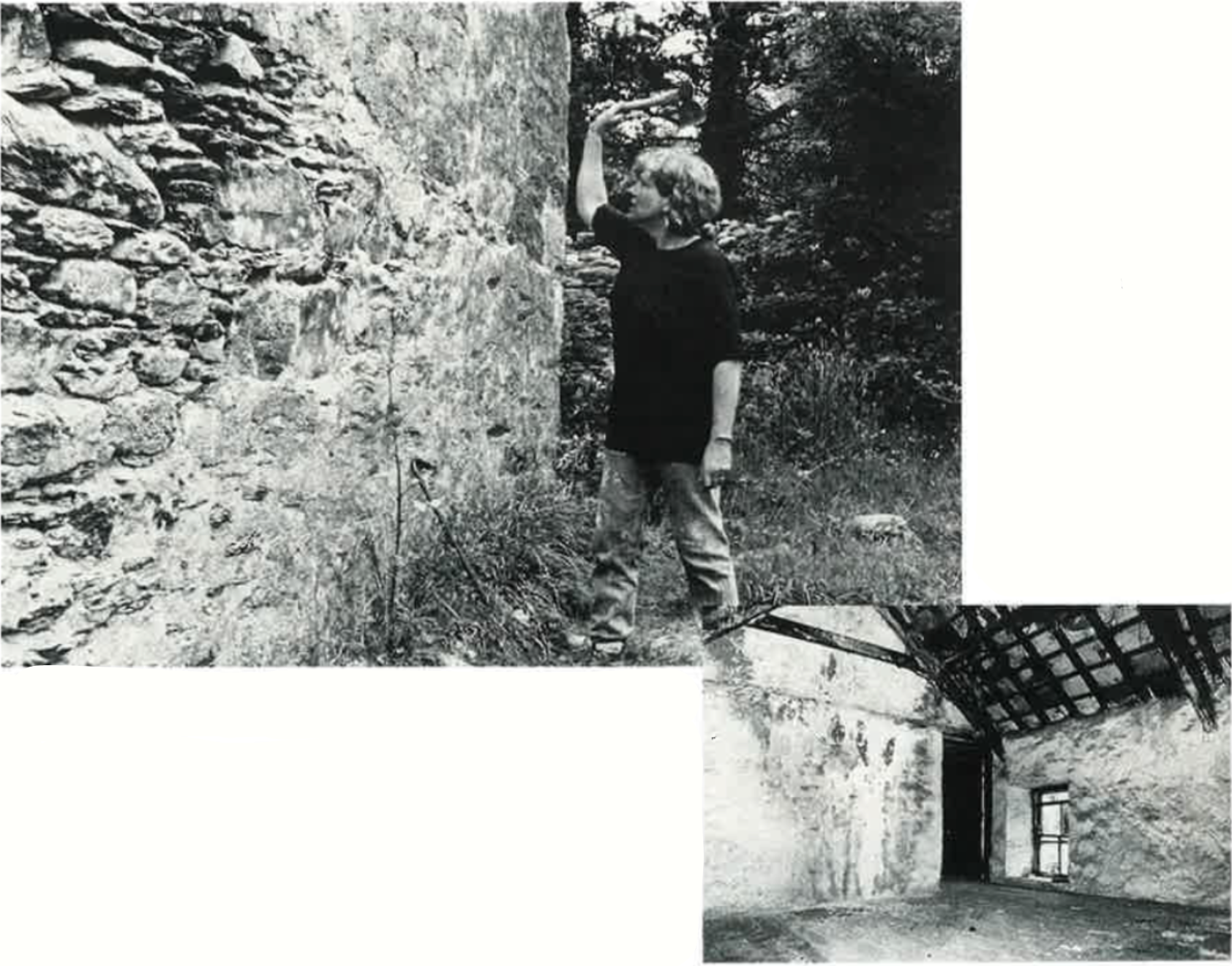
In mid-stride, I was suddenly struck by the absurdity of it all. One woman and a hatchet against this untamed wilderness. The whole idea was ridiculous. But there could be no turning back now, ridiculous or not. My cozy, compact, manageable cottage was sold. This was it. I whistled up the dogs, who were enthusiastically rolling on the badly decomposed corpse of a badger, and kept walking.
Five weeks later, I was still hacking at plaster, thick clouds of lime-mortar dust in my hair, my nose and my eyes. It was rough, hard work, but slowly, very slowly, there were signs of progress. You could almost hear a faint heartbeat returning to the old place again. Now we have a roof and a water supply, cold and clear, from the mountain behind the house. And soon, we will have electricity. The first quote I received for a power supply—£5,000-was completely out the question, and so I decided to check into available farmer’s grants. Perhaps there was something that might help bring that quote down to something that less closely resembled the national debt?
As it turned out, in order to qualify for a grant I had to get a herd number. And in order to do that, I had, quite reasonably enough, to acquire livestock. The going rate seemed to be one cow or ten sheep. I eventually opted for a little red heifer, a dairy shorthorn, who was promptly and wittily christened Electra by a neighbor.
And then we discovered that the little red cow was pregnant-another story for another day…. Meanwhile, Kitty the mare has taken to Lickeen with great enthusiasm. When not grazing about the place with the discernment of the true gourmet, she spends much of her time dozing contentedly in the kitchen, rubbery lips flapping gently in time with her steady breathing, and completely unperturbed by falling masonry or hatchet blows to the wall. This is a habit I suspect I should discourage because in months to come, I have a feeling it might be difficult convincing her which is her stable and which is mine.
I’ve a long, long way to go yet, but it’s coming on, a little more every day. And the knowledge that I’m living in what must be one of the most beautiful and unspoilt places on earth does much to sustain me when the going gets rough.
And the constant challenge of trying, in my own unique and occasionally inept way, to preserve an old farm and its history before it disappeared without a trace beneath a welter of Sitka spruce. And may God bless the work….
Editor’s Note: This article was originally published in the July August 1993 issue of Irish America. ♦
Leave a Reply