
The Comstock Lode provided over half the silver ever mined in the United States but the Irishmen who discovered it weren’t quite as lucky as one might think. By Jim Sullivan.
Between 1850 and 1860 the numbers of Irish arriving on the shores of America rose from 206,041 to an incredible 1,611,304!
Packed into the slums of New York City’s East Side and Boston’s North End, many of the new arrivals experienced unbelievable hardships.
During the next few decades, however, many of these immigrants left the “eastern Irish ghettos” and ventured to the far corners of their newly adopted country.
Some went to the Midwest to become farmers. Others risked life and limb working as rail layers and timbermen on the Central Pacific Railroad. And many, lured by the promise of finding gold, headed for Sierra Nevada mountains to try their hand at prospecting.
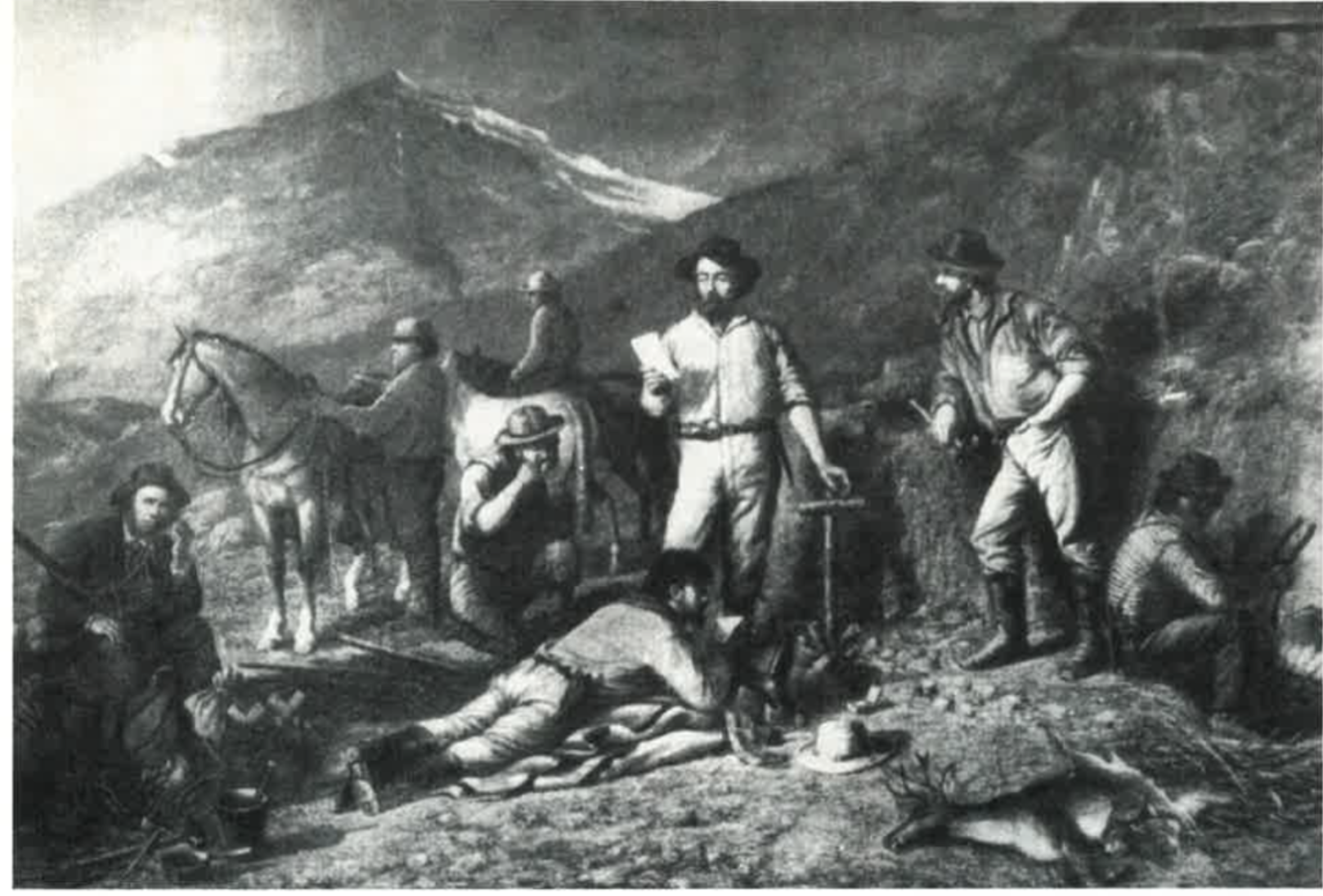
The most famous of all the “Mother Lodes,” the Comstock Lode, was discovered on June 12, 1859, by two such Irish immigrants, Peter O’Riley and Patrick McLaughlin. O’Riley and McLaughlin worked sixteen-hour days, seven days a week at the head of a ravine near Six-Mile Canyon, on the north side of Mount Davidson, adjacent to modern day Virginia City. The two were friends and worked together for safety safe.
Their initial results were disappointing.
Working with only shovels and pick axes, they had to dig much deeper into the rocklike soil than they had hoped. Days passed without finding any gold at all. It was hard just finding enough small nuggets and gold dust to buy essential supplies.
Then one day, while excavating in a sandy area with a peculiar tint to the soil, they dug into an unusual layer of decomposed ore that had the look of solid bluish-black earth, underneath a sulfur-yellow clay layer. It was very heavy and unlike any ore they had seen. They placed the strange soil into their “rockers” to wash away the sediments and were astonished to find the bottom of their ore rockers lined with what looked like pure gold. But they weren’t completely convinced, so they collected several pounds of the blue and yellow ore and secured it to their pack mules to be taken into town to be assayed.
With evening rapidly approaching, O’Riley and McLaughlin met another prospector traveling in their direction. His name was Henry “Pancake” Comstock and he knew the Irishmen well. All three had primary camps in Johntown. Com-stock told the two that he had posted “exclusive ranching and mining rights for the entire area,” and falsely indicated that he had filed a claim earlier that week for this specific area which was initially called “The Ophir Mine.”
An argument ensued. The Irishmen knew they were being taken advantage of, but their legal options were limited. Due to the lack of precise surveying maps, the filing of papers for specific claims were hard to prove. Finally the miners agreed that if they were to keep the area a secret, it would be wiser for all three to become “partners.”
O’Riley and McLaughlin had been working the hills surrounding Johntown for months. They were very cautious of the other miners, and with good reason. Many of their fellow Trishmen had “mysteri-ously disappeared” after laying claims to productive sites. So when Comstock, who had a reputation for being an unstable and violent man, demanded to be included in “the partnership,” O’Riley and McLaughlin eventually acquiesced.
The next day the three proceeded to nearby Virginia City. There the two Irishmen learned there were to be three “other partners” but when they questioned the “arrangement” they were presented with additional “official papers” (falsely contrived) that listed the claim as belonging to all of them.
Not knowing what to do, they approached another Irishman, Judge James Walsh, who had recently arrived from Grass Valley, California. They gave Walsh a sample of the “blue ore” in order to have it assayed.
Walsh cautioned the men to accept the terms as presented — at least until the ore’s value could be determined, and since he was admired and had a great deal of clout in the area they trusted him.
Within days the assay results were back in the miners’ hands. Not only did the ore contain an incredibly high amount of gold, it also was laden with high-grade silver (the strange blue hue was indicative of heavy amounts of silver). This was the first of many “Bonanza” discoveries in the area. O’Riley and McLaughlin were to be rich beyond their dreams! Or so they thought.
Dan De Quille, a leading authority for that era wrote in his book The Story of the Big Bonanza, published in 1877, that “Once Comstock got into the Ophir claim, he elected himself superintendent. He made himself so conspicuous on every occasion that he soon came to be considered not only the discoverer, but also ‘Father of the Lode.’
“People began to speak of the vein as Comstock’s Lode, a name which it bears today, while the names of O’Riley and McLaughlin, the real discoverers, are seldom heard of.”
Yet the first claim notice dated 1859 and recorded in the official Mining Recorder of the area, now on display at the historical County Recorder in Virginia City, reads: “We, the undersigned, claim this spring and stream for mining purposes.” Signed: Peter O’Riley, Patrick McLaughlin.
(It should be noted that O’Riley’s name was actually O’Reilly when he immigrated to the U.S. from Ireland.)
McLaughlin became very despondent in not having any voice in the day-to-day operations of the mine. He withered into retreat. Even his close friend O’Riley couldn’t lift his spirits. Near the end of 1859 he sold his interest for a paltry $3,500 and decided to move to California, where he again sought work as a miner.
While working in various California mines as a common day laborer, McLaughlin continued to hear of “the great Comstock Silver Lode. “This constant reminder only drove him further into depression.
Soon he began to ramble incoherently about “ghosts and visions.” In an effort to keep him from harming himself, he was committed to an insane asylum where he died shortly thereafter. Meanwhile back in Nevada, O’Riley was experiencing menacing threats by many jealous miners. He decided it wasn’t worth the trouble and sold his interest for $40,000 and about $5,000 in back dividends. He had big plans and soon built a hotel in Virginia City, but the enterprise failed. He began drinking heavily and in broken health, died a few months later, penniless.
Poetic justice was to prevail, however.
“Pancake” Comstock ended up faring no better. His shifty and devious machinations were known to all. He became a bane to the newly arriving miners, especially the Irish. Seeing the writing on the wall, Comstock decided to sell his interest to Judge Walsh for $11,000. In the months that followed, he too was afflicted with a great bout of depression. Reduced to starvation and forced to scrounge for food and handouts, he finally ended up committing suicide on a lonely horse trail a few miles outside Virginia City.
De Quille wrote, “Out of the first bonanza, into the top of which O’Riley and McLaughlin first struck their picks, was taken $40,000,000 before the deposit was exhausted. Their find later led to many other rich veins nearby.” Numerous other Irishmen eventually benefited from their brethren’s discoveries. Most noteworthy were Irish born John W. MacKay, who became known as “Boss of The Big Bonanza,” William S. O’Brien, James G. Fair and James C. Flood, a New York native whose parents came from Ireland early in the 1800’s. And of course Judge Walsh, who made millions over the next decade.
Editor’s Note: This article was originally published in the July August 1993 issue of Irish America. ♦
Leave a Reply