
Election fever in the North of Ireland over the last few months was more like a head cold than a serious illness. It coughed and sighed for a while, but the few sneezes as it dissipated marked for some their political demise while for others it just helped clear out the system.
The Local Government Elections in Northern Ireland are held every four years in 26 council areas. Over 900 candidates vied for 582 seats, 16 more than in 1989. In most areas it takes approximately 1,000 votes to became a councillor, but the vagaries of the PR System (Proportional Representation where one candidate’s surplus votes are distributed after they are elected or eliminated) means that a person can be elected after receiving a minuscule number of 1st-preference votes but a huge number of transfers. Voters mark their ballot papers 1, 2, 3 and so on. Thus a high-profile politician might receive several thousand 1st preference votes and have one or two running mates who pick up their transfers and get elected.
Clear? Well, don’t worry, there are many commentators, party managers, and the majority of candidates who don’t understand it either.
There were a number of “headline stories” that dominated the results and subsequent commentary, with most agreeing that it was a case of the same old story.
Quantitatively yes but qualitatively no.
The “protagonists” were Unionists in the form of the Democratic Unionist Party (DUP), the Ulster Unionists (OU), the Alliance (All), and the local branches of the Conservative Party.
Facing them were the Nationalists in the form of the Social Democratic Labour Party (SDLP) and Sinn Féin (SF).
On the Unionist side predictions that the DUP would lose substantial ground to the UU failed to materialize, but they did lose ground in two of their bedrock areas, Mid Ulster and Ballymena.
In Mid Ulster three DUP councillors had resigned because of the party’s “softening” attitude.
Their replacements who included the wife of DUP MP Rev. William McCrea, didn’t fare so well with a drop in the percentage poll. In Ballymena, their absolute heartland, it was down to the “ELO factor.” ELO are a group of has-been musicians who had been booked to hold a “massive” rock concert in Ballymena on a Sunday. Therein lies the crux.
The DUP is inexorably linked to the fundamentalist Free Presbyterian Church; Ian Paisley is the leader of both, and they have a rhetorical commitment to “never on a Sunday” in all council facilities; including the showgrounds where ELO were due to perform. “The devils music” would not be heard on Sunday. They successfully prevented the concert, but the outcome was the loss of many valuable votes and seats on the council, where they lost overall control for the first time.
Asked was it worth it, one DUP stalwart said, “The devil was defeated in Ballymena,” to which one wag quickly retorted, “so was the DUP.”
Several of the DUP personalities received massive personal votes, two and three thousand ahead of the quota to be elected. There is no question that for some it is purely egotistical with “whispering campaigns” clearly audible in the counting centers.
The Rev. William McCrea, for example, in Magherafelt who is MP for Mid Ulster, received over 2,100 votes while his running mates Paul McLean, a councillor for four years, received just 88 (he got 150 in 1989) and Danny McAllister got the derisory total of 32. McLean got in on transfers, McAllister handed over his party colors and left to consider his political future.
In Belfast the UU suffered the ignominy of failing to get the mayor reelected. Herbie Ditty was the victim of the fallout over “junkets” to foreign ports that cost ratepayers hundreds of thousands of pounds, and the fact that he held a meeting with the Lord Mayor of Dublin, Gay Mitchell.
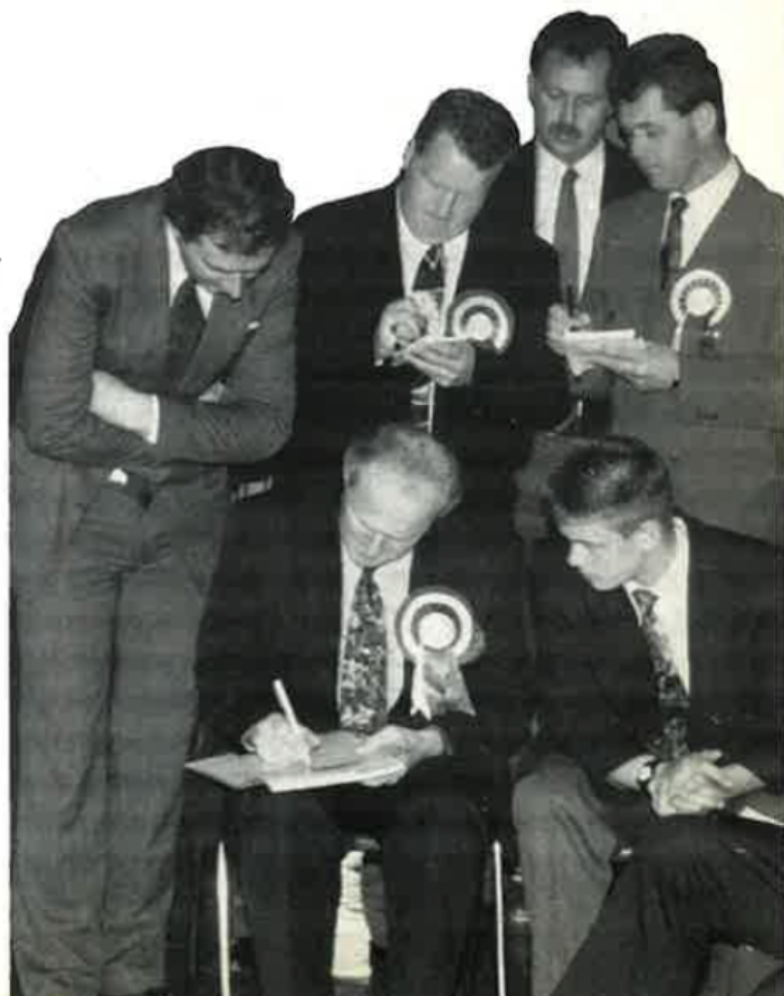
In Dungannon the MP for Fermanagh/South Tyrone Ken Maginnis, a former major in the now disbanded Ulster Defence Regiment, lost his seat to a “major surge” by Sinn Féin, which went from three seats to five, and topped the poll in all the councils and wards. The “liberal darling” of the Dublin media and the beaten McGinnis described the winning Sinn Féiners as “dummies” on a live TV inter-view. Realizing his remarks sounded like a sore loser, he swallowed hard and changed tack quickly. He, a councillor for 12 years, said it wasn’t right for someone to have two jobs, and his defeat was the result of a planned gamble using the PR system to get in on his running mates’ surplus!
On the Nationalist front all eyes focused on the battle royal between SF and the SDLP in Belfast, the biggest and by far the most controversial of the councils.
On day one of the count SF “did the business” by getting three seats in the north of Belfast which included retaining a seat they had won in a by-election. On day two they took another seven and ended up with more votes in Belfast than any other party, Nationalist or Unionist, and 25 percent of the poll.
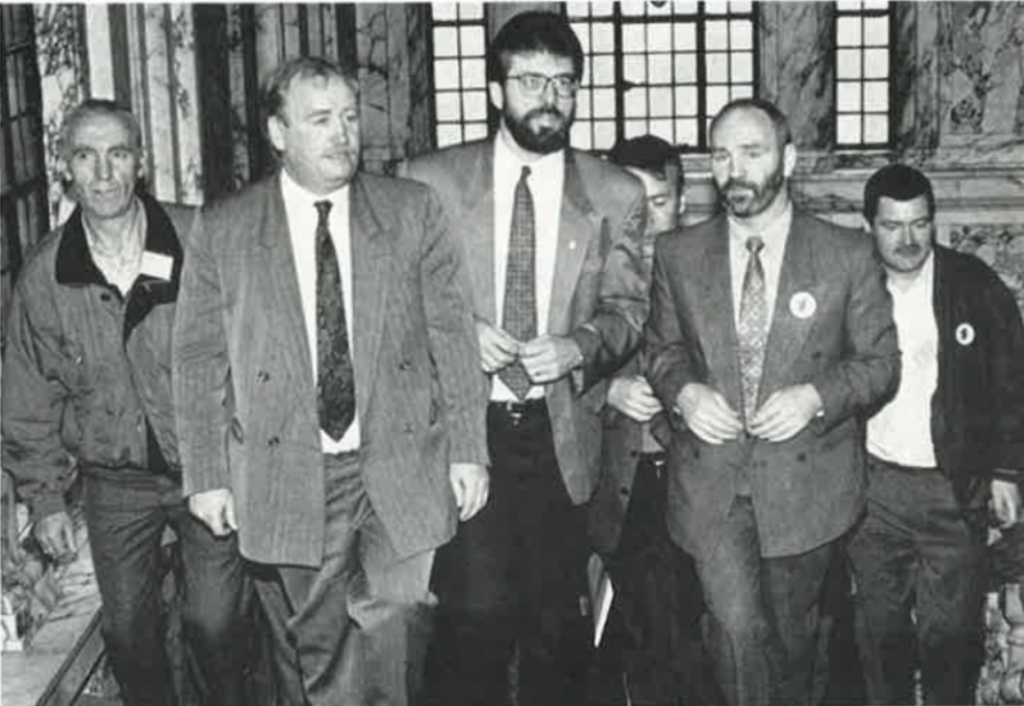
Standing on the marble staircase in the ornate bastion of Unionism Gerry Adams of Sinn Féin, cracked open a magnum of champagne and declared in Irish (which is banned by the council) and English that “Belfast is our city as well as the Unionists’ city. The City Hall is also our City Hall.”
The council is still Unionist-controlled but only by one. Predictions that it will be Nationalist before the year 2000 seems more and more possible.
In Derry the SDLP gained a numerical majority on the council with 17 out of the 30 seats going to them, and in Limavady control switched to the Nationalists with the SLP gaining an extra seat.
In Fermanagh, which 12 years ago elected the Hunger Striker, Bobby Sands, the final Sinn Féin candidate was 69 votes short of his nearest rival and the council is now Unionist dominated.
Magherafelt also changed to Nationalist control with Sinn Féin and the SDLP both picking up an extra seat. Former SDLP councillor Mary McSorley who was awarded an MBE by the Queen didn’t stand and her seat was taken by Sinn Féin.
Overall no party’s percentage share of the vote changed more than two percent, with the UU, DUP and SDLP all dipping slightly. Sinn Féin and the ALL were both up in percentage terms and in the number of seats they captured.
What Now?
Eamonn Mallie, a noted political commentator and author, said on the eve of poll that the results would be carefully analyzed by the British government and the Northern Ireland Office who are anxious to restart last year’s failed political talks involving the four “Constitutional Parties” but excluding Sinn Féin, with a “British Agenda” being the blueprint.
Their “worst case scenario,” he suggested, would be if the DUP held its ground or increased its vote and Sinn Féin were to increase its vote and take 10 seats in Belfast. Their nightmares are coming true.
The Unionists’ “pact” between the DUP and UU is under considerable strain as the DUP harden their stance and try to regain their own identity. The talks between John Hume of the SDLP and Gerry Adams of SF will, in spite of the “controversy” they engendered, probably resume and SF remain adamant that they must be part of “inclusive dialogue” if there is going to be any progress towards peace.
Qualitatively Different
While the numbers may have remained largely the same, the subtleties and the mood are quite different from the two previous Local Government Elections in ‘85 and ‘89. In ‘85 the DUP replete with sledgehammers at their press launch set out to “Smash Sinn Féin.”
There was no broadcasting ban preventing Sinn Féin from appearing on TV or radio as there is now, and generally the atmosphere was confrontational and very much fever pitch.
In ‘93 the confrontation was notably absent, particularly in the counting centers.
The party managers, a rare breed by any definition, of all parties stand shoulder to shoulder leaning over an invisible “polite barrier” to see the contents of ballot boxes tipped out on the tables.
They share numbers, percentages, guesstimations, and even sweets as they all try to work out where “their” vote is coming from. Some can clinically predict the outcome from what is a folded mountain of ballot papers and they become the “guru” for all to consult.
All carefully avoid talking “politics” as they share the same arena for hours on end in a process that is for the uninvolved like watching paint dry.
Tribal comments are exchanged more for banter’s sake than in any sectarian way, and bursts of laughter from the most unexpected groups break the tedium. Like the DUP and SF leaders putting the milk and sugar in each other’s tea, the RUC (Royal Ulster Constabulary) policewoman holding open the door for two republicans, and the UU candidate putting his party sticker on an SDLP man’s back and then both parties laughing at the unfortunate butt of the joke.
It may be unreal and a somewhat contrived situation; elections are like that in the North of Ireland, but it is not confrontational when a few years ago a sideward glance could and did start boxing matches.
The unkind note cynically that it is all pointless anyway as the councils have minuscule power. They in fact control refuse collection, burials and leisure facilities and a few other minor responsibilities. They have been bastions of bigotry and gerrymandering; many still are, but things are changing slowly.
West of the River Bann, which bisects the North of Ireland from north to south, is very much going green, (Nationalist) while the Unionist base is retreating more and more into the Greater Belfast area.
The elections are a four-year barometer that this time show changing times ahead; calmer days hopefully.
Editor’s Note: This article was originally published in the July August 1993 issue of Irish America. ♦
Leave a Reply