
The Irish Take Broadway
Brian Friel has been writing significant and respected plays ever since he captured the hearts and funnybones of the public with Philadelphia, Here I Come!, his first international success, in 1968. But it is with his latest, Dancing at Lughnasa, that he achieved the kind of success that leaves even him awed. For two years now it has been a steady hit in Dublin, London, and New York, and, having already been translated into several languages, is well on its way to conquer the bookshelves, the theatres, and minds of the world.
Dancing at Lughnasa, which is more than a little autobiographical, is the story of the five unmarried Mundy sisters in the mythical Ballybeg in County Donegal (based on the real-life Glenties), but which Friel’s several plays have firmly imprinted on the map of the world. These sisters vary considerably in age and disposition. Kate, at 40 the eldest and the only wage-earner, is a schoolteacher and the embodiment of common sense; Maggie, 38, is the housekeeper and family wit; Agnes, 35, is the saddest and bitterest—it is she who must look after Rose, 32, who is sweet but mentally not quite there. Agnes and Rose earn piddling sums with their knitting. Chris, 26, is the prettiest, wildest, and most lyrical sister. She is also the devoted mother of little Michael, her illegitimate son by Gerry, a decent but feckless Welsh traveling salesman who occasionally pops in with unrealistic marriage proposals to Chris.
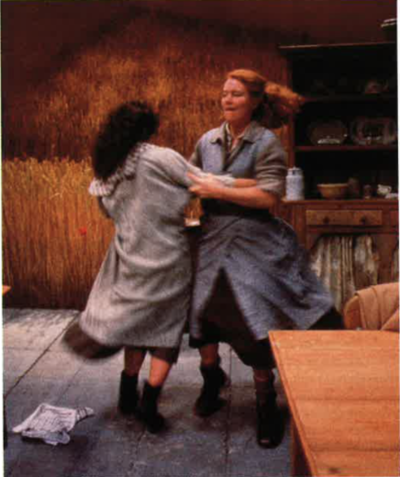
Chrissy will dance with him— they’re both beautiful ballroom dancers– but not marry him.
Besides Gerry, the men are Father Jack, the only Mundy brother, who has just come back from years as a missionary in Africa, somewhat unhinged but lovable for all his befuddled-ness; and Michael. Michael, the play’s narrator, is a man of indeterminate age, looking back at the summer of 1936, the time of the play, which is the way we see and hear him. But he is also, as the sisters see him and speak to him (though invisible and inaudible to us), the small boy that Michael—-or Brian Friel— was then. The sisters are desperately poor, having as their only luxury a beat-up old radio, the Marconi, the voice of the lares and penates of the Mundy household. The spirit of the Mundys is indomitable, best expressed in Chrissy’s unquenchable thirst for life. The play embodies the Mundy-or Friel-soul with shattering immediacy; it is heart-warming, heartbreaking, and full of hearty humor.
One afternoon over tea I had the opportunity to chat with the five actresses who opened in the play on Broadway, though most of them had also acted their roles in Dublin and London. They struck me as five of the finest women and actresses I had met in many years as a drama critic, film critic, and lover of women. Two days later I also had a most enjoyable talk with Patrick Mason, who directed Lughnasa in Dublin, London, and New York. Here is the gist of the conversations.
Director Patrick Mason speaks with John Simon.
John Simon: What is your relation to Ireland and to the play?
Patrick Mason: I grew up in England but my mother’s father is from Galway. I went to drama school in London, the Central School of Speech and Drama. I was offered a job as a voice coach in the Abbey Theatre, Dublin, and I ended up as an assistant to Hugh Hunt and Michael Cacoyannis who were directing that season. And that, as they say, was the experience that changed my life. I decided I wanted to live in Dublin and be a director. That was nearly 19 years ago.
John Simon: How did Dancing at Lughnasa do in Dublin?
Patrick Mason: Lughnasa has had three runs at the Abbey. It could have run for months but because the Abbey works on a rotating cycle, a play doesn’t settle in for long. Lughnasa will be back this summer with a new cast. That will be the fifth cast. They will then do a tour of Ireland and then go to Australia. For a small city Dublin produces an awful lot of theatre. The population is just over one million and it supports the Abbey, The Gate, The Gaiety, The Olympia and a dozen or so small studios.
John Simon: Is the play still running in London?
Patrick Mason: Yes. We moved to a smaller but better located theatre. Two weeks ago we opened a U.K. tour at the Liverpool Playhouse. It broke box office records and will tour for six months. The cast is all English actors.
John Simon: How do English actors do with the Irish accent?
Patrick Mason: They do it extremely well. They may be actually truer to Donegal because they have to study it. But it’s like starting off with the American cast. It’s not about having an absolutely perfect Donegal accent. If they had you wouldn’t understand it anyway. It’s about situating it so everyone’s in the same place. There’s a sound that serves the play and serves the characters and is accessible to the audience.
John Simon: Could you describe the differences in casts?
Patrick Mason: For example over the years there have been three Maggies, all very different, but all Maggie. Some have gone deeper into the darker side, the wounded, isolated side. Some have been much more the vibrant, earthy woman some have been cruder, some more subtle.
John Simon: And that affects the entire cast.
Patrick Mason: Of course, it changes the balance and changes the amount of darkness in the play. Personalities matter particularly in this play because it’s a play about being about presences. It demands that the actors call much more on their personalities. Different facets of the play come out with different casts.
John Simon: Did Brian Friel have a lot to do with how the play is being acted?
Patrick Mason: The text is very tightly written, I don’t feel it is a text you muck around with. We had long discussions beforehand about how he saw it. I had worked with most of the Irish playwrights and always welcomed their presence during rehearsal. Brian just sits there happily and waits. Every now and then he’ll say something but he gives remarkable latitude both to me and to the actors. If there’s anything, he’ll say something like, “Possibly there’s another reading of that line.”
He’s always very tactful.
The thing about an Irish audience is that there are so many overtones and undertones that are shared. For an Irish audience, Lughnasa is not just a good play, it’s a kind of celebration of national identity. You are speaking to a community. People see a writer as their own and they want to know what he has to say about them.
Dublin can be very provincial at times, yet there’s something in Ireland, There is no embarrassment in talking about spiritual things. In fact, they’re all around you. They’re second nature, they’re coming out of the ground. In London to refer to anything spiritual is an embarrassing social gaffe. But in Dublin I’ve never been at a party or in a pub where at some point theology hasn’t come into it. And sides are taken and argued with great passion. Everyone is closer to the land. You drive 20 minutes from the center of Dublin and you’re in the mountains or out in the fields.
John Simon: Doesn’t the church still act as an inhibiting force?
Patrick Mason: There is this awful Jansenist influence which is still felt and which Lughnasa is very much about. But in the last 20 years that’s been changing.
John Simon: Was there any religious or ideological objection to the play?
Patrick Mason: No, on the contrary. I remember one night in Dublin a lot of missionary nuns arrived on leave from Africa. I saw them in the audience and I went up afterwards and asked, “How do you feel about Father Jack?” They said, “We know hundreds of Father Jacks.”
John Simon: Has the music in the play always been the same?
Patrick Mason: Yes. “Dancing in the Dark and Anything Goes” and the opening and closing music have been the same from the beginning. And those are Brian’s choices in those specific recordings. For the dance we wanted a particular tune The Mason’s Apron and got together a group of traditional musicians and rehearsed with them and then recorded that.
John Simon: How do you think the American cast will work out?
Patrick Mason: Very well, because they are very strong actors and they relate to it in their own way.
John Simon: The only thing that worries me is that in spite of Vietnam and Watergate Americans are still an extremely optimistic people and this is not an optimistic play. I wonder how an American cast can deal with pessimism.
Patrick Mason: But it isn’t a pessimistic play. There’s great optimism within those characters. I know what you’re saying but I still think there is an increasing awareness here of the darker side of life. Funnily enough one thing that is difficult to convey is the particular type of humor. It’s not about optimism or pessimism; it’s about a very Irish thing which is to laugh in the face of despair. Beckett, O’Casey, Shaw, they all have this.
John Simon: They have the right to it. They earned it.
Patrick Mason: The play does acknowledge the dark side of life but at the same time it celebrates a lost togetherness to be somehow recovered in the past.
John Simon: Would you say that there is something about the play Dancing at Lughnasa that brings out good performances?
Dearbhla Molloy (Maggie): It’s very simply written— you simply play it. It plays itself in a way.
John Simon: Have you found that the audience reaction here is different from that in London or Ireland?
Catherine Byrne (Chris): Religion colors reactions in Ireland. For example, when Fr. Jack says to me “I haven’t met your husband yet.” In Ireland before I say a word there is an ohhh.……
Bríd Ni Neachtain (Rose): When Gerard [narrator] says the words “out of wedlock” there’s a strong reaction.
Dearbhla: But here [U.S.] some references aren’t understood. Someone asked me why Aggie and Rose couldn’t get a Job when they went to London. I said you have to understand the context from which they came and why they had gone in the first place. If Aggie had five pounds saved that was all the money she had. That got the two of them on the boat and that was as much as they thought of. They had come from a very rural place where they knew absolutely everybody.
And they had to start dealing with cities. The person asking me this question was asking me in a New York setting.
Catherine: One girl about 16 said to me “I don’t know why you got so annoyed when Gerry kissed Aggie.” To her it was a simple little kiss.
John Simon: To the audience there is something very special that comes off that stage.
Do you feel that there is anything special in the play or each part that makes it particularly endearing or significantly akin to your spirits or needs? Oris it just a very good play?
Dearbhla: I come from a big family and my mother comes from a large family with five women in it. On my dressing table I have a picture of the Ryan family, my mother’s sisters. The Maggie that I am presenting is an amalgam of two of my aunts. Although their accent was different I’ve used my own family history. Because I’m playing something quite close to home, I find it the hardest part I’ve ever played. I’m groping in my family psyche.
John Simon: Interesting that you say “though the accent is quite different.” Is that such a major consideration?
Dearbhla: My mother’s family came from the Midlands, from the very center of Ireland. This is set in the North so the expressions are quite different.
Brid (Rose): I don’t find anything of myself in it. I just find it a very good play. I’m from the West, Galway, and Donegal is North West, so I understand the background of the piece. From an acting point of view it is a terrific ensemble.
Dearbhla: May I say something about this ensemble idea? It throws me slightly because I don’t know that we ever work any other way.
Catherine: We’ve picked up on what people have been saying because it’s a group of five women confined in the kitchen. We’ve picked up on that word ensemble but of course we don’t work any other way.
John Simon: Is there a problem of getting into the spirit of 1936 when the action takes place?
Catherine: We read the script three times and then we sat around discussing it-being in Donegal, being sisters, being in 1936. Each one of us revealed bits of ourselves that we would never have done in different rehearsals. This is the first role I’ve ever had that I could create myself.
I’ve usually been given a script and been told how the part was played in 1952.
Rosaleen Linehan (Kate): I would say I had an affinity with the thirties because I was a girl in the 50’s and they were identical to the 30’s. Things didn’t change in Ireland until approximately 1963 when a tiny little niggling came in through the cracks. The Church had a stranglehold on every aspect of life. We hadn’t got television and life was around the radio. I remember people used to settle in at 8 p.m. to listen as a family to the radio.
John Simon: Is the play very much anchored in this mythical Ballybeg or is it equally applicable to people from other parts of Ireland?
Dearbhla: It’s a small country and everyone has relatives in every part of it. So even if you were brought up in Dublin you can know the countryside.
John Simon: Do you find yourselves playing the parts differently over here?
Rosaleen: As you know, an audience is an audience is an audience. But I’d say there was a fractional difference here. American audiences are very sharp. They’re used to sharp, quick humor and they pick up desperately quickly.
John Simon: Is there no feeling of incomprehension from the audience?
Catherine: The big dance in the kitchen can attract different reactions, sometimes silence, sometimes a round of applause. Brian Friel [playwright] doesn’t like the round of applause. He feels when that happens it hasn’t hit right, hasn’t been effective.
John Simon: How do you as a performer feel about such applause?
Bríd (Rose): I don’t like it.
Rosaleen (Kate): It’s more effective not to get it. I feel a gasp is more effective.
John Simon: Has Brian Friel sort of guided you as things went along?
Catherine: He was a fantastic influence. Because he was there, you wanted to hear what he had to say. It was getting it out of him that was hard.
Rosaleen: He’s very shy. He’s such a gentle man, but he is also so astute.
Dearbhla: Sometimes he’ll say “Ach, sure, I don’t know. It’s up to yourselves.” Do you remember the long speech that leads up to the dance and fuels the dance? I had no idea how to get through that and I tried different ways. One day Brian came over and said, “I don’t think Maggie knows what she’s feeling until she dances.” And that was it. That took all the business out of the speech.
Catherine: I remember Brian saying to me, “I want you to think about what other people are saying about you, not what you’re saying.” So I listened. “I want that from the very beginning,” he said, “A certain air of uncertainty about whether she’s a good mother.”
Rosaleen: As Kate, from time to time I go into a corner with myself when I feel it’s moving too much toward caricature. But if you pull back too much you can lose the essence of the character. She is the necessary motor for the play. She is upward and outward. She is the one with all the news from the town. She’s the bossy one.
John Simon: Did you do any research into the type of mental disturbance you have to play for your part?
Brid (Rose): No, Brian didn’t want that – the part I think is written so well all you have to do is play it.
John Simon: I think actors should just be allowed to act and not be asked to do scholarly or journalistic research.
Catherine: Friel has already done the work.
John Simon: Has any one of you gotten anything from doing this play in New York?
Dearbhla: It has broadened my horizons enormously. I love the way Americans say things straight out and everything seems possible. That attitude has opened me up and given me a lot more confidence.
Catherine: I was quite lonely here before my husband John and our two boys came over. But last Sunday they went home and I left them to the airport. And I got a bus back in and I dozed on the bus. It was quite late and dark and I suddenly opened my eyes and I didn’t know where I was. And there was the skyline of Manhattan and I was completely calm on the bus, on my own and I thought, “Ah, there’s Manhattan.
That’s how changed I am!
Rosaleen: I was down on Orchard Street in this place that was very old fashioned. I wanted a towel that had the skyline on it. Over the speakers comes a voice saying, “She wants Manhattan” and I sang “The Bronx and Staten Island too.” The fellow behind the counter joined in. The poor woman next to me just looked and said, “Are you in entertainment?”
John Simon: But you didn’t all break into the dance.
Dearbhla: I hadn’t been able to figure out the ethos of America. But when I went to Ellis Island I really understood why people got off the boat and knelt down on the ground and said, “This is my country now.”
Bríd Brennan (Aggie): You carry with you this great mythology of Broadway. It’s tremendously exciting to have it become a reality. I’ll never forget that first preview night. It reminded me of when I was starting out in the business, when it was all a real adventure. And I do enjoy the sense of working here because it’s such a workers’ city.
Catherine: What I like is that audiences here are incredibly moved sometimes. When I watch people being so moved right in front of me I remember again how lovely the play is. I never expected so much.
Bríd (Rose): They write letters to you here; they never do that at home.
Catherine: Over here they seem to be overwhelmed by it. At home people would have things they didn’t like but l haven’t seen any of that here.
John Simon: Do you have any sort of interesting reactions from your families about your role or your being in the play?
Brid (Aggie): My father loved it. Funny enough when he first came to see it, and there was a lot of laughter, he said to me, “I need to come back and listen to this play.”
He actually came three times and each time he got more out of it. The first time he said to me “Oh this is a classic, Bríd.” The second time he said, “But, my God, it’s terrible sad.”
Dearbhla: My parents came twice in three weeks. They came again because they didn’t like it the first time. They were embarrassed about saying that they didn’t like it. They came the second time to try to convince themselves they did like it. But in fact they didn’t. It is too close to both their own backgrounds.
Rosaleen: My son came and said, “You’re playing yourself, Mom. This was written for you.” But then you see my roots are there.
My father came from exactly this kind of house in the same valley, the same bog, the same lane—-just fractionally poorer. He knew that kind of fear, that there is nothing if the money goes. No safety net. There’s only, perhaps, the boat. In the play I read The Donegal Democrat of that time. It lists four or five sailings a week from Derry, the nearest port, to Boston and New York. It was 1936. The rest of the people went to Scotland for potato picking. It was terribly harsh. It’s a harsh county. It’s the most beautiful county in Ireland but it’s harsh.
John Simon: Tell me about the one night stand you did in Glenties, which is Ballybeg in the play.
Brid (Rose): We played in what was the workhouse which is mentioned in the script. For me it was an amazing experience. The audience knew the five sisters the play is based on.
Catherine: It caused quite a stir. It’s a tiny place. The hall was jammed. People standing in the back. You could hardly breathe. The stage was tiny.
They had thrown a bit of straw on the floor. I just had a hanky and a big iron as props. I kept ironing this one hanky and folding it and unfolding it, and nobody ever noticed that I was ironing the one hanky. It was really very strange because the people were right there. In the front row they’d put all the “celebrities”. There was John Hume right in the front row.
Bríd (Rose): Have you heard the story about one woman in Glenties? Everyone was saying, “Are you going? Are you going to the play tonight?” She said, “I wouldn’t go to see that. They were an awful crowd of bitches.”
Rosaleen: I remember the doctor of the town took Catherine and myself out for a drive. He knew all the sisters, you see. Catherine said “What were they like? What did they look like?” And he said “Now I’ll tell you the honest truth. Chris was a very nice little wee girl. The rest of them were very plain.” John Simon: Would you like to swap and try another part in the play?
Rosaleen: Well I couldn’t because of my age. Unless I played Fr. Jack.
John Simon, the preeminent Theater and Film Critic, writes for New York Magazine, National Review, and many other publications.
Editor’s Note: This article was originally published in the March 1992 issue of Irish America. ♦
Leave a Reply