
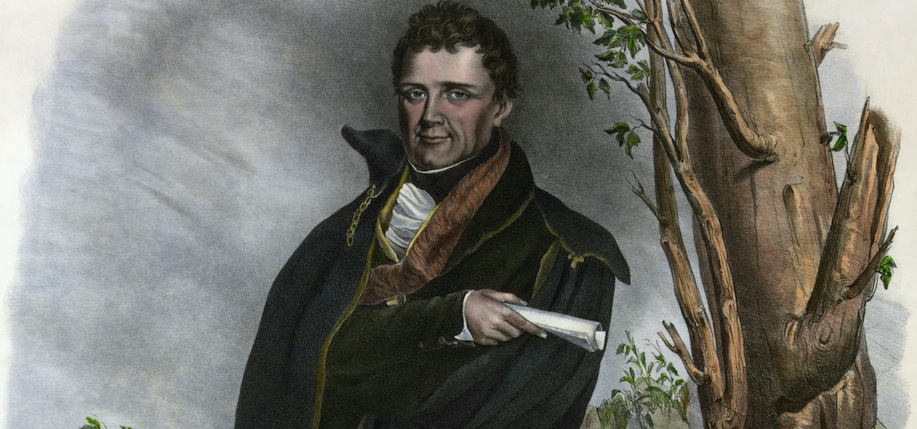
The founding of The Nation, and the tragic rivalry of the 1840’s between the followers of Daniel O’Connell, celebrated as The Liberator, who favored gradual, non-violent parliamentary reform to repeal the Act of Union, and the Young Irelanders who advocated for cultural revival and armed insurrection, which ended in a failed rising and transportation to Van Diemen’s Land (now Tasmania) of its leaders.
In the early 1800’s Daniel O’Connell was a young lawyer in Dublin, a member of the tiny Catholic middle class. In those days, although the worst excesses of the Penal Laws had passed, Roman Catholics still were deprived of full civil rights, and many opportunities remained closed to them.
O’Connell became active in the Catholic Committee, the group working to win full rights for Catholics, and soon became its most influential member. Drawing its membership from Catholics in business and the professions. This organization was by definition narrowly based, although it did enjoy the support of liberal Protestants such as Henry Grattan.
It was O’Connell’s genius to transform this somewhat elite grouping into one of history’s first successful popular mass movements. In 1824 he extended membership in a reorganized Catholic Association to peasants and workers for only a shilling a year, enlisting the rural parish clergy as his organizing and recruiting agents. He gave the demoralized poor a sense of dignity and purpose, while schooling them in political agitation. As the common people came together for the first time in a unity both of intentions and methods, a new and powerful sense of Irish nationalism emerged.
The British government became apprehensive of the power of O’Connell’s movement, fearing indeed that the unleashing of Irish nationalism could lead to the demise of the union between the two countries. Finally, in 1829, having failed in their efforts to derail the Liberator and his allies, the Tory government had given in and granted Catholic Emancipation.
In the decade after winning Emancipation, O’Connell went on to concentrate on Parliamentary measures in the hope of achieving his next goal, Repeal of the Act of Union, leading to some form of autonomy for Ireland.
However, despite securing many important reforms in an illustrious career at Westminster, he was thwarted in his larger aspiration. In 1840, at the age of 65, he decided to return to mass agitation as the means to advance Repeal. Popular enthusiasm for this new movement was muted in the beginning.
“Repeal” seemed like an abstract political idea, devoid of the appeal to religious loyalty that had driven Catholic Emancipation. It appeared to offer little to motivate the great mass of the people, for whom the daily struggle to survive was contest enough. Members of the growing and increasingly prosperous Catholic middle class were fairly content with the status quo, and more inclined to devote their energies to their business careers.
Most of the hierarchy, conservative by nature and secure in their newfound political influence, were by no means eager to have the Union repealed, although a minority faction led by Archbishop MacHale of Tuam, Co. Galway, strongly backed O’Connell in his renewal of agitation.
But a new spirit was stirring throughout Europe in the late 1830’s and into the 1840’s, a Romantic nationalism perhaps best exemplified by Mazzini and Young Italy, or articulated in the writings of Thomas Carlyle. This spirit found its echoes in Ireland too, surfacing with the establishment of The Nation newspaper in 1842.
The youthful founders of The Nation can be seen as having been very representative members of their generation and class. All were educated, urbanized, trained in the law, and generally liberal and secular in outlook. Thomas Davis had been born into a Protestant Ascendancy family: his liberalism was tinged with a European anti-clericalism. John Blake Dillon‘s antecedents had been well-to-do Catholics, reduced in circumstances during Penal times. His views were the closest to O’Connell’s, being broadly Benthamite [at the core of a Benthamite perspective is the concept of “the greatest good for the greatest number”] with a strong empathy for the sufferings endured by rural Catholics. Charles Gavan Duffy came from a newly-rich shopkeeper family of the embattled Ulster Catholic community, and whose rise to the middle classes was due in part to the increased opportunities in the era after Emancipation.
What all three shared most of all, however, was a commitment to the “Irish Nation,” which they saw as liberal and non-sectarian, and having a decidedly Romantic complexion. Davis especially can be regarded as the progenitor of the idea of a particularly Irish nationalism, which harkened back to an ancient Gaelic culture, whose values were supposedly preserved among the peasantry.
This was not the same thing at all as the kind of nationalism pictured by the O’Connellites and their mainly rural supporters.
Their notion of the “Irish Nation” could more accurately be described as the “Irish Catholic People. “While the Liberator himself – a Benthamite liberal – held firmly to the idea of religious freedom, he seemed to have envisaged a Catholic Ireland in which Protestants would enjoy full rights and liberties, rather than a wholly secular Irish state.
Davis and his friends had come to see repeal as leading to nationhood, and resolved therefore to join the Repeal Association. In retrospect, it seems obvious that their almost doctrinaire outlook, typical of many of their generation, would in time lead to clashes with O’Connell and his long-time supporters.
Above all, O’Connell was a pragmatic, utilitarian reformer, not a revolutionary. Repeal was to be pursued, in his view, because it offered the best hope of the greatest reform. But ultimately, “Repeal” remained a conveniently vague concept, capable of being altered if necessary in order to achieve practical and immediate reforms to the benefit of the Liberator’s people.
However, when the men from The Nation applied to join the Repeal Association, they were received with open arms by O’Connell himself. He welcomed their vigor and vitality of resource, and the Repeal mass movement benefited from the introduction of systematic political propaganda, an innovation at which Davis excelled.
There were others on the O’Connellite side who were less hearty in their greeting. The Nation became an instant success. being awaited avidly each week in Repeal “reading rooms” throughout the country. where it was read aloud for the benefit of those unable to read for themselves. This served to antagonize Richard Barrett, editor of the O’Connellite newspaper The Pilot, which became a forum for those opposed to Davis and his friends.
A more serious source of opposition was the network of Catholic clerical supporters of Repeal. The rank-and-file clergy were among the most important allies of O’Connell, but their support was for Repeal as a Catholic movement. Furthermore, while the attitude of the hierarchy was divided, the support of Cardinal MacHale was seen as crucial, and he was deeply suspicious of the secular-minded newcomers, particularly the Protestant Davis.
Differences began to emerge almost immediately over the way the Repeal Association managed its finances. Traditionally there had been little distinction between the money subscribed weekly by the movement’s supporters and the personal expenditures of O’Connell, his sons and the Association’s other officers. The young men from The Nation, steeped through their upbringing in an ethos of probity, were appalled at this casual approach. This difference of outlook was generational: neither longtime O’Connellites nor the movement’s supporters saw anything wrong with the Liberator and his lieutenants spending contributions in any way they deemed fit.
Personality conflicts manifested themselves too, however subtly in the beginning. Hitherto, O’Connell’s stature within Repeal had led to his judgement and authority being unquestioned. Perhaps with the brashness of youth, the newcomers were no respecters of this tradition. Davis’ arrogance rankled particularly, as he criticized both the Liberator’s style and his positions on certain political issues.
All of this served to sharpen the resentment of the older Repeal leaders, including Barrett of The Pilot, long-term Association Secretary T.M. Ray, and veteran agitator, Tom Steele. They coalesced around the figure of John O’Connell, the Liberator’s son, who now saw a serious threat to his ambition of succeeding his father as the undisputed leader of Irish nationalism.
The success of The Nation caused many other educated young nationalists to flock to it, and thence to the Repeal Association.
The name “Young Ireland” began to be applied to the newcomers, in imitation of Young Italy and similar movements on the continent. Many of the newer recruits tended to be much more radical in their views than Davis, Dillon, and Dufly, adding to the disquiet of the older O’Connellites. However, all of these differences were papered over at first, due in large part to the unquestioned contribution made by these young men to the movement.
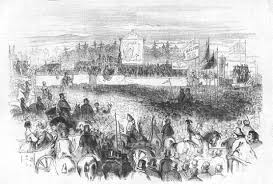
Particularly impressive were the organizational skills of Young Irelanders such as Michael Doheny, who were instrumental to the success of the Repeal “monster meetings,” enormous mass gatherings usually addressed by O’Connell which generated tremendous enthusiasm for the reinvigorated movement.
If there had been dissension between O’Connell and the Young Irelanders regarding their differing conceptions of nationhood and the ultimate meaning of Repeal, it was fairly minor compared to the disagreement over the means for achieving these ends. In the spirit of Mazzini and Romantic nationalism, Davis, Dillon and Duffy were ambivalent regarding the use of physical force.
O’Connell, on the other hand, abhorred violence, a deeply held principle which dated from his student days in France during the excesses of the Revolution. It is true that in his speeches to the monster meetings he tended to use violent rhetoric, suggesting that disorder might result were his constitutional and peaceful methods to fail. In other words, while he was committed to non-violence as a principle, he did not exclude invoking force as a rhetorical threat.
This distinction tended to be lost on many of the more youthful Young Irelanders, who equated rhetoric with reality. These militants became disappointed when O’Connell backed down from a number of confrontations with the authorities including, most famously, a decision in 1843 to call off a monster meeting at Clontarf, which had been banned by the government, in order to avoid certain bloodshed.
The radicals had argued in favor of going ahead with the meeting, calculating that bloody repression by the government would be the spark to ignite a popular uprising.
It was at this point that William Smith O’Brien joined the Repeal Association, to an extraordinarily effusive welcome by the Liberator. O’Brien was the scion of ancient Irish nobility, a pillar of the establishment who claimed descent from the Kings of Thomond. He was a reforming landlord, a Westminster M.P. of 20 years standing, and was widely respected across the political spectrum in Ireland and London.
A growing disgust with the government’s handling of the Repeal agitation had driven him to side with O’Connell. The Young Irelanders hailed O’Brien as their natural leader, an honor he did not encourage at the time. He became particularly close to Davis, his fellow protestant, and several young men advanced quickly in the Repeal movement through association with him.
His, in essence, anointment as O’Connell’s successor both by the Liberator and Young Ireland, only alienated O’Connell’s son, John, even more.
It was around this time also that O’Connell’s physical and mental vigor began to deteriorate. While he had been at his peak he was able to keep the quarreling factions together, but this moderating influence was soon to be missed.
The split between Young Ireland and the older O’Connellites came into the open in 1844-45, when The Nation supported on principle three bills before Parliament, education and charitable reform measures.
These bills were designed to favor the Catholic Church, but were calculated by the government to draw the hierarchy’s support away from Repeal. It mattered little that all three bills enjoyed some support among the bishops; MacHale opposed them, choosing them as issues on which to do battle with his rivals. The Repeal Association weighed in behind MacHale. Young Ireland was clearly portrayed as being out of touch with Catholic Ireland.
The polarization became more complete through 1845. The moderate O’Brien, rebuffed in his attempts at compromise and mediation, was driven closer to Young Ireland by John O’Connell and his supporters.
Davis had died tragically on September 16, 1845; Duffy and Dillon were immobilized with grief.
In 1842, Duffy married Emily McLaughlin in Belfast. Their first child, Anne Eva, died in 1844 and Emily died giving birth to John Gavan in 1845.
Dillon’s own health deteriorated after the sudden death of Davis. While he recovered in Madeira, his poor countrymen struggled to survive during the first year of the great famine.
Newer, more radical voices became more prominent within Young Ireland.
All of the political bickering seems surrealistic, considering that the potato blight had struck by this time, bringing devastation to the Irish countryside. Among prominent Repealers, it seems that only O’Brien and Daniel O’Connell grasped the magnitude of the tragedy, with both making agitated appeals for relief of the mass suffering. As countrymen, they had an understanding that eluded their more urbanized associates.
The final split came in 1846. Fiery Young Irelanders like John Mitchel and Thomas Francis Meagher, speaking in the name of Repeal, had become more ready to advocate violence. The aged and failing O’Connell, anxious to head off bloodshed, called for the unequivocal renunciation of force as a means for securing Irish freedom.
Matters came to a head after a speech by Meagher in which he extolled “the sword” in politics. Meagher was expelled from the Repeal movement during a tumultuous meeting: O’Brien protested in defense of the younger man’s right to free speech and walked out, followed by most of Young Ireland.
Following the death of Daniel O’Connell, the bitterness intensified. T.M. Ray purged the Repeal Association of all suspected Young Ireland sympathizers. The “negative campaigning” of our recent presidential contest pales when compared to accounts of the 1847 elections. There were many incidents of street fighting instigated by mobs loyal to John O’Connell and the older Repeal leaders – seemingly there were limits to non-violence!
John O’Connell had eliminated all potential rivals from the Repeal movement, but this was a Pyrrhic victory. The Famine continued unabated. Meanwhile, in Paris and elsewhere in Europe, the Revolutions of 1848 broke out, seemingly presaging something similar in Ireland. In June, outflanked by the more honorable O’Connellites and recognizing that he had lost the support of the country, John O’Connell retired from public life.
Barely a month later, the arrest of several of its leaders and the suppression of The Nation pushed Young Ireland into insurrection. O’Brien, disillusioned with the failure of attempts at constitutional reform and distraught at the continuing effects of the Famine, was the highly unlikely leader of a futile rising in County Tipperary. Despite his bravery and sincerity O’Brien was no military commander, and Young Ireland had neither the manpower nor materials to stage anything more than a token rebellion. The small band of would-be revolutionaries equipped mainly with home-made pikes, was quickly routed by a well-armed and professional adversary.
A total of seven prominent leaders of the Young Ireland rebellion were convicted of treason and transported to Van Diemen’s Land (now Tasmania), including, William Smith O’Brien, Thomas Francis Meagher (later famous in the American Civil War) and John Mitchell, were transported to Van Diemen’s Land (now Tasmania).
Ireland in the 1840’s had been unable to resolve the conflict between its generations. The O’Connellites passed from the scene, and Young Ireland was swept away.
Whether the crisis was aggravated by the unprecedented horror of the Famine, or whether the lack of leadership contributed to the Famine’s baleful effects is something that could be debated forever. In any event, it was to be several decades before a new generation of vigorous Irish leaders emerged from the cataclysm’s aftermath.
Editor’s Note: This article was originally published on page 38 of the January February 1993 issue of Irish America. ♦
This was wonderfully inclusive of so much history. I thoroughly enjoyed reading it! As an American, references to Daniel O’Connell , the hero, have been in my mind for decades. But little did I know of the history of his years-long fight with the Young Ireland group. Thank you for this brilliant history lesson! Articles such as this one keep me reading Irish America!