
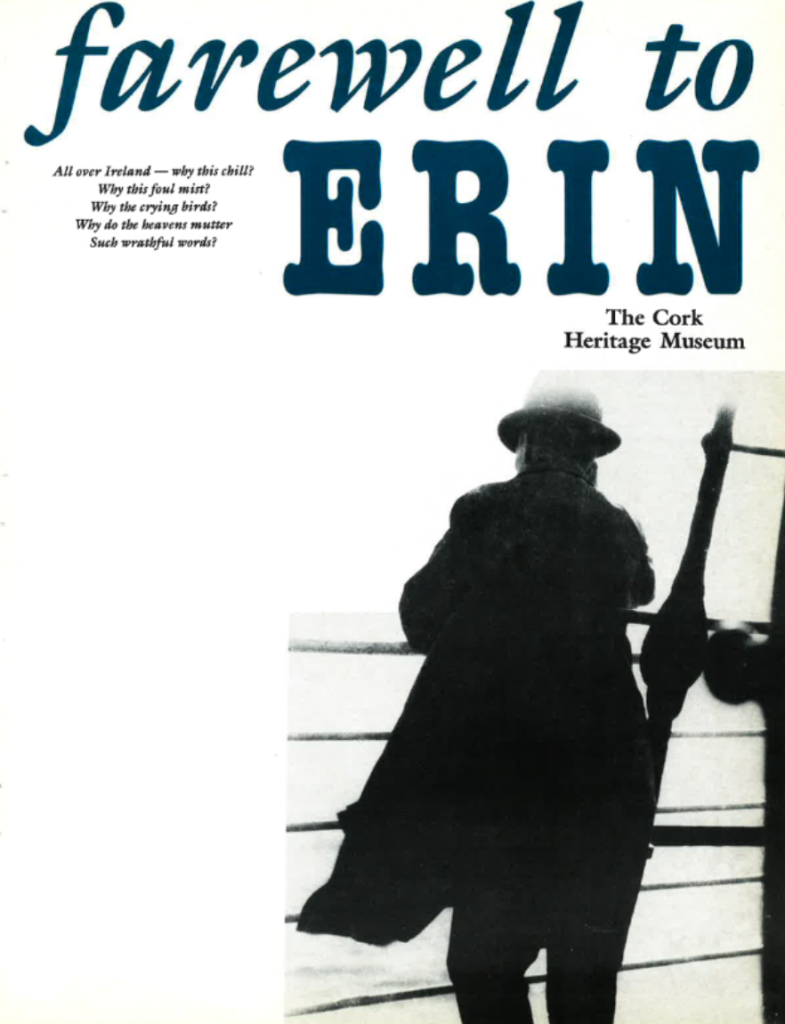
All over Ireland – why this chill?
Why this foul mist?
Why the crying birds?
Why do the heavens mutter
Such wrathful words?
In 1840 Ireland’s population was close to 10 million; less than a decade later, starvation and emigration had reduced it to 6.5 million.
Such was the devastation that a visiting Frenchman wrote in his diary: “I saw the American Indian in his forests. And the black slave in chains, and I believed that I was seeing in the pitiful condition the most extreme form of human misery; but that was before I knew the lot of poor Ireland.” Millions fled knowing that their only chance of survival lay on the other side of the great ocean in the United States and Canada. The last sight that they would see of Ireland was Cork Harbor with the spire of St. Colum’s Cathedral fading into the distance. It was this sight that they would hold in their memories and pass down to their children and children’s children.
For many Irish Americans who have been handed down stories of the sad farewells, the horrendous sea-crossing, and the music and storytelling that made the journey bearable, The Cobh Heritage Center opened in March of this years offers a chance to travel back in time to that embarkment place and relive the beginnings of the incredible journey that would take their forefathers to the new world.
The center, located in a restored 1862 brick railway station, has been designed as a walk-through facility with audio-visual accompaniment that features a series of displays that details the life and times of those emigrants. Artifacts such as postcards, original passenger tickets, and photographs are all part of the exhibit.
To show the conditions that the emigrants had to endure (crammed in with as many as 900 others, with barely space to stand), a ship’s steerage quarters has been re-created in exacting detail. And in sharp contrast, the lobby of the 19th-century luxury harborside Queen’s Hotel is also re-created as are the first-class facilities of the deluxe transatlantic steamers—with film clips recalling the rich and famous who could afford first-class passage to and from Europe.
There are cutaway ship models, remembering another phase of Ireland’s unhappy history—the convict ships. Rebels from the 1798 Rising and Robert Emmet’s 1803 rebellion were among the 30,000 men and 9,000 women transported as convicts from here to Australia between 1791 and 1853.
Two recent Australian visitors were so moved by the exhibit that they tearfully donated £100 of their holiday money to the center. Were they descendants of these rebels who were treated so badly on the voyage and on their arrival in the penal colony? Or perhaps an ancestor was one of the over 4,000 orphan girls from workhouses who were transported as domestic servants to Australia between 1848 and 1850?
There are models of the White Star’s Titanic which sank on her maiden voyage, and the Cunard Line’s Lusitania torpedoed just outside the harbor by a German submarine in 1915. Many of the 1,198 passengers lost are buried in mass graves in Cobh’s old burying ground (still maintained and owned by the ship company).
Memories of Annie Moore are preserved not only by her statue in Ellis Island but also here where another “life-size” statue has been erected.
Annie, then 15 left the port of Cobh in 1892 and became the first immigrant to land on the newly-opened Ellis Island.
And as in Ellis Island the Cork Heritage Center has also created a very special Wall of Dedication where Irish-Americans can preserve family names as a testimony to their ancestors who took the demanding trip to the New World.
For more information on the Cobh Heritage Center call 1-800-989-7676.*
Some of the photographs and artifacts on display at the Heritage Center are included on pages 24-25 in the May June 1993 flipbook.
Background etching: Bustle at the quayside.
Clockwise: Typical postcard from Queenstown (Cobh). St. Colman’s Cathedral – the last sight of Ireland. The long line at the ticket office.
Queenstown (Cobh) Co. Cork. 1915. A baggage ticket. The Railway Station. Tender Blarney with passengers, 1950’s. A passenger ticket dated July 31, 1872.
*Editor’s Note: The number for the Cobh Heritage Center may not be currently valid. Please visit https://cobhheritage.com/ for more information.
This article was originally published in the May June 1993 issue of Irish America. ♦
Leave a Reply