
Survival, we are told, is the first law of nature. If so, the Irish are the most law-abiding citizens in the world. That they survived centuries of English occupation and oppression is legend, but it was a recent trip that illustrated this in a very different way.
It was my first trip to Ireland. To my knowledge I was the first descendant of James Burke, my mother’s father, to set foot on the old sod since he left there in 1870. Although my personal sense of being Irish is distant, I was prepared for the rich literary heritage, and I was prepared for the beautiful green countryside. I was not prepared for the stone.
Not very far beneath the beautiful emerald green mantle is very hard rock. It is exposed in some spectacular ways in places like the Cliffs of Moher and the Burren, a vast, desolate expanse of limestone. More remarkable is the ubiquitous expression of Irish culture in stone-from the humble walls that seem to divide the whole country into little rectangular pastures and fields to the sixth-century clochans or “bee hives” constructed by the hermit monks, to the towers and walls built by the Danes to fortify their settlements, to the myriad of castles, friaries, monasteries, and abbeys, many in ruins resulting from attempts by invaders to suppress or destroy that culture. The Irish are survivors, and I believe that their survival owes as much to these millions of stones as it does to the millions of words their poets have written.
“How far is that pile of rocks we’re supposed to see around here?” a tourist looking for Blarney Castle asks. A pile of rocks, indeed, I thought: a bit more than that. Hardly an apt description of a castle whose fame for harboring those with the gift of the gab dates to Elizabethan times, long before the “leg-end of the stone” was concocted a mere hundred and fifty years ago. Why do people insist on disparaging something they don’t understand? Or is it that their ennui needs to be relieved with humor? I thought of the question as my wife and I stood in front of the Gallarus Oratory on the Dingle Peninsula. This was, indeed, a pile of rocks. But what an elegant and sublime pile of rocks!
The oratory, or chapel, is about sixteen by twenty-six feet in plan dimension, and about sixteen feet in height. The only openings are a door in the front wall and a small window in the back. The faces of’ these two walls rise almost vertically, the sides tapering in slightly, up to a level twice the height of the doorway, then incline further to the ridgeline of the roof.
The sides follow the edges of the front and back walls, forming the side walls and sloping roof. But to use the terms sides and roof is misleading and does not do justice to the simple but ingenious construction. It consisted of, literally, piling one rock upon another.
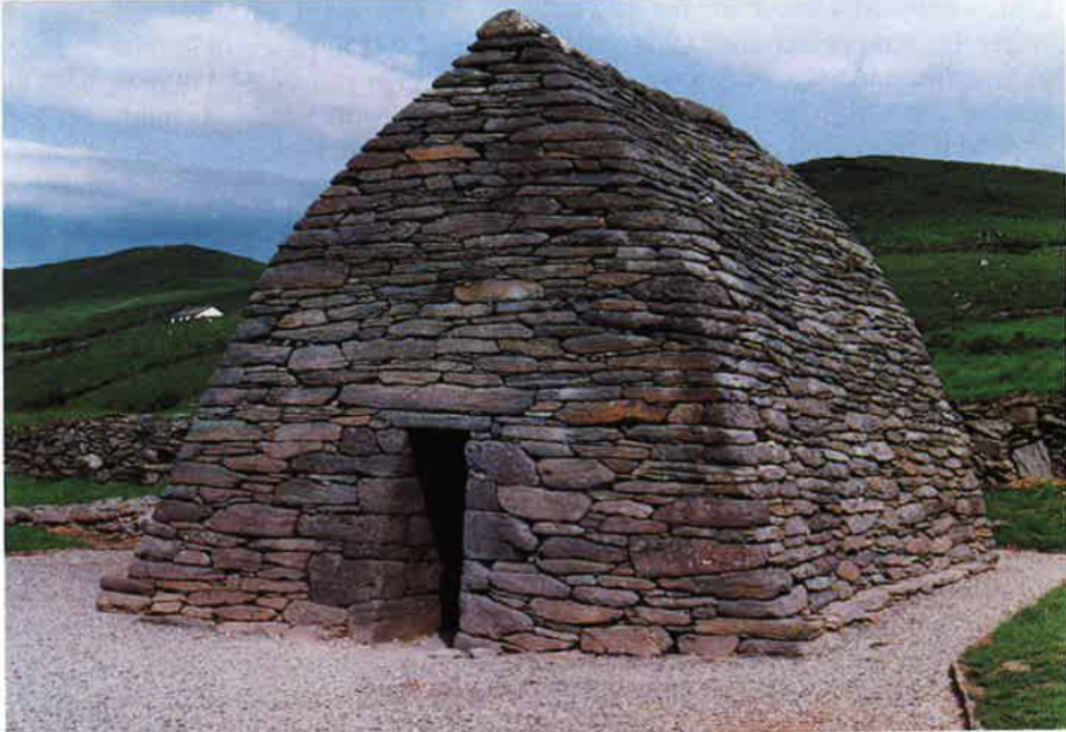
No mortar was used. Each stone was selected for its size and shape so that it fit with its neighbors. But for the framing of the door and window, there is no obvious evidence of the stones having been shaped.
The walls are about three feet thick at the base and taper to about one foot at the ridgeline. They are opened to the outside to shed the rain. Thus they have stood for 1,200 years and, barring an earthquake or human intervention, will stand for another 1,200. Many other ancient buildings, of similar construction, dot the peninsula in various states of dilapidation, but none match the condition and simple elegance of the Gallarus Oratory.
One can only begin to appreciate the faith that went into the construction of the edifice, a faith that encompassed the willingness to accept, almost welcome, the hardships of life on the Dingle Peninsula.
This faith has been passed down through the centuries to the people who lived there until the first third of this century. A wonderful description of the life there, and on the nearby Blasket Islands, can be found in two autobiographies: The Islandman, by Tomas O’Crohan, and Peig, by Peig Sayers. The Gallarus Oratory stands in tribute to the faith and durability of these people.
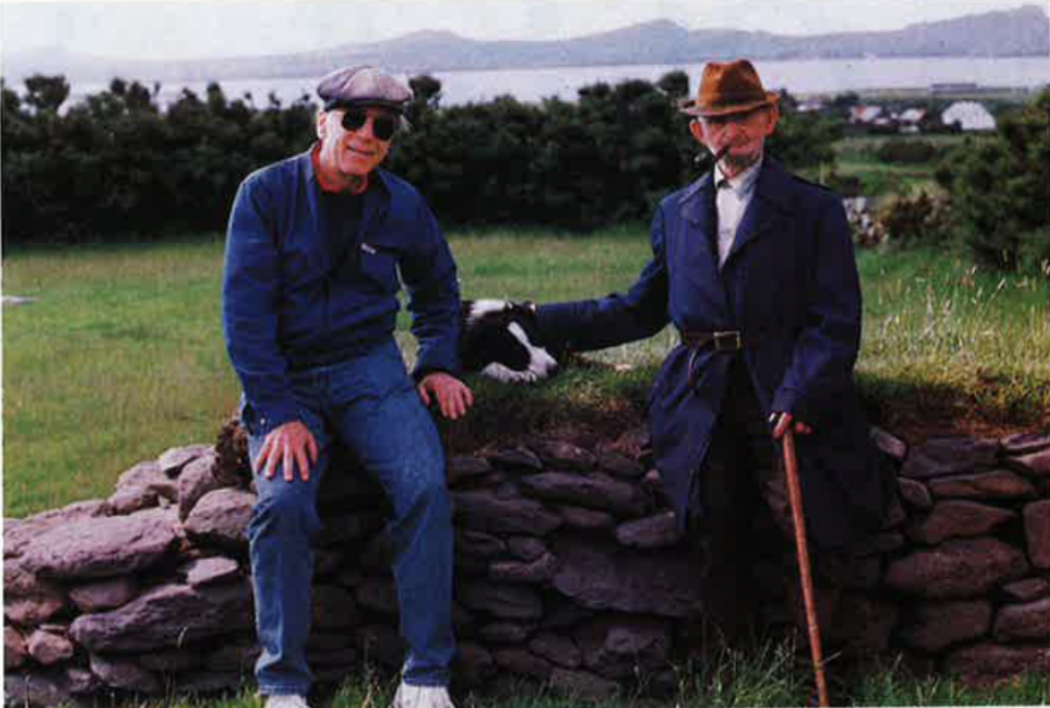
My wife and I had spent about a half hour viewing the building. The few other tourists had left, and we were alone, or almost alone. When we arrived I had spotted an elderly man sitting on a corner of the wall that surrounded the site of the Oratory. He was dressed in brown trousers and a white shirt buttoned at the neck, but without a tie. Over this he wore an unbuttoned blue trench coat which he held around himself with a brown leather belt. He wore a nondescript brown fedora and carried an equally nondescript walking stick. A large brown pipe was clenched in his toothless jaws. Completing the picture was a medium-sized black-and-white dog sitting at his side. They were like statues; neither moved during all the time we spent there.
I thought to myself, I’d love to get a picture of this old gent. But it would be rude to just stick a camera in his face, and I was a little reluctant (or embarrassed) to ask his permission. I needn’t have been concerned on either score. I was taking a picture of the Oratory when I heard a call from behind me. I turned to see the old gent beckoning to me. As I walked over to him, he got up and proceeded towards me with the dog trotting at his heels. He strode with a sure gait, one hand stuffed in his pocket. The other, gripping the stick, looked as if it had just harvested a bushel of potatoes. As we met he looked at me with eyes that conveyed the very sure purpose of what was to follow. He began, immediately, to tell me that I shouldn’t miss seeing the Chapel of St Brendan, and then to describe how I should get there. He waved his stick wildly, pointing generally in the direction he wanted me to take. All this was in English, well rehearsed but difficult to understand, considering that he hadn’t taken the pipe from his mouth. I interrupted to ask for some clarification, at which point he launched into what I took to be Irish with more wild gesturing with the stick for emphasis. This, of course, prompted another question on my part, which elicited an even more energetic response in Irish. I saw that this was getting very quickly out of control.
“Okay,” I finally said in desperation, “I understand.”
“Fine,” he said, resuming his rehearsed English. “Now give me a tip for showing you the shortcut!”
I was taken aback a bit by his frankness but not enough to miss the opportunity to get the photo I wanted. My wife had joined us by this time. “How about a picture?” I asked.
“Sure,” he said, and we both walked over to the wall and sat down for the photo.
“You’ll be wanting the dog, too,” he said as his companion hopped up on the wall between us.
He grabbed the dog by the scruff of the neck and pulled it into position, and the photo was duly taken. I reached into my pocket and handed him a half pound (about eighty-five cents). He looked at the coin in his hand, then at me. Handing it back to me, he said, “I need two pounds for a pint.”
I chuckled half out loud at this forthright observation, handed him a pound, and said, “Here, have a half pint on me.” It was my frugality, born of the Depression, parrying his instinct for survival. He seemed satisfied with the results of the negotiation, so we took our leave.
The autobiography of Tomas 0°Crohan, who lived out his life on the Great Blasket Island, just off the Dingle Peninsula where we stood, describes the hardscrabble lives of these people: how they survived, in a considerable part, by retrieving the flotsam of shipwrecks with their fragile canoes. I can understand the old gent’s approach to the Yank tourist. Only those with the durability of the stones of Gallarus, folks who go after life’s opportunities like the Blasket Islanders, can survive the rigors of the Peninsula.
I wish I had gone and had a pint with the old gent; I guess I just don’t have that survival instinct.
Editor’s Note: This article was originally published in the September October 1993 issue of Irish America. ♦
Leave a Reply