
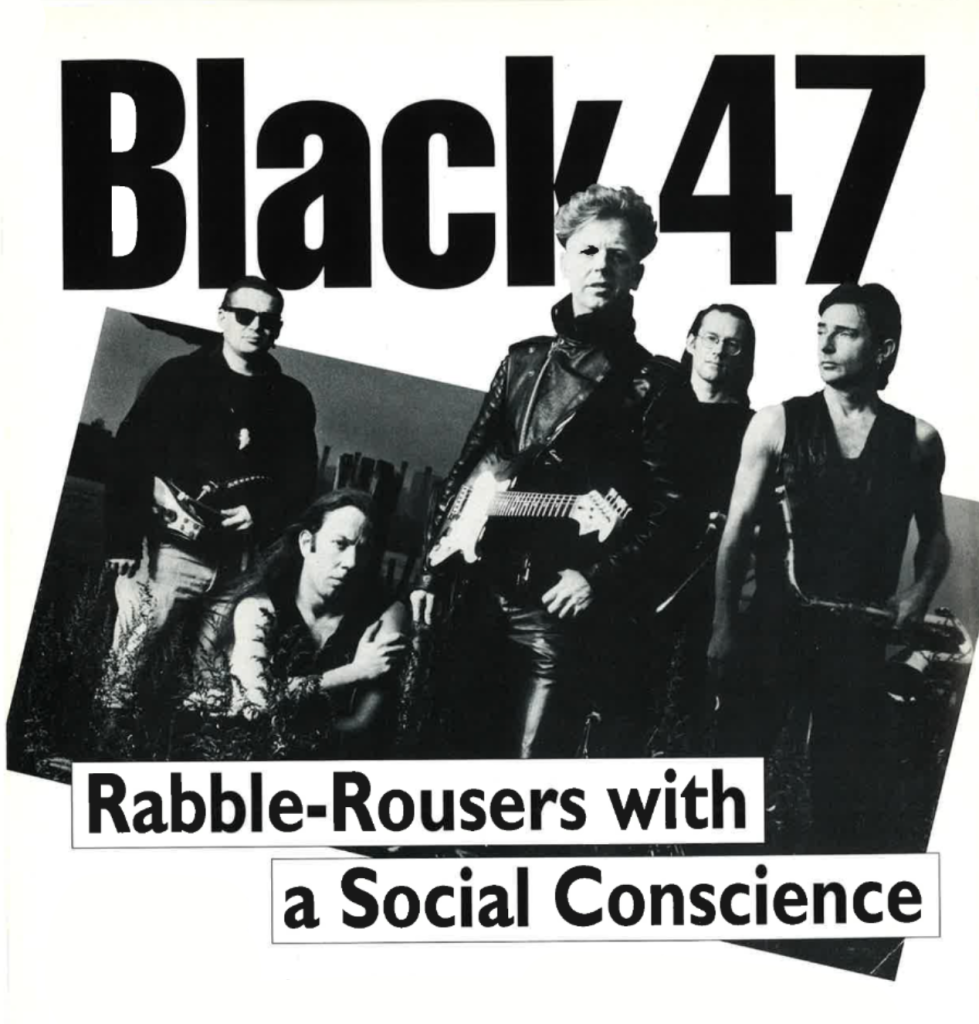
Rabble-Rousers with a Social Conscience
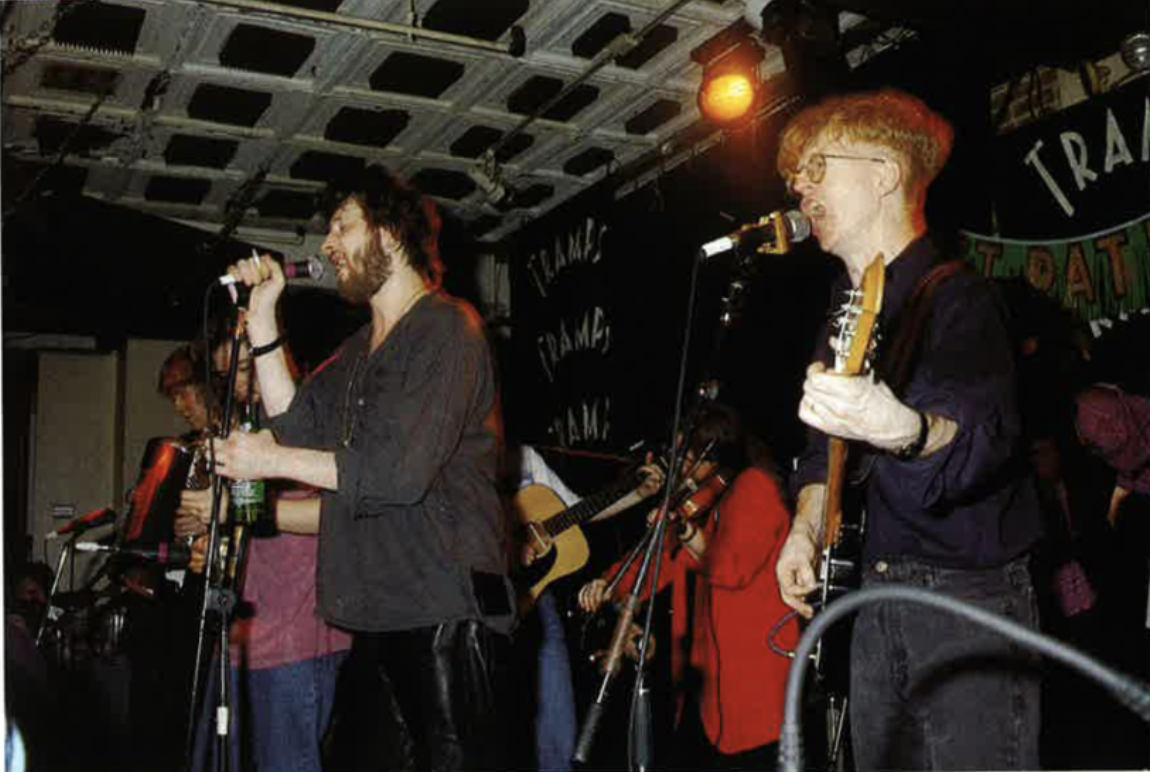
“Free Joe Now,” the song by Black 47, the Irish American group spearheaded by Larry Kirwan and Chris Byrne in 1990, became the anthem for those seeking political asylum for Joe Doherty, the Belfastman fighting extradition to the UK. These were early days for Black 47, the gigs were mainly fundraisers for one Irish cause or another — Joe Doherty, Irish Gays and Lesbians, the Irish Rape Crisis Center, Celtic Care — the venue most-often was Paddy Reilly’s bar in Manhattan, on 28th Street and 2nd Avenue — not exactly in the fashionable part of town.
Although Reilly’s now enjoys a reputation for good music with block-long lines to get into the place it remains essentially a “local” pub just as Black 47, who have now made it into the big leagues, with guest appearances on David Letterman, The Tonight Show, Good Morning America, and features in Time, People, and Rolling Stone, extensive radio play, and a record deal, are still essentially a bar band relating to the working class.
One of the songs on Fire of Freedom, the band’s recently released album, is called “Black 47” and is a memorial to those died in the Irish Famine. Larry Kirwan’s great-grandfather, Jack Hughes, narrowly escaped starvation but he witnessed much and passed on his horrific legacy to Kirwan’s grandfather, Tommy Hughes, “who made me promise I would never forget these forgotten people.” Indeed, Black 47’s title comes from 1847, the worst or blackest year of the Famine.
Other songs on the album, all written by Kirwan, who was born in Wexford and immigrated to New York in the 1970s, also have political overtones, “James Connolly, ” one of the group’s most popular on-stage numbers, speaks of the Trade Union Leader who was shot for his participation in the 1916 Rising: “My name is James Connolly — I didn’t come here to die. But to fight for the rights of the working Irishman….”
On July 4 this year, Black 47 played to 0,000 people in Central Park. The enthusiastic crowd embraced them singing along to the words of “Maria’s Wedding” and “Funky Ceili,” (tales of what it is to be young, in love, and drinking) but it wasn’t always so. In the beginning Black 47 took their music to the Bronx, bastion of Irish immigrants, but their message was a little too strong for these homegrown Irish. It was the Irish Americans who Black 47 found appreciated their music. And now when they line up outside Paddy Reilly’s (Black 47 still play there on Wednesday and Saturday nights when they are in town) they are joined by the young Irish from the Bronx and Queens who first turned them away.
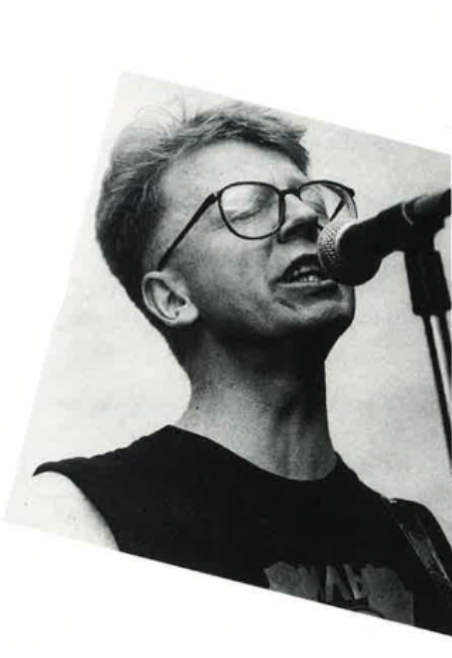
All of the band members are experienced musicians. Kirwan was part of the duo, Kirwan and Turner, (look for Pierce Turner’s on the RCA label). Uileann piper Chris Byre, a former New York City cop, had a great thing going with Beyond the Pale, with Patrick McGuire who went on to form Speir Mor. The rest of the lineup includes Geoff Blythe formerly of that great Liverpool band Dexy’s Midnight Runners, Fred Parcels on trombone, and Thomas Hamlin, percussion.
But it is Kirwan’s lyrics, described as “an Irish equivalent of the young Bruce Springsteen” by the Los Angeles Times, that make Black 47 different. Kirwan, a serious student of history, which is often reflected in his lyrics, is also a playwright and it was after a performance of Blood, a one-act play on James Connolly, that we spoke. Accompanying the play was a dance interpretation of the 18th-century Gaelic poem “The Lament for Art O’Leary,” choreographed by June Anderson, Kirwan’s wife and mother to his two children, Jim and Rory.
Patricia Harty: What was the idea behind Black 47?
Larry Kirwan: Chris Byme and I formed the band because we’d heard that the young irish [recent immigrants] were this great new breed of people ready to accept original music. We headed off to the Bronx and we played for them and they nearly killed us.
What happened then was that the young Irish Americans heard about us, they came, and to this day I haven’t heard a negative word from an Irish American about Black 47. But the response from young Irish [from Ireland] was hostile. Now we have a young Irish following, but again, it’s because we were in Time magazine or whatever.
PH: Now you’ve made it.
LK: We’re accepted, and the begrudgery stops. “Oh, yeah, Black 47, yeah, I saw them back in the Bronx three years.” My f— you did, you were throwing things at us three years ago in the Bronx. But young Irish Americans accepted us totally and they were the ones coming up and saying, “You’re singing about James Connolly, my grandfather told me about James Connolly, you know, I want to find out more about him.”
PH: Any advice for the new immigrants?
LK: Yeah. Get out of the Bronx. Get out of Woodside. Get out of the bars. New York is a great city. You can learn so much here from the blacks and Puerto Ricans, the Dominicans and everyone else. And for Chrisake don’t come over here and be racists. You talk to some young guy off the boat two weeks and it’s n—r this, s–c that.
When I came here I went straight into the East Village and lived with black people and Puerto Ricans and gay people and transvestites—the dregs of society as it seemed-and they opened my eyes. Humanity doesn’t have to be some guy in a green shirt following the Irish soccer team.
It comes in many forms. People are genuinely good if you reach out to them.
PH: Are you glad you emigrated?
LK: Yes. I’m glad I live in New York. I always thought I was a pretty happy person living in Ireland but when I got here, a cloud lifted off and I didn’t want to go back. It’s nothing against Ireland, because I love it. But I think there’s a repression there. It’s this weight of 150 years of Jansenism. This whole ultra-conservative Catholicism which doesn’t suit the Celtic race. It’s not right for us. We’re a lusty, drinking, loquacious people. We don’tneed the shackles of Jansenist Catholicism on top of us. And for anybody who doubts what I’m saying, go and read “The Lament for Art O’Leary.” The Irish of 1743 were a lot different.
PH: So you’re saying Catholicism works against us?
LK: Kills us. Slays us as a race. Slays us socially. Slays us politically. And it’s not just Catholicism, it’s that particular Jansenist Catholicism that came out in the early 1800s. That was imported when young men – it’s the British problem again [Catholicism was banned] had to go to France and Rome to become priests, and they came under the influence of the Jansenists and then went back into Ireland and introduced it, and since the priests were the ones with education at the time, they brought it into the whole community.
PH: Ireland does seem to be coming out in some ways what with all the controversy over Bishop Casey [fathered a son by American Annie Murphy and the X case [14-year-old rape victim denied access to abortion in England].
LK: It’s just like the gay issue here.
Although people mightn’t realize it, the whole controversy over the St. Patrick’s Day parade is a great thing for Irish Americans, because now you’ve got to come out and face up to the 20th century, that gay people are there amongst us. And we can’t discriminate against them. They’ve always been there, and they always will be there.
I’m passionate about freedom for gays to be what they are. The whole controversy over the gays in the St. Patrick’s Day parade is not so much about gays as how do you define an Irish person? Is it this strict narrow way that Frank Beirne [led the fight against the gay inclusion] would want and that’s all there is? Or do we accept someone like Oscar Wilde? There’s a way that Irish men in particular look at Irish people — you have to be this certain type of person – you drink beer, you follow sports. But you know, we’re broader than that. We’re an amazing race. And we’ve got to accept everyone. But to give one other point about ILGO [Irish Lesbian and Gay Organization] because I know these people, they’re just nice ordinary Irish people who happen to be gay, what’s the big deal?
PH: You talked earlier about the poem “Lament for Art O’Leary,” which your wife [June Anderson] directed and choreographed with you providing the music. June said she was profoundly affected by the poem when she first read it several years ago. Do you feel the same way?
LK: Yeah. I find in a certain way I understood Irish womanhood a lot better. There’s a certain characteristic a lot of Irish women have and it’s a coyness, it’s because they’ve been kept down by the Church and by the men in our society and even more so, by themselves. It’s great when I go back there now and see that young Irish women are discovering feminism. They’re actually standing up to men. And through reading “An O’Leary,” I realized that that’s the way Irish women used to be. They were less inhibited, more in touch with themselves and the earth around them, and in touch with society. Jansenist Catholicism relegated them to a certain corner of our society where they had certain things to do, and now they’re actually discovering themselves again.
PH: “Lament” was produced in conjunction with your play Blood, on James Connolly. [In the play Connolly is kidnapped by the Irish Republican Brotherhood, told of the planned 1916 Rising, and persuaded to join their forces with his Irish Citizens Army, made up of trade unionists.]
LK: Yes. June needed a piece to go with “Lament,” and I had this idea about Connolly being kidnapped by the IRB, so I knew the scenario of the play. I wrote the play while I was on the road, traveling with Black 47. I did it in three or four weeks but put my whole being into it.
Connolly epitomized Ireland to me. That whole idea of the humanistic Ireland working for its people. He was the one who insisted that in the proclamation for the Irish Republic that it be put in there about women’s rights, and even more importantly that a government, any government, is responsible for the happiness of its people. And that’s a significant part of the proclamation that the Irish Republic pays lip service to at the moment.
When we played at the Feile [annual concert held in Thurles, Co. Tipperary] last year, we started off with the song “James Connolly” and I don’t think people knew who James Connolly was, but I usually walk down to the audience afterwards, and one young guy came up to me and he shook my hand and said, “I want to awful.
PH: Do you find that Irish Americans, on the other hand, know about Connolly?
LK: They know about him. And one of the great things about Black 47 is that we are bringing Connolly back to the people, he’s becoming a symbol of Irish Americans. We played in Detroit, where there’s a Connolly Bookstore — all these people showed up. In Cincinnati we played and all these very left wing people showed up They’d just come back from Washington where they’d been marching for gays, and they’re basically humanists but they knew about Connolly. Sean MacBride put it very well when he said Irish Americans know more about what’s going on in Ireland than Irish people do. They are more knowledgeable about the northern situation.
PH: Is “Fire of Freedom” going on release in Ireland?
LK: Yes. Right now, Black 47 is having a hard time actually getting this record released in Ireland. It’s going to be released, but people over there think we’re the musical wing of the IRA because we write a song about James Connolly or we talk about 1847 [the worst year of the Famine]. It’s amazing.
PH: There are kids out there now who’ve never heard a rebel song played on the radio because of Section 31 [broadcasting ban].
LK: I didn’t even realize until someone pointed out to me when I went back, that I wasn’t hearing rebel songs of any sort on radio any more. But that’s a part of our heritage. It’s part of our history.
PH: You also wrote a play about Parnell.
LK: I wanted to explain the different political and social forces that caused the downfall of Parnell and how the Irish people came to desert him — again through this Catholic Jansenism that is like a cloud on the Irish people. I was fanatical about Parnell because my family had been split by the whole issue. Two sets of family living next door to each other didn’t speak until the 1950s over it. One of them was an election agent for Parnell in Carlow. So 1 always knew a lot about him but then as I researched it more and more, I just wanted to give the knowledge back to the people, and put it in a form like a play that would explain it.
PH: In terms of the situation we have now, do you think Home Rule would have been a much better way to go?
LK: Yes. Ireland would have evolved like Canada, like Australia now, it would have been peaceful, I think. And everyone would have had a chance to get together.
The British blew it. Blew it so badly. They didn’t have the courage of their convictions at the time. Gladstone [British Prime Minister at that time] did, understood it, the rest of them didn’t. They used the Irish for their own political purposes to get reelected. Gladstone being Gladstone, a great thinker could see the future. He was a statesman, the rest of them couldn’t do it.
PH: We recently saw John Major use the Unionist vote for his own political purposes, so it wasn’t the first time this happened?
LK: No. In1886 Randolph Churchill came in and played the orange card and changed everything forever. Up until then northern politics wasn’t as monolithic as it is now. There were many different forms of Protestant and Unionist opinion up there thạt came together in the 1880s and 1890s because Randolph Churchill, the leader of the Conservative party in England decided to stir things up in the North of Ireland so they could use the Unionist deputies as part of their party to vote with them. And that happened at the exact same time as Parnell was in power in Ireland.
PH: Do you think, say now, with the peace talks that there should be an Irish American representative?
LK: Totally. I think that any solution to the northern problem or to the English problem, however we want to look at it, in Northern Ireland is not going to come in Dublin or Belfast. For whatever reason they’re just —they’re exhausted there, for want of a better way of putting it.
Irish Americans are a really generous race who would love to give something towards settling this situation in Northern Ireland both financially or otherwise, but they also want to be accepted. They don’t want to be patronized.
PH: Do you think the Irish in Ireland have a bad attitude to Irish Americans?
LK: They look down on Irish Americans. Basically all they want is for us to go over there and spend our money in the summer time and support their tourist industry. You know, I as an Irish person feel kind of ashamed when I arrive in Shannon or Dublin,
There’s these hustlers there waiting to sell you expensive car hire and rip you off. At least the customs guy could say “Welcome home.”
You’d be amazed how Irish-Americans feel put off by the welcome they get over there.
They go there with the greatest intentions of finding their roots, and yet — as Chris Byme said in an interview for an Irish magazine, “You know, take me seriously. I’m as Irish as you are. I don’t want to be just ripped off by you hustlers. I have an Irish heritage. And I don’t need to go to Ireland to prove it.” Irish Americans have had a tough time.
They landed here in 1847 penniless. They were wiped out on the docks in New York, and in the basements of Boston, and barely got through that first winter. The descendants of these people are a tough people— one of the toughest races in the world— they’re streetwise, they can see through an Albert Reynolds [Irish prime minister] and a Dick Spring [Irish foreign minister].
So wise up, you know, if you want to come over here, come over here and learn for six months first. And just because Dick Spring worked in a bar over here doesn’t mean he learned anything [about Irish Americans), as far as I’m concerned listening to him.
I came with a preconception about Irish Americans too because I didn’t know about the union leaders. I didn’t know about the business leaders. I didn’t know about their great history.
I came here and I met an Irish American lawyer who took me in, actually and got me my green card-everyone else had given up on me. It was amazing. I’ve lot to be grateful for….
PH: Any problem going from bar band to rock stars?
LK: [Laughs]. I don’t see us as rock stars. We were a bar band, and we still are to a certain degree. Were still relating to people.
(Since this interview, “Fire of Freedom,” was released in Ireland and received good review in Hot Press.)
Editor’s Note: This article was originally published in the September October 1993 issue of Irish America. ♦
Leave a Reply