
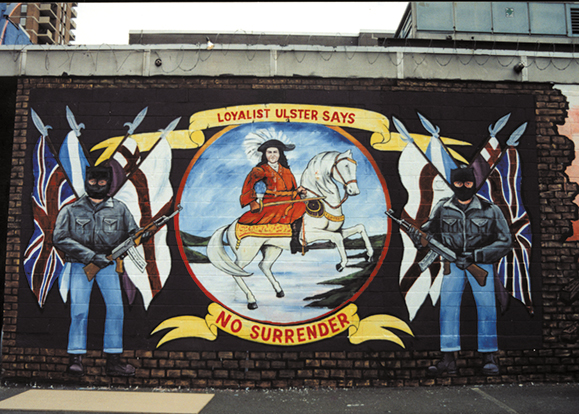
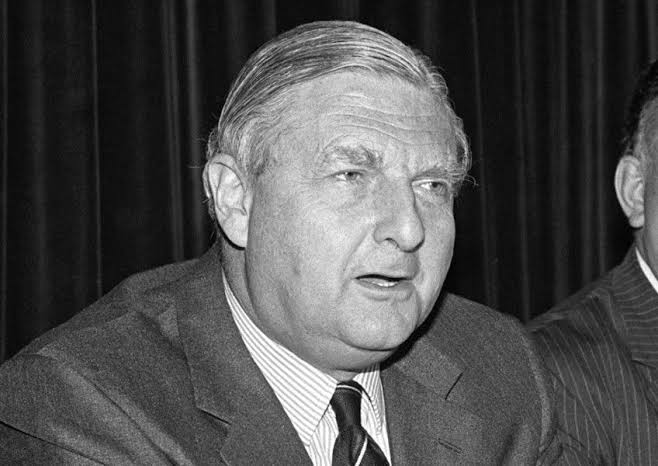
The following is the text of a speech given by the Secretary of State for Northern Ireland, the Rt. Hon Sir Patrick Mayhew, QC, MP, at the Centre for the Study of Conflict, University of Ulster at Coleraine, Northern Ireland, on Wednesday, 16 December, 1992. (The text has been edited as indicated by “…”)
Here, then, follow my own observations of the lines by which the community in Northern Ireland is divided…..
The first and most important line of division separates national identities. The two main groupings are of course those who see themselves primarily as British and those who see themselves primarily as Irish. Broadly, the first seek to maintain the union with Great Britain, while the second aspire to some form of a united Ireland.
The second line separates the two major religious groupings, Catholic and Protestant. The conflict in Northern Ireland, I know, is not primarily about religious differences, although they certainly provide an important ingredient.
The third line separates cultural traditions. This difference has a greater importance than has always been acknowledged in the coloring of people’s attitudes to society and politics in Northern Ireland.
The fourth dividing line derives from the fact that, in the main, it is the minority community in Northern Ireland that suffers more from economic and social disadvantages. It remains generally, but not universally, true that unemployment, not least long-term unemployment, educational under-attainment, poorer housing conditions, and other indices of disadvantage are still relatively more widely to be found in the minority community than the majority.
Problems in Northern Ireland require a solution which recognizes these divisions.
Until fairly recently I think most people would have considered that the divided nature of our society is unique in its character, and that no other society faced anything like such a complex amalgam of conflicting identities and interests. Can anything be like Ireland?
Well, no, not quite like Ireland. Yet I think it is now increasingly recognized that actually we may be able to draw lessons, in broad terms at least, from the conflicts of others and their resolution, or at least their accommodation….
Sadly, however, we can also now see less helpful examples, of which the former Yugoslavia is perhaps only the most striking. There we can see differing national and ethnic allegiances, religious and cultural traditions, erupting into a communal violence which we had come to associate with an earlier age, at least in leafy Europe.
All law is set at nought: chaos prevails.
This is a hideous warning of which I think many in Northern Ireland have taken heed.
And it has perhaps also created a fresh understanding here that, properly understood, ‘Brits out’ means the ethnic cleansing of a million human beings….
Let me consider first the question of identity and allegiance…
First, there is the present reality, in fact and in international law, of the union of Great Britain and Northern Ireland, affirmed in the 1973 Constitution Act.
We are committed warmly, solemnly, and steadfastly, to honoring our commitment to the wishes of a majority in Northern Ireland. And the Irish Government has endorsed this through its signature of the Anglo-Irish Agreement. The reality is that the identity of unionists is safeguarded in fact, and also in national and international law: it is also recognized as wholly legitimate by constitutional nationalists.
But there is also the aspiration to a united Ireland, an aspiration that is no less legitimate. Irish nationalism in its normal constitutional form has produced many fine patriots and advocates, who have enriched both Ireland and other countries too.
We can hardly fail to have a profound respect for men like O’Connell, Parnell, and Joe Devlin. They attract it not least because of the manner in which they sought to pursue their aims. What attracts no respect, and ought always to attract our condemnation, is the prosecution of the nationalist ideal, or for that matter the unionist ideal, by violence, or by the threat that if you cannot have your own way regardless of the views of others then you will resort to the gun. Those who kill and maim, claiming that their victims are legitimate targets simply through belonging to a different side of the community, really exhaust the vocabulary of rejection. “An eye for an eye makes us all blind,” said Martin Luther King.
I should like to set out again the approach of the British Government to the aspiration for a united Ireland.
The history of the island of Ireland as a whole, you will need no reminding, is in many respects both saddening and uplifting. You will not find me seeking to argue that Britain’s role in this island has only ever been associated with what has been uplifting. On the contrary, there is much in the long and often tragic history of Ireland for deep regret, and the British Government for its part shares in that regret to the full.
But that long history of conflicts convinces me that an Ireland that were to become united now only by dint of force and coercion, would fall very far short of the true nationalist vision. Such a state would surely meet no true patriot’s expectations — and certainly not the vision of Wolfe Tone. Unity cannot be brought one inch nearer, let alone achieved, by dealing out death and destruction. It is not just sensible to suppose that any British government will yield to an agenda for Ireland that is pursued by means of violence. Nor would any British government be pressed to do so by any serious body of opinion.
Force and coercion have been rejected, as has yet again been confirmed in the Republic’s recent election, by over 95 percent of Nationalists within the island of Ireland. Irish Nationalists are generally fair and practical people who choose to pursue nationalist aims through constitutional means alone.
There have been welcome signs that the truth is getting through to some Republicans. There are leading Sinn Féin speakers who voice their wish for a peaceful solution and their desire to follow a constitutional path. Provided it is advocated constitutionally, there can be no proper reason for excluding any political objective from discussion. Certainly not the objective of an Ireland united through broad agreement fairly and freely achieved. But there can be absolutely no question of our dealing directly or indirectly with anyone who still espouses violence. The provisional movement has so far excluded itself from discussions, by its devotion to the very methods it has followed. If its cause does have a serious political purpose then let it renounce unequivocally the use and threat of violence, and demonstrate over a sufficient period that its renunciation is for real.
In the event of a genuine and established cessation of violence, the whole range of responses that we have had to make to that violence could, and would inevitably be looked at afresh. As my predecessor said two years ago: “Violence can never be allowed to succeed. It is and will remain the first priority of the Government to defeat terrorism, from whichever side of the community it comes….For so long as violence continues, it will be met with a firm and resolute response.
Thus when terrorism is seen to have genuinely ended…the routine support of the armed forces would no longer be required: the army could return to its garrison role as in the rest of the United Kingdom.
…The political development process in which we are engaged seeks the prize of a comprehensive political accommodation, encompassing relationshipsnot only within Northern Ireland but also within the island of Ireland and between the two Governments….Any such accommodation would of course have to command widespread support within both the Unionist and Nationalist communities. Within it, any new structures for the Government of Northern Ireland would have to be acceptable to both major traditions.
Within this process the British Government is not guided by any blueprint or master plan leading to some pre-selected constitutional outcome of our choice. We want to see broad agreement developing, democratically sustained. That is why, 20 years ago now, the 1973 Constitution Act made clear that Northern Ireland’s status as part of the U.K. will not change without the consent of the majority of the people who live there. A majority now quite clearly wishes Northern Ireland to remain part of the United Kingdom. It is welcome to do so while that remains the case, welcome to play a full part in the family of people who make up the United Kingdom, welcome to enjoy the benefits and also shoulder the burdens that go with our citizenship.
But, as it has equally made clear, Her Majesty’s Government would never try to impede any body of opinion in working to achieve a place for Northern İreland within a united Ireland, provided they work only by democratic and peaceful means. If by such means they were to persuade the greater number of those living in Northern Ireland to agree with them, then Her Majesty’s Government would present no obstacle. All this is indeed well known and already constitues a binding obligation upon us.
The Government is therefore a facilitator of the expression of the democratic will in Northern Ireland. With no self-interest leading it to pursue a separate agenda of its own, the Government is just as plainly the facilitator of the will of the people in Northern Ireland, democratically expressed, as terrorism is its enemy.
…Out of respect for the different attitudes to religion and social values prevalent here, we do not seek to replicate in Northern Ireland legislation affecting certain areas of personal life which applies in other parts of the United Kingdom. Successive administrations have taken the view, for example over abortion, that the law which applies in England and Wales would not be accepted here.
But just as there exists such differences, so surely there exists as well the need for a similarity of approach to the issue of cultural diversity and tolerance.
The Irish language literary tradition, for example, goes at least as far back as the English, and has a wealth of imaginative writing and art which is rightly treasured.
One thinks, for example, of the epic sagas of Cuchulainn and Maeve. And of course this wealth that resides in Gaelic literature is reflected gloriously in the writings in the English language of Yeats, Shaw, Synge and in the work of O’Casey and Joyce among many others. The world owes a great debt to Irish culture.
…But, Irish culture in its turn draws on its proximity to Britain….The cultural achievements of each country draw on and enrich the other. There is therefore no place in anyone’s thinking for cultural superiority let along hegemony.
…The fourth line of division – in the economic field — is in many ways much harder to tackle.
…It is an easy assumption to make from outside Northern Ireland that only Catholics suffer economic and social disadvantage. Those living here know better.
…It remains the case, however, that disadvantage, measured in terms of unemployment, housing, education, health, etc, continues overall to bear more heavily on the Catholic community as a whole. There are complex reasons for this, which have their roots deep in the past. Enduring solutions are unlikely to prove simple or rapid. But we are committed to targeting Government programs in —industrial and agricultural strengthening, education, training, housing, health, for example — on those areas where problems and needs are greatest under the Targeting Social Needs program.
…Again our aim here is not to promote one community at the expense of the other.
What we seek to do is to create a level launching pad for all the people of Northern Ireland.
The same objective can be seen in our commitment to fair employment, as enshrined in the 1989 Act. We recently set out how we plan to review its operation and all the other factors which bear on equality of opportunity. The aim again is not a pre-determined outcome in favor of one grouping or another, but genuine equality of opportunity and a healthier and more prosperous society as a result.
In sum, then, the Government is wholly committed to a fair, equitable society where the sharp edges that constitute injustice may at least he taken off its dividing lines.
We have made a lot of progress, despite the negative impact of violence which has undoubtedly inhibited advance towards greater equality.
More, undoubtedly, remains to be done within the resources available to us. But the ideal of a tolerant, pluralist society where all legitimate aims, aspirations and forms are respected, is one I hope we can all strive for: a society where political difference would be regulated by debate and not the gun.
It is sometimes said that the return of power to new local institutions would merely mean that decisions now taken by Englishmen would in future be taken by Ulstermen. That, I suggest, is to misunderstand both our intentions and the nature of society here.
As Britons we may seek to ensure fair play as best we can. We may seek to encourage in directions of tolerance and generosity. But a real resolution of the divisions of society can be found, I suggest, only by those who have first-hand experience of them, who know the hearts of their fellow-countrymen and women, who know what they can and cannot accept. Only an accommodation hammered out on a local anvil, and with widespread local support, will survive the tests of time and practice.
It is for that reason that I sought to ensure in the recent Talks that the role of the British Government was one of facilitating, not steering in a particular predetermined direction. Any arrangements which flow from dialogue between the main constitutional parties, and the British and Irish Governments, will need to pass the test of widespread acceptability. They will need to provide public services effectively and fairly, and be likely to endure healthily and robustly, so as to give good governance to all the people of Northern Ireland.
Northern Ireland deserves and receives parity of services with other regions of the U.K. in return for parity of taxation. Given the problems of the economy and society here, this requires a level of public expenditure well above the capacity of the Province to generate public revenue.
The Exchequer, as it does with some other British regions, therefore subsidizes public expenditure here — by over two billion pounds a year. This we are happy to do, but it scarcely amounts to the actions of a government which is motivated by gaining economic advantage to Great Britain.
Likewise the market on the island of Ireland as a whole is not such as to sustain any wider, vaguer plan to help open doors for British companies and goods, through preservation of the Union and payment of a continued subsidy to public expenditure here, as some have seemed to suggest.
Even if that were ever so, the emergence of a Single European Market in a fortnight’s time opens up all of the markets of the European Community member states to each other’s firms, irrespective of location. So neither from the perspective of national finances nor for the sake of British companies is the Government here.
The future of Northern Ireland, the resolution of the divisions which mark its society, and the nature of future government institutions here, are all in the hands of the people of Northern Ireland.
It is for political and community leaders here to take the development of a fair and tolerant society further, where one group’s self-expression is not seen as a threat to another group, where compromise is the common coin of politics, and where equality of opportunity and equity of treatment are the experience of all sections of society.
Talks between the main constitutional parties, and the British and Irish Governments are the gateway to that sort of future for Northern Ireland. We aim to enable the people of Northern Ireland to reach that sort of future: to achieve a society characterized by fairness and debate not scarred by violence and destruction.
In that endeavor we intend to persevere.
The following is Sinn Féin President Gerry Adams’s reply to the British Secretary of State Sir Patrick Mayhew’s speech.
Sinn Féin has a keen interest in examining closely any comments which are presented as a shift in British policy or thinking. All Republicans wish for a peaceful solution. The central and most urgent issue facing everyone, including Mr. Mayhew, must be how to resolve this conflict and bring the violence to an end. How to create the conditions for justice, equality, and democracy through which a lasting peace can be achieved.
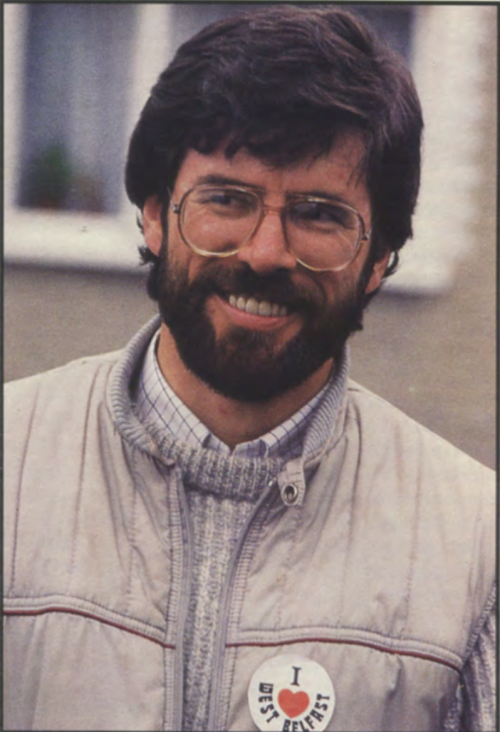
Mr. Mayhew has set out his views of the situation at length. It is significant that he is one of the line of British ministers who has been moved to respond in this way.
If this is a genuine effort to address the above matters, then despite the flaws in his analysis, nationalists and republicans will be concerned that this should be built upon, and so I approach Mr. Mayhew’s remarks, as Sinn Féin always seeks to approach such developments, in a positive way.
In doing so I note that every British initiative to date has been within the context of partition, a British political agenda, and with the Unionist veto underwritten.
Unfortunately the Mayhew speech falls into this category and reflects a refusal on the part of the British Government to recognize that its presence and its insistence on partitionist structures remain the greatest barriers to peace….
Nowhere does he mention partition and its effect. Nowhere in his opening four-point analysis is the presence of Britain and its role as instigator of the divisions in Ireland even a mention!
Instead we are again presented with the proposition that the British are ‘neutral’ or in Mayhew’s term ‘facilitators’ with no “blueprint or master plan.’
…Contrary to Mayhew’s claim Britain does have a ‘blueprint’ and one which was clearly discerned during the Stormont talks when British ministers again tried to secure agreement on a partitionist arrangement.
If Mr. Mayhew is hinting at a change in this position and if he wants to be taken seriously on this issue, then he should accept that the Irish people have the right to national self-determination and ‘facilitate’ the introduction of measures to give legislative effect to the exercise of that right. Instead of the current position, the British Government should move to a positive policy and use its influence and energy to win the unionist consent for an agreement between all the people of Ireland on their political future.
The British government is in a position to dramatically transform the situation by adopting a policy of ending partition.
Such a policy shift at this time would meet with a positive response from Republicans and usher in a new era.
Historically the British presence in Ireland and its denial of an Irish national democracy to the Irish people has been a continuous source of conflict. For centuries every generation in Ireland has suffered the consequences of that conflict.
Despite periods of an absence of violence, the conditions fostered and imposed on the Irish people by British occupation have meant that Ireland has never known real peace.
The refusal by successive British governments to allow the Irish nation to exercise its right to self-determination and democracy has been and is British government policy.
In 1980, during the Republican hunger strikes in Armagh and Long Kesh, the Anglican Bishop of Salisbury, Dr. John Austin Baker, commented on Britain’s denial of democracy in Ireland and its effect. He said: “No British government ought ever to forget that this perilous moment, like many before it, is the outworking of a history for which our country is primarily responsible. England seized Ireland for its own military benefit. It planted Protestant settlers there to make it strategically secure. It humiliated and penalized the native Irish and their Catholic religion; and then, when it could no longer hold on to the whole island, it kept back part to be home for the settlers’ descendants, a non-viable solution from which Protestants have suffered as much as anyone.
“Our injustice created the situation; and by constantly repeating that we will maintain it as long as the majority (in the North) wish it, we actively inhibit Protestant and Catholic from working out a new future together. This is the root of the violence.” Sir Patrick Mayhew, like his many predecessors, ignores this central issue. That he chooses to do so is an indication of how far removed his analysis is from reality. He is remiss also in praising the work of successive British governments, since 1972, in promoting equality of opportunity in employment. …On the contrary, any examination of the practice of discrimination in that period demonstrates the lack of concern and commitment by the British to tackling the problem of structured discrimination….
His remarks about Yugoslavia are in a similar vein and it was with particular disappointment that I read his outlandish claim that “properly understood, ‘Brits out’ means the ethnic cleansing of a million human beings.”
He knows that a British withdrawal means nothing of the sort and his remark is particularly inappropriate coming at a time when Loyalist gangs are murdering Catholics almost on a daily basis, in their homes and on the street; have killed more people than any other group this year; have killed more civilians than any other group in two decades of conflict; have a history of pogrom against the nationalist community and have expressed a determination to increase their bloody activities.
Having criticized some of his remarks, it is only fair to examine what Patrick Mayhew’s speech is about? Is he, as some observers suggest, trying to start a peace process. Has he even bothered to study Sinn Féin policy, including: Towards a Lasting Peace? Are his comments really aimed at Republicans or at the wider nationalist community?
Is he concerned only to put a gloss on British strategy for the benefit of international, including British and U.S.A. opinion? Given the failure, to date, of this strategy including “the talks process,” is he attempting to shepherd Unionists into another phase by arousing their fears of the alternative? Perhaps he has all these concerns in mind?
Mr. Mayhew makes much in his speech of the need to identify the nature of any conflict and of dialogue as a means to resolve it. He is right, but he must know that conflict resolution is not possible if any section of a community is excluded from the negotiating process. Perhaps Mr.
Mayhew harbors the hope that Republican resistance will be worn down. It will not.
Peace will have to be negotiated, and peacemaking is about bringing hostile parties together to seek agreement through negotiation.
Two years ago Archbishop Tutu of South Africa advised the British government: “Let your negotiations be as inclusive as possible. Don’t let any feel they’ve been excluded. Let them be represented by those they regard as their authentic spokespersons, otherwise talks, as we have discovered at home, are an exercise in futility.” The exclusion of Sinn Féin by Patrick Mayhew is undemocratic and is itself an obstacle to peace.
Our party represents approximately 35 percent of the nationalist vote in the six counties, a greater proportion of the nationalist vote than the DUP represents of the Unionist vote; we command greater electoral support than the Alliance Party; and are the second largest party in Belfast.
Sinn Féin has a democratic mandate and it is that mandate which gives us our right to be involved in any discussions.
To put any precondition on Sinn Féin participation serves only to delay our inevitable involvement. That Sinn Féin will be involved in talks is absolutely certain.
Patrick Mayhew and his advisers know this as well as I do. So does lan Paisley. Hence his outburst!
Sinn Féin does not put any preconditions on talking and we are committed to the development of a real peace process. It is a matter of regret that this commitment is not shared by the British government at this time.
Patrick Mayhew would do well to look to the international community where significant political changes are taking place.
That community will not always be so patient with British policy makers.
The UN and the EC are useful avenues which should be explored in any genuine peace process in Ireland. The imminent succession of President-elect Bill Clinton provides a further interesting area of change where assistance to help end this conflict might be found.
The people of Ireland and Britain want peace, a lasting peace which can bring an end to the cycle of violence which has been a part of our history for generations.
A peace process, if it is to be meaningful and genuine, must address the political problems which have been a part of our history for generations.
What is needed is a strategy for change and peace. This means London adopting a policy aimed at ending partition and which seeks, with Dublin, to achieve this in the shortest possible time consistent with obtaining maximum consent to the process and minimizing costs of every kind and recognizing the centrality of inclusive dialogue in this process.
The international community can help the peace process in Ireland. The European Community, which is involved in a process of economic and political restructuring, can provide valuable assistance, while the UN, which has the authority to monitor a decolonization process in Ireland, could during any transitional period convene an international conference on the democratic resolution of the conflict in Ireland.
Every British effort to rule Ireland has failed. The Irish people have been the main victims of this failure. The Government of Ireland Act was not a solution. The various British government “initiatives” since then have failed also. Since its creation 70 years ago the six-county state has been in a permanent state of crisis, and for the last two decades there has been open conflict. Partition has failed. Britain’s presence in Ireland and peace are incompatible.
A new approach is needed. One which would involve comprehensive negotiations between all of the parties. Sinn Féin remains willing and able to play its part in this process.
Editor’s Note: This article was originally published in the March April 1993 issue of Irish America. ♦
Leave a Reply