
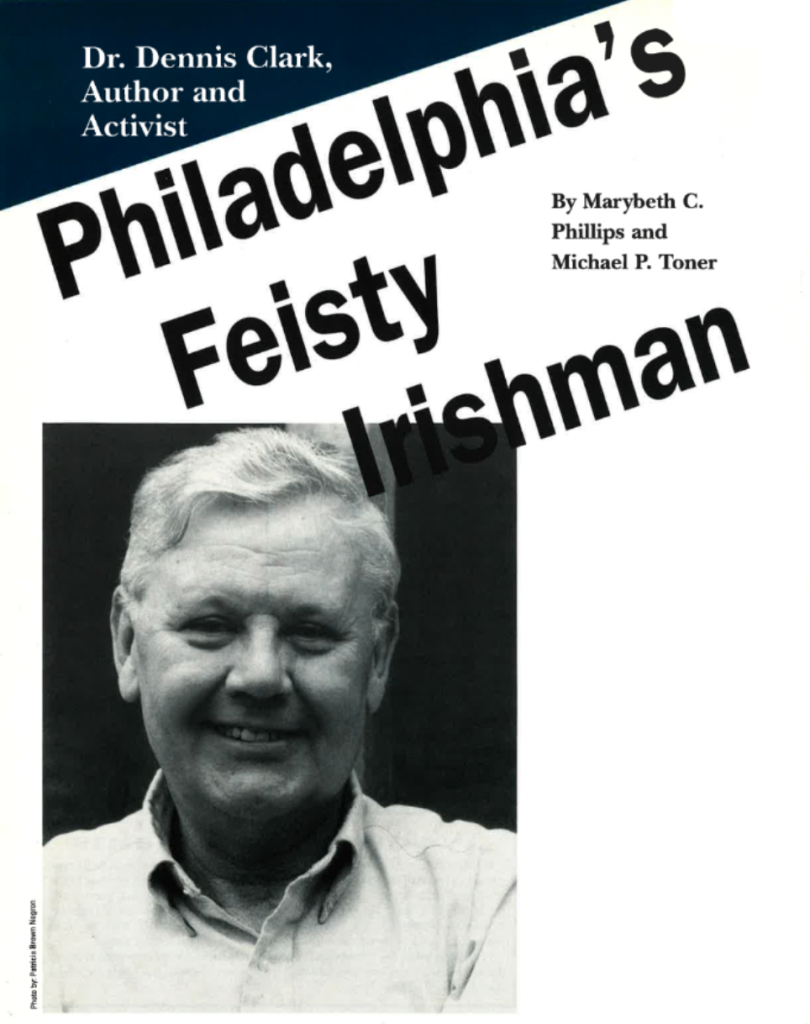
Most grandparents take their grandchildren to the playground. Dennis Clark takes his to picket the homes of politicians.
Though the kids may never acquire the perspective he has from growing up in Philadelphia’s Kensington neighborhood during the Great Depression, Clark wants them to avoid the “cocoon of American consumerism” and to have compassion for the have-nots. Clark, a 65-year-old historian, is the author of 12 books of non-fiction dealing with the immigrant experience, race relations, and urban society. One of those, Hibernia America, received the American Book Award in 1987. Although he considers himself a “minor-leaguer,” Clark is a foremost expert on the Irish in America.
He also has written two unpublished novels, one based on Philadelphia’s MOVE tragedy in which black people were killed by police and a bomb set fire to whole blocks of houses. For the many contributions to the city of his birth, Clark was honored by Philadelphia’s Atwater-Kent Museum.
In his youth, Clark organized migrant laborers in the West, had some amateur prizefights, worked on the Philadelphia docks, and dealt with some searing interracial conflicts for the Catholic Interracial Council in New York. But much of his career before retirement four years ago was with the Fels Fund, a charitable foundation with $26 million in assets. He has lectured at dozens of universities across the U.S. and Ireland.
In an interview, Clark speaks of his beloved but broken city, and an America tragically changed, problems peculiar to American society, and global ills nearly unfixable.
“This country is so large that everything you say about it is both true and false, Clark said. “Nevertheless, things are getting worse here, the underclass is growing, and it’s no way to go. We’re going to pay a big price for this.
“Picketing’s the least of it. We ought to be human famethrowers, politically, to stop gangsters in Central America, and to get our WASP govemment to stop supporting the British in Northern Ireland.” Those sound like fighting words, but Clark’s dictum of “agitate, educate, organize, win” is restricted on his part these days by his battle with health problems. “I could still go six rounds, but not ten,” he said. He clings to ideals over cynicism and the belief that a few individuals can make a difference, all the while regretting the fall of the public man.
And if it seems like Clark is jumping on the liberal bandwagon of late, it should be noted that he published warnings on public insolvency, higher taxes, and the loss of cities’ economic bases 30 years ago in his writings on urban affairs.
“Those wretches in Washington stealing our tax dollars as wages are bankrupting the country. The S & L’s? Firing squads for the guilty,” Clark jokingly suggested.
No mere critic, Clark has plenty of answers if anyone’s asking the questions.
With three levels of government buck-passing, America is a particularly vulnerable society, and any country would have difficulty dealing with the scale of our problems, he noted.
“But to declare social war on a significant segment of our fellow citizens like we’ve had during the Bush years is ideologically revolting,” Clark said.
“When Pennsylvania’s Governor Thom-burgh threw people off welfare and the city had to cut services because of federal cutbacks, people were whipsawed at the conditions of Veterans Hospitals, public schools, and so-called employment services in our cities are absurd failures of administration.”
Clark thinks America’s decaying infrastructure, whether it be plumbing under the roads or the family unit, needs an overhaul, one which won’t happen until we are at an even more extreme crisis stage.
“The physical comforts for most people living in the U.S. are so full of diversions that civic and political duty is irrelevant to them,” he said. “It’s always been the minority that works for change, but really. We need new gonads in this country. We need to get unhooked from the automobile, break our addiction to this idiot mobility which has permitted people to move away from problems, rather than solve them. It’s a losing game-we can’t build highways fast enough.”
Clark says bringing back public transit is inevitable, but this time without railroad barons manipulating the legislature. They must be public services for the people. American cities, he added, were built exploitatively with immigrant labor in an extravagance that subsequent generations have not been able to maintain.
Extraordinary decay needs extraordinary measures like government help in the form of a new Works Progress Administration, and another Civilian Conservation Corps, not wars in the Persian Gulf which may or may not keep the price of oil low, but which take a human toll and further devastate the U.S. economy.
Clark is especially concerned about the fate of the American worker.
“There is such a shrinking pool of jobs here any-more, skilled or unskilled,” he said. “Rebuilding the country would take care of that. But we also need a better system here. Everybody wants to give a kid a computer and hope for the best. In Germany, 60 percent of all jobs are through apprentice-ships. Our education system, on the other hand, dumps people onto the marketplace without any preparation.”
“And people need to own their careers and the facilities to which they’ve devoted their lives. Every company needs to be like Sears with profit-sharing, giving people a stake in their lives, developing a co-op medium for working people.”
As the man who wrote Work and the Human Spirit in 1967, Clark should know.
He says that the hype that’s unique to this country is responsible for perverting the American Dream, which is now, the saying goes, to be hit by a Coca-Cola truck and sue the company.
“Hype is everything here, and it sells everything,” Clark said. “It screws up careers and ruins everything – even writing. But marketing is not for serious scholarship.”
“We have a cultural prejudice because of hype that makes us downgrade certain careers, like child-care. Then our society consigns women to them. We have failed dismally in social services, whether it’s home care for the elderly or child-care. It’s a disgrace the richest country in the world has rotten social services.”
Clark continues his lifelong compulsion to write, and stored in his computer and at the Balch Institute for Ethnic Studies is his 40-year diary.
He does woodworking for exercise and, at any one time, there are several works-in-progress in his basement, Celtic interlacings destined for the walls of relatives.
He constructed most of the fumiture in his house and collected pieces by George Nakashima, before the artist’s death and ultimate recognition. Clark contributes regularly to Philadelphia’s Irish newspaper, Irish Edition, and his articles appear occasionally in Irish America and the Philadelphia Inquirer; the latter published his walking tour of working-class Philadelphia for the Labor Day weekend in 1990.
Growing up as he did with an Irish identity (Clark is second-generation) in a predominantly Irish-American neighborhood, he never lost touch with his roots. So he has a different outlook than most historians on the predicament of the underclass because, he says, “the Irish were America’s most rejected white minority until World War II.”
Clark worries about what’s left of the core group of Irish-Americans, their dispersion to the suburbs, and their psychological diffusion.
“The changes of the 1970’s and 1980’s broke the social escalator and altered the whole world of family stability. The great force of Irish indignation was removed from American life — the Irish rebellion against injustice, and the potent service in behalf of the poor and the losers. That legacy was subverted by the culture of comfort and the politics of pleasure, ” Clark said.
If he agitates long and hard enough, he figures, those values can be brought back, or calamity in American society will dictate their return.
“Our Irish holocaust, the famine, is 150 years behind us now,” Clark said. “There is no force driving to unite us the way Jews do for Israel. Ireland herself has been undergoing an identity crisis, and the new immigrants reflect this. It’s like a fever — it’s not sensational, but it can be devastating.”
“Many are trying to deny their Irishness and that’s foolish. You can’t pursue a disembodied course of cultural autonomy, one without reference to family and community and the civic culture in which you were raised.”
The European Community is a mixed blessing for Ireland, and 1993 will bring both good and bad.
Clark said that by the year 1700, a half-million young people had left Ireland for the Continent, so the tradition is old.
“The Irish will have more mobility in and out of Europe, and the EC will help relieve the suffocating mental embrace of England’s media on Ireland. Culturally, Europe will be glittering with Irish writers and musicians,” Clark said.
“But economically, Ireland will be to Europe what North Dakota is to the U.S. – not very vital indeed.”
He agrees with Irish writer J.J. Lee that Ireland’s identity crisis can only be solved by renovating its educational system, and paying attention to its roots, beginning with the restoration of the Irish language.
“In the past, Ireland’s particular brand of cultural Catholicism has functioned as a kind of Mediterranean voodoo. This generation of Irish has lost belief in the old twin pillars of church and state. But with no ready substitute, they are lost,” Clark said.
With regard to Northern Ireland, Clark said it has the features of a racial conflict.
“Catholics can be identified by name, and often by looks, the way African Americans may be recognized and treated unfairly. Some think I’m crazy to say that,” said Clark, who served on Philadelphia’s Human Relations Commission. “Until you get rid of the inequities and frustrations that cause these tensions, the problem will not go away, regardless of what government agreements are signed.” And when government fails, people must work on a level to alter the human dimension, like those involved in Project Children do.
Any discussion of social problems always leads Clark back to three buzzwords: identity, family, roots.
Without an emphasis on these as values to be upheld, education, the economy, and government cannot maximize a society’s potential. Likewise, the latter three must work for people, not against their interests.
The American family is the weakest link,” Clark said. “What’s going on with it now is a tremendous erosion to American life that undercuts formal education. The role of family and community is crucial in children’s development. It is the primary human dimension of our lives, the only thing we’ve got that is truly our own.”
Editor’s Note: This article was originally published January February 1993 issue of Irish America. ♦
Leave a Reply