
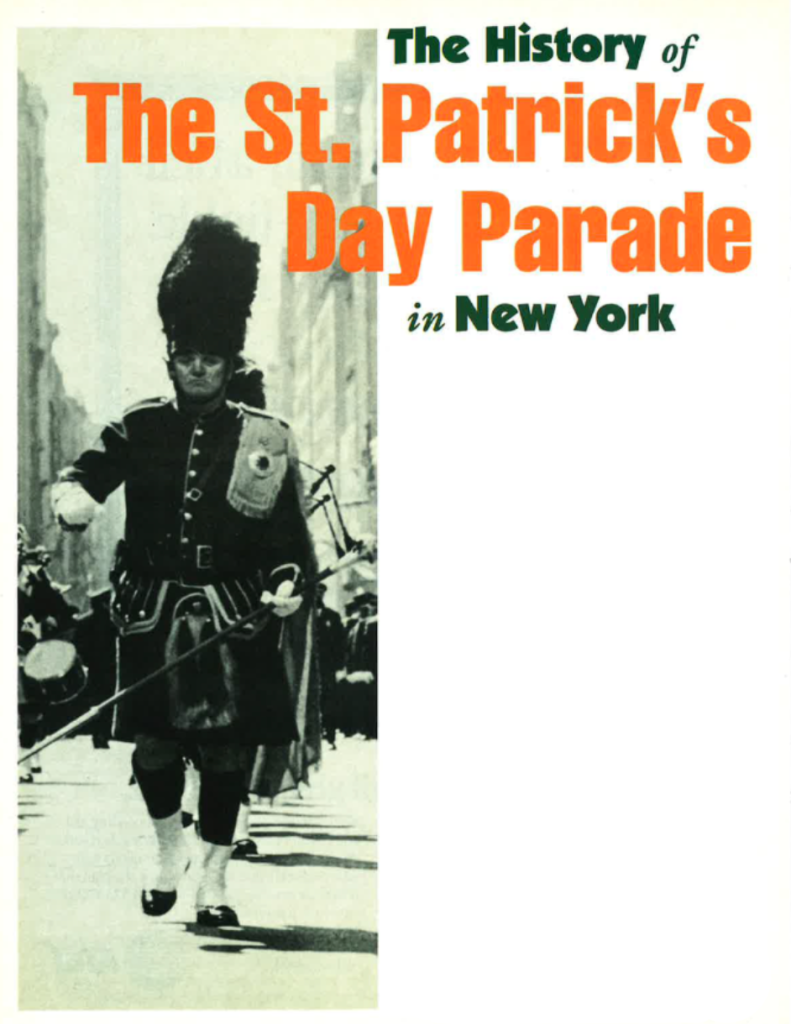
The St. Patrick’s Day Parade in New York is not new to controversy. 1992 and 1993 saw an all-out battle openly waged in the media between those who support the inclusion of the Irish Gays and Lesbian Organization in the parade (including Mayor Dinkins) and the AOH (backed by Cardinal O’Connor) who are determined to keep the parade strictly Catholic and heterosexual. John T. Ridge has written a book on the parade’s history, and as the following excerpt shows, the long green line has had many a curve since the very first parade.
The celebration of St. Patrick’s Day in the City of New York goes back at least as far as 1762. The first recorded festivities took place in the house of an Irish resident by the name of John Marshall at Mount Pleasant, near the College.” This location would have placed it west of Broadway close to where St. Peter’s Roman Catholic Church stands today.
No specific mention of a parade is made, but if the day was at all similar to what it was in later years a small group of friends may well have decided to proceed in a body to Marshall’s house.
A more elaborate celebration is recorded in 1766. It is also the first mention of a parade.
“Monday last being the Day of St. Patrick, tutelar Saint of Ireland, was ushered in at Dawn, with Fifes and Drums, which produced a very agreeable Harmony before the Doors of many Gentlemen of that Nation and others.”
The meagre details leave us to speculate as to what form this parade took. Undoubtedly, it was one of the military units stationed in the city and raised in whole or in part from Irishmen, some of them possibly recruited in Ireland and sent over to New York. While fifes and drums at dawn may not have been every citizen’s cup of tea, the military unit apparently made the rounds from door to door of the leading Irish citizens without incident – a fact which testifies to the generally favorable regard held towards the Irish at the time.
1853
1853 marked the appearance of a new society which was to play a key role in the years ahead and was ultimately destined to assume total responsibility for the maintenance of the parade tradition. The new group, the Ancient Order of Hibernians, affiliated with the parade at the February meeting of the Convention of Irish Societies and on the 17th they marched behind their president, James Saunders, along with a hired band and a handsome banner.
The Brooklyn delegations to the Manhattan parade were assuming more and more importance.
Although the Brooklyn Irish were both numerically smaller than in Manhattan and comprised a smaller proportion of the population, Brooklyn had its own strong St. Patrick’s Day traditions. separate parade was held in Brooklyn as early as the mid-1820s. In 1853 the Laborers Benevolent Union with a band of music passed down Brooklyn’s Fulton Street early the morning of the 17th on their way to the New York ferry forming the largest procession of one association we have ever seen.”
While some Americans were not especially sympathetic to the idea of an annual St. Patrick’s Day Parade through the streets of their city, it had been going on for such a length of time that it had become more or less an accepted fact of city life. The July 4th parade was another story entirely. Anti-Irish and anti-Catholic feeling in this era of the “Know Nothings” concentrated itself on Irish participation in the Independence Day celebrations. Irish societies had paraded on the 4th of July as far back as the first decade of the 19th century, but in the 1850s the advisability of Irish participation was being questioned.
In 1852 the Convention of Irish Societies had peacefully taken part in the Independence Day Parade, but a hostile political and social climate had caused them to consider participation in 1853 too risky.
The Ancient Order of Hibernians, however, felt that the tradition should be maintained and directed that its members form up at its regular meeting rooms and march as a group to the parade’s assembly point.
Unfortunately, near Abingdon Square in Greenwich Village the AOH met “Know Nothing” hostility from the followers of Bill Poole, a notorious rowdy and leader of the anti-Catholics of the city. A team of horses and wagon was driven into the rear of the parade and a fight developed between the Hibernians and their attackers.
On March 17, 1854, the Know Nothing attack was still fresh in the minds of the paraders. Because of the pervading fear of another attack on the Irish Catholics of the city, a particularly large turnout of military appeared to act as escort. In addition to predominantly Irish regiments of the state militia, the 69th, the 9th and the 72nd, the march was joined by many units of the Irish volunteer military, units which were not under state regulation and were a little less formal. The volunteer companies carried names like the Irish Dragoons, the Jackson Horse Guard, the Montgomery Guard, the Napper Tandy Light Artillery, the Republican Rifles, the Emmet Guards, the Irish American Guards, the Shields Guards, the Carroll Guard and the Irish Rifles. In the case of Jackson, Montgomery and Shields the names came from Irishmen who had distinguished themselves in American military service, while the names Napper Tandy and Emmet came from leaders of the 1798 and 1803 Irish Rebellions. In every case their costuming was striking; the Irish Dragoons, for example, wore “the bright helmet and breast plate so much favored by the French service.” Protection of their community and the chance to someday participate in the armed liberation of Ireland were two motivations that made the volunteers popular with young Irishmen.
1856
On the Sunday preceding St. Patrick’s Day in 1856, the anti-Trish element in New York hung an effigy of St. Patrick on the liberty pole at the Union Market, but on St. Patrick’s Day the Irish took little heed of that.
Owing to the fact it was Holy Week, the civic society postponed their parade until the 24th, but the Irish military “were so scrupulous” and marched on the 17th in a parade of the 69th, 75th and 9th Regiments.
1858
Tammany Hall raised its head to cause interference with the workings of the parade in 1858. It began when a meeting was held at Montgomery Hall in Prince Street a week after March 1 7th of 1857. Because the meeting was held without notice to the general membership, a controversy erupted when a section of the general committee which had not been present complained that it was an illegal meeting. The committee chairman argued that this was the normal post-parade meeting and needed no special notice as it was expected and known by everyone concerned. The dissidents called for a meeting at Tammany Hall to protest the chairman’s actions.
Further developments had to wait until the following year when the regular parade meetings resumed in February. A dissident group led by James Keelan decided to form their own parade committee at Tammany Hall.
“For several weeks the arrangements had been under consideration, and although there was some ‘bad blood’ created during the discussion of the program, the result was all that could have been expected, where so many were ambitious of distinction.”
Two parades resulted, both following the same parade route. The first was under the direction of the Tammany party with their grand marshal, Thomas Kiernan, president of the Quarrymen’s Association, and the second parade was under the direction of Grand Marshal Patrick McCoy of the small Hibernian Benevolent Society. The second parade was composed of the societies loyal to the old Convention of Irish Societies of Prince Street.
1860
Another new kind of participating organization appeared for the first time in 1860 — an Irish county society. Although there are several references to various Irish county groups in New York in the 1850s, none were known to have participated in the parade. On March 16th the County Monaghan Social Club was formally accepted into the Convention of Irish Societies and the next day marched in the parade.
The Monaghan men made this their only appearance in a parade although they existed for many years after that. Also marching in this parade but not as a civic society was a military unit known as the Limerick Guard. It is not known whether or not this was a group strictly of Limerickmen, but the very name strongly suggests that was the case.
1861
In the fall of 1860 the Prince of Wales made a grand tour of Canada and the United States. With so many exiles of famine and political oppression in the city. the prince’s visit was hardly popular with the Irish. In New York there was, however, no shortage of Anglophiles and they decided to honor him with a grand military parade and called out the local militia units including the Irish 69th Regiment. The commander of the 69th was Michael Corcoran, an exile of the 1848 Rising in Ireland and a founder of the Fenian Brotherhood, a secret revolutionary society pledged to Ireland’s liberation by force of arms. Corcoran felt it was an insult to both his adopted country to entertain the great-grandson of George IIl and to his birthplace to pay homage to “his mother’s son,” the offspring of the detested Queen Victoria. Corcoran and the 69th refused to parade for the little prince and as a result Corcoran was brought up on court-martial charges. His action, of course, endeared him and his regiment to the New York Irish. At its meeting on March 8, 1861, the Convention of Irish Societies formally endorsed the action of Corcoran and the 69th. The St. Patrick’s procession consequently turned out to be almost a public tribute to the regiment.
“A greater significance was given to the celebration this year on account of the ferment into which some of our Irish citizens have been thrown by the visit of the Prince of Wales to this country; fomented, further, by the refusal of an Irish regiment to take part in his reception in this City, by the court-martial of its Colonel, by the recent efforts of Ireland for the abrogation of its present relations with Great Britain, and by the comments of Irish presses and speakers there and in this country, in which intimations have been thrown out that the day of another Irish revolution is at hand, and that the French stand ready to aid in it.”
The Convention chose as grand marshal Owen Keenan of the AOH. Keenan had been president of the senior division of the Order, Division No.#1, and General President of the New York County Hibernians.
It was to be the last peacetime parade for several years to come; the 69th and its colonel, courtesy of an official pardon, were off five weeks laterto the battle fields of Virginia to help preserve the union.
The Fenian Brotherhood furnished its military unit, the Phoenix Zouaves, for the first time in 1861, marching behind the 69th Regiment. The Phoenix Zouaves very much impressed Thomas Francis Meagher, a popular leader of the 1848 Rising whose escape to New York from British imprisonment in Australia made him a great favorite among the American Irish.
“I believe that Meagher’s determination to join the Fenian Brotherhood as a bona fide working member, was come to on Patrick’s Day, 1861, after he had witnessed the First Regiment of the Phoenix Brigade march under the “Green Flag which had, on that morning, been presented to them by the patriotic Irish ladies of New York. His natural soldier instincts were aroused as they had never been previously — and with good cause, for never were Irishmen more devoted to the cause which that flag symbolized than those over whom it waved on that day; physically, morally and intellectually, they were the true representatives of the flower of their race. This fact was tacitly admitted by their fellow citizens at large, even those who did not understand the actuating motives of the Fenian Brotherhood, and had no sympathy with their aspirations, respected them for their disinterested earnestness, and evident determination of purpose — as evinced by the whole line of march on that occasion.”
1862
Unquestionably, “the crowning feature of the day in 1862 was the appearance of the gallant 69th, the same that fought so nobly at the battle of Bull Run.” Ăs the procession moved it was frequently cheered and the 69th received a complete ovation along the whole route. In less than a year the untested soldiers had become veterans and their deeds the talk of the town.
Because of the accomplishments of the Irish-American companies, the anti-Irish prejudices of many of New York’s newspapers seemed to have vanished for the time being. The parade was now treated in respectful if not glowing terms and more details were furnished of the procession than ever before.
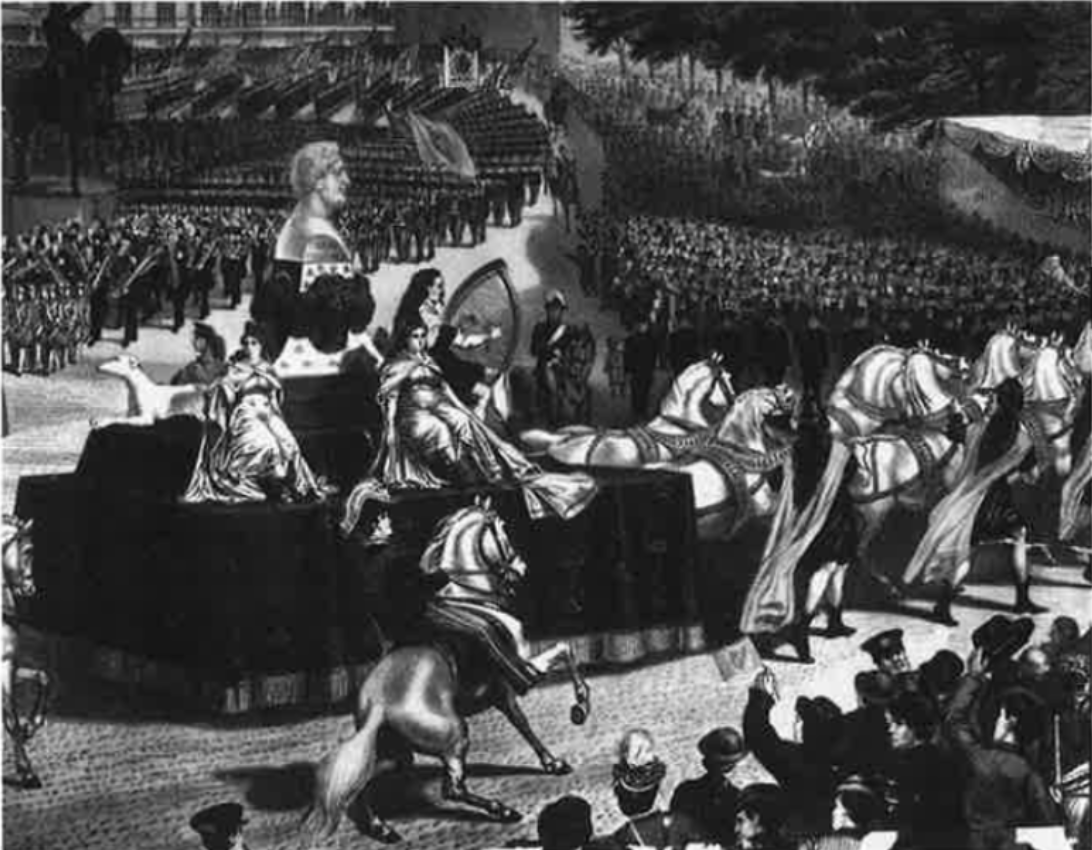
1866
Hysteria marked the approach of St. Patrick’s Day in 1866. New York newspapers whipped up all kinds of stories relating to the Fenian movement in America, including the rumor that more than 20,000 armed Fenians were to march in their own distinct column through New York’s
streets. Other rumors forecast riots for the day. The public so expected the Fenian military to be marching that when the 200-man unit of the Ocean Steamship Coal-Heavers Society, uniformed in blue flannel and wearing badges representing a full-rigged ship, appeared they were mistaken for the Fenian Navy. The head of the Fenians, the exiled patriot John O’Mahoney, was expected to ride in advance of the 99th Regiment, of which unit he was colonel, but he permitted his second in command to lead the unit to the disappointment of the waiting crowds. No less than six militia regiments were participants in the line of march.
While the Fenians were not present in a distinct body they were present both inside and outside the ranks. The route of the march passed Union Square where the Fenians had set up the headquarters in exile of the soon-to-be, they hoped, Irish Republic at the old Moffat Mansion. The building was elaborately decorated with banners that loudly proclaimed: “American Soldiers in English Prisons”; “Sailors Rights-Barry, McDonough, Perry, Sullivan”; “Broken Reeds-The English Army and Constabulary”; “Neutral Rights: Two sides to a question”; “we celebrate the national Patron’s Day of a ‘Proclaimed’ Country.’”
After the parade was dismissed at Cooper Union, “a vast concourse” made their way to the Fenian headquarters where speakers spoke of the impending re-establishment of Ireland as an independent entity. Presentations of money from groups and individuals were then made and bonds of the Irish Republic were sold to the enthusiastic crowd.
1872
In July of 1870 and again on July 12, 1871, the City of New York was rocked by disturbances which resulted from public demonstrations by the Orange Order in New York.
The Orange Order was a society dedicated to preserving the supremacy of the British crown and the Protestant ruling class in Ireland. Its vehemently anti-Catholic program was made clear in the old country every 12th of July when the order marched to partisan melodies whose words, as every Irish person knew, were highly insulting to the Catholic religion. The Orange Order had a long record of fomenting trouble between Protestants and Catholics in the old country and had as early as the 1820’s sought to create the same ill feeling in America.
The Orange parade of July of 1871 had seen a small group march down Eighth Avenue. Before the Orangemen had gone more than a couple of blocks their nervous military escort had fired on the onlookers killing almost fifty. The daily press blamed the Irish Catholics of the city for the trouble and by the following St. Patrick’s Day the Orange disturbances provided an excuse to launch a full scale attack on the March 17th parade. “The procession was one of the largest of its kind that New York has ever seen, and included several features which rendered it attractive to certain tastes. The Irishman never looks more grotesque than when he is “rigged out” in a long black coat and new “Silk Hat,” and yesterday some thousands of such caricatures of the ordinary human being paraded through the streets. The display of bunting from the houses along the line of march was decidedly meagre in comparison with that of former years — people getting ashamed of toadying to the most intolerant class of the population – and most American-born citizens looked with very little patience on a show which suspends the business of a great city for the best part of the day.”
1880
Difficulties in Irish agriculture had caused severe hardship in the old country.
Many small tenant farmers were again feeling the pressure from rack-renting British landlords who were evicting them from their small holdings in increasing numbers.
Coinciding with the terrible hardships for the Irish tenant farmers there arose a new movement in Ircland called the Land League. The Land League united the tenants in a struggle against unjust rents and pressed for complete land reform to enable the Irish farming class to purchase their holdings. The key figures in the movement were Michael Davitt and Charles Stewart Parnell, the leader of the nationalist segment in the British Parliament.
A very strong movement, the Irish American Land League, duplicated the fundraising efforts of the League in Ireland. Branches of this organization were formed across the country, and the backbone of the League came from the membership of the Ancient Order of Hibernians.
As low as sentiment had been for a parade in 1879, support virtually evaporated in 1880. The Convention of Irish Societies convened initially in February with only a few AOH delegates present and most of these reported that their individual divisions had decided not to parade.
Instead, they chose to give the funds ordinarily expended for the purpose of Irish relief. Nevertheless, there remained a few traditionalists who decided they could keep the parade alive without putting out the usual expenditure. This did not sit well with many of the New York Irish.
“We hardly know how to speak rationally of the irrational set of fanatics at the head of eight or ten ‘divisions’ of the Ancient Order of Hibernians who seem bent on showing themselves in public procession through the streets of New York on Wednesday next. There is an old saw which says – give a fool plenty of rope and he will soon hang himself; and it seems the best way to deal with such people. We advise our countrymen to treat the parade with the contempt it deserves from every right-minded Irishman and let it alone; so that, if any of those stubborn vilifiers of the starving countrymen should appear on the streets the very paucity of their numbers and public disdain with which they will be treated, may put them to shame if, indeed anything can shame them, after the sorry exhibition they have already made themselves.”
1885
Events which had taken place in the AOH over the previous years culminated in 1885 with great effect on the parade. New York up until 1878 had been the sole headquarters and site for the annual convention of the national Hibernian organization. Naturally enough, this gave the Manhattan Hibernians control of an organization which had grown far beyond the confines of the city. Between 1878 and 1884 the special position of New York County in directing the affairs of the national organization was lessened in series of steps undertaken at a succession of national
conventions.
The majority of the New York divisions in the metropolitan area as well as a scattering of divisions across the country formed a separate national organization called the AOH Board of Erin (AOH BOE) in 1884.
The AOH BOE constituted the clear majority of the divisions in New York, but there were enough members loyal to the national organization, the American Board of the AOH, to maintain a separate county organization. Both sides claimed to be the legitimate society and both sides felt it was their individual right to direct the 1885 parade. The result of the conflict was that there would be two parades, the AOH Board of Erin controlling the original Convention of Irish Societies parade organization and continuing the basic route from the preceding year from Cooper Union to the finish at Jones’ Wood. It was described in the press as the “up-town” procession simply because it headed in a northerly direction.
The other procession headed downtown from the old assembly point at 23rd Street and First Avenue passing City Hall as in times past and then over the new Brooklyn Bridge to join the American Board AOH divisions in the Brooklyn parade. Except for marching south along Broadway to City Hall, the route was similar to the old City Hall route.
1887
The division in the Hibernian ranks again resulted in two parades.
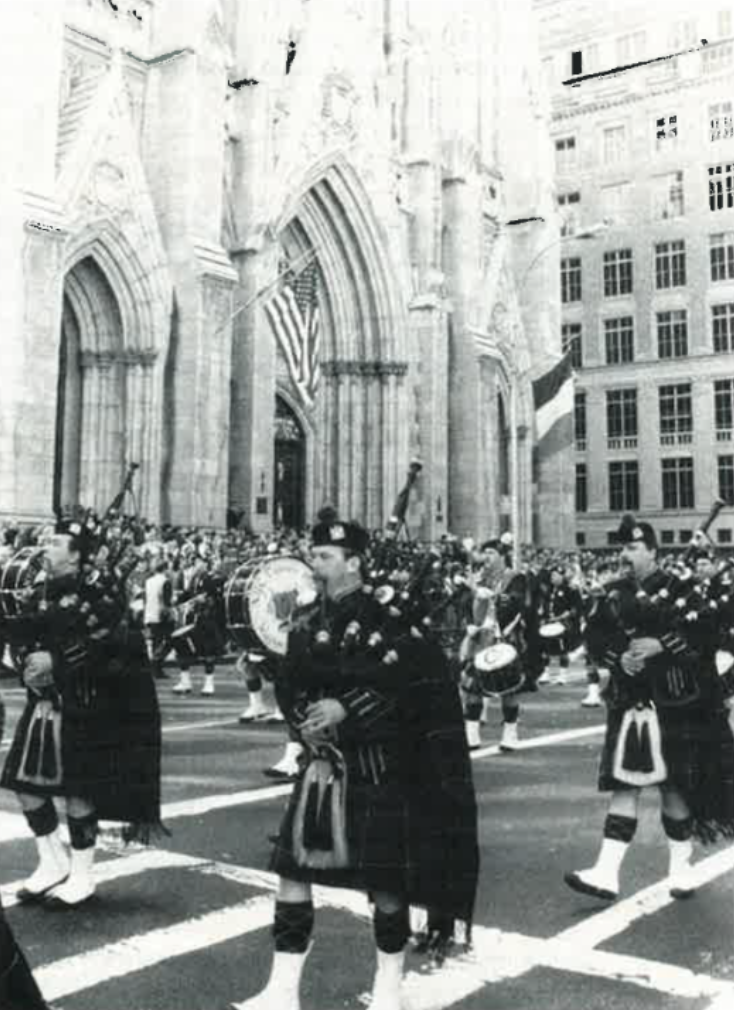
The 69th Regiment did not parade, seeking not to recognize either faction, but it assembled at its armory for an independent march to St. Patrick’s Cathedral for high mass. The uptown parade of the Convention of Irish Societies was again the larger of the two on this occasion. Thomas Fitzpatrick of Division No. 13 AOH acted as the grand Marshal and led the 49 divisions of the Hibernians, Hibernian Rifles, two societies from St. Columba’s Parish, and the St.
Patrick’s Alliance Guard, a military unit of the fading St. Patrick’s Mutual Alliance. At Jones’ Wood the principal address was given by the embattled pastor of St. Stephen’s, Father Edward McGlynn.
1894
Once again a movement was on the rise in America dedicated to an anti-Catholic, anti-Irish purpose. The American Protective Association, or APA as it was generally known, was a powerful secret society organized in many American communities and was growing in strength in the city.
For the approaching 17th of March the focus of the APA’s attention was the green flag that had been hoisted every year almost without exception on City Hall and the municipal buildings. The aldermen had passed a resolution calling for its display beside the national and state flags, but pressure to prevent the raising of the Irish flag was orchestrated by the APA.
The first intimation of APA activity came in the form of a notice to the mayor that 1,000 public school children would march to City Hall to request the veto of the aldermen’s resolution.
The acting mayor, Col. George B McClellan, the son of the Civil War general so beloved by the Irish, was visited at his office by a number of people demanding that the green flag not be flown. But McClellan told them that the Irish were a noble class and deserved much credit, and if the Americans did try to down the flag it was a dishonorable kind of patriotism. The choice of the grand marshal was Patrick Costello, president of Division No. 6 AOH, who had represented the Order at the national convention as a delegate over the preceding 10 years. Sligo-born Costello at just 33 years of age was described “as fine a specimen of the stalwart Irish race to be found anywhere; tall, broad-shouldered and as straight as an Indian.”
The parade route was the familiar route from Washington Square to Jones’ Wood. Five county organizations now marched: Fermanagh, Cavan, Sligo, Donegal and Galway. For the first time the first aide to the grand marshal was chosen from among them, Matthew C. Flynn of the Galway Association.
1910
In 1910 a remarkable man, Roderick Kennedy, became the chairman of the Arrangements Committee, the chief officer of the parade organization. Kennedy was to be a dominant figure in connection with the parade over almost all of the next 25 years and was in part responsible for the significant changes in the parade. As had happened in the past when various nations presented the potential to aid Ireland in its struggle for independence, relations between two of America’s largest ethnic groups, the Irish and the Germans, became more cordial when it was discovered that both had mutual interests.
The parade committee reemphasized the necessity of solidarity with the German-American community to prevent America from entering a war on the side of Britain while Irish revolutionary groups were contemplating an armed rising in the old country. The committee noted “political measures which are of benefit to the two great peoples who are among the most loyal and devoted of the supporters of the great “Stars and Stripes.'”
1915
Roderick Kennedy, chairman of the Arrangements Committee, who was at heart a thorough nationalist and Clan na Gael man, had issued orders expressly banning the song “It’s a Long Way to Tipperary” from the musical repertoire of the parade and copies of the order were sent to all the bands. The song today has lost its original significance, but in 1915 it was the favorite theme song of the British recruiting sergeants in Ireland who used this product of the English musical halls to appeal to a misplaced sense of patriotism among the Irish youth.
Strong forces were at work among the politicians to do everything possible to push the Irish-Americans into the British camp. Chief among these advocates were John Purroy Mitchel, New York’s mayor and oddly enough, a grandson of Irish patriot John Mitchel, the “Coroner” Tim Healy. When the band of the Eccentric Fireman, a group well known to be close to Healy, approached the reviewing stand at the cathedral, it struck up the banned tune “It’s a Long Way to Tipperary.” Immediately, Roderick Kennedy, who was a native of Co. Tipperary, ordered an aide to stop it, and when the band continued to play, Kennedy raced out from the reviewing stand and wrenched a brass instrument from one of the musicians and told the bandmaster if “Tipperary” was not stopped the whole band would be turned out there and then.
The Cardinal and other members of the clergy were shocked at Kennedy’s action, and one of the priests rebuked Kennedy for acting the way he did. Cardinal Farley, it appears, did not recognize the significance of the song and indeed had never heard it before.
Kennedy explained quickly the reasons for his actions, adding, “it was an insult to Tipperary to associate the county with the disreputable streets in London like Leicester Square and Piccadilly and playing an English marching song in the parade would be a violation of President Wilson’s Neutrality Proclamation.”
“You are perfectly right,” answered the Cardinal, “and I doubly apologize to you.”
1916
What happened to the parade in 1916 was directly related to the history of the building project of the New York County AOH to establish an Irish center – long the dream of Irish organizations in Manhattan. Although the projected Hiberian Hall was originally slated to have been built on East 47th Street and ground actually purchased there in the 1890s, the building committee of the Hibernians decided the site was “too far downtown” and shortly after 1901 purchased a building site at 116th Street and Fifth Avenue.
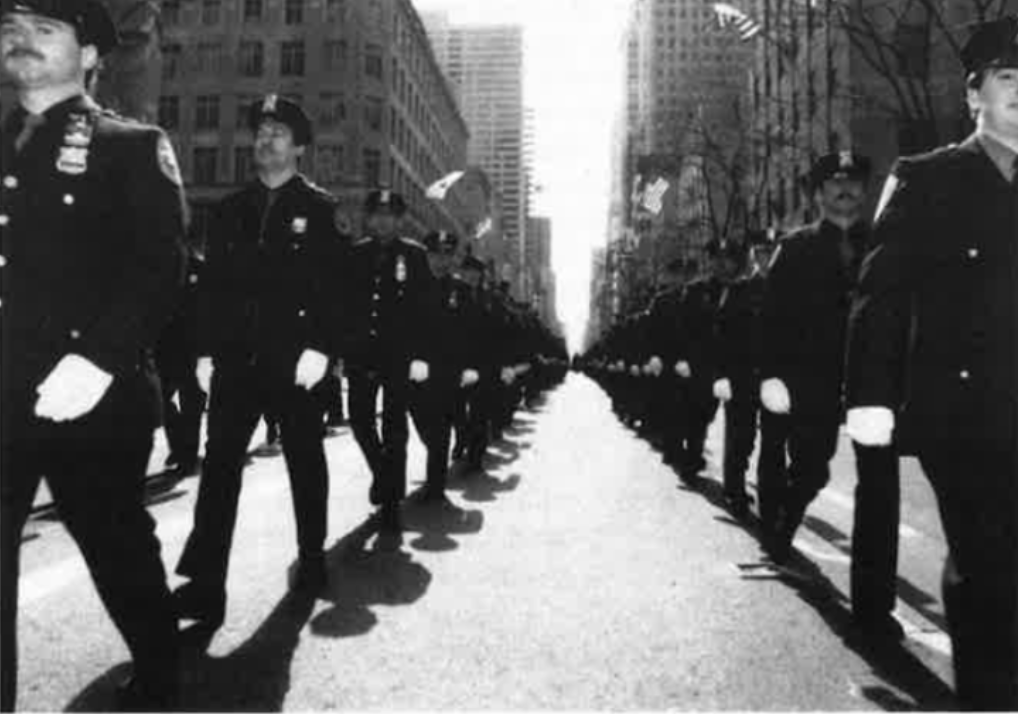
It was an ill-fated decision. The building was to cost $250,000, an amount the AOH could not raise, and consequently they were forced to take on themselves a heavy mortgage. The building was in fact never owned as a Hibernian Hall, but was put out on a long-term lease to a group of businessmen who opened the Mount Morris Theatre there in March of 1913. Despite this arrangement the New York Hibernians were still hard pressed for cash to the extent that they were unable to pay their overdue assessments to the national organization. After the indebtedness reached a considerable amount they were suspended in May of 1915 the national board of the AOH reorganized the suspended county board when seven of the 21 division agreed to pay their outstanding assessments. The new county board elected Roderick Kennedy as the county president. The other divisions which were controlled by P.J. McNulty, Eugene Flood and Tim Healy refused to submit and instead instituted a series of legal actions against the Kennedy group. The “McNultyites” as they became widely known had their suit to stop the annual picnic at Sulzer’s Wood dismissed, but they were successtul, however, in obtaining the permit for the March 17th parade from the Police Commissioner.
Mayor Mitchel was accused of having had a direct hand in arranging it. The Kennedy AOH lost their last appeal to have the permit restored to them as a result of a judgement based solely on technical grounds. Kennedy’s men had been so confident of victory that they had chosen their own grand marshal, Mayor Joseph I. Berry of Division No. 6 in the Bronx. Berry was a former official in the Parks Department, and it was to be his misfortune to be the grand marshal who never got to lead his parade. Since the Kennedy group would settle for nothing less than Fifth Avenue, the parading was reluctantly left to the McNultyites.
The “McNultyite” parade received the blessing of the pro-British press in the city, and the New York Times, in a highly uncharacteristic move, went so far as to print in unusual detail on the day preceding the parade the complete line of march, complete with a list of the organizations and their leaders. Despite such extraordinary publicity the parade of the suspended AOH was “the worst fiasco the city has ever seen” as most of the Irish societies boycotted it.
The Gaelic American observed: “The men for whose crooked political purposes Mayor Mitchel insulted the majority of the Irish Citizens of New York were able to turn out only a few hundred men and boys. The regular Hibernians and all the other organizations except Redmond’s little handful of loyal West Britons kept aloof. Mayor Mitchel and Police Commissioner Woods learned a much needed lesson about using the Irish National Festival for a discreditable political game and the endorsement of John Redmond’s betrayal of Ireland.”
1918
With a new mayor in City Hall, John F. Hylan, the parade permit once again reverted to the regular AOH headed by Roderick Kennedy, but the rivals had not given up. The parade was denounced in very strong terms by John H. O’Connell, the counsel for the opposing group.
“The Americans decided not to parade, and the pro-Germans, or anti-British (they are of the same ilk, Mr. O’Connell says) intended to flaunt the Irish Republic colors down Fifth Avenue.
“I say it is pretty close to treason. Those men who parade are either very foolish Irishmen or very treasonable ones. It is the duty of the Irish of this city to see to it that such a spectacle should not occur this year. About 65 percent of those who will march with Kennedy are of the Bolshevik-Hilquit clan. The movement to have a parade is fostered by pro-Germans.”
1920
Great enthusiasm was evident for the 1920 parade, reflecting the continued concern over events in Ireland. Some 400 delegates attended pre-parade organizational meetings. On the day of the parade the young president of the struggling Irish Republic Eamon de Valera, looked down from the reviewing stand on a “tossing sea of green, white and orange.” De Valera was the first Irish head of state to review the parade. His position was recognized not by other govemments, but by his thousands of faithful supporters. He was joined on the reviewing stand by Mayor Hylan and Governor Al Smith, leading Irish-American political leaders of the state.
The tricolor had completely displaced the old green flag with the gold harp which had long been the flag carried in St. Patrick’s Day parades.
1933
With 53 years of parade experience, many of them as chairman, the lot of grand marshalship fell to old Roderick Kennedy. Although he was unanimously chosen he accepted the position only to settle a battle over whether the designation should have gone to Mayor John O’Brien or not. Since 1915 Kennedy had seen the parade through the most difficult period in Irish political history, a time filled with the deep emotions of an armed rising, a tough guerrilla war and finally a short but bitter civil war. While Kennedy was not the great unifier of conflicting factions, he always gave New York a procession full of dignity and decorum which reflected well on the Irish community. He was chiefly remembered as the great organizer who brought to committee meetings, held in places like the Irish American Athletic Club, an unmistakable style.
The biggest problem for the committee turned out to be how to keep the 85-year-old Tipperaryman off a horse, but his friends finally wore the stubborn chairman down.
“The thing is,” he said, ‘I’m a good man on a horse, I carry the mark in my mouth still that I got riding in the farmers’ races in Norwood in the old country. There we call flat races flat races and everyone runs over the paddock to see the steeplechases. I rode in them and I like a frisky horse still. Perhaps I’ll ride and my years be forgotten. I’ll do what my people want.”
1936
The parade increased dramatically in size for the first time in many years thanks to its new chairman, John J. Sheahan, a Co. Limerick native. Forty thousand marched. The increase was the result of the wholehearted cooperation of the Archdiocese of New York and the Diocese of Brooklyn.
“An unusual feature this year will be the presence of many of the Catholic and
Church, organizations of the archdiocese. His Eminence, the Cardinal, is very much interested in the success of the parade and has requested that the Holy Name Societies and the different Cadet Corps in the different colleges and churches participate.”
1966
A new parade chairman, Criminal Court Judge James Comerford, assumed control for the 1966 parade. The colorful and witty Kilkennyman conducted some of the most interesting parade committee meetings with his clever commentaries and friendly exchanges with delegates on the floor. He had the most amazing ability to recall names of hundreds of parade participants and details about their lives and families.
No one forgot a meeting chaired by “the Judge.” John Lindsay became the first mayor ever to walk all the way to the finish line without being an official of the parade.
The only others to do the same went up the avenue as grand marshals or were 19th century office holders enjoying the benefit of a horse-drawn carriage. Coming just after the transit strike that had inconvenienced millions, Lindsay did not receive a hero’s welcome, but he stuck it out to the end amid a mixed chorus of cheers and boos.
1969
There were two causes remembered in the St. Patrick’s Day procession in 1969 — a new immigration law which effectively ended three centuries of Irish immigration to America with the stroke of a pen and the continuing oppressive conditions in Northern Ireland for the nationalist minority. Many of the paraders wore black armbands as a token of their solidarity with the Irish in the six counties. One of the changes taking place on St. Patrick’s Day was a slow but steady decrease in the good behavior of the crowds.
Over the century up to this time the number of incidents at the parade involving public drinking or wild behavior was virtually nil. The Irish-born crowds and their descendants were extremely respectful of the day and were careful to make sure everyone around them maintained good behavior. But with the fall-off of immigration and the dispersal of the Irish from their old neighborhoods in the city, a new element — rowdy, rude and totally lacking any identification with St. Patrick or Ireland – began to assemble in the side streets for every parade.
1983
Michael Flannery had been an active leader of the Irish-American community since the time he came to America from Co. Tipperary in the 1920s. He was well known to thousands of people in the city’s Irish circles, having served as president of the United Irish Counties Association and in various positions in the Ancient Order of Hibernians. Moreover, he was well-liked for his gentle, good-natured manner and the old world courtliness he extended to even casual acquaintances.
As a young man he had fought with the Irish Republican Army in the War of Independence and had been imprisoned for his efforts. He maintained his strong Irish Republican convictions down through the years and as far as anyone could remember he had been arguing the cause of a united Ireland in America. He was elected grand marshal by nearly the unanimous vote of the 400 parade delegates many of whom knew him personally.
Available from AOH Publications, One Ira Cours, Brooklyn, New York 11229.
Editor’s Note: This article was originally published in the March April 1993 issue of Irish America. ♦
Leave a Reply