
Normal Mongan visits Monsterrat, a tiny island in the Caribbean with an Irish past.
Coming down the steps of the LIAT aircraft at Blackburne Airport on Montserrat, the first thing that catches the eye is the big green shamrock that adorns the airport building.
“Welcome to the Emerald Isle of the Caribbean” — the sign reflected in the puddles in the tarmac. The rain was on hand for a real Irish “Céad Mile Fáilte.”
Her Majesty’s Customs Officer didn’t bat an eyelid when I handed him my Irish passport. After all, the last of the Irish had only left the island in 1850 — just yesterday really. Maybe he thought I was just dropping by to pick up something I’d forgotten,
“What hotel are you staying at?”
“I haven’t made a booking yet.”
“Well, you must give an address for your stay on the island.” He handed me a list of hotels. I chose one at the top of the list, formerly “Emerald Isle Hotel,” now the Montserrat Springs.
Then we were led into the customs shed.
Driving from the airport, the taxi driver — Brother White by name — was pleasant, chatty but dignified. Explaining that I was Irish didn’t make him react particularly, so I didn’t press the point.
We wound our way through lush tropical countryside that resembled a hundred islands throughout the West Indies. Possibly the scale of the mountains in relation to the landscape had an Irish look? We drove through a few typical island villages, the brightly painted huts with the half-doors, children playing at the foot of the palm trees. We climbed hillocks and rumbled down little valleys.
As we bumped along I began to wonder if I was on a wild-goose chase. As a teenager I remembered hearing references to an island in the West Indies where Cromwell had transported thousands of Irishmen and women and where Irish had been spoken up till 1800.
Was this really it?
We came over the brow of a hill and further down to the left I could make out the dark silhouette of abandoned buildings against the evening sky.
“What are those buildings over there?”
“That’s an old abandoned sugar plan-tay-shun,” said Brother White, in the singsong patois of the islanders. A touch of an Irish brogue? As we drew abreast of the buildings I suddenly saw a white metal sign with green letters that said one word — “Farrell’s.” I relaxed with a smile. I had come to the right place.
Montserrat is so small that you can’t find it when you look at a map. It lies over 3,000 miles to the west of Ireland in the Leeward Islands. In the 17th century it took three months to make the hazardous crossing — that is, if you ever did arrive.
The first Irish arrived in 1633 when, due to religious disputes going on in St. Kitt’s, Sir Thomas Warner migrated with a group of Irishmen and settled on Montserrat.
These were followed by a second group fleeing from persecution in Virginia around the same time. An Irish priest. Fr. O’Hartegan, writing in Paris in 1643, asked to be sent to tend to the Irishmen in the West Indies. “I am more than usually well acquainted with three languages, French, English and Irish, all of which are used freely in that part of the world.” Today there is still a secluded valley in the center of the island called Glenmór, Gaelic for “big valley.”
The first estates were founded by the initial wave of Irish planters: Blakes, Gallways, O’Garras, Farrells, Fogartys, Tuitts, Mulcares, Bradeys, Brodericks, Rileys, Roches, Sweeneys, Whites. These extensive properties cultivated tobacco originally, but later switched to sugar as the major export commodity.
On January 26, 1634, Fr. White, an English Jesuit, noted in his diary, “By noon we had come before Montserrat where is a noble plantation of Irish Catholique whom the Virginians would not suffer to live with them because of their religion.” The Irish had to fight the Carib Indians for control of the island. A war party of two thousand Caribs attacked Montserrat in 1650, massacring several hundred people, and plundering cattle and provisions before being driven off. The last Carib attack was in 1682 when they murdered several boys, burned a sugar factory and carried off some slaves.
Irish historian Fr. Aubrey Gwynn S.J. reveals that one of the prominent landowning families of Montserrat from 1668 to 1692 was the Blakes of Galway, He quotes from The Blake Family Records which shows how the family survived in the aftermath of the Cromwellian upheaval: … John Blake transplanted from his ancestors estate to Mullaghmore County Galway in 1656 and died there in 1680-81.
He was succeeded by his oldest, Thomas. His second son, Henry, and a third son, John, emigrated to the West Indies about the year 1668. The two brothers purchased an estate in Montserrat, but John settled in Barbados as a merchant, whilst Henry lived in Montserrat. In 1676 Henry sold his share in Montserrat to John and returned to Galway where he purchased the Rynvyle estates in 1678. John moved soon afterwards from Barbados to Montserrat and died there in 1692.
Blake’s Estate, interestingly enough, is located a mile and a half southeast of Catt’s Bay and still bears that name, although owned by the Lees in the 1960s.
The end of the Cromwellian Wars in 1649-50 brought another wave of Irishmen to the New World. These were political prisoners, transported for having resisted the onslaught of the Roundheads in their native land. Many reached Montserrat by way of Barbados, Virginia and St. Kitt’s where they swelled the population that in 1618 amounted to “1,000 white families.”
They were different from the first wave of planters who had emigrated through their own enterprise or through the indenture system. The enforced exile of these Cromwellian refugees explains that retaliatory hostility shown to the English in Montserrat during the Anglo-French duels. They became workers on the plantations, hacking through the tropical undergrowth in torrid heat to clear the land for planting. The suffering of these men must have been appalling — exiled at the other end of the earth, their Celtic skin scorched by the fierce sun, driven to a frenzy by the mosquitoes, dropping from heat exhaustion and fever. It was only 15 year later that African slaves began to arrive.
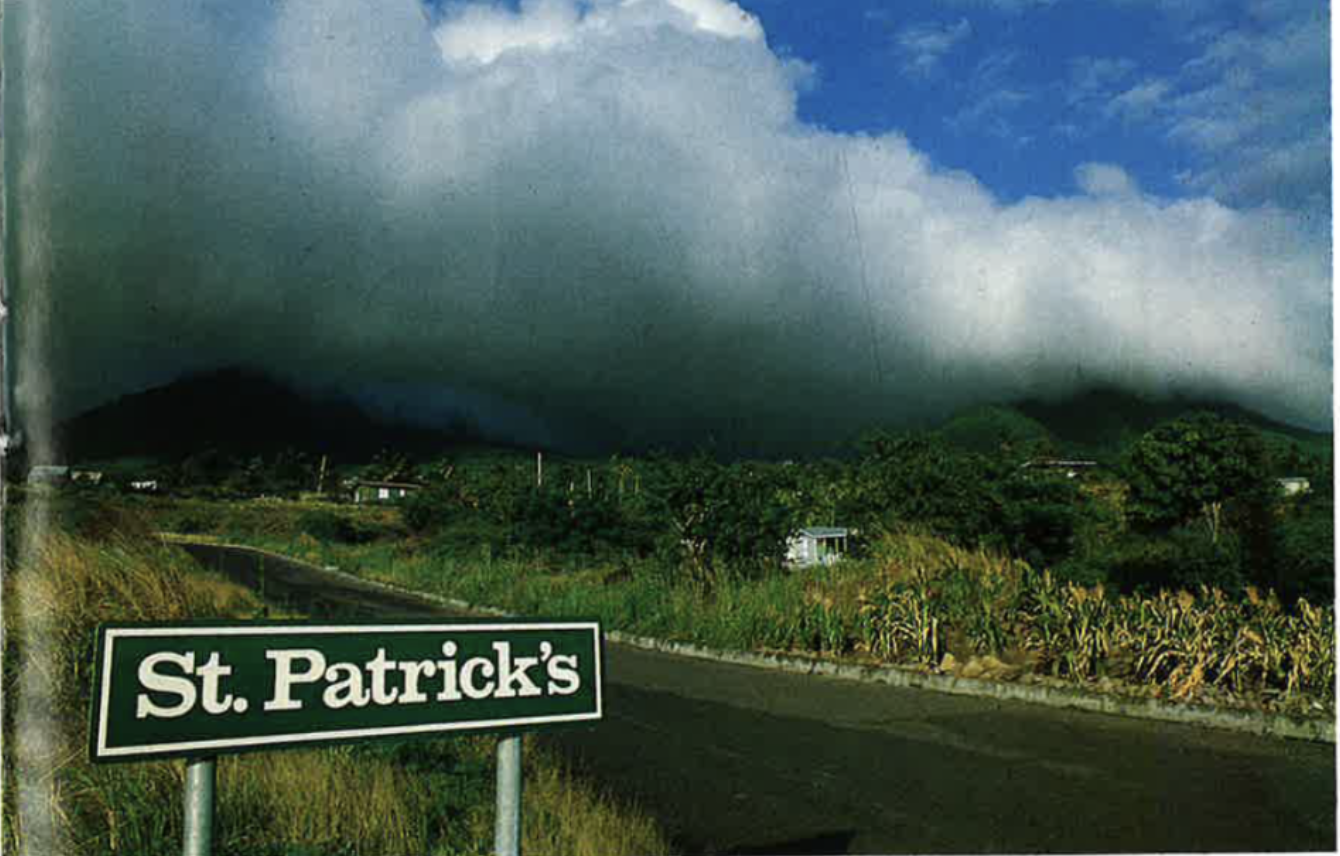
Carr’s Bay at the north of the island is considered to be the landing spot of the earliest settlers, while later groups used Sugar Bay near Kinsale. Kinsale jetty is only one mile and a half from St. Patrick’s where three 17th century cemeteries, several churches and the majority of the Catholic population are located.
The earliest township was known as Stapleton Town, and the bay on which it stands is Brisbit’s Bay, both named after Irish governors who served the island.
There is also an old 17th century cemetery at Carr’s Bay.
African slaves were imported from 1664 onwards and by 1678 the slave population numbered 992. (They had reached a total of approximately 10,000 by 1805.)
In 1689 the Irish population was around 800, with the English around 300.
Although the Irish plantation owners had a reputation for being liberal, there is at least one recorded slave revolt against their Irish masters. In 1768, there was a Negro conspiracy that misfired because, as the story goes, the plot was discovered by a Negro woman who heard the two leaders disputing about the disposition of their arms. The plan was to have been carried into execution on St. Patrick’s Day. “The slaves were to have secured the swords of the gentlemen and those without to have fired into the house.” The ringleaders of the plot were summarily executed.
Howard A. Fergus, a local black historian, has written a poem dedicated to the leaders of the St. Patrick’s Day revolt.
Here are the first two stanzas: To heroes of St. Patrick’s Day in whose black breast the multicolored pulse of freedom beat /A bloody march to bloody death /To heroes of a nighted thrall whose livid lips /Made universal call /To freedom Evoking stony silence /From St. Patrick’s Whited gods.
It must have been ironic for the Irish of Montserrat in 1768 to have to put down a revolt in the name of “Freedom.”
Mr. Mead, a local government official whom I met in Delvin, kindly provided me with a copy of John Messenger’s article, “The Irish of Montserrat.” Messenger, an American sociologist, spent some months on the island in 1965 on a Ford Foundation grant. I have drawn from this work for the early history of the island.
Messenger believes that the “Black Irish” as he terms them are the descendants of Irishmen who took legitimate African spouses and are today found scattered among 13 villages but essentially in the northern part of the island, around St. John’s. They are members of several closely related families (clans?) in particular the Sweeneys, Gibbonses and Allens. They intermarry out of a sense of tradition and to preserve their light skin color, which is a status symbol in Montserrat as elsewhere in the West Indies.
Howard Fergus questions Messenger’s theory of the “Black Irish” and tends to believe they are descendants of English and Scots ancestry, which would explain their Protestant religion.
The Delvin plantation was probably founded by one of the Tuitts, a well-known Westmeath family. A valuation of this plantation in 1726 showed that the slaves were sold as part of the estate: “16 negro men (40–15 punds) including Westmead very sickly (30 pounds) – 475.”
Numerous African slaves, upon emancipation in 1843, took the names of their former masters. Names like O’Garra, Kirwan, Riley, Irish, Hamilton, Burke, Power, Tuitt, would correspond to this origin.
Nincom Riley, the only literate slave at Rileys, was called upon to read the Declaration of Emancipation. Few slaves were baptized during the two centuries that Africans were imported into Montserrat for fear that converted blacks might become subversive. The earliest record of any extensive baptism of slaves appears to be a Catholic one, when Fr. O Hannan baptized all the slaves belonging to the Kirwan, Canonier, Semper and Hamilton families, around 1828. The Kirwans, Hamiltons, along with the Burkes and Powers were the staunchest supporters of the Catholic church during the century from 1740 to 1840.
I called on Belgian-born Bishop Antoine Demets at Patrick’s Church, Plymouth. A charming, erudite scholar, he has written an excellent history of the Catholic church on the island. He was only too happy to identify the landmarks of Irish colonization that still exist in the island. He is ably assisted by Fr. Donal Broderick P.P. from Cork (no relation to the Brodericks of Broderick’s Estate it seems) who has been on the island for ten years.
Not surprisingly there has been a long Line of Irish priests as missionaries on the island. One of the earliest was a Limerick-born Jesuit, Fr. Stritch, who came disguised as a lumber merchant in 1651, because Catholicism was proscribed at the time by the English administration.
A Fr. O’Brien ministered on the island from 1777 to 1800 and left a detailed diary of events. Now unfortunately missing, the diary recorded ihe Irish descent of many planter families: Riley, Sweeney, Power, Ryan, Fergus, Allen, Burke, Furlonge, Kirwan and Hamilton.
The present Catholic church was built in 1854, when Bishop Monaghan, first Bishop of Roscrea (the diocese of the Leeward Island) made a special visit to give it his blessing. Although originally, in majority, Catholic, today the island’s population are mostly Methodist, Anglican or Wesleyan, with only a small Catholic community.
A local black Methodist preacher, Thomas O’Garra, was connected with the early Methodist missionary activities around 1850. George Lawrence’s book on the life of O’Garra tells how “Uncle Tom” as he was popularly known, used racy and humorous Monserrati patois interspersed with occasional phrase and grammatical constructions that betrayed his “English” education.
The last of the descendants of the original Irish settlers left around 1850 after the passage of a major hurricane had devastated crops. Most moved elsewhere in the West Indies or to Panama, though some did return to Ireland.
After the decline of the cotton and sugar markets, the island economy became focused on the lime-growing industry, set up in 1850 by Francis Burke. This continued to flourish until the 1900s and Montserrat lime-juice gained a well-deserved worldwide reputation. Lime plants are still grown in reduced quantities, along with some cotton, but the former great sugar plantations have shrunk to a few hundred acres. The Government hopes to develop the sugar industry again, gearing it to the export market. A local white rum is produced that compares favorably with Irish poteen.
The Montserratians are so used to living with the Irish connection that now they don’t notice it any more. Wandering around Plymouth, the visitor is nevertheless struck by the shop signs: Sweeney’s Furniture, Riley’s Rainbow, Emerald Island Newsstand. At the latter establishment I was able to purchase a souvenir sun-shade, white plastic with a violent green shamrock: “Love my Montserrat.” On Parliament Street, which is Plymouth’s main street, I discovered the site of the former Hamilton family property, now owned by M.S. Osbourne, a local businessman. Over the main entrance is a blue enameled sign that states “Trescellian House” from the Gaelic meaning “trefoil” or shamrock.
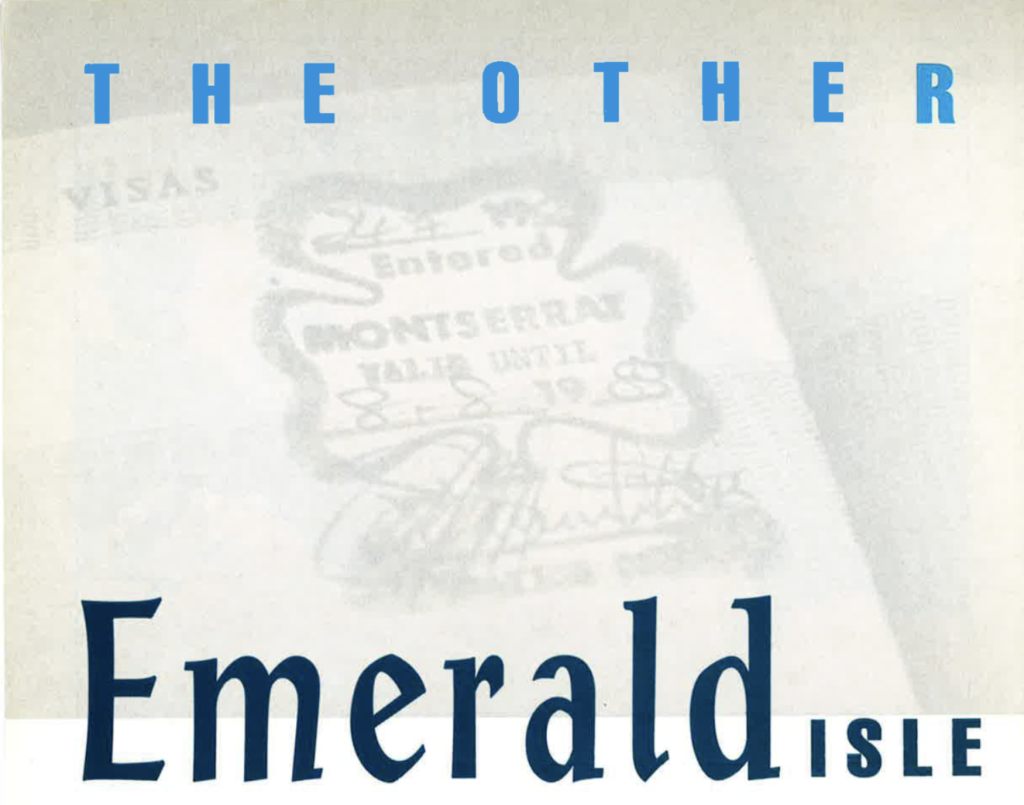
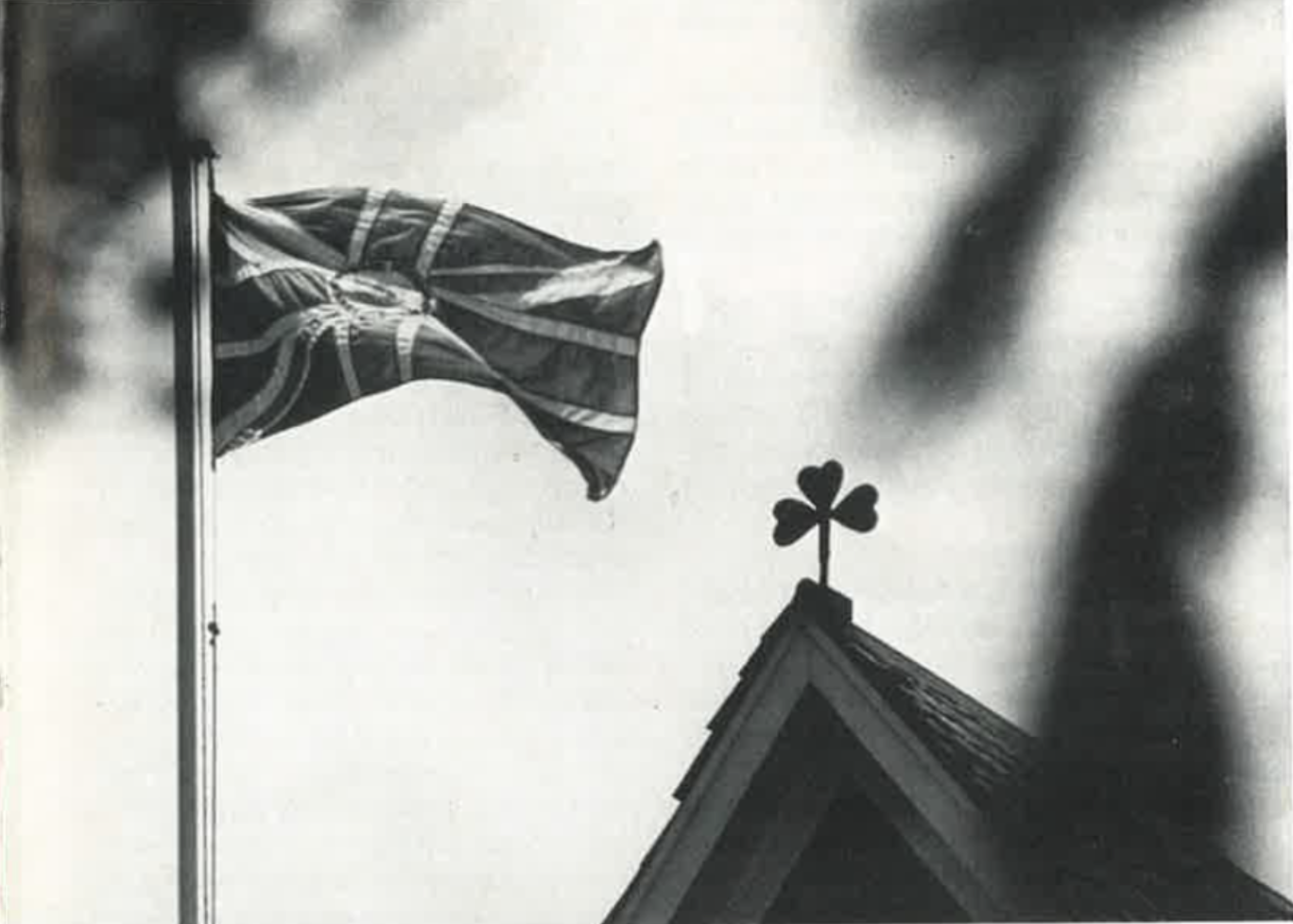
As you drive around the island, names with an Irish connection constantly appear: Cork Hill, Fogarty Hill, Harris Lookout and Fergus Mountain all recall the presence of the Gael. But probably the most constant reminder of Montserrat’s past are it’s Kelly green shamrock passport stamp and the shamrock on top of the Governor’s mansion.
Apart from its scenic beauty, Montserrat is certainly an emotional pilgrimage for anyone with a drop of Irish blood in his or her veins. Sitting on the terrace with a rum cocktail at hand, contemplating a dramatic Montserrat sunset, the mind is inevitably drawn to the countless Irishmen and women who lived and died here, so far from their native land.
They may rest assured that they have left an indelible genetic and cultural mark on “the other Emerald Isle.”
NOTE: Less than two years after this article was published in Irish America, the Soufrière Hills volcano on Montserrat erupted on July 18, 1995, starting a long multi-year series of eruptions that lasted intensely through 2010 (with minor activity ending around 2013).
The island has only partially recovered and remains permanently altered. About two-thirds of the island (the southern half) remains an uninhabitable exclusion zone. The former capital city, Plymouth, was completely buried under deep layers of ash and rock and functions as a modern ghost town. Two-thirds of the original population fled abroad or relocated permanently, dropping the population from around 11,000 to roughly 3,000 to 4,000 people.
A new town and port area called Little Bay is being developed in the safe northern zone to serve as the new capital and commercial hub.The island survives on a mix of British aid, eco-tourism, and unique scientific interest centered around the Montserrat Volcano Observatory. While the north of the island is green, functional, and safe, the south remains a dramatic, frozen-in-time monument to the natural disaster. YOU CAN HELP fund community programs, elderly care, and disaster preparedness via the Montserrat Red Cross.
Editor’s Note: This article was originally published in the September October 1993 issue of Irish America. ♦
Leave a Reply