
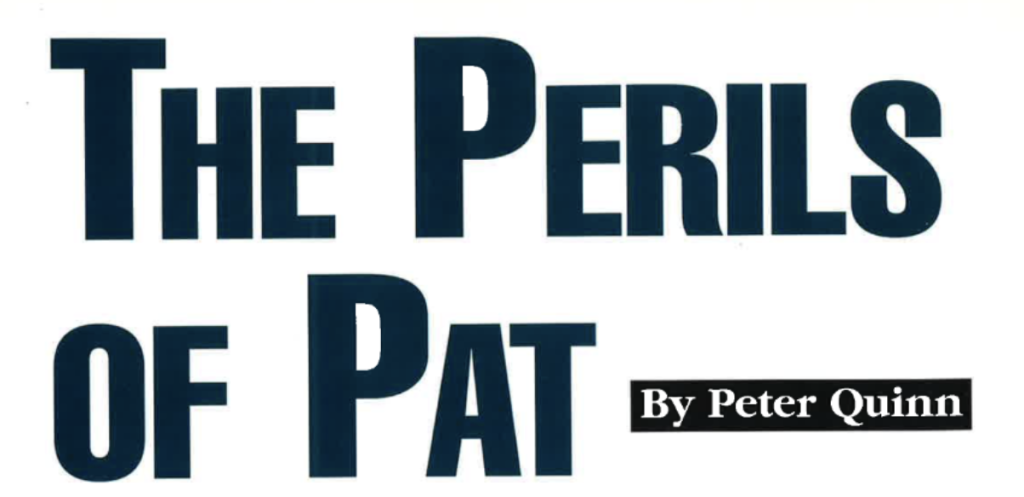
The man on the horse is my paternal grandfather, Patrick Francis Quinn. The date is September 5, 1904. Pat is about to take his place as Grand Marshal of the New York City Labor Day Parade. The horse was rented for the occasion. I have the sash he is wearing in the photograph, a piece of faded blue silk embroidered with gold lettering: P. F. QUINN — PRESIDENT — CENTRAL FEDERATED UNION
The place is outside the old Fifth Avenue Hotel, which stood at the corner of 23rd Street, across from Madison Square Park.
Somewhere out of view of the camera, my grandmother tended her three children, Gertie, John and my father, Peter, born the previous May.
Pat was just short of his forty-fifth birthday. He’d been born outside Thurles in County Tipperary, on September 27, 1859, barely a decade after the famine that had ravaged much of Ireland. At the height of it, Colonel Douglas, a relief inspector in Tipperary, had written his superior, “Nobody who has not personally seen the state of matters in this country can form to himself any idea” of the horrors. Pat must have heard a good deal of those horrors as a boy.
Although Pat was dead when I was born, he was fixed in my mind by my own father, who–for better and for worse—had been dominated and driven by Pat. This is how Pat taught my father to swim: Took him to Coney Island, walked him out to the end of the pier and threw him in. Later, he would discourage my father from the acting career he wanted to pursue, and push him into Democratic politics (a theatrical career of a kind, I guess, and one my father followed with some success, becoming a state assemblyman, a U.S. congressman and a judge).
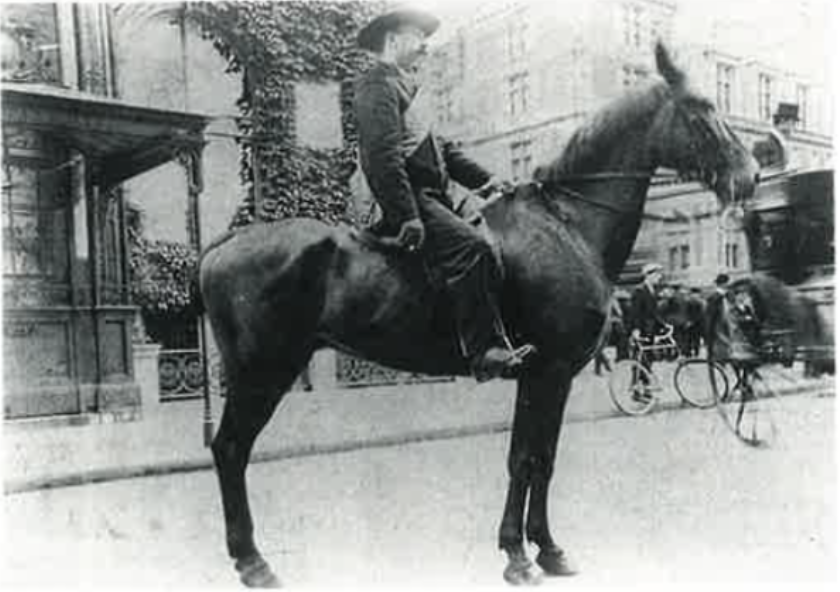
I have some idea now, as both a son and father myself, of the tensions that must have existed between the two. I know also that this must have been aggravated by radically different experiences and expectations: the father, unschooled, making his way in the world through brawn and bravado, a born wanderer; the son, lithe, with none of his father’s workingman’s bulk, a graduate of Manhattan College and Fordham Law School, a young man who loved to dance and read Shakespeare, and who was at home in New York.
There was between Pat and his son, I’m sure, a touch of the shadow that demarcated the lives of James and Eugene O’Neill-that perhaps falls between every emigrant and his son. But his own private long day’s journey was something my father never spoke about. Instead, he held us spellbound with tales of the public Pat. The bones of the story are contained in the obituary printed in the Bronx Home News in October, 1941. Pat, the boy who went West, who fought in Cuba, who played a prominent role in the union movement. On these bones my father put flesh and blood, a chronicle of serialized adventures beside which even Davy Crockett (cynosure of every red-blooded Bronx kid in the 1950s) seemed to pale.
Pat landed in New York in 1873 with his parents and siblings (their passage paid by a relative who’d come out in the 1840s). He attended school only briefly before he was put to work. Sometime around 1880, Pat set out on his own, got a job on the railroads and headed to the frontier.
It was at this point the sketchy details of Pat’s early life gave way to the full-blown talents of my father’s abilities as senchai and raconteur. Pat wasn’t merely one of the army of Irish laborers stoking furnaces on the hundreds of trains crisscrossing the continent.
Pat’s train was pursued through the wildest west by the most ferocious of the Apaches, and as the engine struggled up a steep incline, it was Pat’s epic coal shovelling that gave the train the steam it needed to escape.
The irony of an Irishman helping drive forward the same process of colonization in America that had dispossessed his own people in Ireland was one we never considered. Yet, though caught like everyone else in the contradictions of history and marked by his own inconsistencies, Pat was a man with a gut-seated hatred of injustice. “I know what it’s like to be hungry,” he once told my father. “And that changes a man.” By the 1890s, Pat was fully immersed in the struggle of organized labor. He was an early member of the Knights of Labor. In 1894, he went to Chicago to help support the famous Pullman Strike and was threatened at gunpoint by railroad detectives. He was set upon one night in Tompkins Square Park by anti-labor goons. He earned his place at the head of that Labor Day Parade.
Pat was married twice. When his first wife died in childbirth, Pat left his infant daughter, my aunt Gertie, with his sister and went to Cuba to bury his grief by digging for gold. He ended up fighting alongside the Cuban insurrectionists.
Back in America, he married a new love, my grandmother, and became a leader of the Coppersmith’s Union and an organizer for the AFL.
Pat’s union work kept him on the road part of the year, and sometimes he took my father along.
My father remembered one time in particular, in the summer of 1916, when they travelled from a labor convention in Detroit for a day’s outing in Toronto. It was at the time of the British offensive on the Somme, and the imperial patriotism of many Canadians was running high. Pat and my father were crossing a public square at dusk when a band began to play “God Save the King.” Silent, reverent men removed their hats as the Union Jack came down. My father went to take off his cap.
Pat stopped him. “That flag is a symbol of royalty and aristocracy,” he said in a loud voice. “It stands for empire and greed. Never doff your hat to it.” There were shouts from the crowd, and threats. My father was scared but kept his eyes on Pat, who wouldn’t be cowed. Pat stood there with my father at his side, hats unremoved, heads unbowed. And that’s how I most like to think of them: the Irish immigrant laborer and his son, together in that one moment, afraid perhaps but refusing to bend a knee before emperors or empires.
Peter Quinn’s first novel Banished Children of Eve, set in Civil War-era New York, has received rave pre-publication reviews, and will be published in March by Viking/Penguin.
Editor’s Note: This article was originally published in the November December 1993 issue of Irish America. ♦
Leave a Reply