
Christmas season is the time to eat, drink and be merry! Wherever one goes it seems, someone is slicing up a fruitcake or pouring a glass of holiday cheer. Surrounded as we are by Madison Avenue merchandising it’s easy to forget that at this time of year we are participating in one of the oldest rituals known to humankind.
Eons before the birth of the Child whom angels praised and shepherds sang, the sun’s movement through the heavens was a wondrous cycle. Our ancestors were simple folk. They planted crops in the spring, nurtured them through summer and reaped harvest’s bounty in fall.
Winter was another matter. Cold winds blew and plants withered. Food ran out and people starved. Daylight became feeble. For all anyone knew, the life-giving sun might disappear altogether, forever plunging the world into dismal darkness. In an attempt to prevent this calamity, early humans honored the sun with ritual and ceremony on the shortest day of the year, Winter Solstice.
Around the world many places are famous for their ancient solar observatories: Egypt’s Great Pyramid, Mexico’s Mayan Temple of the Sun, England’s Stonehenge. Yet few know that the oldest sacred sun site on earth is found in Ireland. Less than an hour’s drive from Dublin, Newgrange in County Meath has been a silent sentinel of the sun’s celestial journey for more than five thousand years.
There in the inky black of the midwinter night, people gathered, waiting to honor the sun. The sky in the southeast would brighten, heralding its approach. Then, as the golden orb rose over the horizon, the first ray of sunlight passed through a small opening over the mound’s entrance, crept along a 60 foot passageway, illuminated the inner chamber and slowly crept out again as silently as it had come.
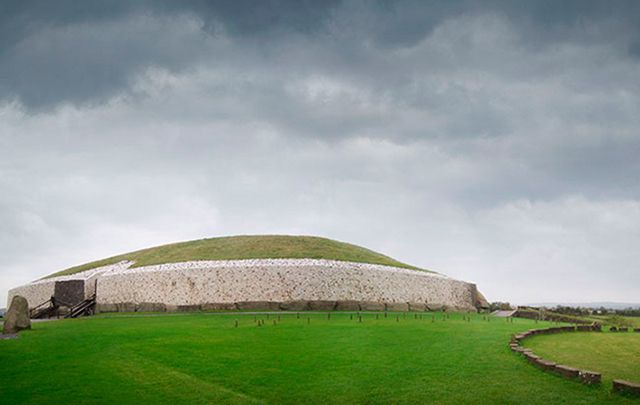
The sheer size of Newgrange is astounding. It rises 55 feet high, covers an acre of land and contains over two hundred thousand tons of material! The phenomenon that occurs there annually testifies to the engineering genius of its Stone Age builders. The ceremonies that took place there left an indelible mark on our ancestral memory.
By the time Christianity came to Ireland, the Winter Solstice observance was so firmly fixed in the lives of most early populations, there was no getting rid of it. And since the date of Christ’s birth was unknown, the Church decreed December 25 be recognized as the Feast of the Nativity.
Philosophically, it made sense. Winter Solstice was a feast honoring the sun god’s light. The Christ Child was the Son of God and the Light of Redemption.
With hardly a blink, ancient pagan rituals were absorbed into the new faith’s celebration. The main purpose of Winter Solstice festivities had been to dispel fear of the dreaded dark. In homes and public places alike, lamps, candles and hearth fires blazed forth. People put aside everyday chores and made merry.
As elsewhere, when Rome brought Christianity to Ireland, Christmas blended with local Winter Solstice rituals. Celtic tradition was absorbed. Mistletoe was revered because it remained green and bore fruit in the bare branches of oak trees.
Enemies who met beneath it were obliged to lay down their arms and embrace in peace. It became the delightful Kissing Ball. Holly was sacred because its red berries grew in the midst of winter snows. Soon it decked the halls.
A spicy fruitcake has been the crowning glory at an Irish Christmas feast for centuries. Made with dried fruit and drenched with a healthy dose of fine Irish whiskey, it kept well and even improved with age.
When the Crusaders returned from the Holy Land, they brought with them the secret of marzipan. Often cooks encased their fruitcake with sheets of this sugary almond paste and a coating of royal frosting. Homemakers with fewer resources made a simpler version. But rich or poor, everyone had a Christmas cake!
It is the New Year when one of Ireland’s national treasures is most appreciated. For it is then that we raise a glass filled with “Visce Beatha” (the Water of Life) and wish a year of good fortune to all. And though we have a never-ending selection of toasts, here’s one of the best for sharing.
“Health and long life to you! Land without rent to you! The mate of your choice to you! A life of peace to you! And may you be half an hour in heaven before the devil knows you’re dead!”
Sláinte! in this and every season.
Recipes
Traditional Christmas Fruitcake
- 1 cup dark raisins
- 1 cup golden raisins
- 1 cup currants
- 1 raw apple, grated
- 1/2 cup candied cherries, quartered
- 2 cups walnuts, coarsely chopped
- 1/2 cup mixed candied citrus peel
- 1 lemon, juice & grated rind
- 1 orange, juice & grated rind
- 2 cups sugar
- 1 pound butter, softened
- 8 eggs, beaten
- 1 teaspoon salt
- 1/4 cup Irish whiskey
- 5 cups flour
Begin the night before baking. Preheat oven to 200 degrees. Mix together the first nine ingredients in a large baking dish. Cover and place in the oven for 1 hour.
Remove and let sit overnight. Heat plumps the fruit, makes it sticky and keeps it from sinking during baking.
On baking day, preheat the oven to 300 degrees. Grease an 11 inch springform pan and line with greased parchment paper.
Cream sugar and butter in a large bowl. Stir in eggs, salt and whiskey. Add flour alternately with fruit and nuts. Mix well, using your hands when the batter becomes too thick to stir. Spoon into prepared pan until two-thirds full and spread smooth. Cover with greased parchment paper.
Place on oven’s middle shelf and bake 1 hour. Reduce heat to 275 degrees and continue baking. After another 2 hours, remove cover and bake 3 more hours. If cake browns too fast, lower heat and replace parchment cover. Cake is done when a tester can be inserted and withdrawn dry. Approximate total cooking time: 6 hours.
Remove cake from oven and cool. Remove cake from pan, invert on a wire rack and pierce with a skewer. Sprinkle with 2 tablespoons Irish whiskey, wrap in a whiskey-dampened cloth. Wrap in tinfoil and store until Christmas. Every week, unwrap cake, sprinkle with more whiskey, rewrap and store again. Allow to age at least 6 weeks.
Irish Whiskey Cake
- 13/4 cups golden raisins
- Grated rind of one lemon 1/2 cup Irish whiskey
- 2 cups Hour
- 1/8 teaspoon salt
- 1/8 teaspoon ground cloves
- 1 teaspoon baking powder
- 3/4 cup butter, softened
- 3/4 cup brown sugar, firmly packed
- 3 eggs, beaten
Mix together raisins, rind and whiskey, let sit overnight. The following day, preheat oven to 350 degrees. Grease a 9 inch springform pan and line with greased parchment paper.
Sift together flour, salt, cloves and baking powder. Set aside. In a large bowl, cream butter and sugar until fluffy. Stir in eggs. Add flour mixture alternately with raisins and soaking liquid. Turn into prepared pan, place on middle rack in the oven and bake approximately 90 minutes. Cake is done when a tester can be withdrawn dry.
Cool on a wire rack.
Icing
- Juice of 1 lemon
- 13/4 cups sifted confectioner’s sugar
- A little warm water
- Crystallized lemon slices
Mix lemon juice with confectioner’s sugar and enough water to make a semi-thick icing that will pour. Put a large plate under the rack to catch icing run-offs. Pour icing on cake, letting it run down the sides. When icing sets, decorate with crystallized lemon slices.
Editor’s Note: This article was originally published in the November December 1993 issue of Irish America. ♦
Leave a Reply