
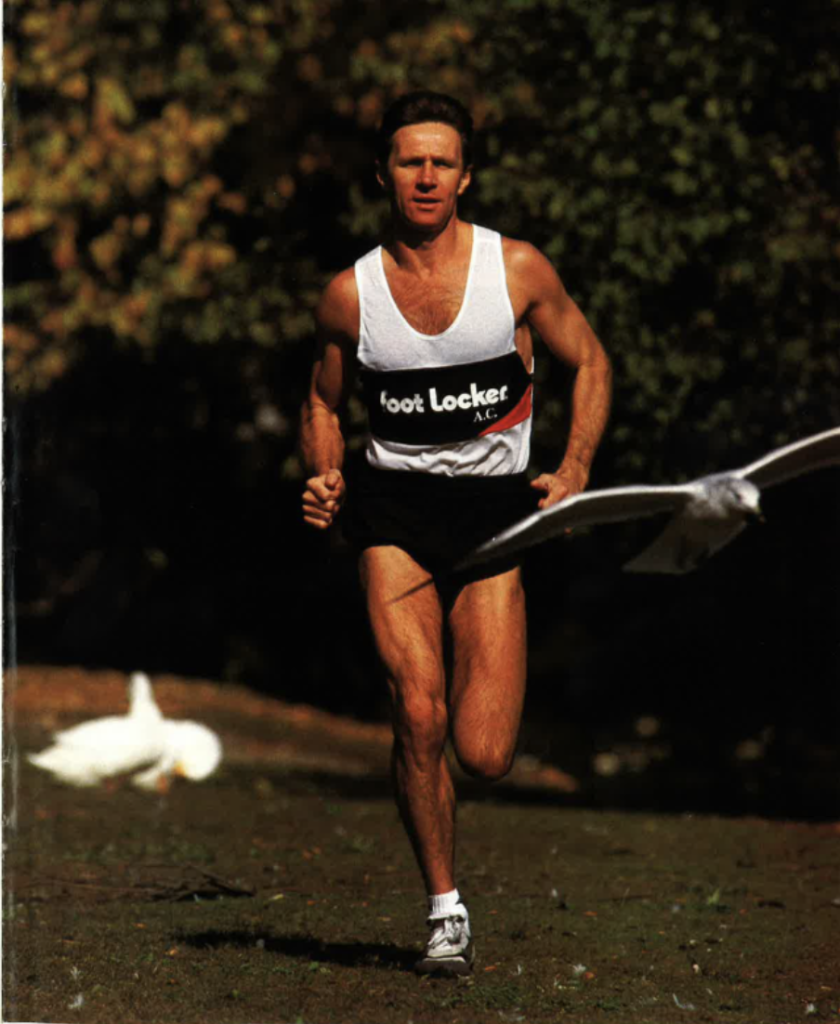
Irish runner Eamonn Coghlan is heading a team of runners in the New York City Marathon who have more than winning as their goal. He talks to Frank Shouldice.
When Eamonn Coghlan steps onto the starting line at the Verrazano Bridge this year it will be the second time he has taken part in the New York City Marathon. It was Fred Lebow, a co-founder and current director of the event, who persuaded Coghlan to compete in the 1991 marathon. The Irish miler had finished with competitive athletics but he decided to give it a go. To his surprise— and delight – he clocked 2:25:13 hours and finished in 41st place.
This time his eyes will be less on the clock than on his team of 50 runners who will set out to raise a minimum of $5,000 each, for research at Our Lady’s Children’s Hospital in Dublin, where Coghlan now works as Marketing and Communications Executive. The aim of the marathon project is to raise $250,000 for the hospital.
Running as co-captain of the team will be nine-time women’s winner of the event, Greta Weitz. Also helping with the team is Charles McCabe, a graduate of Iona College and currently executive vice-president of Corporate Marketing & Communications with Chemical Bank. New York and the United States hold more than a passing interest for the 41-year-old Dubliner, having lived on the East Coast for 20 years, it was the American experience that brought him into the limelight of international athletics.
“I don’t really feel that I’ve left America,” he says candidly. “I have to admit I don’t think there’s a minute of any one day when I don’t really long to be back there. It’s like the grass is always greener on the other side — when I lived in America all those years l’d think about going back to live in Ireland. And now it’s the reverse. When I get on the plane and head to New York, to me it’s like going home. When I get out in Kennedy Airport, it’s just like getting out in Dublin. I’d have absolutely no problem living over there at all!” he says in a way to suggest he means it.
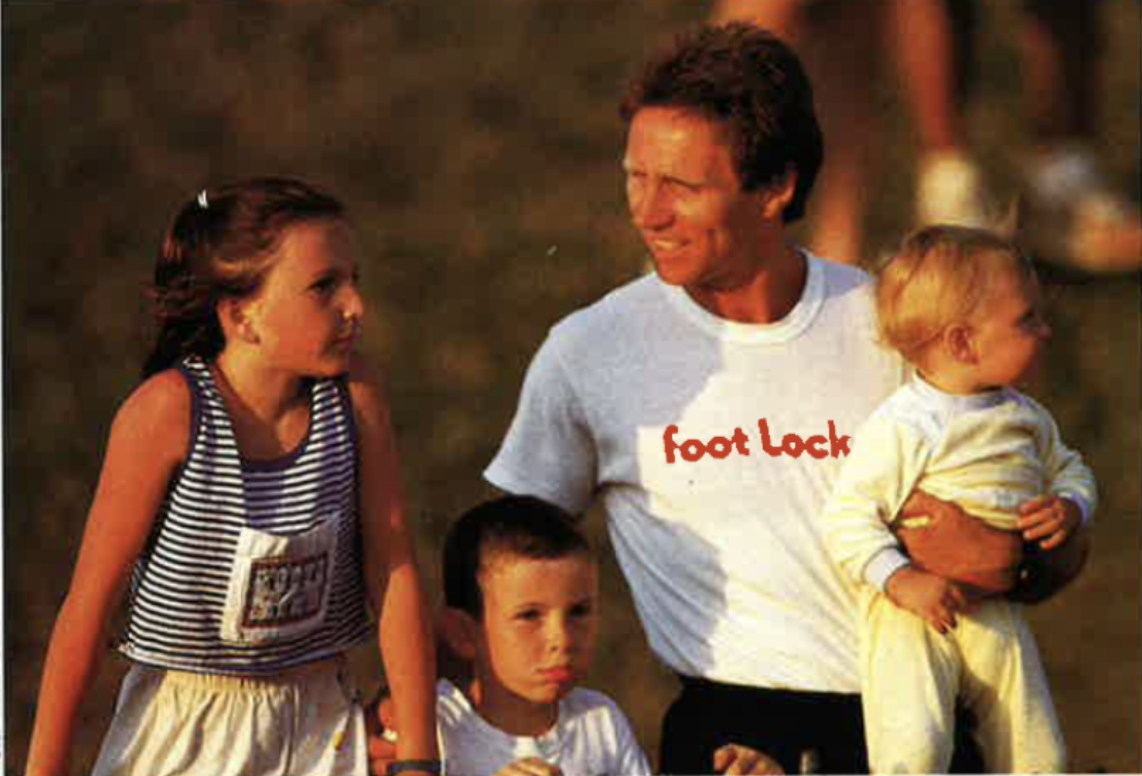
The decision to move back to Dublin three years ago was more a family decision. Like many expatriates, his wife Yvonne was keen to try living in Ireland and the time had come to give their children, Susanne and Eamonn Jr., an experience of both lifestyles.
“Really, we wanted to give the kids the opportunity to have what we had, a solid foundation of a family feeling in your life, which most young Irish-American kids don’t have because their parents who emigrated there have grown up without that extended family around them.”
But of all the family, the move was the hardest decision for the athlete. “It’s difficult to leave a period of your life where people are running after you, looking for you to do things,” he explains.
“Where there’s a constant buzz of excitement all the time, where the pace of life is an awful lot faster, where you have been admired — if you like — and adored and cheered, on a high emotionally for many many years of great racing. And to leave that and come back to an environment where, generally, no one really gives a damn, it’s tough psychologically to understand. But I think I have a grip on it. And basically, finishing fourth twice in the Olympics really prepared me for what the other side of the coin was like.”
Considering he came to prominence during his years in the U.S. the ready acceptance of Eamonn Coghlan by the American public is hardly surprising. He was good for America and America was good for him. His confident, direct, forthright – sometimes abrasive – manner suited public life there. In Ireland, where confidence is not worn so brashly, the scale of things is more conducive to coy participation than to the unintentional arrogance of the achiever.
But Coghlan’s stature in U.S. athletics has never been fully understood in Ireland.
The indoor circuit may be a huge draw in the U.S. for instance but Ireland does not have even one indoor track. ‘The indoor mile event — which Coghlan made his own — is the jewel of any indoor meet but to Irish sports fans, it’s just unfamiliar territory.
So when the Dubliner won his seventh Wanamaker Mile to earn the lasting accolade of Chairman of the Boards, his success was viewed from Ireland with distant admiration. He wore “Discover Ireland” across his vest but ran as an individual as though Ireland had never really discovered him. He was “ours” but he was never there.
“I think that applies to nearly anybody who goes abroad and is successful in a foreign country.” he feels. “Like Sean Kelly or Stephen Roche [cyclists] or Tony O’Reilly in the business world.
I think that’s just the way Irish people generally are. They almost don’t want to admit that you have made it to a certain level of fame or fortune abroad. People here (in Ireland) certainly don’t understand the extent of the fame, or whatever, I would have reached in New York.”
When it came to the Olympics, Coghlan became an “Irish” athlete. Along with John Treacy, he represented the best hopes of an Irish medal. Running in the 1500m final in Montreal in 1976 he finished fourth.
Four years later in Moscow he switched to the 5000m and again finished fourth in the final. Although these disappointments were offset by a spectacular win three years later at the Helsinki World Championships, the news of his many successes in the U.S. and the public failure in the Olympics Ied to a querulous sense in Ireland that Coghlan was not everything he was cracked up to be.
He does not dispute the position but at this stage, is hardly troubled by it. “I think there’s more a sense of nationalism when you’re abroad than there is when you’re at home. When Irish people in foreign countries see Irish people doing really well they want to come out and feel proud that they’re sceing one of their own doing some thing away from home. And it seems like there’s obviously less begrudgery for that individual, whereas at home, even though they might be proud of you, they don’t want to let you know they’re proud of you.” One seldom thinks of athletics as a metaphor for life but for Coghlan, the low-point came when he went back to Dublin — he resigned from the Irish athletics body (BLE) when internal opposition to him became unappeasable.
“When I think back to the 31st of July. 1976 or to the 10th of August, 1980,” he begins, “I remember how my whole life went into the preparation (for the Olympics), only to be let down. And then all of a sudden your career is behind you. Everything that a person does, from going to school and college and getting a job and retiring at sixty-five, is captured in your experiences as an athlete. So those highs and lows did give me a certain amount of philosophy for life in terms of keeping level-headed, and how to relate my experiences to other kids coming through, or even my own kids.”
Although he formally retired several years ago, he has retained his 1981 world record as holder of the fastest indoor mile.
He likes to keep that record but does not see it lasting forever. Meanwhile, there is something else to occupy him. Coghlan’s former adversary, John Walker of New Zealand, aspired to be the first 40-year-old to break the four-minute mile.
Walker didn’t make it and retired through injury. Coghlan is now attempting the same goal. Earlier this year he clocked 4:01 on the European circuit. In July thousands of fans came to University College Dublin to see if Coghlan could do it. In windy. outdoor conditions he clocked 4:04 but the warmth of the crowd was genuine and clearly it meant a lot to him.
But what importance does this race have anyway? “First of all it’s a personal challenge – and we all have personal goals,” he says. “But the bottom line is if I do it I’ll get a lot of money as well. If I was getting zero for it, it would be harder to motivate myself to do it. But the personal challenge is number one. And I could always say I was the first bastard to run the four minute mile at 40. But,” he laughs, “who gives a damn?”
It is not, he insists, an effort to get back into the glory days. The chances are he might move back to the U.S. lo prepare a proper assault on this record.
Maybe he and Yvonne might someday move back to their home in Rye, New York. But for the moment, he’s working from a small Dublin children’s hospital and he wants to raise $250,000 from a marathon being run in his favorite city.
“There’s a great sense of satisfaction in doing this job,” says Coghlan. “I’ve got a great team of people. All I have to do is walk across to the next building and see all these kids dying of cancer. Or go up to the intensive care unit and see these kids who are in bad shape from serious accidents.”
“You go down to the lab downstairs and you see the researchers, working on AIDS, on immunization projects, on the development of growing skin in a lab and you realize the back-up support you are giving is going to help somebody that’s more important to mankind than me running the four-minute mile at 40 or holding the indoor mile record.”
Editor’s Note: This article was originally published in the November December 1993 issue of Irish America. ♦
Leave a Reply