
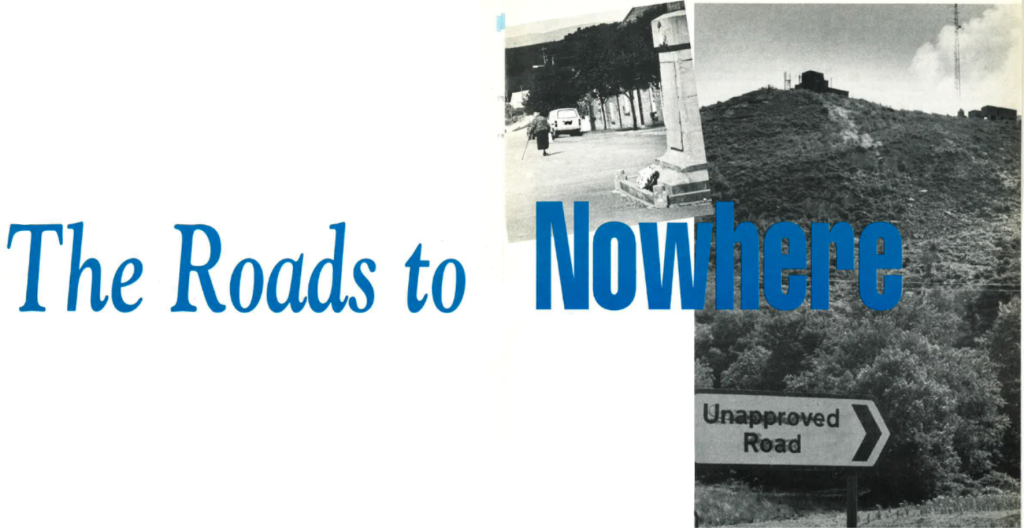
With the implementation of the Single European Market at the end of 1992 that “opened up all European frontiers to free movement and trade” no one in the border counties of Fermanagh and Leitrim registered more than a cynical shrug of their shoulders. For years the border, imposed under threat of war in 1922, had not only cut through their homes and fields but every aspect of their often bleak rural existence.
That the border dividing their communities resembles in places the Ho Chi Minh Trail and in other areas the Berlin Wall is living testimony to their plight and torturously slow economic demise. Oistin MacBride spent a week talking to the farmers and soldiers, the women and the clergy whose lives center on this meandering line. It is a story of contrasts, economic survival versus “security requirements,” hi-tech versus high hopes.
In County Fermanagh, there are 50 roads that go nowhere. In an anachronistic throwback to the years of the Famine when roads were built into the middle of the bog or up mountainsides as part of ill-conceived poor relief programs, roads that once carried shoppers, workers and tourists, and were the intimate infrastructure of this stunningly beautiful rural county now simply end in the middle of nowhere.
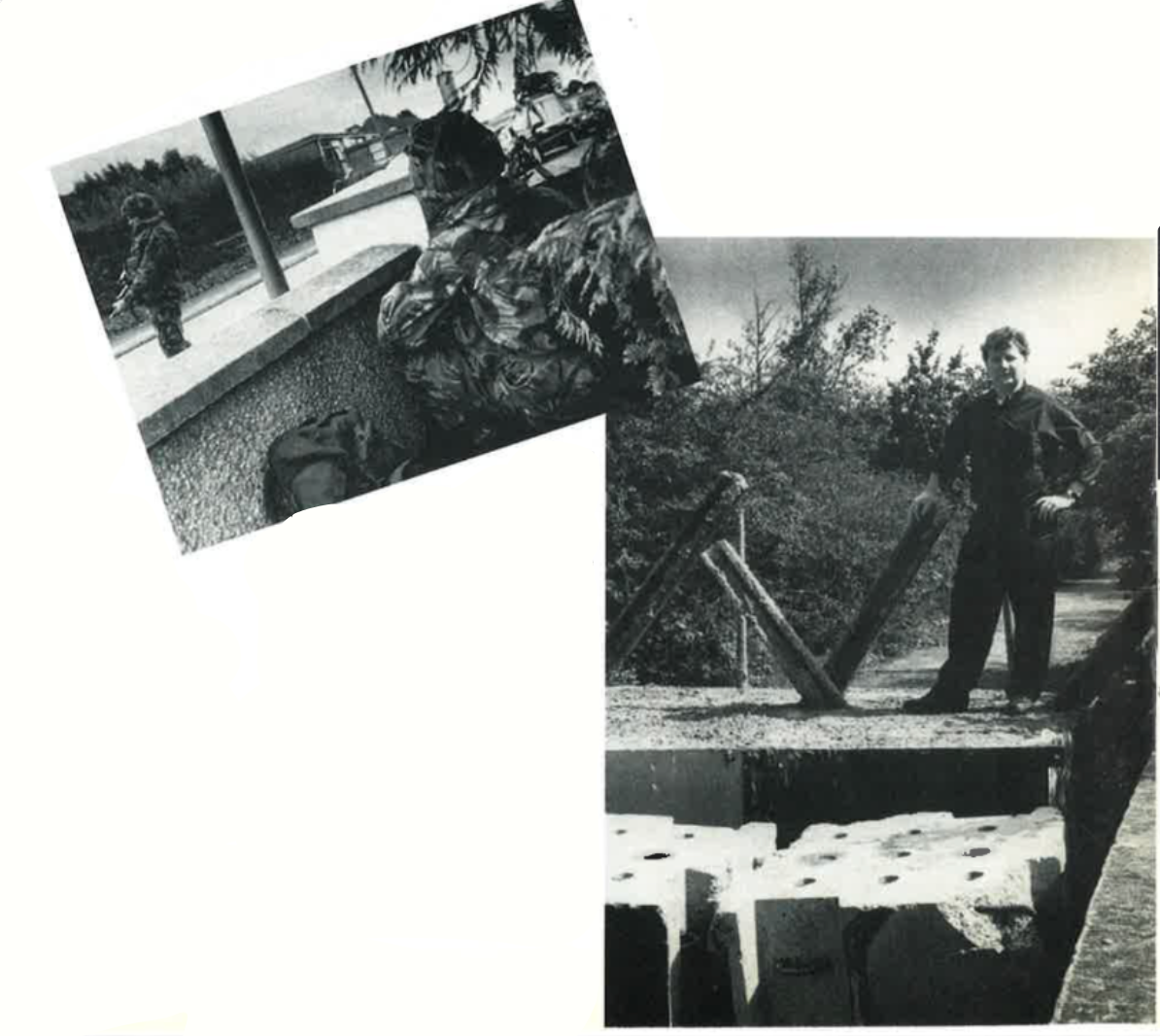
There are massive concrete bollards, huge steel spikes and areas of cratered land that in places resemble No Man’s Land during World War I.
Bridges and roads have been blown up, fords have been gouged out of existence, and fields have been entrenched for up to three hundred yards by British Army engineers intent on preventing the roads being used or bypassed by any means, including, in many cases, foot.
“The many negative effects” of the systematic policy of road closures were what brought the Irish Minister of Foreign Affairs, David Andrews, to the border areas for a much publicized visit in April of last year.
His promises to raise the issue at the Intergovernmental Conference in London were welcomed by a community that feels time is running out for it. They have organized themselves into the Fermanagh Leitrim Community Association and on any given Sunday from 50 to several hundred of its members and supporters engage in “Border Bustings.” Those who are not driving machinery, swinging picks or lipping stone, keep themselves busy with a vigorous and well-orchestrated lobby of politicians, clergy, personalities and sporting bodies.
They are farmers, publicans and even clergy, involved in what everyone is keen to stress is a cross-community effort. A perfect example of this they say is that one of the first to suffer as a result of a road opening operation was a Protestant farmer with land on both sides of the border who had a tractor worth over £15,000 confiscated under new emergency legislation.
“It is a two-pronged effort,” says outspoken cleric Fr. Joe Me Veight CC in the small border community of Garrison and PRO of the Community Association. “The people are empowering by their own actions, they see the results of their efforts every time a road is re-opened. It is a very real feeling of success. It is like a little miracle at times. Where once there was a wasteland of craters or concrete and steel barricades there is a new road as a result of popular community action.”
Not a Single Road
Garrison is a picture postcard village on the shores of Lough Melvin. Its two nearest neighbors are Kiltyclogher and Ross-inver; they are less than five minutes away.
That is if the roads were open. Now there is a 20-mile detour through either County Cavan or County Donegal because there is not a single road open from Fermanagh into Leitrim. In days gone by the people of Garrison went to Kiltyclogher to do their shopping and to céili.
There was a thriving community, business was good in the shops and the bars, and there was the constant social and business interaction between the two parishes that is typical of any neighboring communities and makes them economically, socially and culturally interdependent.
Now travelers on the road between the two villages park their cars at a footbridge (erected over a fast flowing stream after two local men drowned trying to cross it) and walk the last half mile on what looks like an overgrown laneway to a deserted house, into the low end of the town.
Living but Dying in a Ghost Town
Coming out of the shadows of overgrown hedgerows on what was once the busiest route into the town is like stepping into the empty set of a movie. All the accoutrements are present, but the people needed to bring it to life are thin on the ground. There are two shops left, a pub and a hotel. The Technical School is closed and the priest left town two years ago.
An old woman on a stick walks down the middle of the main street under the noonday shadow of the statue of the town’s most famous son, Sean MacDiarmada, executed following the 1916 Rising. On her way to the butcher’s shop, which sells “great beef,” she knows she is in no danger of being run over by passing traffic.
Wake-like, three timeworn residents gather round a tractor on the edge of the square and preside quietly over the imminent death of their community. They point to the mass exodus of young people to England, the United States, and even to work in the Middle East. At a rough count two-thirds of the 30-something houses in the town will probably remain empty when the present residents die or leave. There will soon be more trees neatly lining the main street than people to walk in their shadow.
On the way back across the footbridge a farmer whose furrowed face is stamped with worry explains that he is waiting patiently for the vet to come and tend to a very sick cow. He is picking the vet up on the northern side of the bridge to save him a round trip through Donegal of 56 miles.
If the road was open it would be 22 miles and he could wait with his sick cow instead of running a ferry service. Eventually, he can wait no longer as there is no one at home with the cow.
The agreement not to do so is “more often violated than honoured according to Headmaster Kevin Campbell.
Right: Garrison priest Fr. Joe McVeigh
CC atop one of the many concrete and steel barriers that cut his parish in half.
Kiltyclougher is a ghost town at the end of one of the 50 roads to nowhere in Fermanagh. Its jugular has been cut and it is hemorrhaging its life blood at an ever-increasing rate.
The members of the Fermanagh Leitrim Community Association know that their efforts are like putting a Band Aid on a gaping wound, but after 20 years of road cratering and barricades being built and rebuilt they feel they have to do something to save the life of their community.
Hi-Tech 8 Human Shields on Europe’s Last Frontier The corollary to the border-long policy of cratering and barricading hundreds of roads, that result in 50 out of 58 roads into Fermanagh being closed and destroyed, is the opening of a number of strategic “Frontier” routes so that traffic from as wide an area as possible can be funneled and filtered through what are euphemistically called “checkpoints” but what are in most cases specially constructed “Forward Patrol Bases” containing up to 400 British soldiers.
Even in the later days of the Berlin Wall it had nothing to compare with the state-of-the-art technology and methods of fortification employed by the British security forces operating in and around what have become infamous landmarks along a meandering border from Derry to Newry.
Bases like Aughnacloy, where Aidan McAnesie was shot dead (following years of documented harassment) as he went to play a game of Gaelic football.
Buncrana Road, where five soldiers and Patrick Gillespie, a civilian working for the British Army, were killed in what was called a “human bomb” attack.
And Derryard, where an attack reminiscent of The Flying Columns in the 1920s involving several dozen IRA men on board a hijacked truck containing a massive bomb and using rockets, automatic rifles, grenades and even a flame-thrower left the base totally destroyed and several soldiers dead and injured.
Since the signing of the Anglo-Irish Agreement in 1985 these border bases have sprung up like futuristic mushrooms on hilltops and roadsides and now more prevalent than in South Armagh where it seems every hilltop of significant height has such a Forward Patrol Base accompanied by at least one huge observation tower, several outer observation posts, a helipad and a large radio mast.
With One Sweep of His Hand
Standing on a hilltop overlooking the shimmering crooked Camlough Lake one cannot help but be impressed by the awesome beauty laid out as if on a canvas in front of you, that is until the subtleties of conflict in what the British call “Bar Country” are pointed out by a farmer tending to a broken fence. He names townlands, the hills, his neighbors and friends who own the farms that run up to slopes and down to the water’s edge. Then with a slow, accusing sweep of his hand taking in the whole of the horizon points out one by one the watchtowers, the hilltop, forts and the radio masts. As he pauses to reflect and with only the sound of a hilltop wind cuffing the cars he inclines his head like a mother listening for a child crying in another room.
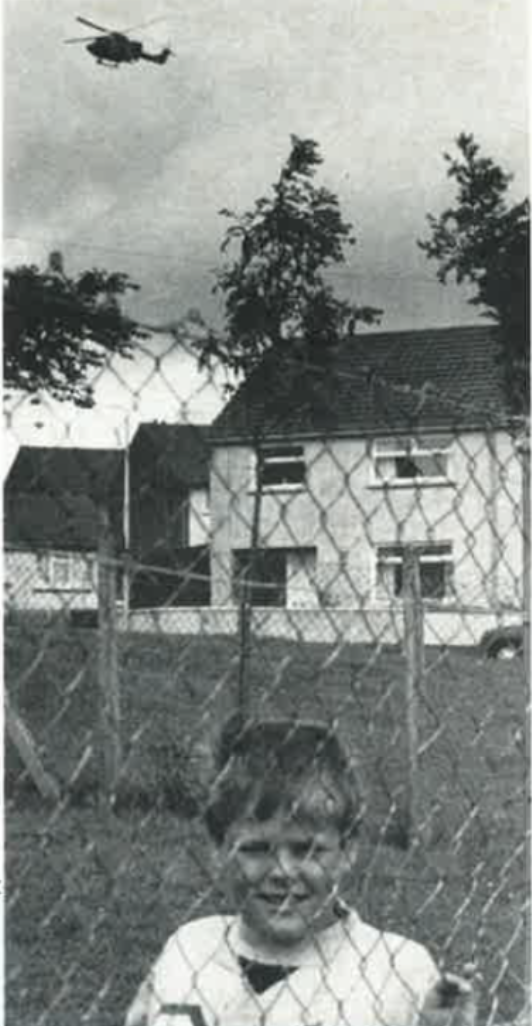
“Lunchtime,” he says and points to the one clump of clouds in a pristine blue sky. In their midst tiny specks emit a hum he instantly recognizes as that of helicopters which he explains come three times a day to deliver breakfast, lunch and dinner as well as to take in and out the rubbish.
Within moments the deafening roar and breathtaking downdraft of an aerial convoy of six helicopters, four transporters and two scouting gunships sweeps over us on their way to what has become the most controversial of all border bases/checkpoints, Cloughoge, on the main Belfast-to-Dublin road.
Not out of any sense of parochialism the local people pedantically emphasize that the checkpoint is at Cloughoge and not, as mistakenly stated in the media, at Killen which marks the border and which they point out is in fact three and a half miles away. When the Customs Post was there it was blown up 17 times.
The Cloughoge checkpoint was virtually destroyed and a soldier, Fusilier Andrew Grundy, killed in a massive bomb explosion in February of 1991. The IRA hijacked a van, a mechanical digger and a railway trailer south of the checkpoint.
Using the digger they lifted the van containing the 1000-pound device down an embankment and onto the trailer. Then using a wired remote control system they moved the trailer and its deadly cargo into position along the railway tracks, which run immediately behind the checkpoint, before detonating it.
The political and security fallout from this, the latest in a series of such attacks at permanent checkpoints, catapulted the whole issue onto center stage and has incensed the people of Cloughoge.
Utter Disbelief
At 10 a.m. one bright July morning, British soldiers arrived at homes along the Forkhill Road and handed sequestration papers to a number of farmers. Under existing emergency legislation they were taking large chunks of their farms to build a new operational base on. A base it transpired that would share a perimeter fence with Cloughoge Primary School.
There was utter disbelief given the fact that the local community, politicians, clergy and school’s Board of Governors had all been campaigning for four years to have the checkpoint removed completely.
“It was a calculated kick in the teeth for all our efforts,” said one campaigner.
Cloughoge Primary School has close to 400 pupils from nursery to 11 years old; there are also 35 members of staff. It was opened in 1835 and has had an expanding intake ever since. Headmaster Kevin Campbell, an articulate speaker who has all the facts at his fingertips, is impassioned by the whole affair. He tells how there have been 23 murders in the vicinity of the checkpoint and seven break-ins at the school, yet the soldiers had never seen anything. An army major when questioned about this admitted there were several “blind spots” from the towers and base and that the school was one of them, bringing into serious question the whole “security” argument put forward by British ministers and their generals.
“Whose security?” Campbell asks.
Like every other issue in Northern Ireland, the amount of common ground on the subject between politicians is negligible. The SDLP, in the form of local MP Seamus Mallon, want the post moved and more covert patrols introduced. Sinn Féin, who have two councillors elected in the Slieve Gullion ward, which takes in Cloughoge, want the soldiers and their bases removed completely, and the Unionists, in the shape of Danny Kennedy, Vice Chairman of Newry and Mourne Council, while admitting there is a problem in siting the base next to the school, maintains that if the army requires it there, so be it.
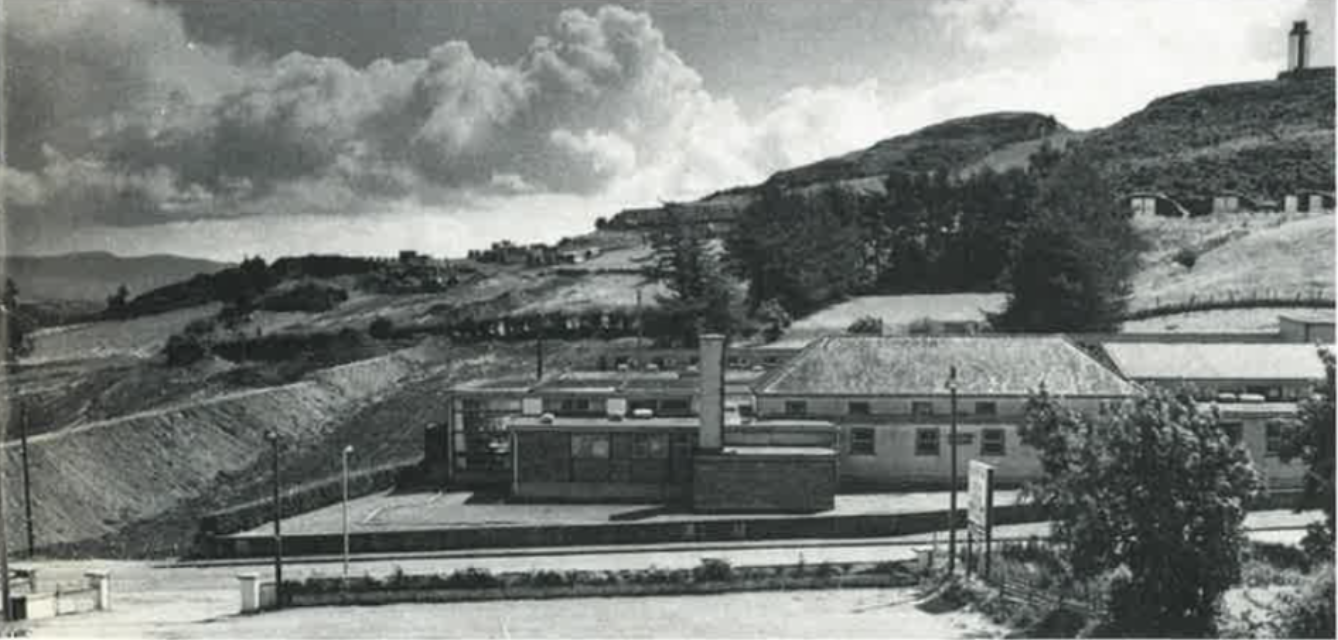
Even as construction of the base got under way, an attack using homemade mortars was launched by the IRA.
According to Headmaster Kevin Campbell, if the schools had been open during these blasts a total of 178 children would have been in the classroom that were completely wrecked.
The previous site of the checkpoint prevented all the junior children from ever going out into the playground, helicopter overflights were a source of constant distraction, an agreement with the security forces not to mount additional checkpoints outside the school was “more often violated than honored” and when this happened the pupils and staff were complete prisoners with no entrance or exit.
The school was closed for 30 days last year as a result and there were at least another 50 days when there was “major disruption.” Teachers, parents and government agencies all agree that there is no feasible evacuation process in the event of a serious incident. He sees no possibility of any improvement now that the base is going to be nearer.
Human Shield
The most evocative of statements, which is quoted regularly, including editorial comment in the normally conservative Irish News, is that the British government is doing exactly what it rightly condemned Saddam Hussein for, i.e. using children as a human shield by placing military installations next to populated areas.
It is difficult to thwart the logic of this argument when a soldier in full combat fatigues and with face blackened lies inside the grounds of the school, looking down the barrel of a heavy calibre machine gun at a line of traffic stopped by his colleagues.
Behind him huge earth dykes and a convoy of heavily guarded trucks driven by civilian contractors roll up the muck-covered road. Within days of the work starting a bomb was hurled at one such convoy. Soldiers and RUC men are at every gate and gap in the hedge, they lie behind walls and they walk amongst the swarm of huge yellow machines that are carving a base to hold 400 soldiers out of the hillside.
Two helicopter gunships vulture-like circle continually around the beacon of the sixty-foot watchtower overlooking the entire site. There are no subtleties here, this is a military zone plain and simple.
Newry Council set up a five-man committee to meet British Secretary of State Sir Patrick Mayhew and his Deputy Michael Mates; both are seen as hardline Tories very much to the right of the party.
Predictably according to Sinn Féin’s Jim McAllister, they were excluded from the delegation in spite of being elected to represent the area. This is in spite of an obvious change in British ministerial policy of refusing to meet delegations that included Sinn Féin.
Mates, at an earlier meeting, had reportedly said he was in favor of moving the base to Kileen and having it manned on either side by the Gardai and RUC but that Dublin was implacably opposed to this idea.
After the meeting, which lasted two and a half hours, Mayhew in a statement read out on the steps of Stormont Castle said that upon considering the views of the delegation, which included teachers, their unions, clergy, residents and councillors, all who had asked for a suspension of work while proper consultation took place, “the one thing that is certain is that the building of the base will continue.”
The people of Cloughoge are adamant that if the soldiers don’t move the school must. They repeat, however, that the community and the church are still very much in the firing line and they know, as do the security forces, that the IRA will attack the base again.
Eventually a few weeks before the school was due to reopen after summer recess the nuns in a local convent came to the rescue and new premises were found for the children and their teachers. The school which had been a community’s focus for 57 years closed its doors for the last time. It was cheaper to move the school than the checkpoint.
Anatomy of a Checkpoint
Obviously all checkpoints are not the same but the following facets and procedures are common to many.
For up to several miles before reaching a checkpoint one can frequently see the massive watchtowers on nearby hilltops that invariably accompany them. There may well be Controlled Zones of several miles on either side where parking your car can lead to it being blown up as a “suspect device.”
As you approach the actual base there are forward roving cameras that are monitored at the roadside base and tower. There are up to thirty such cameras on some checkpoints and they have infrared, i.e. night vision capability. They are paralleled by a similar number of directional lights.
The landscape around the newer posts is moonlike with huge craters, earth ramparts, long winding dykes and dry moats. Juxtaposed against this are massive sectional blast walls 3-40 foot high that are painted camouflage green and appear to be placed at arbitrary angles and distances to each other but that are designed to prevent “line of sight attack” from gunfire, rockets and remote control bombs.
A yellow and black steel barrier points skyward ready to be dropped at the flick of a switch should a bomb-laden vehicle try to drive to the center of the complex. One such barrier has already fallen and crushed a car slightly injuring the passengers. There is also a set of “Klaptrap” steel spikes that can also be automatically fired across the roadway bursting the tires of any vehicle going over them. Finally, at this forward position, there are several steel hydraulic rams about one foot in diameter that can be raised up out of the ground, blocking any entry or exit. At the Derry crossing earlier this year rain apparently caused these rams to malfunction and a family were hospitalized after their car was lifted several feet into the air as they drove over the barriers.
Vehicles are brought forward by a series of signs to a set of directional traffic lights. Further signs instruct you to look right into a camera, turn off lights and engine. A camera just above ground level reads the number plate and at night a powerful searchlight is pointed straight into the vehicle, making it impossible to see into the checkpoint. There is also an intercom system a la drive-in burger joints that is used to ask the driver questions by the unseen operator who could be several hundred feet away in one of the fleet of the towers. Name, address, age, destination, occupation, ownership of the vehicle, are common questions.
This information is then fed into the base computer which within seconds can give the operator a confirmation.
It will also give him one of several codes, for example “Zulu,” or “Lima,” assigned to every vehicle in Northern Ireland and many in the Republic.
The former means that the vehicle is allowed to proceed, the latter means it is brought forward into the search bay and all details of the vehicle and occupants must be taken and both thoroughly searched as well as any other information that can be gleaned by the search team such as mileage, contents of the trunk and details of any “casual conversation” that takes place. All are recorded and sent first to an Intelligence Collator within the Army, and then to the RUC.
Some of the search bays would be the envy of even a Rolls Royce garage equipment-wise with the capability to strip down a vehicle, any vehicle, to the engine block. Sniffer dogs, hand-held explosive detectors, portable X-ray machines, chemical analysis equipment and optical fibre cameras are used to search every inch of the vehicle and people under scrutiny. A standard form with over thirty additional questions on such things as accent, disposition, hobbies and perceived intelligence may also be filled out by the specially trained search team. All of this must be accomplished in a maximum of four hours as that is the time-span that the British Army are legally allowed to detain a person before they must be released or handed over to the RUC.
The soldiers’ living quarters are behind blast walls. Windows in the towers and bunkers are made of inch-thick green-tinted bullet-proof glass. The roofs are of steel plating to protect from mortars. Towers are surrounded by a cage of rocket netting. Many have directional microphones capable of picking up conversations in houses, cars or fields several hundreds of yards away, and there are also movement sensors placed in the ground and hedgerows round the checkpoints.
Finally, Army commanders in these posts can control the power supply to all surrounding houses and street lighting, and in some cases the phone lines as well.
Editor’s Note: This article was originally published in the May June 1993 issue of Irish America. ♦
Leave a Reply