
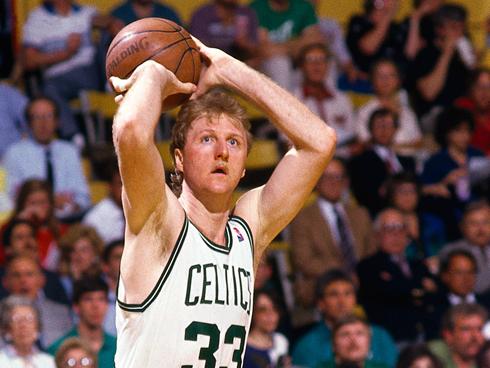
The Boston Celtics are probably the most famous basketball club in the world. Since its formation in 1946, it has brought success, fame, and glory to the city. However, the Celtics’ winning team is now in transition and the changes that face the club could pose difficult times ahead.
A Working Day at Boston Garden
The ice floor and the hockey goals from last night have been put away, the parquet surface is laid down, and already the basketball nets are up.
There’s a mid-season fixture tonight between Boston Celtics and Houston Rockets. It’s hardly the Mother of All Games, but like most Celtics matches at the Garden since 1980, every seat is sold out.
Houston players are out on the court, throwing a few shots and a few passes, getting the feel for the place. Their practice shouts echo around the empty arena.
From the outside, Boston Garden is nondescript – the building could be a warehouse for all you’d know. Built in 1928 as a boxing venue, it’s an old structure that feels cold and drafty when empty. At the entrance to the court area the walls and pillars are chipped and dull.
The whole place could do with a coat of paint – or, as its critics would suggest, the wrecker’s ball.
Local reporters line the court without removing their coats. The sideline is their beat. It’s winter outside and it feels like it indoors as Houston finish their warm-up at the hoops. There’s no question they would like to win at the Garden – like many teams, it’s been an age since they did. Last time the Rockets won here was November, 1981. Some of the players look around at the empty stalls, knowing all too well how fiercely partisan this crowd is.
Surprisingly, with 14,890 seats, the Garden is second only to Portland as the smallest venue in the NBA. And in a sports-mad city that means one thing: The only people who wouldn’t kill for tickets here are people who might die for them. Tonight’s game will be the 522nd consecutive NBA sellout at the venue.
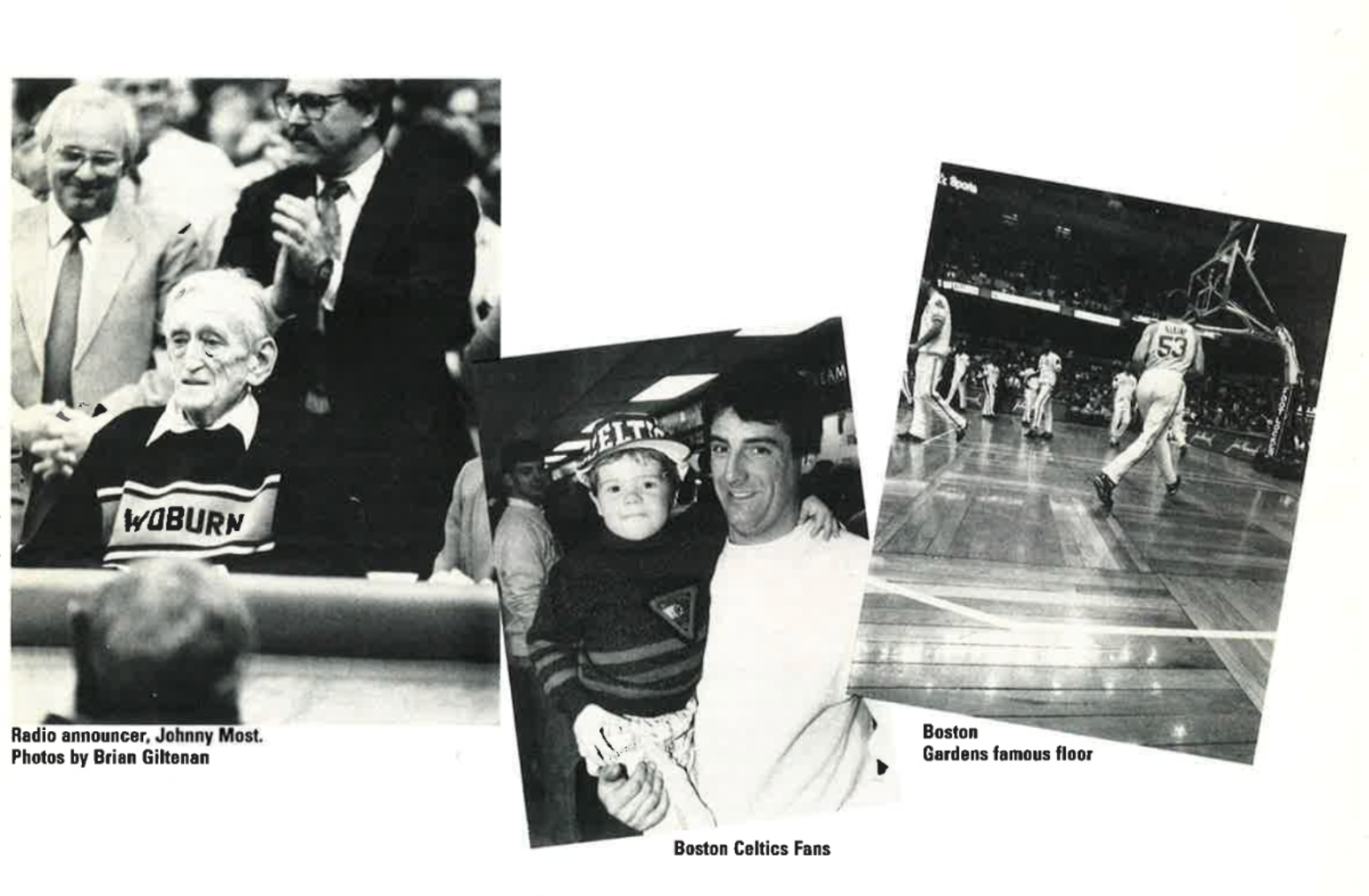
There is also that Boston playing surface to contend with — a unique parquet floor which detractors allege has hidden dead spots. Maybe it has, maybe not, but the court is so unlike every other NBA court that familiarity means an advantage to the home team.
Overhead, the pennant flags of the Celtics and the Boston Bruins hang from the rafters in a proud display of achievement.
Even in an empty stadium, Celtics tradition, or its famed “mystique,” is palpable despite the generally run-down appearance of the Garden.
But the last pennant flag shows that the Celtics have not won the NBA championship since 1986. Six years is a long time for a major club to go without a national title, and at the Garden there is huge pressure to succeed. Like the Knicks in New York, anything short of winning is losing, and in such a big-money business, heads tend to roll at losing teams.
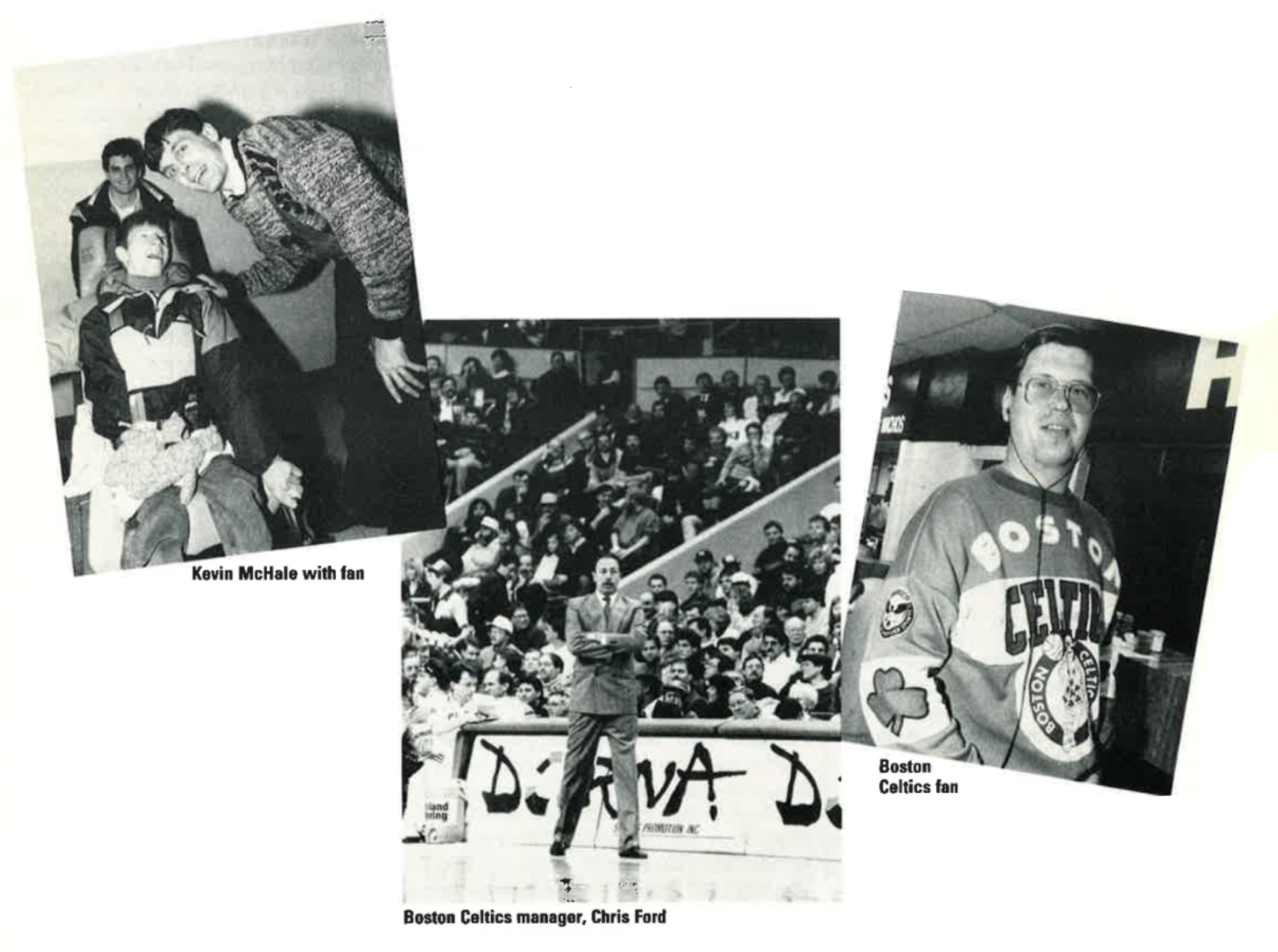
It’s a long spell that has cost team managers K.C. Jones and Jimmy Rogers their jobs. Last year Rogers gave way to Chris Ford, a former Celtics player. Ford brought the Celtics success in the Atlantic Division championship, but they were then upset by the New York Knicks in the playoffs. This year, he is trying to mold a team of several outstanding newcomers — Reggie Lewis, Dee Brown, Kevin Gamble, Rick Fox – with an ailing superstar trio – Robert Parish, Kevin McHale, and Larry Bird. McHale and Bird have missed a number of games this season due to injury and without them, the team has struggled to find its rhythm.
Many feel that this will be the last chance for these three players to win another NBA championship medal. At 38, Parish is the oldest player in the NBA; McHale is 34, and at 35, Bird is no spring chicken.
The loss of McHale and Bird from the starting five so often this season has changed the character of the side. It has also given the younger talents a chance to take charge on court. However, the city and the media remain transfixed with the old guard, and every day reporters and club spokesmen trot out repetitious exchanges on how Larry and Kevin are progressing.
How are their injuries? they ask Ford. Will they be ready for the playoffs? “If this is a transition team, do you see this as passing on the torch?” asks one earnest young reporter from Texas.
Ford scowls, clearly unimpressed with the metaphor. “Or is that a little cliched?” adds the reporter, hurriedly aware of the dreaminess that often takes a grip when discussing the Celtics.
Houston clear the court. The Celtics players arrive from the dressing-room, yawning, stretching. In the waking hour of professional basketball player, they reach for a basketball like most Americans reach for coffee.
Second-string center Joe Kleine appears, selects a ball from the rack, strolls towards the hoop, bounces the ball lazily, and tosses it into the basket.
Limbering up, the players shake out any stiffness and within minutes they are fully awake and mobile. The session is up and going, led by assistant coach Jon P. Jennings and his clipboard. He calls a huddle and it’s a bit like school.
It’s a land of giants. Standing at about 5-10, Jennings is dwarfed by players who stride around the court. Ed Pinckney stands at 6-9; Stojo Vrankovic hovers by at 7-2, ducking his head below every portal; even the relatively slight Reggie Lewis looms in at 6-7. On the street, they’d stand out like freaks; on the court, everyone else looks odd.
Dressed in a green tracksuit, Chris Ford watches from the sidelines. It’s not match time. He does not chew gum. Instead, he watches Jennings and his charges go through a few practice moves. The players are shown how Houston have been going inside this season. Jennings outlines the plans to double-team Hakeem Olajuwon and cut off the passes to the right. Every so often, Ford makes a comment or gives a terse instruction. And then it’s over for the morning. The reporters pick out their men – there are, after all, sports columns to fill.
After the practice and a few quick interviews, the players go home for the afternoon. With the game beginning at 8 p.m., there is nothing to do but wait for the night.
Counting Down
It’s 15 minutes to showtime and fans are streaming into the Garden. At Sullivan’s Tap nearby, the walls are decorated with all the paraphernalia of an old sports bar.
Beer is the drink of choice. How important are the Celtics to this part of town? “It’s great for business and it’s good for the area,” replies manager Richard Steele.
“The Bruins fans are a little bit rowdier; Celtics fans are more laid-back, suit-and-tie, that sort of thing.”
Ticket prices have become very expensive, peaking at $40. The practice of corporate clients buying up blocks of seating to use as gifts and perks is rampant throughout the NBA, and many observers reckon that the profile of NBA supporters has changed significantly.
“The Celtics crowd is very spoiled,” argues veteran sportswriter Bob Ryan. “In terms of fervor, I think there was a period of time in ’85/”86 when they had an almost invincible home court advantage. They had a very supportive, raucous crowd. Since then, the crowd has become much more difficult to please. The Garden crowd now is very iffy, very marginal. It’s no great intimidating thing and the Celtics no longer have one of the great home court advantages.”
His Globe colleague, Dan Shaughnessy, agrees. “I think that when Bird is done, that will be the test of how much of their fan base is committed and how much is trendy.”
In modern times, the Celtics are seldom mentioned without reference to Larry Bird.
Such was his early promise at Indiana State that the Celtics took an extraordinary step by picking him from the college draft one year in advance. The move paid off — within two years, the Celtics were NBA champions.
In an Irish-style city where consensus is not easily reached, everyone pinpoints the Celtics’ re-emergence to Bird’s arrival.
Indeed, as he blossomed on the East Coast, a national rivalry built up between the Celtics-plus-Bird and Magic Johnson’s L.A. Lakers. Detroit and Chicago added a Midwest dimension to the league. This was a benchmark in the life and lucre of the NBA. Bird’s salary rocketed to $7 million this year – receiving through bonuses what he never made under contract. Next year he goes back to around $4 million.
The wages structure is a complicated system where teams can, at their own expense, surpass the $12.5 million team cap. As a result, this season Parish has reportedly signed for $3 million and McHale for about $3.5, plus what they make on endorsements.
Bird is certainly on his last, long legs. He might not even have another season in him, depending on his back injury or any other injury that befalls him. Like the halo around the Celtics, there is a halo around Bird. In the city, fans speak of pre-Bird and post-Bird in almost biblical terms he is yet to retire, but the eulogies are already half-written.
Showtime!
There’s a huge cheer for Johnny Most, the legendary Celtics radio commentator who is now confined to a wheelchair. The gravel-voiced Most, now in his seventies, spent 38 years as radio announcer at the Garden. Tonight he sits at the sideline, enjoying the acclaim and the sport which has been as much a part of him as he has been of it.
The teams enter before 8 p.m., do some stretching exercises, take a few shots. It’s time for the national anthem. The electronic scoreboard is brought into use in case anyone has forgotten the words.
Then it’s down to business. Ford, Jennings, and first assistant coach Don Casey line the bench in well-tailored suits. Every non-player on the bench is dressed immaculately. Chewing-gum is also part of the fashion.
Up goes the ball and we’re off. Every time Parish gets the ball, the crowd breaks into a tribal, punctuated roar of “Chief… Chief…”
At one stage in the first half, Houston are seven points ahead. It’s a promising lead but Celtics fans are too confident to be perturbed. Security guards stand around both benches to prevent supporters getting too demonstrative although both teams are very much within earshot for abuse and encouragement. Houston don’t get much encouragement.
Dee Brown makes his return in the second quarter. He gets a standing ovation, affirming general predictions of greatness.
Brown plays for 11 minutes and scores seven points. Boston overturn a half-time 43-47 deficit with a strong third quarter, brought to a beautiful climax when John Bagley’s overhead pass puts Parish in for a slam-dunk. “Fantastic!” yells a courtside fan, showing that even complacency can yield to appreciation.
With four minutes to go in the game, Boston lead by nine points. Fans begin to trail casually out of the arena and the match, Celtics 19th home win of the season, draws to an uneventful 98-85 close.
More than half the crowd is gone before the final whistle.
The Celtics dressing-room is nevertheless besieged by reporters and autograph hunters.
Eventually the door is opened and the players, just out of the shower, face the familiar round of questions. Each player has his own spot in the locker-room. In an empty corner, Kevin McHale’s area is as untidy as if he had just played. Taped to the wall is a family photo, there’s a half-read book on the floor beside a worn pair of his size 15 1/2 sneakers.
Robert Parish (The Chief), sporting a tattooed heart over his left nipple, is nonplussed about playing at home. “We try to take advantage, ” he says like a true professional, “but I don’t think it’s no advantage. It’s just a case of the players getting the job done.”
Ford is equally detached when it comes to analyzing performances. “It’s great to play here, but the talent, that’s the main reason. You have that Celtics tradition, but,” he adds, “it’s a challenge for us every time we play here. I think that other teams sense now that we are vulnerable.”
Like everyone else, Ford acknowledges that the Garden is “part of the Celtics mystique and the tradition. ” But unlike others, Ford does not want the Celtics to stay there forever. “I think our players would prefer a better floor and I would favor a new Garden,” he says. “It’s time to move on — just as players move on, so does this [building].
“There has been talk about building a new venue, especially since the successes of the mid-“70s. Local political wrangling is blamed for various plans running dry. “I wouldn’t think they would be quite the same without the Garden, to be honest. It’s quite a part of their fabric,” says Dan Shaughnessy, echoing the sentiments of many supporters. “There’s only one thing sure about a new Garden,” says a colleague “Bird will never play there.”
The Past and Present
Bob Ryan, a columnist with the Boston Globe who began reporting on the Celtics in 1969, acknowledges the importance of the club to Boston. As is increasingly evident in professional sport, nobody refers to Boston Celtics as a club; the Celtics is a franchise.
Founded in 1946 by a popular Irishman, Walter Brown, traces of an Irish hand remain visible to the extent you’d expect in Boston.
Brown negotiated use of the name from a soccer team, the Boston Celtics, which was run by another Irishman, John O’Riordan. The team colors are green and white; when they play away from home, some of their fans in other U.S. cities dress completely in one color, earning the tag “green people”; the team mascot is still a winking leprechaun festooned in shamrocks.
Sport has always been a source of great pride to Boston, firstly with the Boston Bruins in the NHL but to a greater extent with the Celtics. Ironically, basketball was brought the city in 1946 effectively as a filler for an empty arena when the Bruins were out of town. Even when the Celtics won the 1957 championship, they were averaging just 7,500 fans per game.
Obviously it’s all changed now. The club has an estimated value in the region of $100 million. The team is well-known around the world, and the Celtics are a central point of identification for the city.
But their winning team has aged, and transition has been difficult. Faced with a fall from the top flight, observers do not expect the Celtics to retain such a level of popularity. Their cable-TV operations are beginning to lose money. Automatic sellouts at the Garden will not be so routine.
Also changing is the team’s image as a white team. “Nationally, that’s been part of their identity,” concedes Shaughnessy, “and some pockets of America liked that.” At the finish of the “80s success, three of the starting five – McHale, Bird, and Danny Ainge — were white, although the NBA was predominantly black. Alongside teammates Parish and Dennis Johnson, they won championships. Whether more white by coincidence or by design – as critics alleged recently in the book The Selling of the Green – that five were then the best basketball team in the world.
As for racist theory, the Celtics are sensitive to the charge although it will never stick. Winners, regardless of color, seldom have to look far for acclaim.
In fact the Celtics were a frontrunner in breaking down racial prejudice in the sport. Under Walter Brown, the Celtics became the first NBA club to draft a black player (Charles Cooper in 1950) and appoint a black coach (K.C. Jones in 1983). Four of the Celtics past five draft picks were not white. As one commentator sees it, “The team will be more black and less white because they want to win.” This season, even if the three veterans escape further injury, no one would expect Boston Celtics to win the NBA championship. Maybe they will make the playoffs; realistically, not much more can be expected of them.
Like any former greats in sport, the demise of the team is a difficult and frustrating sight to behold. After the Houston game, the Celtics went on the road and lost four games in a row. Away from the Garden, they have won only one of their last 10 matches.
Bird was out; McHale struggled on court against the unrated New Jersey Nets. After being beaten 109-95 by the Nets, the Celtics dressing-room was a lonely place where mystique counted for nothing.
Robert Parish, the oldest player in the NBA, toweled himself down. “Obviously,” shrugged The Chief, “things do change.”
(Since the time of writing, Larry Bird has resumed playing with the first-team. Since his return, the Celtics have won 7 out of 11 games).
Editor’s Note: This article was originally published in the April 1992 issue of Irish America. ♦
Leave a Reply