
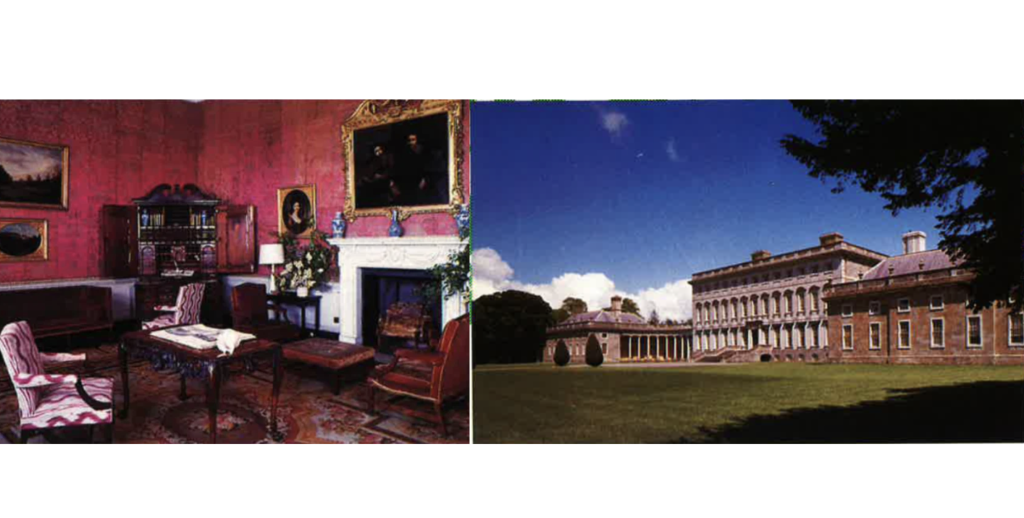
Although the Irish Georgian Society has many admirers here in the United States, in my view it lacks sufficient appreciation and support on its native soil, (We Irish Americans are always quick to recommend appropriate behavior to our cousins back home.) The Society was founded some thirty years ago by the Honorable Desmond Guinness, resident of the village of Leixlip, in County Kildare. Over the years, Guinness has shared the arduous task of running the Society with his old friend Desmond Fitzgerald, the twenty-ninth Knight of Glin. The Knight, author of several learned books and a renowned authority on eighteenth-century Irish paintings and furniture, has recently accepted the office of President of the Society, with Guinness assuming the title of Founder.
The somewhat posthumous ring given off by this appellation is contradicted by the undiminished alacrity and lively good humor with which its bearer continues to describe to audiences in both hemispheres the precious heritage of Georgian architecture in Ireland and the means by which it must be preserved.
Two or three times a year, Guinness undertakes a semi-royal progress through the States, putting up in the pleasure domes of wealthy friends and giving illustrated lectures on Irish houses and castles (including his own at Leixlip) for the purpose of drumming up interest in and raising funds or the cause to which he has devoted much of his life.
His premise is that the beautiful Georgian houses, public buildings, and follies that lie scattered like so many half-forgotten jewels across the green countryside and gray cityscapes of Ireland should not be allowed to tumble down through neglect or, more commonly, reach such a state of disrepair that small-minded government bureaucrats and greedy private real-estate speculators are able to justify throwing them down. This premise would appear to be self-evidently a laudable one, but it isn’t all that popular in a country with a memory as long and bitter as Treland boasts.
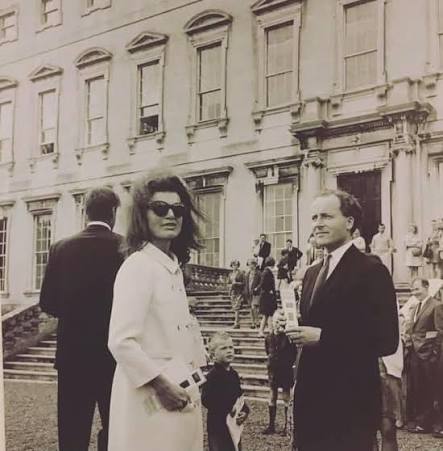
Georgian architecture is largely the handiwork of the once hated Protestant Anglo-Irish Ascendancy, and the Irish of today still tend to feel a certain hostile skepticism in respect to it.
The very word “Georgian” brings many a quick Hibernian temper to the boil, and it has been proposed more than once in the Dublin press that if the Irish Georgian Society would only consent to take on some such unprovocative name as the Irish Classical Society, it would find its goals far easier to achieve.
Not that the Irish are as clear as they might be about which national monuments are theirs to cherish and which are not. Some years ago, the Nelson Pillar in O’Connell Street, in Dublin, one of the few noble specimens of architecture designed by an indigenous architect, was blown up and destroyed by a band of so-called patriots, apparently under the misapprehension that because the Pillar bore a statue of a titled Brit at its top, it must be perfidious Albion’s through and through.
Rocky as the road sometimes looks, the Founder has by no means labored in vain.
The Society has preserved a towering affair of arches and obelisks known as Connolly’s Folly, in County Kildare, which is perhaps the greatest work of its peculiar kind ever raised. It has restored half a dozen country houses, in whose exquisite plastered drawing rooms farmers had been accustomed to storing potatoes and in whose grand halls the hanging marble stairways had long ago pitched headlong into the cellar. Its most recent triumph is the total restoration of what Mark Girouard has called the finest cottage orné in the world Swiss Cottage, in Tipperary, designed by John Nash for the eldest son of the Earl of Glengall. The Society’s headquarters, now in a lofty house in Merrion Square, were located for many years in the most precious of the society’s possessions, Castletown House. Begun according to the designs of an Italian architect named Galilei in 1722, it is generally considered the handsomest, as well as the earliest, of all the grand Georgian mansions in Ireland. It contains upward of a hundred rooms and stands in a pleasant demesne within easy driving distance of Dublin. Not far from Castletown House is Guinness’s own Leixlip Castle—a charming mock-Gothic and Georgian structure, mostly of the eighteenth century, that beetles above the river Liffey. “Leixlip” means “salmon leap,” and amateur etymologists in Dublin pubs, themselves leaping perilously from “leix” to “lox,” have been known to claim that this demonstrates that the Irish are, as an old legend holds, one of the Lost Tribes of Israel.
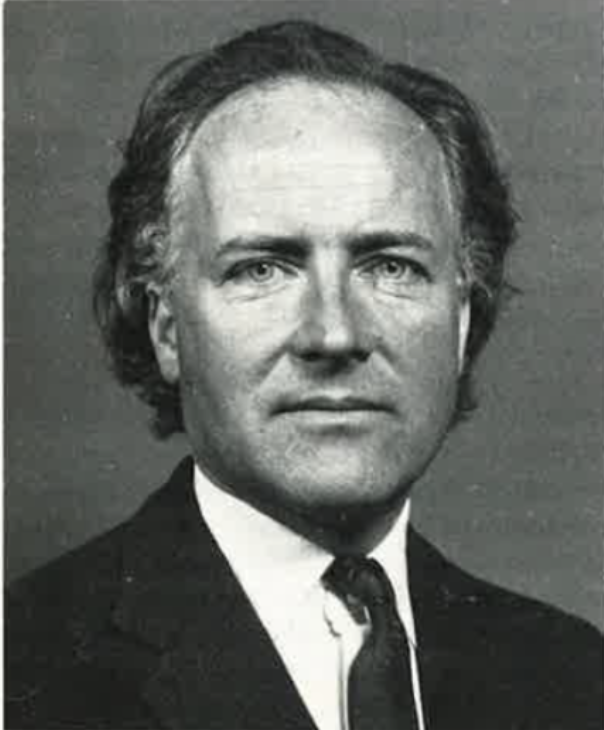
(Actually, “leix” is of Norse origin.) Guinness, a handsome man of sixty-one, with springy white hair, a ruddy complexion, and astonishingly bright-blue eyes, is the second son of the poet Lord Moyne and a grandnephew of the late Lord Iveagh, the head of the Guinness family; his mother is the widow of Sir Oswald Mosley and a sister of the Duchess of Devonshire, Jessica Mitford, and the late Nancy Mitford.
Guinness’s wife, Penny, works every bit as hard in behalf of the Society as he does.
A hazardous by-product of their pursuit of new members for the Society is the number of Americans who, having signed on the dotted line, then rush intemperately across the Atlantic and turn up at Leixlip and whom the Guinnesses hospitably consent to entertain. Until a few years ago, the only deterrent to such unexpected arrivals was the long, winding drive that leads up to Leixlip Castle. It was composed of rough gravel, notably pitted and potholed, and one thought twice before venturing onto it. Then it happened that Mick Jagger rented the castle for a couple of summers, and thanks to the substantial rent that he paid, the Guinnesses were able to pave the driveway with small, neatly cut and neatly fitted blocks of granite paving.
Overnight came the Mona Lisa of driveways, a work of art almost too exquisite to bear the taint of tires upon its immaculate surface.
Mention of the Mick Jagger Memorial Driveway prompts me to recall my first visit to Leixlip, many years ago, when I was myself a brand-new member of the Society. I approached the front door of the castle, only to discover that it possessed neither a brass knocker nor a doorbell.
Perplexed as to how to announce my arrival, I noticed a small piece of paper thumb-tacked to the wooden door. Scribbled on the paper were the words, “Kick the bottom of the door and someone will come.” I kicked the bottom of the door, and sure enough, a servant did come, and the next thing I knew I was standing before a roaring fire with Desmond on one side of me and Penny on the other, holding in my hand a glass of some liquid that, tawny-colored and tasting of smoke, struck me as being a welcome improvement on water.
From that day to this, I have never doubted my good fortune in gaining the friendship of the Guinnessés and of being enrolled as a member of their incomparably useful Society.
Brendan Gill is a writer for The New Yorker magazine.
Editor’s Note: This article was originally published in the March 1992 issue of Irish America. ♦
Leave a Reply