
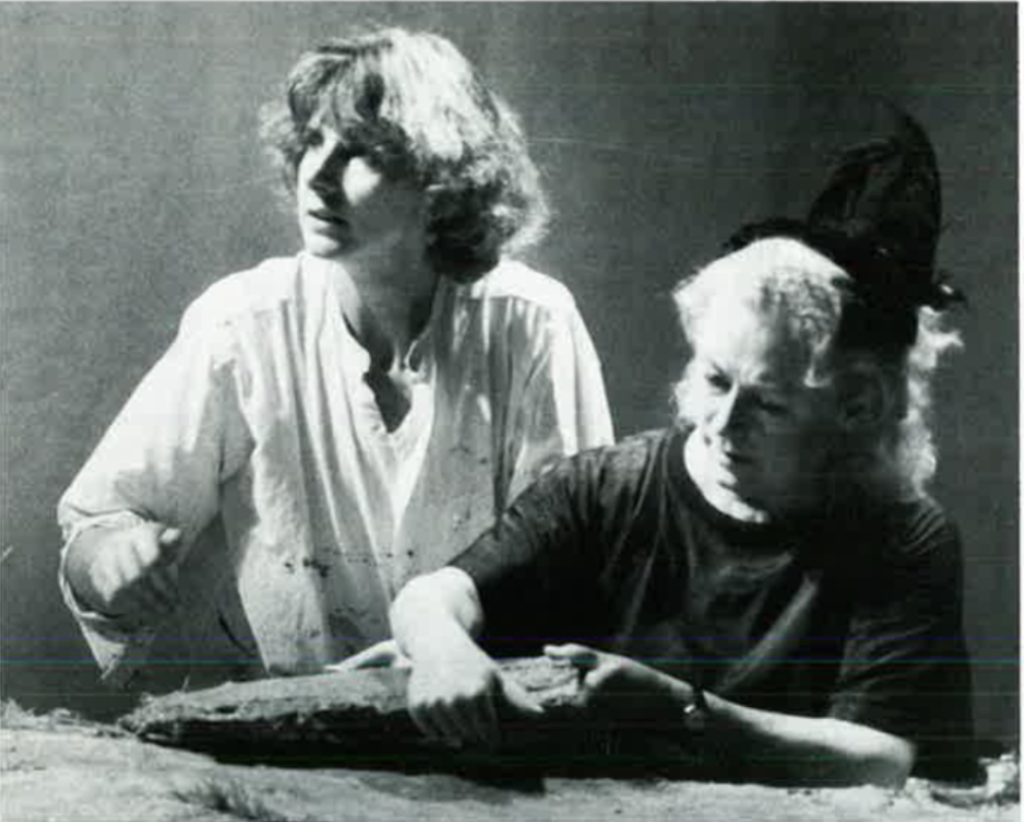
When Shivaun O’Casey first met Irish-born Nobel Literature Prize winner Samuel Beckett, she was a shy young girl of 16 studying acting in London. In the 32 years that have followed that meeting, she has kept in close contact with Beckett, now recognized as one of the leading 20th century playwrights, whose dark visions of life inspired a revolutionary stage movement called “Theater of the Absurd.”
The works of the Dublin-born Beckett, now 81, have come to symbolize much of the cynicism, despair and dark humor of modern man.
His most important work is “Waiting for Godot,” the play for which he won the Nobel Prize in 1967.
Other major works by Beckett include “Happy Days,” “Endgame” and Krapp’s “Last Tape.”
Shivaun O’Casey, who is the daughter of Irish playwright Sean O’Casey, always had it in mind to stage a Beckett work but the opportunity arose only recently. Until now she has had a successful and much-varied career in the theater in Britain, both as an actress and set designer. Ms. O’Casey moved to New York five years ago to study with Robert Lewis, a founder of the Actors Studio, who encouraged her to direct.
When she decided to stage Beckett’s “Happy Days,” the reclusive writer was very willing to help with the production. He met with O’Casey and Aideen O’Kelly, who plays Winnie, in Paris, where he has lived for many years, to discuss the play and hold readings, thereby giving O’Casey a unique perspective on and insight into the writer’s work.
That the intensely private Beckett, who once wrote to Shivaun that “I never give interviews, except unwittingly, having nothing to say on any subject under the sun,” should show such an interest in the production, is a mark of both his respect and his friendship with Ms. O’Casey.
Originally intending to put on an evening of O’Casey and Beckett, O’Casey decided to go ahead with the Beckett production of “Happy Days” when Jack Garfield offered her the Samuel Beckett Theatre off-Broadway for the production.
Technically, it presented less difficulty in staging, requiring a very minimal set and two actors, in this case Aideen O’Kelly, who played Winnie, the despairingly cheerful woman who is buried waist-deep and later neck-deep in sand, and her prosaic companion Willie, (John Leighton) who rarely appears.
The O’Casey production was, for the most part, widely praised by the New York critics.
Patricia Harty talked to O’Casey about her choice of a Beckett play to launch her directing career, her valuable insights into the author and the contrasts between her father’s work and Beckett’s.
Irish America: Why pick a Beckett play as your first directing work?
O’Casey: I always wanted to do Beckett because I felt that there is more humor in his work than is normally portrayed.
Visually, I feel there is a stark beauty in “Happy Days,” it’s very minimal—like an abstract painting if you like, with precision-like movement. His work is so rich when you look into it; there is so much in there that really makes sense and I wanted to make it clear.
Irish America: Was it an easy play to direct?
O’Casey: He’s so tightly packed, Beckett, with so much squeezed into a sentence, you really have to look into it to see where he’s going. We worked very hard to find out what he thought. just as far as making sense of the sequences and the transitions and what she was saying and what he was saying. It’s incredibly difficult to do and to achieve at all the different levels that one wants.
Irish America: Do you feel that “Happy Days” is a particularly Irish play?
O’Casey: There’s a great sadness in the play that is redeemed by Winnie’s humor. The humor and the tragedy are there simultaneously, and I think that humor in the face of tragedy is a particularly Irish quality. I see Winnie as a middle-class lady from Foxrock, Dublin (Beckett’s birthplace). But it’s a universal play, really, about a relationship between a man and a woman and what they’ve done to each other.
Irish America: Do you think there is a lot of Irishness in Beckett’s writing?
O’Casey: I do feel that Beckett’s work has an Irish quality about it. And I think that Irish people have an affinity with it. Take Jack McGowran, [the Irish actor who performed in most of Beckett’s dramas] Beckett regarded him as one of the finest interpreters of his work.
Irish America: How did Beckett feel about the proposed production?
O’Casey: I think maybe he felt, “At last she’s going to do something,” [laughs]. He was very excited about it, but he was very concerned about me, whether I was protected and whether I had the money and where I got the money. He’s very paternal and very concerned about people. He knew I was going to do the best I possibly could and he was pleased, I imagine, that one wanted to do it. It’s a wonderful piece to work on and I do like doing it very much. I enjoy the working of it-even though it’s painful, it’s exciting-and the nice thing about “Happy Days” is that we are still working on it.
Irish America: You brought him over a video of the early readings?
O’Casey: Yes. I wanted Aideen (Aideen O’Kelly) who plays Winnie to meet him.
She was a bit nervous, and the day we all met together, he was very tired. He said, “I’d like to meet her tomorrow.” I said, “She’s from Dalkey” (a suburb of Dublin, close to Foxrock) and he was immediately delighted and interested. When we said goodbye I said, “Remember she’s from Dalkey.” “Born and reared in Dalkey,” he said. “That’s the main thing.”
They met and he saw the film and he then asked if he could do some readings with Aideen. This gave her a tremendous amount of confidence. He felt that she shouldn’t make Winnie too capable, he said that she should be fragile, not so able to take command in the first act because in the final act she is nearly gone.
Irish America: Aideen O’Kelly has said, “Don’t let Shivaun fool you by her soft-spoken manner; she is quite a formidable woman.” What do you say to that?
O’Casey: In any play one is dependent on who one casts, but the director must have a preconceived, very definite idea of what is needed. Some people think you can have an open forum, but someone has to have control, the way a conductor conducts an orchestra. The visual element is also very important.
Irish America: What are the future plans for “Happy Days”?
O’Casey: There’s talk of it going to Ireland. It think it will go to the Project Theater. I hope so, I would love it to go to Ireland.Irish America: When you first met Beckett you were 16. What was your first impression of him?
O’Casey: Immediately one felt friendship. He’s a very kind man, he’s interested in people; he’s particularly interested in youth. I met him once with my son Ruben, and I hadn’t seen him in many years. We embraced and I said. “I brought my son Ruben along.” His face lit up and he said, “Oh, where is he?” He loves youth and young people, really. He has this longing, this wanting to know what they are doing and what they think.
Irish America: Why did he leave Ireland?
O’Casey: For much the same reasons as caused Joyce and Sean [O’Casey] to leave.
He was ostracized when his “More Pricks than Kicks” was published. Then there is that famous remark of his. “The Irish don’t give a fart in their corduroys for art.” I think he really felt that at the time. One must remember also that he admired Joyce so much, and Joyce was in Paris. That was another reason for him to stay. It was a student type of relationship. He helped Joyce, whose eyesight was failing, with proofreading and that sort of thing.
Irish America: How does Beckett feel about Ireland now?
O’Casey: He’s very fond of Ireland, very interested in anything Irish. He reminds me a bit of Sean in that way. Sean used to get the Irish papers every day, and at anything Irish, at even the word “Ireland” or “they’re Irish” his ears would prick up. If anyone was Irish and came to the door they were very welcome, unless it was someone from the Abbey [laughs]. And it’s much the same with Sam Beckett.
Irish America: Why do you think Beckett hasn’t gone back to Ireland?
O’Casey: I think for both Sean and Sam, it’s because of a stance they took, in a way. Also, you get to an age when travel is not easy, and if he went back to Ireland, people would want to interview him. He is a very quiet person and wouldn’t like that. But you always have feelings for where you came from. Sam’s are mixed with many different emotions. I know he loved his father very much and he loves the idea of walking through the Irish mountains.
That’s the sort of thing he remembers with great fondness.
I feel that he loves Irishness. Eoin O’Brien’s book, Beckett Country, [which explores the physical and emotional Irish-ness of Beckett’s work] pleased him very much. He adores it.
Irish America: What kind of a person is Sam Beckett?
O’Casey: I dont know him as intimately as I knew Sean, so I can only assume; but from what I see. he’s very similar in that he doesn’t care much for possessions. He dresses very simply. He has this simplicity about him. You can tell that everyone in the restaurant where you meet him likes him very much.
He is very polite, a sweet person. There is not a nasty streak in him. He does everything himself, he doesn’t have anyone to help in the house, he does all his letters all his correspondence, meticulously, by what one sees. You get a response very quickly. And I know what agony that must be. You can imagine how much mail he gets.
And then he drives himself to his country house. He doesn’t have a big car, he just doesn’t need things like that. In that way. Like Sean, he is very simple. And also like Sean he has an affinity with where he came from and who he was.
Irish America: His writings are pretty bleak, is he a bleak person?
O’Casey: He’s not a bleak person at all, he’s very warm. His plays also have a warmth and humanity. His characters are very real, ordinary people. He adds to them his glittering words, and they’re beautiful.
Irish America: Didn’t you originally want to do an evening of O’Casey and Beckett?
O’Casey: Yes. I wanted to do an evening with Sean and Beckett because of the contrast between the two men. One who was brought up in the slums and the other in the middle-class suburb of Foxrock. They are two men who write very differently, and whose philosophies are very different, but who are very similar in lots of ways. Both are very kind, very gentle, very caring, very giving people. And both have in the best sense of the word, an aristocratic kind of bearing. Both have this bird-like quality. Light and alert and yet with a very strong handgrip and eyes that seem to search into you.
Irish America: Sean O’Casey once remarked, “I have nothing to do with Beckett…. I’m not waiting for Godot to bring me life, I am out after life myself.” Did he really feel that about Beckett?
O’Casey: Yes. But he also felt that he was a wonderful writer, a craftsman, he loved the way Sam used words, but he couldn’t accept his philosophy, because it was all so hopeless. I would say, “But it’s not like that,” and – he would say, “Well what does this mean then?” In all Sean’s plays they are fighting for something, they don’t sit back and wait.
Sean’s belief was that you can change things.
Irish America: Do you think Beckett is hopeless?
O’Casey: I don’t think he’s hopeless. There is always a little sense of hope—the one leaf on the tree in “Godot.” They are, in fact, waiting, they’re not killing themselves, but life for them is bleak and that is his philosophy and one can’t get away from that.
Irish America: Why didn’t the O’Casey/ Beckett evening come off?
O’Casey: Because this was the first production I directed and I had to raise all the money for it, and just technically, it would have cost a hell of a lot more-two or maybe three sets, much more complicated.
Even with “Happy Days” financing was such a problem. Because I was working so hard fundraising, I was quite desperate at one time to try and get the time to work on the play itself.
Irish America: So you found that, in the main, the Irish don’t give a damn about art.
O’Casey: Generally speaking, I think that is so. But I think they are beginning to feel that they should. But to invest in something that is not of material value, such as the production of a play, is new for the Irish.
You don’t necessarily make money from something like this, and I think that is something that they have to learn.
Irish America: How do you think that should change?
O’Casey: You can either have an Irish art center that you really support, that can really put on good shows, or you give it to productions or have exhibitions of art, that maybe won’t sell out, but will really show what’s Irish.
There is a lot of Irish American money here and it’s their heritage. Poor Ireland needs it very badly and there must be a lot of young Irish painters and writers who need help. Other countries, Germany and Austria, for instance, have traditionally given to the arts, in particular to the opera and it tells.
There is no national theater here in America, so you have to go each time to seek money and it is very difficult. There are very few theaters that can put something on without you raising the whole capital for it.
Irish America: Do you find being the daughter of such a famous father a bit of a burden?
O’Casey: In a way it is. I thought twice about doing a Sean play, because I felt people would say, “Oh, God, look, there she is doing it,” and although one shouldn’t give a fart in one’s trousers what people say [laughs] one does. So I thought I would do someone else’s work first and then Sean’s.
Irish America: What’s next for Shivaun O’Casey?
O’Casey: I really want to direct “Silver Tassie.” [O’Casey’s 1929 “anti-war requiem”] but it’s going to take a long time to raise the money for that. Luckily, I have people who will help me draw up a budget; so I can start to think about that but first I would like to try and pay back the investors of “Happy Days.”
Irish America: Shivaun O’Casey, thank you.
Leave a Reply