
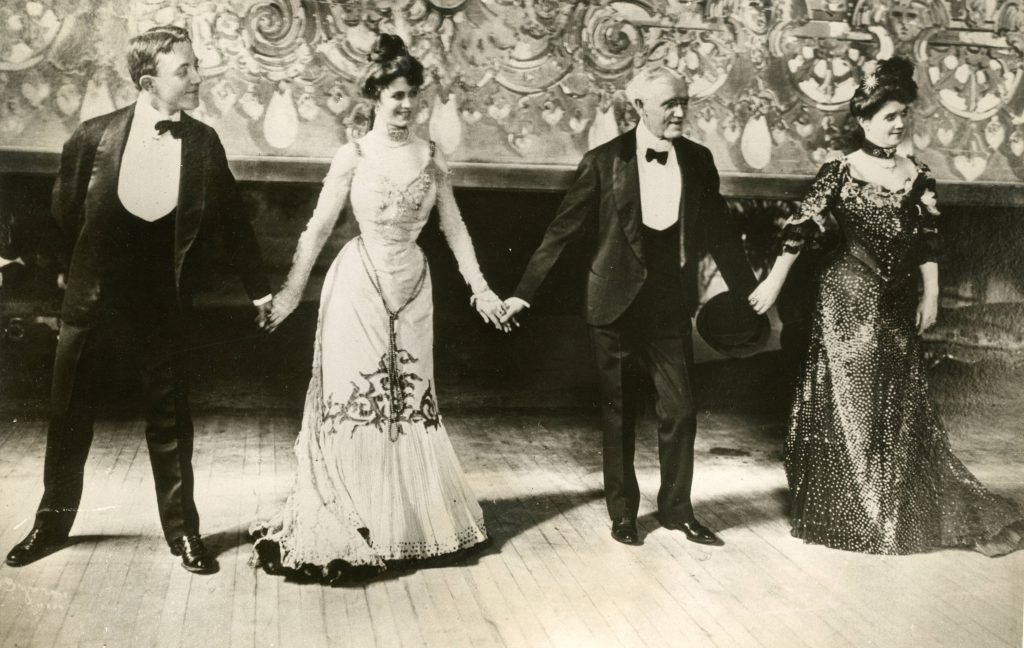
This is a song about George M. Cohan. CO-HAN, not Coen. And yet, when I was growing up in a factory town in Connecticut, I always thought he must have been this older Jewish guy. Jimmy Cagney called him “the greatest song and dance man of all time.”
“George M. Cohan,” Cagney said, “is the real leader of our clan.” This is also a song about the history we have let slip through our hands.
Cohan was born in Providence, Rhode Island, on July 3, 1878. Or perhaps his baptismal certificate was wrong, and he was born on July 4, 1878 — just as he always claimed. He was most certainly the grandson of Michael Keohane and Jane Scott of County Cork, who came out of Famine Ireland back in 1848.
Cohan’s father, Jerry Cohan, was widely known as one of the best traditional Irish dancers in all of New England. According to the Cohan biographer, John McCabe, Jerry Cohan’s specialty was working new world variations on standard Irish jigs and reels. It appears to have been a great age for traditional Irish dancers. On Coney Island, a man by the name of Monahan had earned something like international reputation for dancing a very expressive Irish jig, while balancing a full glass of beer on his head. George M. Cohan grew up on the Irish American musical stage.
As a member of The Four Cohans, he traveled almost from birth with his father, mother, and sister Josie in something called “Hibernicon,”a kind of Irish American early vaudeville show complete with dances, musical instrumentation, and a yard full of bad ethnic jokes. By the time he was 16, George could moo with the best of the old moo cows, and still bring Bridget home before midnight fell on Tara Hall.
The Four Cohans hit Broadway in 1901. Within the year, George had written, composed the lyrics and the songs, directed, produced and played the lead in his very first Broadway play.
Although his family would stay on and play supporting roles in future productions by 1901 George M. pretty much ran his own show.
Indeed by 1904 – although the critics hated to admit it – George pretty much owned Broadway. In 1904 he opened “Little Johnny Jones” – the show that introduced two brand new Cohan tunes, “Give My Regards to Broadway,” and “Yankee Doodle Boy.” In 1906 he opened “George Washington, Jr.” – the show that gave us “You’re a Grand Old Flag (a song which George had originally wanted to title “You’re a Grand Old Rag.”) And in 1908 Cohan opened “Fifty Miles from Boston” – the show that gave us “Harrigan.” George, as they say, had become a smash.
Quite frankly, the critics had no idea what to make of a typical Cohan production. “The show goes by so fast,” one newspaper commented, “that it almost bewilders, leaving the impression of a great machine shooting out characters, chorus, songs and dances with rapid fire quickness and precision.”
Well, the average Cohan production was a “great shooting machine.” Cohan may have been the only playwright in all of American history whose mind invariably thought “Roman candle” when the critics began to speak questions of form.
In point of fact, Cohan never began any of his plays with a written book. He would get an idea stuck in the back of his head, call together his family and cast, and together the entire ensemble would begin to roll out the next production.
As the crowds for these new plays just grew and grew, the critics simply increased their attacks. The New York Times called him a “vulgar, chap; blatant, ill-mannered, flashily-dressed, insolent Smart Aleck” – which, no doubt, in part he was. He was also a jingoist, and a union-buster to boot. Most importantly, however, George M. Cohan had become nothing more or less than the very spirit of turn-of-the-century America itself, with the throttle pushed all the way to the floor.
George’s critics were still thinking in terms of the leisurely, high-brow European comic opera tradition of the nineteenth century. For better, and for worse, Cohan was already living in the century of the Motor Car.
It would take some of these critics 20 years before they finally caught up with him. The occasion came with the 1923 production of “The Song and Dance Man” – by far, Cohan’s most respected play. “The Song and Dance Man” tells the story of Hap’ Farrell, a second-rate variety actor and early Willie Loman figure, who lives with the illusion that he is perhaps the best at his craft in the world.
As William Shannon has written, “Cohan – who probably was the best song and dance man America ever produced – made ‘Hap’ the embodiment of the tradition of the Irish actor as comic entertainer up until that time.” And by that time what a long and strange tradition it had already become.
When Cohan first put on his dancing shoes, audiences were still allowed to sit on the stage with the entertainers, cat brown-bag lunches, and chat among themselves during the more boring numbers. Although the age of the great “Black Irish” minstrels had already passed, in those days the Irish American theater still meant the broad-stroke ethnic portraits of a Harrigan and Hart, and the interesting Irish melodramas of a Dion Boucicault. When George finally got off this train, the tradition had been enlarged to include the new sophisticated comedies of a Preston Sturges, the elegant warmth and mannerisms of a Spencer Tracy, and the arrival from Pittsburgh of a kid named Kelly — a new song and dance man who had gotten a break in a film based on a John O’Hara short story.
“Pal Joey.”
And, of course, the tradition had also come to mean the dark, Freudian Catholicisms of Mr. Eugene O’Neill.
O’Neill and Cohan worked together just once. O’Neill hired Cohan to play the role of Nat Miller in the play, “Ah Wilderness.”
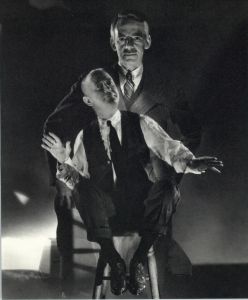
“Cohan was just perfection in that play,” J. D. Salinger would later say – a remarkable Edward Steichen photograph survives from that collaboration. The portrait is all spook lighting, and shadows.
Cohan is sitting in the foreground, on a stool, his hands raised. outstretched, as if he were backing someone away. He is, in fact, gliding. It is almost as if Cohan had also finally mastered the art of how to dance, sitting down.
In direct counter-distinction, O’Neill is standing behind George, dressed in a very smart, very fashionable formal suit. Something dangerously approaching a demonic smile is threatening to spread across the rest of O’Neill’s very young, mustached and darkly handsome face.
There is also something odd about the relative size of the two men in this photograph. Cohan is slightly larger than life, whereas O’Neill is portrayed in normal proportion. The photographer has perhaps superimposed the image of the one man over that of the other, click. The photograph has been taken.
The Ying and Yang on an entire people is in this portrait. It is an altogether haunting piece of work.
“Ah Wilderness” would prove to be Cohan’s last hurrah. In 1940 Jack Warner approached him about making a movie out of his life.
Yes, Cohan would allow such a movie, if the script was right. No. he was far too old to star in it himself. How about this younger guy, Cagney, some of his people asked?
And so Jimmy Cagney became George M. Cohan in more ways than one. Cagney even learned how to dance up the side of certain walls — just the way George used to dance — in his Academy Award-winning role in the 1942 production of “Yankee Doodle Dandy.”
Cohan would be dead from cancer within 10 months when the studio sent a final cut of “Yankee Doodle Dandy” for Cohan’s own private screening. His own son, George, sat with him as he watched the film without comment. When the final credits began to roll young George asked, “Well, how did you like it, Dad?”
“That Cagney,” Cohan snapped back, with real wonder in his voice. “What an act to have to follow.”
When he died 10 months later, a Solemn Requiem Mass was held for Cohan at St. Patrick’s Cathedral. A number of people in the city of New York still remember the moment during the final funeral procession when the Cardinal turned the other way, and the organist struck up the chorus to “Over There.” The ancient sound which had always been contained within that march filled the entire church. Cohan was gone, and yet of course he wasn’t.
The Great George M. possessed your basic, aboriginal Irish, truly fire-cracker heart. He will certainly remain the best thing the Irish ever gave America — just for the Fourth of July.
Note: Bob Callahan (1942–2008) was an influential author, editor, and the publisher of Callahan’s Irish Quarterly. Often known for his broad knowledge of American culture and comic art, he was also the executive director of the Turtle Island Foundation.
This article was originally published in the July/August 1986 issue of Irish America. ♦
Leave a Reply