
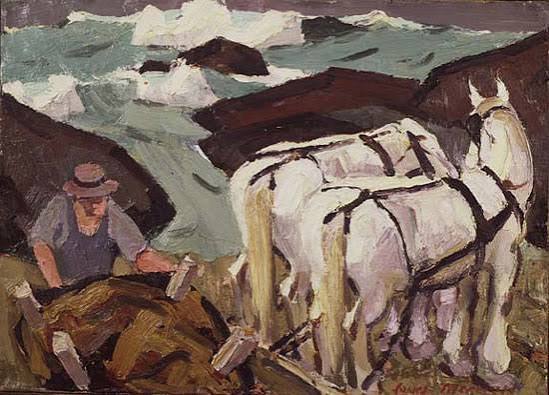
Not every artist who dies abroad enjoys a home burial, though homage is generally paid– to Joyce in Zurich, or to Keats in Rome. Such is sadly not the case, however, for James Fitzgerald, a highly regarded twentieth-century American painter who died on Aranmore Island, County Donegal, in 1971, and whose grave is seldom – if ever – visited in Dublin’s Mount Jerome Cemetery. Yet, what survives is a remarkable body of Irish paintings executed by Fitzgerald during repeated sojourns in the west of Ireland at the close of an unusually colorful, and always single-minded, career. The intriguing story behind these paintings of the Aran Islands, Kerry, and Donegal best begins with a brief look at the artist’s life prior to its including Irish chapters, is brought to you by Anthony Glavin.
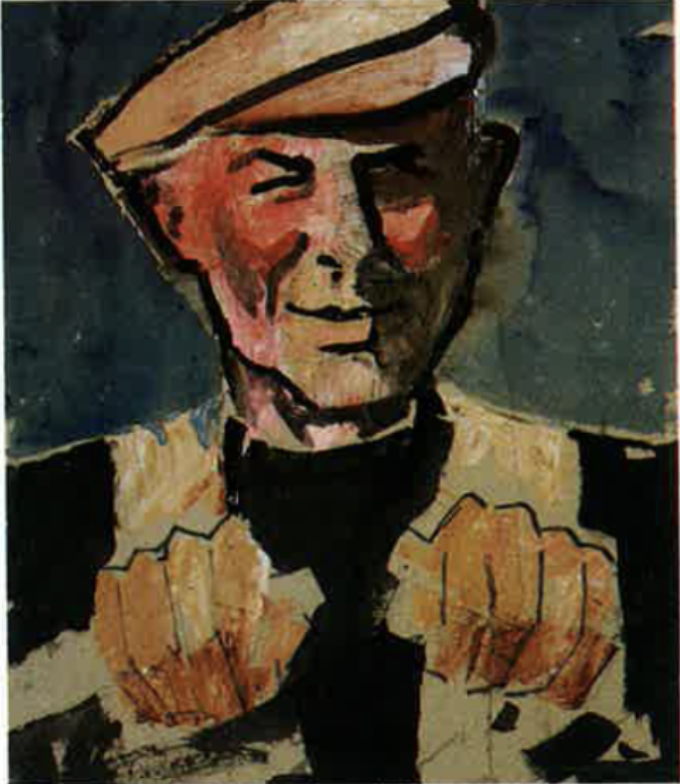
James Fitzgerald was born to Irish American parents in 1899 in Boston, where he enjoyed a happy, if unremarkable, childhood. After a brief stint in the U.S. Marines, he entered the Massachusetts College of Art. Upon graduating in 1923, he spent the next five years both painting and indulging his love for adventure-shipping out on a Grand Banks fishing schooner, or knocking about the Caribbean. The first major period in his painting career began when Fitzgerald moved to Monterey, California, in 1928. After fishing with a sardine fleet, then panning for gold near the Big Sur, the artist had a studio built above Monterey, where he worked for the next thirteen years. An accomplished violinist, his interest in music and theater likely abetted a friendship with Pegs Mather, a young dancer who had trained with Martha Graham, and whom Fitzgerald married in 1931.
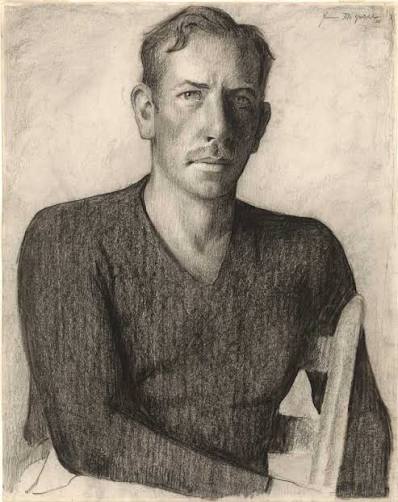
The Monterey Peninsula was a hotbed of artistic activity in the early 1930s, and Fitzgerald quickly established himself as a superb watercolorist, exhibiting frequently and winning several statewide awards. Soon he was part of an informal circle including John Steinbeck, poet Robinson Jeffers, mythologist Joseph Campbell, and actor Richard Boone, who gathered at the laboratory of “Doc” Ricketts, a marine biologist who features in Steinbeck’s Cannery Row. Reserved, yet opinionated and often brutally frank, Fitzgerald frequently clashed with Steinbeck, who, referring to the artist’s penchant for painting plough horses from the rear, once described Fitzgerald as “the greatest horses’ ass painter in the West.” Still, both men managed to curb their mutual antagonism sufficiently for Fitzgerald to finish a masterly drawing of the Nobel novelist, which today hangs in the National Portrait Gallery at the Smithsonian.
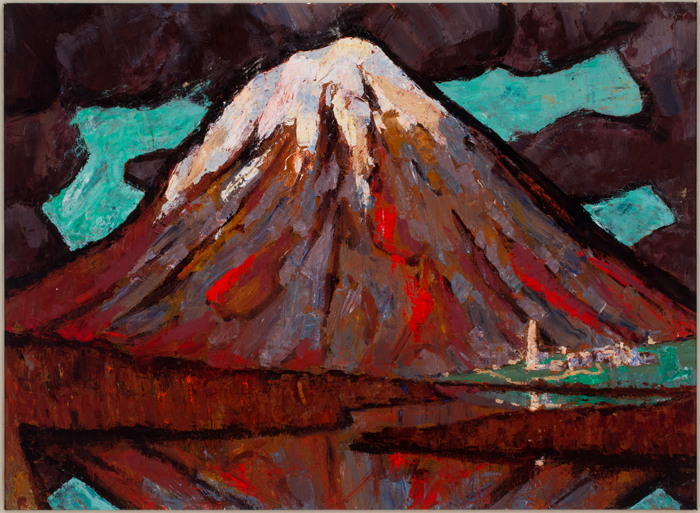
Their marriage in trouble, Fitzgerald and Pegs moved East in 1943, to separate shortly after. Fitzgerald subsequently established himself on Monhegan Island, a celebrated artists’ retreat off the Maine coast, where he painted spring and summers for the next twenty-eight years. Autumns saw him trekking into the Maine backwoods to paint Mount Katahdin, whose majesty had a century earlier captivated Thoreau.
Winters he spent in New York City working as a gilder.
Unlike California, Fitzgerald made little effort to exhibit his work back East-though his dedication to his painting never wavered. Indifferent to his artistic reputation, he was never less than totally committed to his art.
In short, Fitzgerald lived to paint.
Even his daily regimen of walking and reading (chiefly of Zen Buddhism) was designed to aid his painting.
As early as 1954, Fitzgerald, inspired by the writings of Synge, spoke to the Monhegan-based painter Rockwell Kent of his desire to visit Ireland. Kent, who summered in Donegal in 1926, encouraged Fitzgerald to explore that county as well as the Arans. It was not until January 1965, however, that the painter was able to make the first of what would be five trips to Ireland.
Fitzgerald spent two months on all three Aran Islands – no mean feat in mid-winter for a man of sixty-six, often in severe pain from a bad arm. The artist was his trenchant self as regards the old sod: “Holy Ireland holy Hell!” he wrote his Monhegan friends, Anne and Ed Hubert, “Cold as a banker’s heart!” Yet the magic of the Arans, even in winter, was not lost on him.
“But rare beauty flashes out,” he also wrote. “Forgotten time. No clocks. A cold savage dream.”
The foul weather did not prevent the painter from going out in the islanders’ currachs, fashioned from the same “excellent stout canvas” he’d purchased in Galway for his paintings. The currachs were also the inspiration for what Fitzgerald envisioned as his largest painting ever, Aran Rowers, for which he produced portraits, sketches, and cartoons until his death.
Maire Mulkerrins, who kept Fitzgerald on Inishmaan, remembers chatting with the artist evenings by the fire where they compared notes on island life, not least the lobstering common to both the Arans and Monhegan. “My mother-in-law, Brigid, used to repeat songs and prayers for him in Irish,” Maire recalls, and Dancers of Aran may well be based on Fitzgerald’s repeated visits to the elderly woman’s cottage. The painting itself is like something out of Synge-an almost otherworldly vision of dancers silhouetted by firelight and flanked by hens, with a melodeon-playing old woman in the corner.
Both this painting and Sarah, of a woman spinning, demonstrate the unusually strong sense of composition, and slightly abstract style that distinguished Fitzgerald’s art. Sarah herself lived on Inisheer, the smallest of the Arans, which may have been where Fitzgerald was challenged by a local priest for having removed the religious pictures from his room to hang his own sketches. Fitzgerald informed the priest that he felt all pictures came from God, to which the curate grimly responded, “We do not believe that here.” Deciding on discretion as the greater part of valor, the artist replaced the iconography.
His second visit to Ireland in January, 1966, took Fitzgerald to the Dingle Peninsula, where he spent ten weeks in the village of Dunquin. There he hired a Ford Anglia for two weeks to explore the coastline, and ever the adventurer, visited the Great Blasket Island in a currach which capsized on its return. An artist to the core, Fitzgerald rued the loss of a fine sable brush more than his icy, not to say dangerous, wetting in the March seas. His fine Irish Coast, with its monumental topography and startling shafts of sun, resulted from this visit.
In March of 1967, the painter made his first trip to Donegal, spending three weeks in the small village of Derrybeg. “Keep wondering how Roman Catholicism ever took root here,” he wrote the Huberts.
“The Spanish like it for its bloody suffering. These people for its other-worldliness, the surroundings are so harsh. Every morning to Mass! I went Sunday to my sorrow. I couldn’t kneel on the rough board—had to sort of sit. Woman in back of me kept jabbing me to kneel. I sat back hard against her face-she said ‘Whisht!'” In Derrybeg, Fitzgerald got his first look at Mount Errigal, which won his heart much as Maine’s Mount Katahdin had twenty years before.
“Wonderful mountain here—one of the best I’ve seen,” he wrote the Huberts. “I catch a glimpse of the mountain occasionally seven miles away, ” he wrote a week later, but gales and sleet prevented him from working on it.
In May of 1968, Fitzgerald spent over a fortnight in the tiny village of Dunlewy at the base of Errigal. “This is a wild area,” he wrote home. “Eagles, ravens, curlews and skylarks are my only companions.” His stunning Mount Errigal, snow-capped against a sky of turquoise and storm clouds, evokes the majesty of Ireland’s second-highest peak. Still, the artist also wanted to paint what he’d once seen of the mountain at sunset, its quartz summit afire from the departing rays. Nora O’Donnell, who kept the painter, tells how a car took him every evening to the western end of Dunlewy Lake. “He used to get annoyed,” Nora recalls, “that the sun only came out for ten minutes at a time.” Her son Pat, nine years old then, was one of a group of schoolchildren whom Fitzgerald also painted. “I remember him being very particular,” laughs Pat. “When the light went, we were allowed to play nearby until the sun returned!”
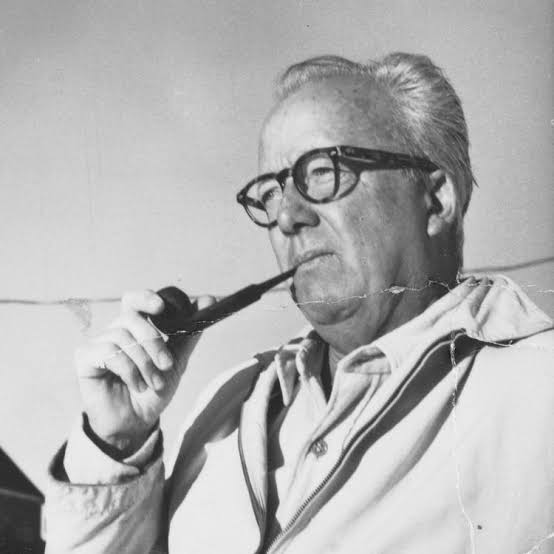
In the spring of 1971, the artist made his fifth and final trip to Ireland, hoping to capture Mount Errigal at sunset, and also gather more data for the large oil of Aran Rowers. After a night in Sligo, he traveled on April 9 to Burtonport in County Donegal, where he checked into a guesthouse, requesting a room overlooking the fishing harbor which he planned to sketch.
Taking advantage of the sunny afternoon, he made the short run by fishing boat out to Aranmore Island, where he followed a group of young people at a fast clip up the steep hill to the Glen Hotel. It was likely the hill that finished him, for shortly after arriving at the hotel, Fitzgerald collapsed and died. It was a quick death, what the fishermen on his Maine island of Monhegan call the “kiss of God.” Several hours later, his remains were brought back to the mainland, Mount Errigal clearly visible in the sunlit distance.
Rockwell Kent considered James Fitzgerald a brilliant watercolorist, an opinion shared by several of his California contemporaries who held that, had Fitzgerald remained on the West Coast, he would have ultimately established himself as a major figure in American art. Be that as it may, his splendid Irish paintings offer a memorial beyond the anonymity of his Mount Jerome grave.
Editor’s Note: This article was originally published in the June 1992 issue of Irish America. ♦
Leave a Reply