
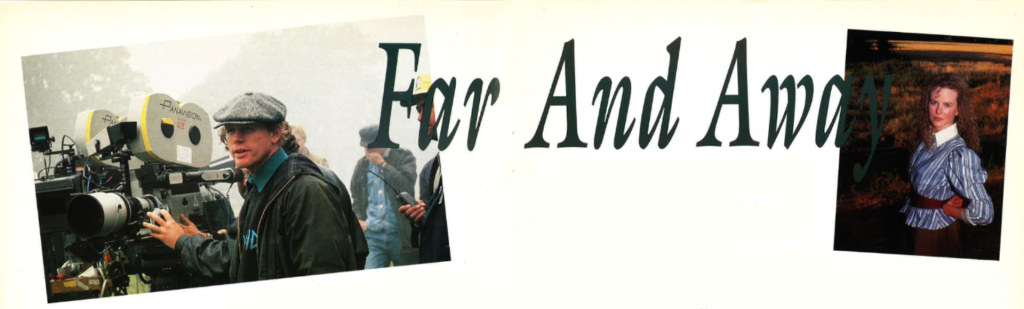
He was only four years old — flying across the Atlantic to his first acting job in Vienna, Austria. We would come to know him well, first as O.P. on Mayberry R.F.D. and The Andy Griffith Show, and then as a high school senior in American Graffiti and Happy Days, holding onto the 50s in a world transformed. As a grown-up director, he mastered the craft that always fascinated him. But now as we begin our story, Ron Howard is a half-asleep small boy high in the sky, far from home, and a little nervous about it all.
“It’s one of my earliest memories,” Ron Howard told me. “I remember looking down and there in the ocean was this green landscape. 1 thought it was a map of the United States – all those shades of green and the stone walls marking off these irregular shapes, like lines on a map.
I asked my Dad and he said, ‘No, that’s Ireland.’ We landed at Shannon Airport to refuel. I walked around on the tarmac. A truck came out and a few men jumped off to take care of the plane. One had bright red hair, and I had this flaming red hair. He smiled at me, tousled my hair and said, ‘You look like you belong here. You should stay.’ This stuck with me. In fact, it’s one of my earliest childhood memories.”
The next time Ron Howard came to Ireland, it was to do a location survey for Far and Away, his new movie starring Tom Cruise as Joseph Donelly, a tenant farmer, and Nicole Kidman as Shannon, the landlord’s daughter whom he loves, in turn-of-the-century Ireland. It’s her dreams of America and the lure of land there for the taking that lead them to Oklahoma and the great land race climax of the movie.
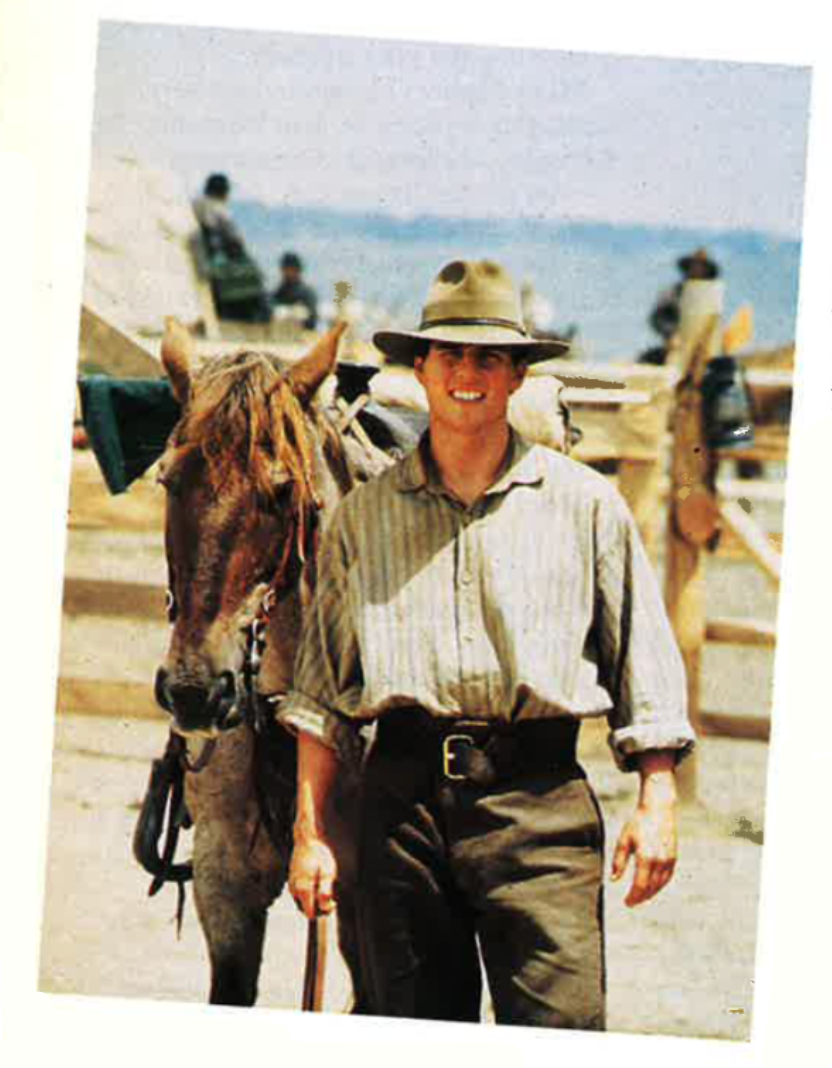
“I always wanted to go back to Ireland,” Howard says, “and when I was up in the helicopter looking down at the same green landscape, the stone wall lines, that early memory came back so strongly and 1 thought of that redhead at Shannon.” But it wasn’t only the airplane mechanic that dawn that inspired this $40 million romantic adventure. The Chieftains come into it, as do Ron Howard’s own great-grandparents and a friend writer, Bob Dolman, who had his own fascination with Ireland.
“I had three great-grandfathers who competed in the great Oklahoma land races,” Howard says. “One, Ralph Tomilson, who was second generation Irish American, in some ways inspired the story.” Howard describes him as “a passionate, colorful character” who wound up as a “very important figure in my father’s life.” It was from his father that Howard first heard the stories of the land runs, where hundreds on horseback, in wagons, on bicycles or just running on foot, raced toward parcels of land offered by the railroads and developers to the first comers. The last great race at Cherokee Station, Oklahoma, is the one reenacted in the movie.
“In fact,” Howard says, “it was all a publicity stunt to bring settlers west and maneuver the Indians further away from their land. It became a wild out-of-control thing that the Army ended up monitoring.
The rules were, you lined up at noon at various checkpoints, a cannon went off, and this huge charge began. This was first come, first served, for the 180-acre parcels. When you arrived, you staked your claim. My great-grandfather Ralph Tomilson and another fellow arrived at the same parcel at the same time. There was almost a shoot-out until Ralph saw a marker that said this piece was Indian land and exempt. They were about to shoot each other over land neither could claim. He never did get land nor did my other great-grandfathers.”
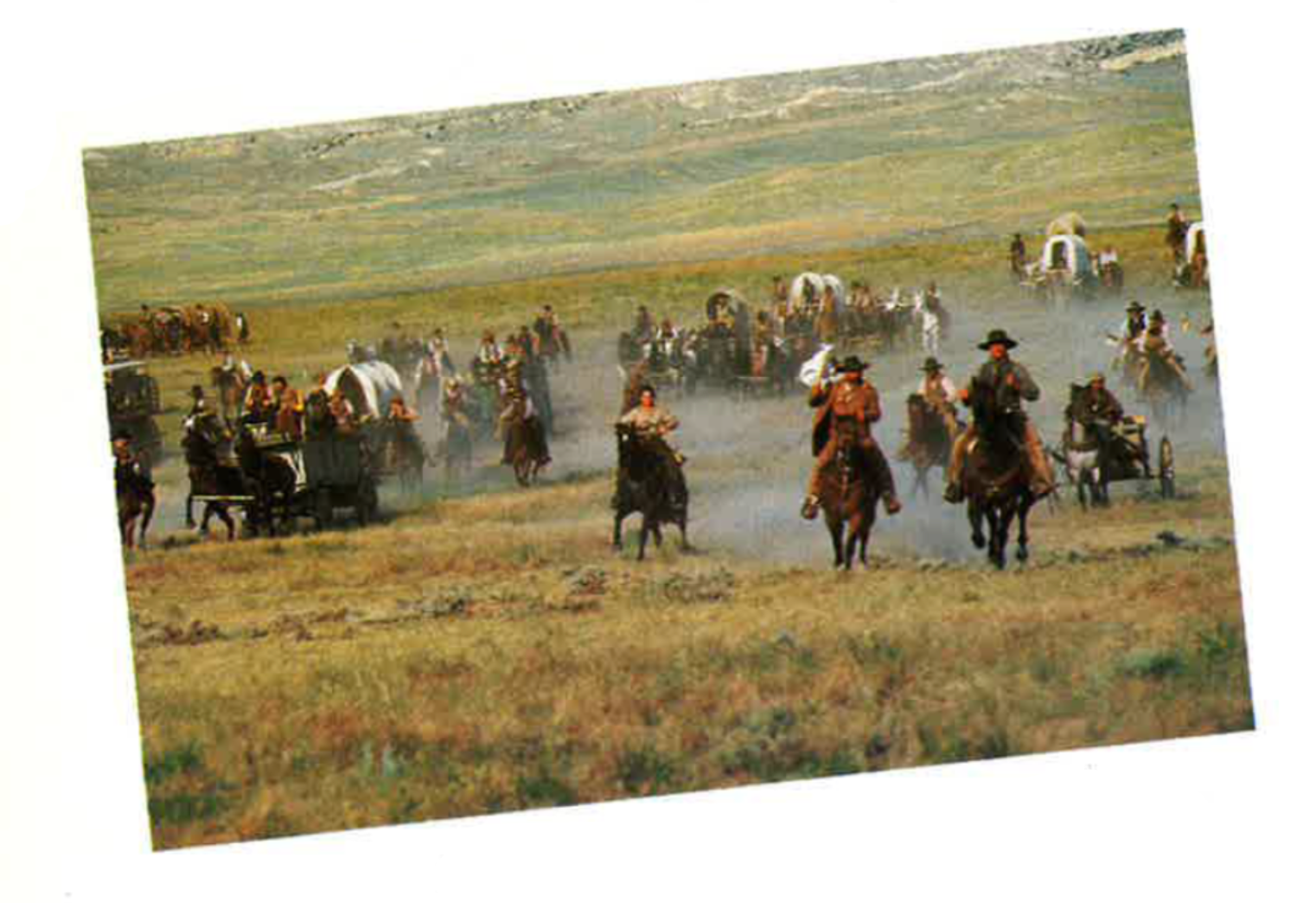
Howard explains that few of the settlers got land this way — only one in a hundred, and it was the lawyers who really prospered, trying to sort out as many as eight claims for each parcel. Still, these men racing for free land became part of Howard’s family history.
He remembers his great-grandmother at 96 pulling out a fragile newspaper clipping. “She showed me this blurry image of this mass of movement and pointed to this guy and said, ‘This is your great-grandfather. He got him a race horse.’” Others in the family doubted the identification, but Howard says, “I chose to believe her.”
Indeed, when I talked to him soon after he had seen a close-to-final version of Far and Away, the family story analogy remained. “It’s like a tale told by a family member where the drama is a little heightened and the ancestor a little more heroic.” Ron Howard had that Irish memory, his family history, and then nine years ago he attended his first Chieftains concert. He had known their music but never heard them play live. “I was listening to the ‘Flower of Sweet Strabane’ – a song that tells the story of going to America. It was so romantic, so bittersweet and beautiful. I started thinking about the reason people left Ireland — the reason why so many ended up here. I have always loved immigration stories, and I went home and started making notes for a movie partly based on my own family, but with the romantic feeling of the song.” Fortuitously, his friend writer, Bob Dolman, felt his own connection to Ire-land. Let Bob Dolman take up the story: “I studied Irish literature at York University and did a course with Marshall McLuhan on James Joyce at the University of Toronto. It was interesting — Joyce is at the center of all of McLuhan’s thinking. Now, my own family has Irish roots, but the real spark of my interest came from a trip I made to Ireland in 1967. I’d dropped out of high school and was traveling through Europe with a friend. We split and I ended up in Ireland – alone and with very little money.
“I was in Dublin on St Patrick’s Day and then began hitchhiking around. I fell in love with Ireland and the people, the land. I went to school, studied Irish literature, and became a writer. I wanted to write a contemporary Irish love story. Then I read Cal [by Bernard McLaverty, the story of a teenager growing up in Northern Ireland] and gave it to Ron. He said, ‘Let’s do this movie.’ But unbeknownst to them, Cal was on its way to becoming a movie produced by David Putnam and directed by Pat O’Connor. “I was completely mesmerized by Cal,” Howard recalls, “and then I saw this documentary about Connemara ponies, went to the Chieftains concerts, saw all these images of my great-grandfather — well, I wanted to do an immigration story that wasn’t just dark and oppressive, but had the humor and power of the Irish character. Bob wanted to do a love story so we combined our ideas and began working on a script. Other projects intervened but this would not go away. We kept coming back to it.” Howard directed Night Shift, Splash, Willow, Cocoon, and Parenthood as his ideas for the Irish story developed. Bob Dolman continued to work too. He went to Oklahoma to research the history of the immigrants who raced for land. He was taken on a tour in Guthrie, Oklahoma by Don Guthrie, a retired resident who filled him in on the history of the town in 1889 — the land rush period. But Dolman wasn’t satisfied. “I told him what he’d given me was helpful but it was all facts. I needed something more personal. He said, ‘I don’t think I can help you — unless maybe you’d like to read my great-grandmother’s letters.'”
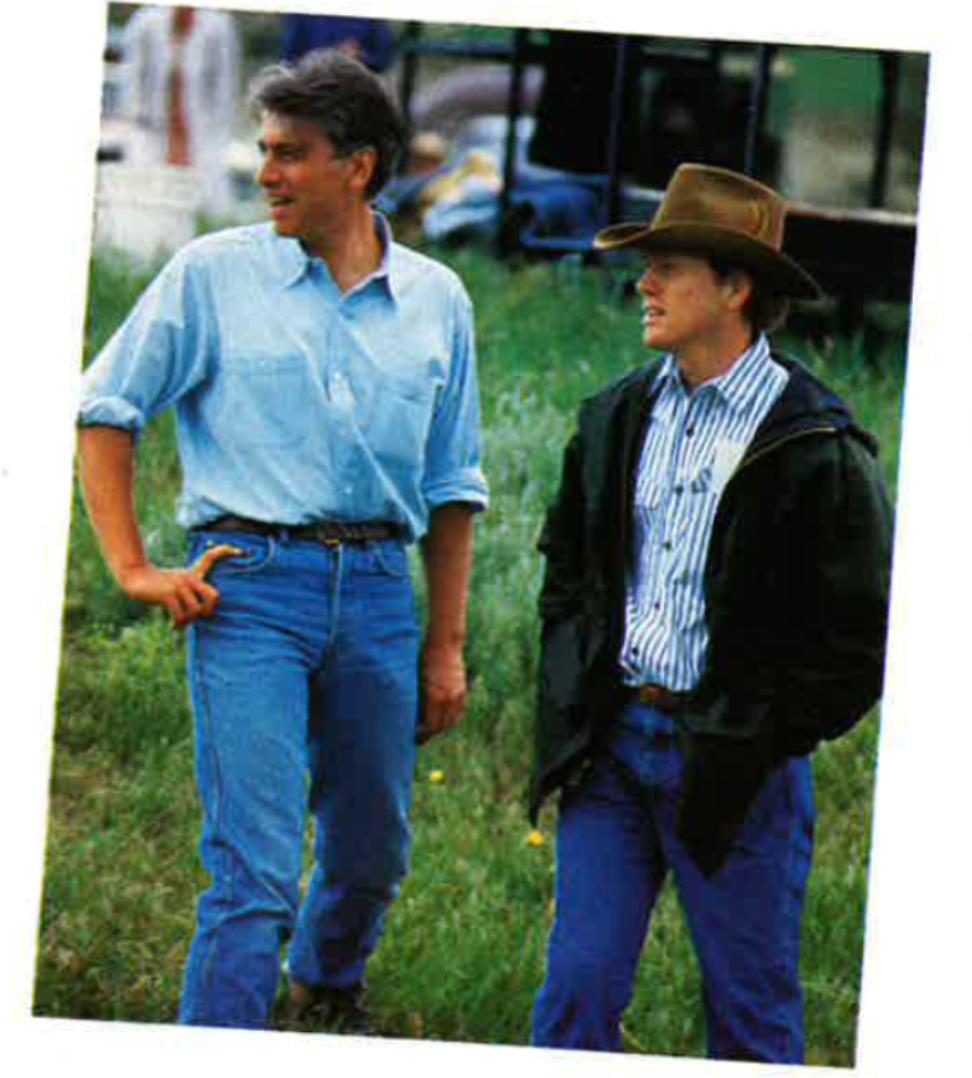
These letters, written to her brother in New York, recounted the land rush days beginning in 1880 and culminating in the last great race in April 1889. Dolman found the very ordinariness of the letters gave them their greatest value. They weren’t poetic or grandiloquent but they led Dolman to “appreciate humor and emotions of people then, and see that it really wasn’t that different from what we feel now.”
Dolman says that they tried to keep the sense of a simple, ordinary story at the center of this wide-screen romantic adventure. “It may seem to be an epic, big movie,” Dolman says, “but at the heart of it is a smaller story, a very human story.” Howard agrees. “This really is my most personal movie. It’s told like a family history that’s been passed down – embellished maybe, but rich in humor and a sense that despite all the hardships it was worth it, because here we are. So while we were painstaking in our research – props, wardrobe, the reconstruction of place – the story is more family myth than plain history.”
But then which of us, given the chance, wouldn’t want to brighten our own stories up a bit, shoot them in 70 millimeter, and score them with music of The Chieftains?
Howard says that technical advances in equipment allowed him to use the wide-format film for the first time since David Lean’s Ryan’sDaughter, and indeed the first shoots made on the Dingle Peninsula had the schoolhouse from Ryan’s Daughter in the background.
But Nicole Kidman and Tom Cruise are of Irish descent and each had an Irish coach to help them with their accents. As co-stars, they had Irish actors Cyril Cusack, Neal Tobin, Colm Meany. But according to both Howard and Dolman, sometimes the right authentic touches would come from a crew member or one of the extras.
Bob Dolman’s trip to the Aran Islands provided him with certain turns of phrase that he added to key scenes. “Our bed and breakfast hostess fixed my friend an Ovaltine and then watched him pour cold milk into it. ‘I never saw anyone drink Ovaltine cold in all my living life.’ “All my living life’ — Joseph says that to Shannon. Another was ‘He’s keeping himself to himself’ – someone in the crew said that. It was as if the country kept giving little extra gifts to us.” And why the name Shannon for the daughter of a 19th century land-lord? Dolman laughed. “1 know it’s not really accurate to the time or her situation. I had a scene where her father explains that he named her for the Shannon — ‘the railing, bailing source.’ But really I called her Shannon in honor of Ron’s moment at Shannon airport.”
So it was the refueler.
“You look like you belong here. You should stay.” The little boy came back and made Far and Away.
Editor’s Note: This article was originally published in the May 1992 issue of Irish America. ♦
Leave a Reply