
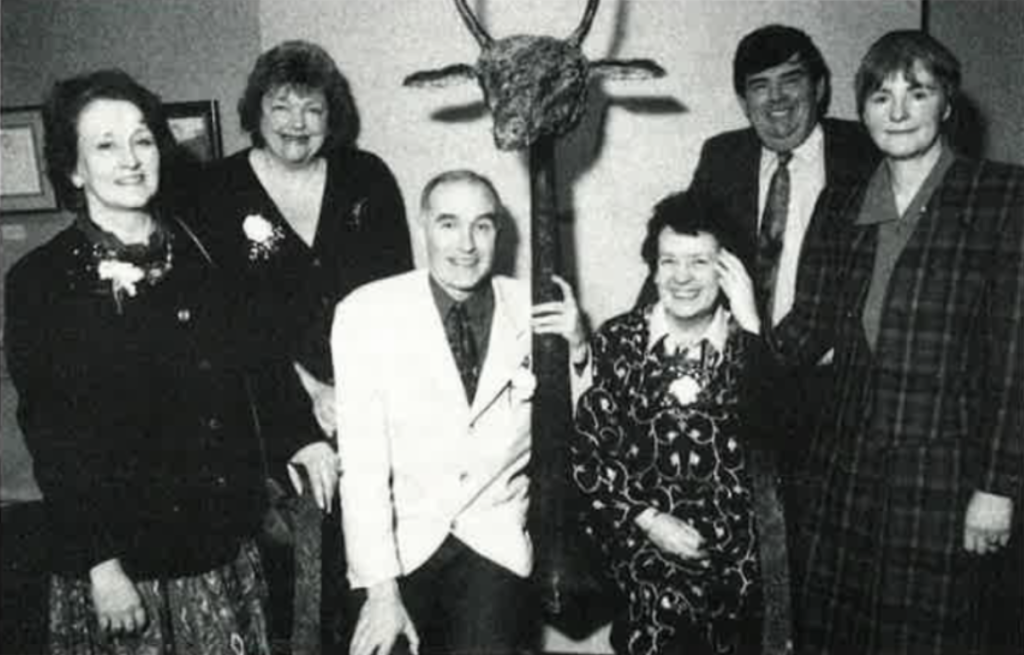
Irish America caught up with five of the writers who were here on a tour sponsored by the Irish Tourist Board and St. Martin’s Press: Maeve Binchy, her cousin Dan Binchy, Mary Maher, Alice Taylor, and Shane Connaughton. Mary Pat Kelly accompanied Maeve Binchy, Dan Binchy, and Mary Maher to their radio interview on Joe Hurley’s weekly program on WBAI, New York. She later talked to Alice Taylor, whose memoir of her childhood in rural Ireland, To School Through the Fields, has sold more copies than any other book ever published in Ireland.
Joe Hurley: Maeve Binchy has written, among other things, Light a Penny Candle, which may be the best known of your books in this country. Circle of Friends is the new one.
Maeve Binchy: That’s right Circle of Friends is the last big novel I wrote. My most recent book to be published in this country is The Lilac Bus, a collection of short stories which link together. The title refers to a phenomenon in Ireland that a lot of people who live in the city, in Dublin, go home on a Friday night to mothers and fathers in the country on various little buses to their local villages.
It’s quite an interesting phenomenon because they retain their roots without being driven mad by their families. They have a littie bit of freedom during the week in the city and yet by going home on the weekends they don’t lose entirely their own sense of identity.
So that was The Lilac Bus, and I’m finishing another one which will be published in September, called The Copper Beach.
Joe Hurley: Set in Ireland?
Maeve Binchy: Yes. I base my books a lot on myself, on the things that I’ve experienced. I was a big, fat, stocky 10-year-old, the most unlikely girl to ever wear a nice frilly dress, I had a fantasy that I would wear one because I’d been to a pantomime and saw a lovely pink, frilly dress that little girls wore, I thought wrongly that I was going to get this dress for my 10th birthday. And so, in my book, Circle of Friends, I wrote this description of the girl, the heroine, who was somewhat like myself, stocky and square and not at all the person that you’d buy a little pink frilly dress for. I described Benny as she came home from school and went into the house. Her loving, possessive mother was upstairs with a big parcel, and Benny got overexcited and said, “Can I come up and see what’s in the package?
Would that be anything special for me?” And her mother said, “Yes, but we’ll bring you into the bathroom first and wash you.” I describe how she stood in the bathroom with her vest and knickers and her mother scrubbed the back of her neck.
And then she went into the room and her mother opened the box and produced not the beautiful pink dress that she wanted with the little velvet collar and not the little black shoes, but instead a horrible navy skirt and a jumper, navy and white — big, thick, and coarse, and a pair of laced shoes and thick white socks – the kind that a footballer might wear.
I describe Benny staring at herself in the mirror, a little fat, red-faced girl with a tear-stained face, in her best knickers. And she sees this horrible outfit on the bed, and she knows that for the rest of her life she would never be somebody that anybody would ever buy a pink velvet dress for. This is a terrible realization for her.
I got a great number of letters from readers about this scene because apparently everybody when they’re 10 has always hoped for some entirely inappropriate present, and been disappointed by something prosaic. I remember when this happened to me word for word. My mother said, her face lighting up with the happiness of it all, “You know, the great thing about it, Maeve,” she said, “it’s so strong it won’t wear out for years and years and years. You can wear it forever.” That bit almost cracked my heart in two.
Well, fortunately, in fiction you can make people more beautiful and more successful and more intelligent than you are. So Benny grows up, she gets quite glamorous. She has a huge cleavage, and all the fellows in the university love her. It’s not an ugly-duckling-into-a-swan story, but she gets popular and successful and happy.
In my life I got confident because I realized that looks didn’t matter and that I never judged my friends on their looks.
And this, I think, is the kind of thing that I write. My writing is full of the dark secrets of the heart that we don’t admit. I’m very, very pleased that I got such a lot of response from readers who have felt something similar in their lives.
Joe Hurley: How do American readers react?
Maeve Binchy: I get many letters from Americans. If they like something, they will put a pen on paper. Americans have this generous, warm handwriting, and they put little stickers on the top of their letters or the back of the envelopes, which we never do at home, with their address.
I answer everyone.
I received a letter from Barbara Bush inviting me to the White House. Now, I’m not necessarily a great supporter of everything that President George Bush does, but I was extremely glad that his wife said she was fond of my writing. She invited me to lunch. During lunch she said, “I had a Presbyterian girlhood in New England, and why do I feel that I have been in exactly the same kind of situations as you have been in Ireland?”
Joe Hurley: I understand that you are a most supportive creature to other writers. Both Mary Maher and Dan Binchy told me you were incredibly helpful to them.
Maeve Binchy: I was a schoolteacher for eight years, and I have a terrible bossy streak. I feel that you do have to give yourself a certain amount of discipline and say, “I will finish the book by this date.” Even a false deadline helps, because otherwise you’ll never finish it.
Mary Maher, my great friend and colleague from the Irish Times, and my cousin Dan each did something wonderful. Their first novels are being celebrated here in New York at the moment.
I heard an Irish writer say once that success is not like a cake where if you divide it up and take a slice away there’s less left for anybody else. It’s more like coal on a heated stove, and the more success you have, the more success another person has, you put another coal on the stove and add to the heat. The heat becomes bigger and bigger and everybody is made great by it. I definitely believe that.
And I think it’s something that’s happening in Irish writing at the moment. There’s a great flowering of Irish writing now.
Joe Hurley: Thornton Wilder said, “I prefer to think of the literary pursuit as a relay race, one runner handing off the baton to the next runner.” Mary Maher, you are a ranking Irish Times columnist and writer on essentially women’s affairs, but your career began in Chicago.
Mary Maher: Yes, I left the Chicago Tribune in 1965.
Joe Hurley: How does the particular politics of Ireland influence and inform your work and your subjects?
Mary Maher: I found Ireland very liberating as a young woman journalist. In Chicago, all young girls were categorized — you did the features, you did the light stuff. I went to Ireland and I immediately got into a wide range of political and other activities, and it was just too interesting to leave. That’s why I’m still there. But for my first novel I chose to write about the Cronin murder trail of the last century in 1889 Chicago.
Joe Hurley: Why was that?
Mary Maher: I’m fourth-generation Irish American. My great-grandparents all immigrated from Ireland. Several of them were quite closely involved in the Cronin case. I had a lot of family documents relating to that period, to the Irish Revolutionary Brotherhood and the political splits. This was an enormously scandalous murder. When I stumbled across the full story, I suddenly realized why I had held on to these documents for the 20-odd years I’ve been living in Ireland.
Joe Hurley: Do you want to talk a bit about that case?
Mary Maher: The Clan na Gael was extremely powerful and it was run from Chicago. There were suspicions that one member, Dr. Cronin, was a spy. And for this he would have to be executed, as an informer.
The story has all the ingredients of an Irish political problem—spies, corruption, allegations of treachery and betrayal. A man was murdered, five people came to trial. Nobody ever found out what happened. It was all revealed many years later. I have written it as a thriller drawing on the documents I had saved as the family archivist.
Joe Hurley: And what does the title The Devil’s Card mean?
Mary Maher: It refers to a card game in a rather deadly version of Old Maid.
Somebody has to draw the devil’s card — he becomes the executioner. I don’t want lo give the plot away but my research raised questions about Dr. Cronin’s guilt.
The book is also a portrait of the Irish in turn-of-the-century Chicago.
Joe Hurley: Dan Binchy, your book takes place in contemporary Ireland. What moved you to write the book called The Neon Madonna?
Dan Binchy: I always wanted to write; and working a farm gives me a lot of time.
Joe Hurley: It’s a real working farm? You’re not a gentleman farmer?
Dan Binchy: No. There’s no such thing.
A farmer trying to be a gentleman is stupid, but a gentleman trying to be a farmer is utterly ridiculous. So I am a working farmer, but I find that I’ve got a certain amount of time in the mornings, especially from about half past 5 until about 11, and I write then. And usually by about 11 I’ve absolutely nothing left in my mind. The shutters just come down, so l go out and do some farming.
Joe Hurley: You say you’ve always wanted to write. What turned the key in the lock to make you do it this year?
Dan Binchy: I have a very hard-working wife. She supported me for the four years that I was writing this book. Maeve was a lot of help, and a lot of pressure as well, saying, For God’s sake, will you get off your ass and finish it, and send it to an agent?” I’ve known Maeve a hell of along time, and we’ve always been very close since we are about seven.
Maeve Binchy: He taught me to ride a bicycle.
Joe Hurley: Tell us about The Neon Madonna..
Dan Binchy: It’s a story about a farm.
It’s a story about a moving statue. It’s a story about a rural Ireland, not the modern, thrusting Ireland that we hear so much about. This is basically about small farmers and the local politicians—it’s a miniature version of city hall. There’s a priest in it who is a central character. He’s a sympathetic character.
There’s this moving statue syndrome in Ireland which usually happens about May. Whether this is due to religion or possibly refreshment the night before. I don’t know.
Joe Hurley: Maeve, what about this phenomenon?
Maeve Binchy: There used to be buses that would go around in the summer to one particular set of moving statues. Quite a lot of very serious people including some hard-boiled radio reporters went down to report the phenomena, and they said they saw it too. So take your choice, whether it was an intervention of the Almighty or a trick of the light. But there’s definitely a kind of hysteria that went over Ireland for a while.
I don’t understand the nature of the actual politics of a town, but Dan’s gotten it very well. And of the clergy, and of the politicians and the people who run the bars. He has been compared to the writer Tom Sharp.
When I saw that my cousin Dan was referred to as the Irish Tom Sharp, I must say that gave my heart a great lift. I thought, wasn’t it great that I had kept shouting at him when he was thinking that maybe he might give up because it’s almost an act of arrogance to finish a book?
At this very moment, Mary Maher and I are working together on the woman’s page of the Irish Times. It’s a marvelous thing now that she and I are moving on to what I might call our prime, just round the sort of 50ish mark. It’s wonderful that we have entered another world. We were young. crusading journalists, and now we are mature and splendid novelists.
Mary Pat Kelly: Alice, yours is such an Irish book, yet it got a very enthusiastic response in the U.S.
Alice Taylor: For me being here in America with the book means coming full circle. I was inspired to write To School Through the Fields by the American visitors coming back, who had left our farm or the area. These were emigrants and descendants of emigrants coming back and they would ask questions of my father.
I was only a child but I would think, what a pity a great grandmother hadn’t written some things down, recorded daily life. The big things in history are recorded, but the ordinary day-to-day things sometimes get lost. These visitors would have loved to have such a record. Then when my children came back, I thought, It’s happening again.” My generation stepped from the old Ireland to the new. I grew up with no electric lights, no machinery.
We used horses.
Then in the 1950s when I was a teenager, things changed. I thought it would be good to have a record of childhood in the old Ireland by someone who had lived through it — the stations, the threshing, the neighbors. I wanted to do it for my own children and my nephews and nieces who were growing up now. But really the people most interested were those who had lived it. It was as if that way of life had slipped away unseen. All of a sudden we looked up and said, “It’s gone.” These people didn’t read my story really. After the first chapter they were reading their own story.
Mary Pat Kelly: Has something central been lost?
Alice Taylor: When those days went away, at first we turned our backs very firmly. Now I wonder if we shouldn’t have been more selective. A lot of the old customs were rooted in very wise thinking which we are just now figuring out. What was thought old-fashioned turns out to be psychologically sound. The old Irish wakes are one example. They helped us go through the grieving. We never analyzed — we just knew. Now we are taking another look at the old. We are at a crossroads, and I think we have the opportunity to have the best of both worlds.
Mary Pat Kelly: How do we achieve that?
Alice Taylor: Communication —one-to-one. We must go against the tide of TV and find sufficient time to talk to each other and to do things together. I take long walks with my neighbors. I’m delighted in all the interest my neighbors have in me. Some call it nosiness but they keep an eye on you.
They’ll want to know how I got on in America and they’ve enjoyed my success with me. It keeps it all in perspective.
Editor’s Note: This article was originally published in the May 1992 issue of Irish America. ♦
Leave a Reply