
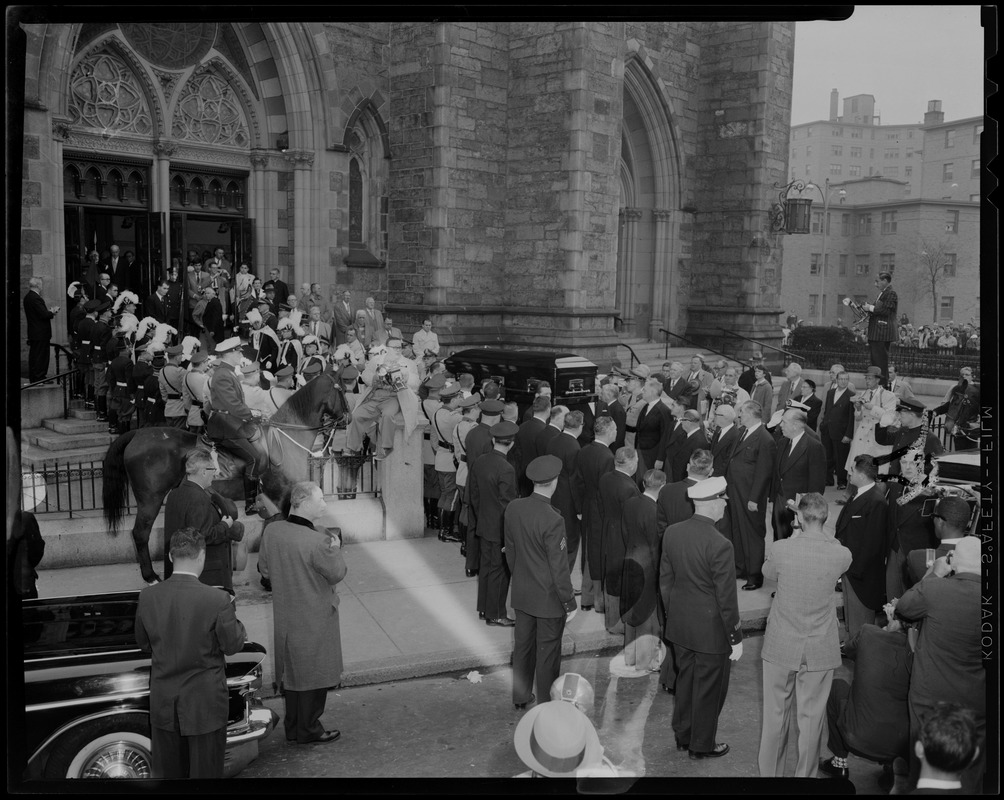
Saint and sinner, champion of the people and shameless grafter, James Michael Curley, four times mayor of Boston, helped to transform our governance from the politics of deference to the politics of serving human needs. In this excerpt from Jack Beatty’s forthcoming The Rascal King, the people of Boston, more than one million of them, turn out to say farewell to one of the most colorful politicians in American history.
It was the biggest wake the old city had ever seen: one hundred thousand mourners filed past the catafalque in the Hall of Flags in the State House.
They came all through the day and night, and the tide of them lapped over to the next day. The biggest wake was followed by the biggest funeral. A crowd of one million, in the impeachable estimates of the police, lined the sidewalks to watch the hearse carrying James Michael Curley pass through the streets of the city he had led and to which he had given life and laughter, sorrow and scandal, for over fifty years. He had been their mayor four times, but he was more than that to them, more than the sum of his other offices, whether alderman or congressman or governor. For the Irish American among them, especially, he was a political and cultural hero, an axial figure in the annals of their people. He had lived for them (“His triumph was their triumph,” the Boston Herald noted in its obituary); he had been a cynosure of their hopes and fears, and now in a sense, he had died for them, freeing them for a new era, with new horizons and new heroes.
The span of his life stretched from a time when the Boston Irish had been a rapidly multiplying but rejected minority to a time when one of them (technically: in reality, Senator John F. Kennedy was more Brookline than Boston and more Bronxville than either) was being introduced on local radio stations as “our next president.” James Michael Curley had lived grandiloquently. The massive public funeral suited his style no less than his significance.
In the months before his final illness, the newspapers had kept up a death watch on Curley’s house. Sightings of a florist in the vicinity would prompt bluntly inquisitive calls from reporters. Without salutation, without greeting, the old man would pick up the phone, growl in his unmistakable baritone, “Yes, I’m still alive,” and hang up. News of his hospitalization, surgery, recovery, brief convalescence, and swift decline occupied the front pages for a week. His death and funeral captured and held the headlines for four more days.
Only the Kennedy assassination, five Novembers later, would surpass that record.
Boston’s heroes and Boston’s martyrs, Curley and Kennedy and their star-crossed families, enacted a dark parable about the price of fame, the levy of fate on good fortune. The Catholic faith accustoms its adherents to frame experience in such parables — which are in their way political, in as much as contemplating the sufferings of the rich reconciles the poor to their poverty – and to see afflictions as tests of faith. James Michael Curley had suffered faith-challenging afflictions in the deaths of his first wife and seven of his nine children. And he had suffered them in public, where flinching can be seen, despair witnessed.
Yet, in a proof of the power of faith that amounted to a kind of existential service to his constituents — a municipal cleanup campaign in the higher numbered wards of the spirit — he had not despaired. He died believing in a Catholic god who had tried him sorely. That he could still believe tended to vindicate belief. The thousands filing past his casket and lining the streets for a final look at James Michael Curley were thus responding to impulses as much spiritual as political in kind. His death was an event in the civil religion of Boston just as John F. Kennedy’s was to be in that of the United States.
But this was the end of an old pol, the last of the big-city bosses, not the murder of a young president, and for days the papers printed anecdotes testifying to Curley’s roguish wit.
There was the one about the time he took the young man to see Governor Paul Dever.
“Governor, this young man is the son of an old and very dear friend of mine, now deceased. I promised him on his deathbed that I would look out for the boy. The young man needs a job, and I would appreciate it if you could find a place for him in the state service.”
Denver replied that he would do what he could, depending on the young man’s abilities.
“What’s his name?” he asked.
“Young man,” Curley inquired, “what is your name?”
There was the ritual of the cigars. “Frank, get the cigars,” Curley would tell his secretary when he had a visitor in his office he wanted to impress. Frank would go over to his desk, reach into the bottom left-handed drawer, and remove a box of cigars. Ceremoniously, he would pass the box to the guest. “No, no, Frank,” Curley would say, “the good ones, Frank, the good ones.” Frank would look embarrassed. “I’m sorry, Governor, I forgot.” He would then close the box of cigars, return to his desk, and take out another box which was, of course, identical to the first one.
There was his quip following the collapse of an approach ramp to an overpass built by one of his pet contractors: the ramp was, he said, composed of an “injudicious mixtures of sand and cement.”
There was the one about his plan to rid Boston of the British. During the First World War a wounded British officer was sent to these shores on a recruiting drive. Arrived in Boston, he asked the greenest mayor in America permission to sign up a battalion of soldiers from among persons of British nationality living in the city.
“Go ahead, Colonel,” Curley replied, beaming. “Take every damn one of them.” There was the one of more recent vintage that caught his endearing remoteness from mid-twentieth-century fads.
Riding with his chauffeur through the South End in one of his late campaigns, he looked at the signs that seemed to be everywhere. “Who is this fellow ‘Pizza’?” he asked. Properly informed, the chauffeur replied correctly. “Oh, I thought he was like Howard Johnson. I figured we might get a contribution out of him.” There was his comeback to a man, not known to be among his supporters, who had congratulated him (‘I think you’ll be a great Governor”) on his greatest victory.
“Very nice of you to say that, Bill,” he replied. “Do say it behind my back some-day.”
And surely his one-liner on Herbert Hoover belongs in Bartlett’s: “If we have another era of Hoover, Gandhi will be the best-dressed man in America.”
“As of now,” The Globe noted in its obituary, “it is difficult to imagine a time when Boston will cease recalling stories about him.” That time has not yet come.
James Michael Curley is still recalled in set-piece stories that float free of context and history, and often plausibility, the way stories about “characters” often do. In fact Curley had achieved the status of literary “character” two years before his death: Mayor Frank Skeffington in Edwin O’Connor’s best-selling novel The Last Hurrah, which gave a clichéto a still-grateful world, was widely taken to have been based on Curley. When the Globe, in an inspired whimsy, sent the novel to Curley for review, he returned it with a note hinting that he was considering a libel action against O’Connor. As O’Connor later described the episode to his friend Arthur Schlesinger, Jr., for some weeks “threats of lawsuits were coming regularly from the house on the Jamaicaway, all filtered through a succession of middlemen whose appearance, to put it mildly, did not inspire trust.” Leaving the Parker House (site today of a bar called, inevitably, the Last Hurrah) a month after the book’s publication, O’Connor spotted Curley getting into a cab.
Tempted to brave the old man’s wrath, he stuck his head in the window and introduced himself. There was a pause; then Curley laughed and held out his hand.
“Well, well. Nice to see you. You’ve written quite a book. I like that book.” O’Connor allowed as how that was a surprise to him, given the threats of litigation that had lately filled the air.
“No, no,” Curley said, dismissing all such talk with a wave. “That’s a fine book. I enjoyed it. Do you know the part I enjoyed the most?” “No,” O’Connor said.
“The part where I die,” Curley replied.
The part where he died, even as he died, was bringing tears to the eyes of the audience at the Loews Orpheum Theater, where the film version of The Last Hurrah was being held over for a fourth week. It could happen anywhere, read the teaser in the newspaper ads below the illustration of Spencer Tracy as Skeffington, including our fair city Boston.
The ad’s coyness on the part of Columbia Pictures, the maker of the film, was a poke in the community ribs meant to play off a recent controversy. Refusing to attend an advance private showing, Curley had sought an injunction to prevent The Last Hurrah from opening. It was, he charged, an invasion of his privacy. It tended (clearly he had not seen the film, a sentimental hagiography) to degrade and ridicule him. Finally, he had valuable property rights, presumably the spoor of his reputation, in it. Skeffington, he maintained, was “a pale and distorted carbon copy of myself.”
Columbia countered that it had paid Curley $25,000 for signing a release before the movie was filmed, producing a document to prove it. Curley insisted that the signature was a forgery. Before that question could be adjudicated, the two sides reached an out-of-court settlement, which is to say that Columbia paid Curley another $15,000. Had Curley pocketed the $25,000, or had someone claiming to act for him forged his signature on the release and made off with the money?
Curley’s version has the transparent implausibility of a story concocted to save face. What was another $15,000 to a big Hollywood studio? At the last minute, with the picture about to have its world premiere in his own city, the eighty-three-year-old Curley had apparently decided to do to Columbia what he had done to Boston contractors for generations — squeeze them for a little something extra. He would be dead in two months. This was his last hurrah.
As the afternoon drew on, their number increased, the lines extending down the long steps of the State House, then down Beacon Street, pushing in one direction toward School Street and City Hall and in another toward the residential district of Beacon Hill, whose mostly wealthy Protestant inhabitants had always regarded Mayor Curley as a civic embarrassment, a revenge inflicted on them by the Irish for the cruelty and callousness and reproductive funk of their ancestors. Watching the people from Curley’s Boston, not the red-brick Protestant city of Beacon Hill and the Back Bay but the wooden three-decker Catholic city that lay beyond, in Roxbury and South Boston and Dorchester, villages that had been annexed by the old seaport in the nineteenth century and that had changed its political destiny watching people from these distant neighborhoods waiting patiently in the November twilight, a television cameraman, a New Yorker, was heard to speak cynically of how Curley had gulled the Boston Irish for fifty years and grown rich off their credulity. A prominent local lawyer confronted the cameraman.
“Have you ever been hungry?” he asked. “Have you ever really wanted for any-thing? Of course not. Well, until you experience hunger or want, and someone willingly helps you, you’ll never understand why these people are here.”
“He was a saint and a sinner,” a businessman on the line remarked. “He got me my first job,” said a red-faced man. Approaching Curley’s body, a man in a shiny blue suit murmured, “I’m sorry, Jim, so sorry.” A tiny old woman handed one of Curley’s surviving sons a bouquet of five white carnations in a water-filled milk bottle.
“I knew your father when I was young,” she said, and moved past the catafalque, through the Hall of Flags, and back into the chill Boston night.
Looming above the throng outside was the floodlighted golden dome of the State House. Once the highest point in Boston and still among the most arresting features of the city’s skyline, the great dome had received its coat of gilt in 1874 — the year of James Michael Curley’s birth. The threads of his life were all drawing together there under the golden dome.
His mother Sarah was there in the scamed faces of the State House scrubwomen, who came by in a body at 2:45 a.m. to say tearful prayers over “Jim.” Lincoln freed the slaves; Curley got the scrubwomen off their knees. Declaring that a woman should do down on her knees only when praying to God, Curley got them long-handled mops. And not only that. According to one of the matrons seeing him off under the golden dome that night, “It was him who did away with calling us scrubwomen, getting us called matrons and cleaners and putting us on the civil service,” laying a proper emphasis on Curley’s understanding of the gain in dignity represented by the change in titles.
The emancipation of the scrubwomen left no trace on the public record. No headlines proclaimed “Curley says let there be more.” Yet, though Bostonians still remember scores of “Curley stories, this sole act of his is still green in common memory. His mother had been a scrubwoman had scuttled like a crab over the implacable floors of the Immaculate Conception Church in the South End, her knees growing callused from the grind.
James Michael Curley never forgot her rough knees; in delirium just before his death, he was overheard chastising the old monsignor at Immaculate Conception for them. He could not raise his mother off her knees when he was a child. But when he had the power he remembered her, and he got those women off their knees.
That was the main thread in Curley’s public life: doing little things for little people who repaid him in votes and gratitude, and who as the years went by and they lasted something of the world’s indifference, magnified manifold the value of the little thing Curley had done for them, their parents, or their friends until it became a big thing — the stern lecture that made a husband swear off drink, the job that saved a family, the gift of a turkey with all the trimmings that brought a spot of joy to a dreary Christmas. But there were also other threads in the human tapestry coming together under the golden dome.
A man from Curley’s nineteenth-century childhood in Roxbury was there; he and Curley used to fetch buckets of water together from the pump in the local park (the Curley house had no bathtub). The aged Dr. Delbert Moyer Staley, the founder of the Staley College of the Spoken Word, was there. Staley had helped transform Curley from a rough bravo of the ward who had left school after the ninth grade into a compelling public speaker capable of turning a hostile audience, of moving grown men and women to wonder and tears.
A deputation from the locally famous L Street Brownies was there. This year-round South Boston swimming club still used the handsome bathhouse Curley had built on Carson Beach in his third term, as so many residents of the city’s neighborhoods still used the parks, playgrounds, schools, and other public buildings he had built for them, and from which, as everyone knew, he had derived a fortune in kickbacks from contractors.
The legendary John (Up-Up”) Kelly was there. As Governor Curley’s barker, it was his job to urge audiences to their feet just as the governor arrived. “Up, up, for the governor,” he would shout. “Up, up, for the governor!” Once the governor had accepted an invitation to speak, via a sign language interpreter, to a deaf audience. But no one had told Up-Up.
“All up for the governor!” he commanded.
They didn’t move.
“What’s the matter with these people?” he asked Curley. “Are they all deaf?”
“Yes, John, they are.” replied Curley.
Of course, the second Mrs. Curley, Gertrude Casey Dennis Curley, was there. She and James had been married on his last day as governor. Massachusetts tradition called for the retiring governor to walk alone down the long steps of the State House, cross Beacon Street, and in a poignant symbol of democracy, merge with the milling crowd on Boston Common. Curley would have none of this merging — he was from the people, not of them. He walked down the State House steps in his wedding clothes and, instead of making the lonely walk across the Common, went no farther than Beacon Street, where his glamorous bride was waiting for him in a limousine. Amid shouts and cheers, they set off on their honeymoon.
His daughter Mary’s ex-husband was there. Mary had been a public figure in her own right — the first lady of Massachusetts during the governor’s term, when he was still a widower. Her wedding to a dashing, handsome, and wealthy military aide-de-camp of the governor’s was a lavish affair. The newspapers had relished every detail, from the tons of lobster thermidor served upto the two thousand guests to the mahogany bookends sent by President and Mrs. Roosevelt. The glittering wedding, however, was cruelly at variance with the subsequent marriage. The couple had no children and were divorced within a few years.
After the collapse of her marriage, Mary talked seriously about running for office.
Charming, intelligent, well spoken, the family liberal would have made a good congressional representative. But her father, who after losing races for senator, governor, and mayor had finally won a seat in Congress himself, would have none of it, fearing being shown up in debate by his own daughter, whose forensic lash he had felt too often around the dinner table.
Thereafter, Mary turned to drink. In February 1950, while talking on the phone in the bedroom of her Beacon Street apartment, she suffered a cerebral hemorrhage and died on the spot. She was forty-one. Later that same day, talking from the same phone in the same room, her brother Leo also had a cerebral hemorrhage. He died in the same spot. He was 34. Their deaths bonded the city in grief to James Michael Curley, who stood for fourteen hours in the great hall of his house greeting each one of the thousands who came to pray over the bodies of his children and to offer such comfort as words could give to their sorrowing father.
The threads of his life, and those of his second life, in fiction, too. For Edwin O’Connor was also there under the golden dome. The next day the local Hearst tabloid featured a front-page picture of him looking at the dead man in the catafalque.
Epilogue to the last hurrah, reads the head-line. Already the literary version of Curley was eclipsing the Curley who belonged to history.
The photograph shows a shocking lot of Curley; it’s rare to see the visage of a well-known corpse blown up across the front page of a newspaper. He looks dead but also, as one of O’Connor’s wake-going old women might say, younger than his years. His hair is thick: silver on top, dark on the sides. His features — the flaring nose, the trumpet ears, the strong jaw — are senatorial. In looks he recalls W.C. Fields and Lionel Barrymore, the latter of whom he also sounded like, and Sidney Greenstreet, whom he was shaped like. He was a big man, six feet and well over two hundred pounds, before illness gaunted him, and the photograph manages to suggest his former bulk in the days when he decked a three-hundred-pound man in the Parker House bar with a single punch. He is wearing a formal cutaway coat, a gray striped tie, and a diamond stickpin; this friend of the common man always dressed like a squire. Pinned to his chest are three decorations he received in the First World War, way back in his first term, when he was one of the youngest mayors in Boston’s history; they were awarded him by the French and Italian governments and by the vanished supremacy of Serbia for the work his leathern lungs performed for the Allied cause.
The photograph doesn’t show it, but wrapped around the fingers of his left hand is a set of rosary beads. It would have come as a surprise to the scores of political opponents he had slandered, vilified, black-mailed, bribed, and bullied over the years, but Curley said his prayers on his knees beside his bed every night, with the simple piety of an innocent child. And, a final thread joining the ends of his life, he has on his father’s wedding ring.
From The Rascal King: The Life And Times of James Michael Curley, An Epic of Urban Politics And Irish America by Jack Beatty. Copyright © 1992 by Jack Beatty. Reprinted by permission of Addison-Wesley Publishing Co.
A William Patrick book.
Editor’s Note: This article was originally published in the November 1992 issue of Irish America. ♦
Leave a Reply