
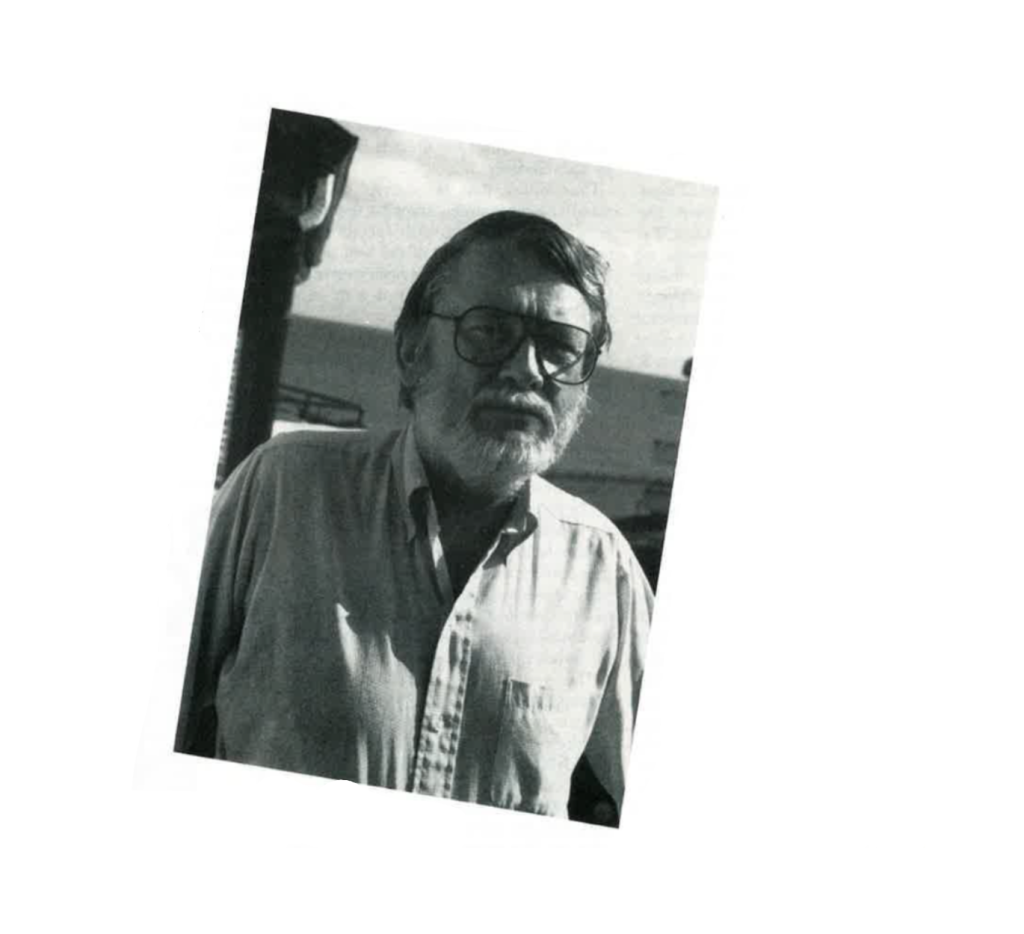
A year ago, veteran correspondent Jim Clarity arrived in Dublin to work for The New York Times. Previous coverage of Ireland had generally been done by its three-man London bureau, a fact that left many Irish Americans dissatisfied and led to charges of Anglophilia especially when it came to the paper’s coverage of Northern Ireland. Frank Shouldice reports.
Several months ago, The New York Times’ Dublin correspondent Jim Clarity incurred the displeasure of Irish Americans, particularly those who had links with Limerick. In a story headlined by a reference to “Stab City,” Clarity outlined the violent, negative image borne by Munster’s second largest city.
On closer examination, however, Clarity claims that the article proves to be a defense of Limerick, and not the attack it was alleged to be.
“No one would deny that Limerick has a reputation in Ireland of being a bad place,” he explains. “And I set out to let them [the people of Limerick] speak for themselves. I’m sorry if the people were offended but if they read the story all the way through, I had nothing but defenders of Limerick quoted. Case closed, as far as I’m concerned.”
For a correspondent who has been based in Southeast Asia, Paris, London, Moscow, Washington and the Middle East, the caliber of this controversy might seem inevitable when you become the only fish in a small pool. Ireland is considered a relatively quiet posting on the world news map, but to Clarity’s surprise, he has reported on a host of important events since his arrival. “There’s been a lot of news,” he says with an air of wonder as he recalls the final ousting of the Taoiseach (Prime Minister) Charles Haughey; general elections in the North; the Annie Murphy-Bishop Casey affair; two major rape-related scandals and Irish approval of the EC Maastricht referendum.
Until his arrival in Dublin in September 1991, the New York Times’ coverage of Ireland was generally done by its three-man London bureau. Irish interests in the United States have often expressed dissatisfaction with this arrangement, particularly in relation to the paper’s coverage of Northern Ireland. Charges of Anglophilia at The Old Grey Lady came to a head in 1986 when one of its London staff, reporter Jo Thomas, alleged she was silenced by the newspaper and recalled from London because of her investigative work in Northern Ireland relating to a shoot-to-kill policy by the security forces.
The Times maintained that Thomas was recalled simply because her two-year term of duty in London was up. Jo Thomas no longer works for the newspaper and in a provocative riposte published by the Columbia Journalism Review in 1988, she wrote, “It is the misfortune of Northem Ireland to be covered from London…. Many stories are simply written from London, with no on-the-ground reporting, even though Belfast is just an hour away by air shuttle. When reporters do go, they rarely leave Belfast, except for a predictable swing through what is thrillingly, if inaccurately, referred to as ‘bandit country’….”
While there is nothing to suggest that her outspoken critique of Times policy had anything to do with the creation of a full-time correspondent’s post in Dublin three years later, the Jo Thomas affair made things a little uncomfortable at the offices on 43rd Street.
“For a long time there was unhappiness that we always covered Ireland, including the North, from London,” contends Jim Clarity. “This made nobody happy on any side. Quite often it meant we went to the North only when a certain number of people were killed. Coverage in the Republic was very sporadic.”
But the Anglophile charge doesn’t cut with him. “Bullshit,” he says. “Not true.” When it was finally decided at the Times to open the first full-time bureau in Dublin, Clarity made himself available. This is no sentimental journey, however. Clarity. whose Irish roots go back to Louth and Connemara, has little inclination to hunt out Irish relations.
“I’m not interested enough to spend a couple of thousand dollars and have some guy draw me up a phoney crest, y’know.”
Born in Brooklyn, Clarity began working with the New York Times in 1967, after completing an education in Russian Studies at Fordham University. After working his way up the editorial ladder he was given a number of postings abroad and then became foreign news editor on the Times weekend section.
Twenty-five years of experience, however, still leaves room for the unexpected – he covered Lebanon for several years and was very surprised by the sudden end to civil war there. As regards Ireland, he does not find everything as it seemed from New York.
“When I came here I thought there would be a lot more republican sentiment than there is. Maybe that’s a function of being in New York where they named a square outside the prison in Manhattan after Joe Doherty [who waged a nine-year battle against extradition.] Over here you can’t find one in 10,000 people who ever heard of him; in New York he’s a hero. What a different perception!”
He questions how truly representative the republican Irish lobby is in the U.S. “Disproportionately noticeable,” he suggests. “Ask them how much of a vote does Sinn Féin get in the Irish Republic and they’ll say, ‘Oh, 60 or 70 percent.’ They have no idea! Their whole view of Ireland is distorted — ask them what does Sinn Féin get in the North? ‘Oh, they’re almost a majority.’ It’s ignorance. A twisted view of the history of Ireland.”
“They don’t know what the policy of the government of Ireland is. That nothing will change in the North unless both sides vote. Somehow they control the mentality of the active Irish in New York. I’m not saying whether they are right or not, or England Out or not. But there is no recognition that there was a civil war and a treaty and that only two percent of the people in the Republic of Ireland vote Sinn Féin.”
On his first trip to Belfast he booked into the Plaza Hotel. It had never been bombed before. The second time he went to Belfast he also checked into the Plaza and the hotel was hit by bombs. “My reaction to that was, well, no one is going to chase me out.” He pauses. “A stupid reaction for a veteran war correspondent. You stay alive by not being macho. I’m sitting here today because I haven’t taken stupid chances like that in all the wars I’ve been around.”
There are, however, less deadly perils facing him. He might carry an Irish passport but he will always be the American in town. “Often it is assumed I would be a donkey from New York and I couldn’t possibly know anything about it. That I wouldn’t know the difference, like our ambassador, between unionist and loyalist. There’s an assumption up there [in Northern Ireland] that foreigners, especially Americans, don’t understand.”
Switching comically to a John Wayne drawl, he says he doesn’t see himself marching into loyalist or republican clubs with an opener like, “Hi, I’m Jim from New York. Will ya take me to the Big Fella?”
Nevertheless, he realizes he has to make his own effort.
“If you do your homework and you know how to use it, without being arrogant you can let people see very fast, ‘Hey, I’m not a clown from New York with a green plastic derby. I’m here for business and I know my business.’”
Drawing from the Lebanese example, he feels strongly that the official line of non-discussion with Sinn Féin leads nowhere. “If we learn anything from covering wars, it’s that if you want to have peace you’ve got to talk to the other side, even if you don’t like them. The policy here is they won’t talk to Sinn Féin, never mind the I.R.A. If they wanted to, they could find a way.
“Even if I think that the situation doesn’t justify violence, that doesn’t mean I’m therefore not willing to talk to people who disagree. Even killers. I’ve spent half my life talking to killers, explaining to me why they have to kill. That’s my job.” Clarity constantly teases out the political realities of life in Ireland. “This is something I’m trying to get at — what do Irish people really want?” he asks. He has, he says, grave reason to doubt the political will in Dublin to end partition.
“Do they not have enough problems without a million Protestants who are constantly pissed off? And the unemployment? Then your taxes and my taxes will start supporting those angry Protestants who don’t want to be there in the first place.
“Why are the British here? They can’t say to protect British interests. Maybe 50 or even 30 years ago that was true, but not now. They’re protecting a dead hangnail on the empire. They’re not sucking anything worth a damn out of Ulster any more.
“It’s depressing. What they call the ‘Miracle Mile’ in Belfast is just a rundown street with a couple of Burger Kings and one or two nice restaurants. I feel bad for them, like I feel bad for any people in a war.”
For a correspondent who depends on being in the right place at the right time, the Times man was well-placed for the recent controversy on U.S. ambassador William Fitzgerald, 82. “I think it’s very reasonable that Irish people feel they are being treated like a second-class country because the last two ambassadors have been very old men,” says Clarity, who found Fitzgerald’s predecessor, Ambassador Richard Moore, 79, extremely impressive.
“But you have to look at it this way too: This is a fella who can pick up the phone and get through to the President of the United States if he wants to. The perception might be, well, we got a guy who doesn’t know his ass from a hole in the ground in Phoenix Park. But that same guy, if he wants to do something for Ireland, is in a position to do Clarity lives in the coastal town of Dalkey on Dublin’s southside. It’s a quiet place “where a crime wave is if someone leaves a radio on very loud.” He has an interest in writing fiction but hasn’t found the time.
And of Brooklyn? New York? “I miss things,” he considers. “I miss some friends, the vitality, the creativity, and things everybody misses. Baseball. But I don’t miss the poverty and the violence. People roaming around the streets — the richest city in the history of the world and there are 50,000 people who live in the streets. I don’t miss that.”
Editor’s Note: This article was originally published in the November 1992 issue of Irish America. ♦
Leave a Reply