
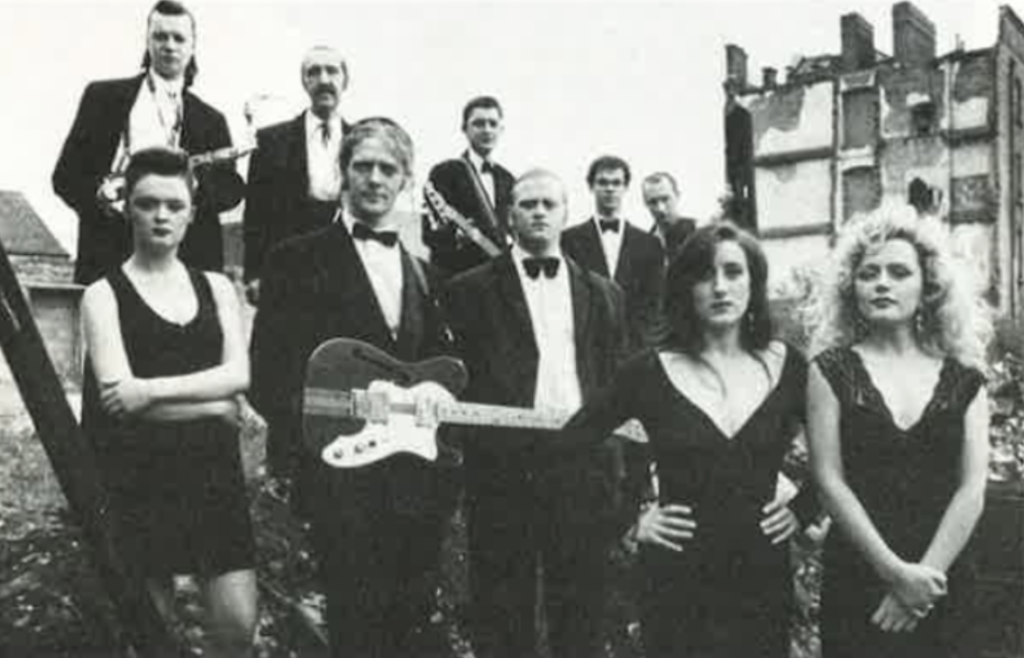
“The Commitments” is a story of the formation and journey of northside Dublin soul band. It is contemporary urban Ireland as you have never seen it before – raw, energetic, joyous, earthy and poverty stricken.
Here, Patrick Farrelly, himself a northsider, sings its praises.
The scene is Spike Lee out of Frederico Fellini. The manager of “The Commitments,” Jimmy Rabbitte is going into a dingy apartment block to see one of his three female backing singers – the Commitment-ettes, as they are called.
Standing by the elevator is a boy holding the halter of a bare-backed horse. Rabbitte asks the kid is he seriously considering bringing the horse up in the elevator. “It’d kill him to walk all the way up the stairs mister,” he replies. No more is said about it — in the next scene Jimmy is upstairs in the apartment.
Welcome, folks to the northside of Dublin – to the kinds of places that tourists and travel brochures avoid like the plague. Alan Parker’s movie presents to us the working class housing estates, and their inhabitants on the northside of Dublin as they really are.
It is virgin territory in film making – an Ireland never captured on celluloid before. Parker gives us the energy, the poverty and the humor — all packed into 100 plus minutes.
Sometimes a film captures a place and a time in an uncanny way. This northside Dubliner watched The Commitments, mumbling constantly, “Yeah, that’s just how they say it” or “How did they get that so right?” Above all it was the thrill of recognition – just to see your own place as it is and not as someone in Hollywood thinks some imaginary section of the “market” would like it to be.
And this is a place where kids can be seen riding to the local store on barebacked horses – young freckle-faced desperados in a bizarre urban wild west show. The Commitments accurately reflects the fact that poverty does not necessarily grind people down. In this film they deal with it in a perhaps uniquely Irish way-with humor and irony.
The Commitments is a faithful translation of a novel of the same name written by Roddy Doyle, a young teacher who works in the Kilbarrack area of northside Dublin. It is a book packed with dialogue that faultlessly captures the rhythms and expressions of the English language as practiced in places like Kilbarrack and Donnycarney.
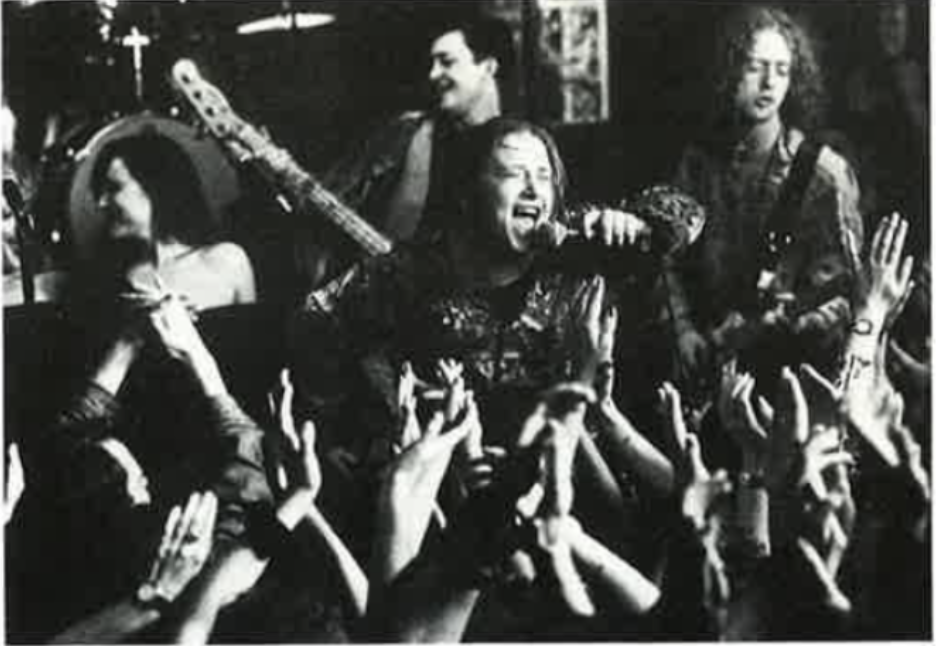
The story is simple enough. Young Jimmy Rabbitte has this idea of starting a band in Dublin— a soul band of all things, whose hero is James Brown. Rabbitte places an advert in a local paper and goes through a hilarious series of auditions to pick his band.
With the help of trumpeter Joey ‘The Lips’ Fagan, who passes himself off as a soul music veteran and a friend of the famous (including Elvis), Jimmy gets the band in shape. With a church hall gig under their belts they soon start playing the bars and clubs.
But first of all, Jimmy had to tell his fledgling band what the music was going to be about: “Where are yis from? (He answered the question himself.) Dublin. (He asked another one.) Wha’ part o’ Dublin? Barrytown. Wha’ class are yis? Workin’ class. Are yis proud of it? Yeah, yis are…. Say it once and say it loud, I’m black an’ I’m proud.” ….They were stunned by what came next. The Irish are the blacks of Europe, lads.” They nearly gasped: it was so true. — “An’ Dubliners are the blacks of Ireland. The culchies have everythin’. An the northside Dubliners are the blacks o’ Dublin. Say it loud, I’m black an’ I’m proud.”
When the London-born director Alan Parker read Roddy Doyle’s book he knew immediately he wanted to make a movie out of it. “I was only a couple of pages in before I was laughing out loud…by using this wonderful language and almost nothing but language, in a few lines he made his characters as vivid and strong as a dozen pages of purple Joycean prose.” Here in the United States Parker has, to put it mildly, a controversial reputation.
His last three movies have done nothing to dispel that. Angel Heart, a thriller with a voodoo strain, had the Cosby Show’s Lisa Bonet in a bloody sex scene with Mickey Rourke that earned the film an X rating; Mississippi Burning was a civil rights drama that ignited a national debate about the authenticity of the story; and Come See the Paradise, a movie about the internment of Japanese Americans during World War II was unlucky enough to be released at the height of Gulf War jingoism.
Controversy apart, Alan Parker has brought to all his movies a breath-taking sense of place. Whether it was the seedy mysteriousness of New Orleans, in Angel Heart, or the brooding menace of the small-town South, in Mississippi Burning, his eye was unerring. With The Commitments Parker does the same for working class Dublin.
There are many who will no doubt be repelled by this vision of Dublin-there is not one tourist image in the entire film.
While so many films set in Ireland do geographical somersaults to include picture-postcard locales, Parker seems to have crept round corners to avoid them. “Gradually we put together a patchwork of places, streets and buildings of a world we could see but not find in one place,” Parker said.
It is measure of his abilities as a filmmaker – and indeed a damning indictment of Ireland’s own film and television producers-that he captures perfectly the ambience of the down-at-heel estates in which most working class Dubliners live.
And it’s not just main characters – brilliant as the performances are from these mainly inexperienced actors – its also in the background, the incidentals, and the one-liners that ring so effortlessly true.
Throughout The Commitments there are always kids running around the place, and quite a few stray horses too. And Parker’s camera keeps returning to linger on these kids and their quirky, animated faces. The bustle and color of working class life is everywhere, and all of it is so natural it seems almost like a documentary.
Parker didn’t tamper with the language which, if anybody does a count, probably has more four letter words than anything ever seen in a neighborhood cinema. It is an integral part of the rhythm of speech and is used in way that is distinctive to working class Dublin.
The sexual explicitness of the language will certainly shock many people – particularly the Jury’s Cabaret crowd. It is an accurate reflection of a raw, youthful sexuality that flourishes despite Church influence and the corresponding laws governing contraception. The music flows naturally from that sexuality. As the movie publicity puts it: “At last a film with bollix, worers, sex, soul, boxes, gooters, the The story itself is compelling – how a group of young people learn to express themselves through the music. It could have been one of those rags to riches movies, an irresistible rise with a couple of character building set-backs thrown in for variety. It could also have missed the whole point.
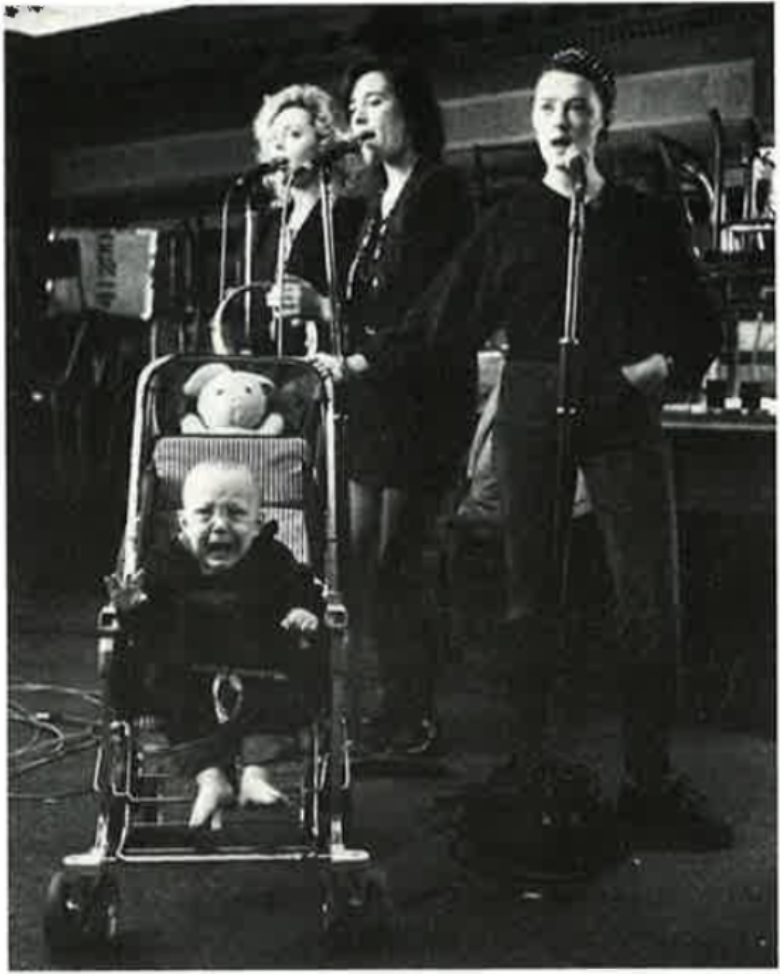
True to Doyle’s novel, the movie shows the hard grind involved in the seemingly endless practice sessions, as each member of the band develops and comes to terms with their own abilities. At a rehearsal above a pool club, one of the Commitment-ettes brings along her bawling baby brother in a pram. We are not spared the non-stop fights, ego clashes and the eventual break-up.
When Alan Parker arrived in Dublin he immediately set about auditioning young people for the parts of band members. In all he saw over 3,000 hopefuls. Later Parker was struck by the amount of talent he came across and wrote that, “Ireland also has the youngest population in Western Europe, and the high unemployment amongst young people is an important factor in why so many struggle to buy their guitars and form their garage bands as a way of gaining some dignity for the present, and hope for the future.”
The Commitments is a celebration of that talent – a real manifestation of that tired Irish political cliché about how “young people are our greatest asset,” always said in the same breath as how terrible it is that they all have to emigrate.
Jimmy Rabbitte tosses it out to the woman in the unemployment exchange who asks him why he hasn’t found a job, “Well we’re a third world country aren’t we?” he says, not skipping a beat.
Editor’s Note: This article was originally published in the September 1991 issue of Irish America. ♦
Leave a Reply