
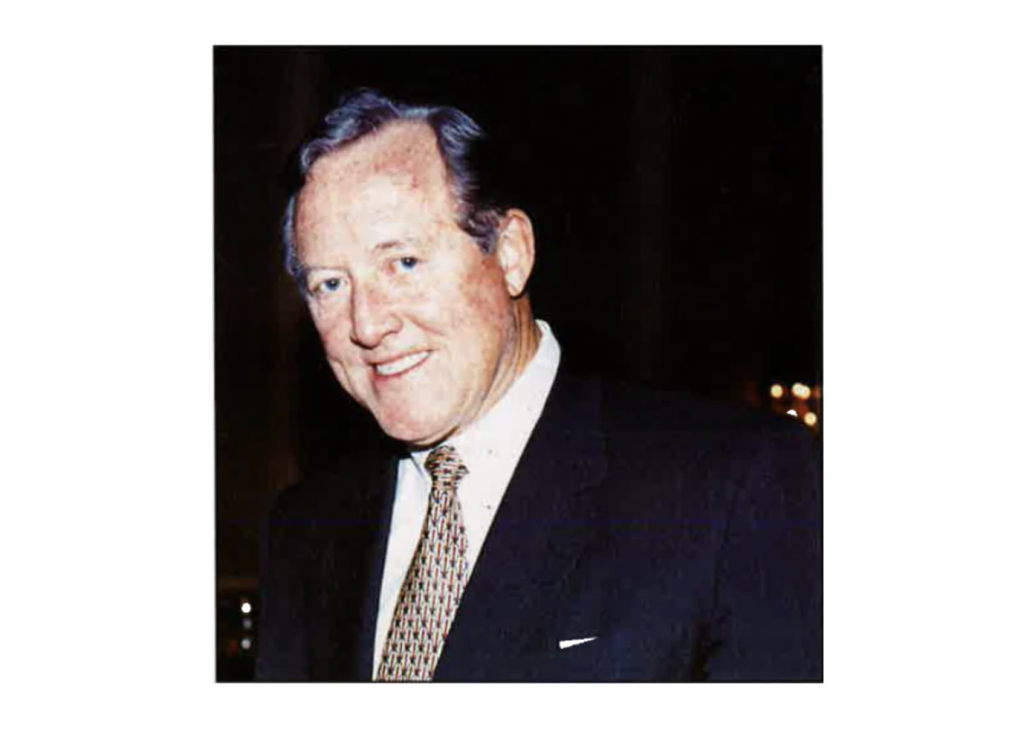
Last August, William Flynn, chief executive of Mutual of America, made the trip most Irish Americans dream about-back to Ireland for a family reunion.
In the remote town of Kiltimagh, in County Mayo where his mother’s family have their home, some eighty people of the Connor clan had gathered to celebrate.
Discovering his roots Flynn felt an emotional tug that he describes as “A mysterious force, like gravity; you can’t see it, but you can feel the pull of it. It’s a feeling of being home and at one with people-a coming together.”
After Mayo it was on to Ballinahinch near Newcastle, County Down, to his father’s birthplace for a smaller reunion of relatives, and then a trip around Ireland, the highlight of which was a stop in Parknasilla, County Kerry.
Flynn is a frequent visitor to Ireland, and has a clear recognition of the need to put something back into the land of his parents. “We need to get Irish Americans together, to use the vast cconomic clout we have to help Ireland,” he says.
A major business figure, Flynn also deals in the currency of philosophical ideas. Mutual of America, for instance, sponsors the highly-praised Bill Moyers program on Public Television and also helped sponsor a four-day conference at the Elysses Palace in France on the ethical and moral challenges facing humankind in the coming century.
French President Francois Mitterrand convened the conference and some 80 Nobel laureates participated.
Following that, Mutual and the Norwegian government sponsored a meeting of Nobel Prize winners and major world figures in Oslo that included Former President Jimmy Carter and Czechoslovakian President Vaclav Havel. The theme being, “The Anatomy of Hatred, Resolving Conflict Through Dialogue and Democracy.”
Speaking of that conference, Flynn states that its prime aim was “to learn how to use the tools of research and the lessons of history to begin eliminating the bigotry and racism that cause hatred.” The resultant series of interviews by Bill Moyers with many of the participants, including Irish Nobel Peace Prize winner Mairead Corrigan made for extraordinary television.
In addition, in 1988 Mutual sponsored the “First Liberty” summit of national leaders in Williamsburg, to celebrate religious liberty in American life, as embodied in the first sixteen words of the Constitution. And drafted what is now known as the Williamsburg Charter to mark the 200th anniversary of the Commonwealth of Virginia’s call for the Bill of Rights.
Given that Flynn once studied for the priesthood, perhaps his altruistic and philosphical bent is notball that surprising. He still loves the cut and thrust of debate and discussion and it obviously helps as a businessman, that he has a wide breadth of experience. Since taking over as chief executive at Mutual of America, he has guided the company from an asset base of $40 million in 1971, to $5.7 billion in 1990 and into the top 50 insurance companies in the United States.
The company specializes in employee benefit plans for not-for-profit organizations such as the Boy Scouts and Catholic Charities in New York. A compound annual asset growth rate of 20 percent a year since Flynn took over in 1971 is testament to his success as a manager.
The philosophy he enforces is a combination of tried and true business practices involving conservative investment allied with innovative marketing and clever use of technology. Mutual of America thrived on the technological advances in the 70s and 80s and was far ahead of most of its rivals in capitalizing on the extraordinary potential the new era unleashed.
“We like to think that we break the mould when it comes to product and marketing. We are not afraid to go against the grain on our investment philosophy, and that helped us avoid that ruinious trouble that other insurance companies experienced,” he says.
Indeed, in their August 1,1990 rating of insurance companies, Standard and Poor wrote, “financially, Mutual of America adheres to very conservative policies. With its risk-averse clientele, Mutual has the opportunity to manage a high-quality investment portfolio while still meeting internal pricing requirements.”
In plain English what that means is that Mutual, under Flynn, avoided the Venus flytraps of Third World loans, leveraged buy-outs and junk bonds that so many other companies were suckered in by.
Flynn states that he relies heavily on advice from other board members, and that he initiated discussion on whether or not the company should be involved with high-risk ventures such as junk bonds.
He particularly credits two board members who gave crucial advice on high-risk investments – Robert Farrell, senior vice president and chief market analyst of Merrill Lynch, and Roger Birk a former chairman of Merrill Lynch, who is now with the Federal National Mortgage Association. “The feeling was pretty unanimous that we did not want to be closely associated with those kinds of ventures,” he says.
In speaking of junk bonds, of which insurance companies ended up holding over 30 percent, Flynn states, “We concluded that not only would Mutual of America refrain from investing any significant amount of our funds in these higher-yield bonds, but that we would move to eliminate from the portfolio the little we already owned. In addition we decided that investment in real estate, despite its considerable appeal, did not meet our requirements. As a result we have been spared the severe trouble that others are now facing and it is clear that we took the correct course.”
The correct course would also be a fair description of William Flynn’s rise to the top in the insurance business. Growing up in an Irish household, he was weaned on the Irish Catholic values he says have stayed with him through his life.
His father, also William Flynn, was an engineer who worked in a many far-flung outposts, including Butte, Montana, before settling his family in New York.
As a graduate student at Fordham University, Flynn, Jr. briefly contemplated a career in stockbroking. Ironically, Merrill Lynch who passed him up for a position, now retains Mutual as one of its biggest clients.
Flynn served with the U.S. Air Force in Korea and married a nice Irish girl from the Bronx, Peggy Collins, while stationed in Texas. Soon afterwards he began his insurance career with Equitable Life Assurance Society, joining Mutual in 1971, when he was headhunted for the position of president. A year later he was made chief executive officer.
Twenty years at the top of the insurance business has dimmed neither his ardor or ambition. However, now he thinks increasingly of putting something back in Ireland. Asked why he feels such affinity with the old country, he recalls the Ronald Reagan phrase, the mystic chords of memories. “It’s part of all of us who are Irish American,” he says. “If we could think of Ireland as American Jews do about Israel, I believe there is no limit to what could be accomplished.”
Editor’s Note: This article was originally published in the May 1991 issue of Irish America. ♦
Leave a Reply