
He has chosen death:
Refusing to eat or drink,
that he may bring
Disgrace upon me; for there
is a custom,
An old and foolish custom,
that it a man
Be wronged, or think that he is
wronged, and starve
Upon another’s threshold
till he die,
The Common People,
for all time to come,
Will raise a heavy cry against
that threshold,
Even though it be the King’s.
From The King’s Threshold by W.B. Yeats.
It has often enough been pointed out that the hunger strike as a device to right a wrong has a long pedigree in Irish history, one that predates the arrival of the English invaders.
Indeed the colonizers are said to have considered it a quaint if somewhat primitive custom.
Later the London government would witness the extraordinary power of this practice of “fasting upon” (in Gaeilge, troscad) the enemy when the IRA used it successfully against them, in individual and mass form, in the Irish War of Independence.
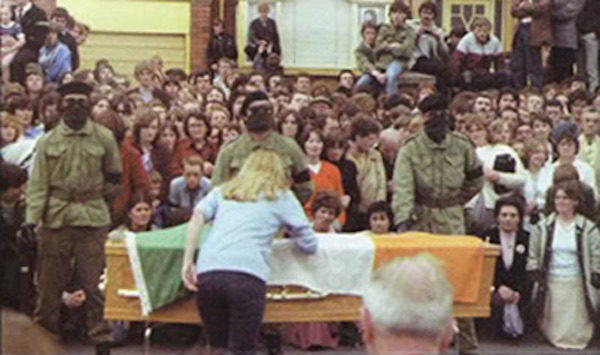
More than 60 years later the deaths of ten Republican prisoners in the H-Blocks of the Maze Prison that took place between May and October of 1981 would have an especially intense dynamic. One has to go back to the executions of the leaders of the 1916 Rising to find an event as traumatic in Irish history.
The period is now a defining one in recent Irish history. From it came the rise of Sinn Féin as an important political force.
From that came the Anglo-Irish Agreement— the frightened response of the Irish and British governments to this alarming increase in support for radical Republicanism.
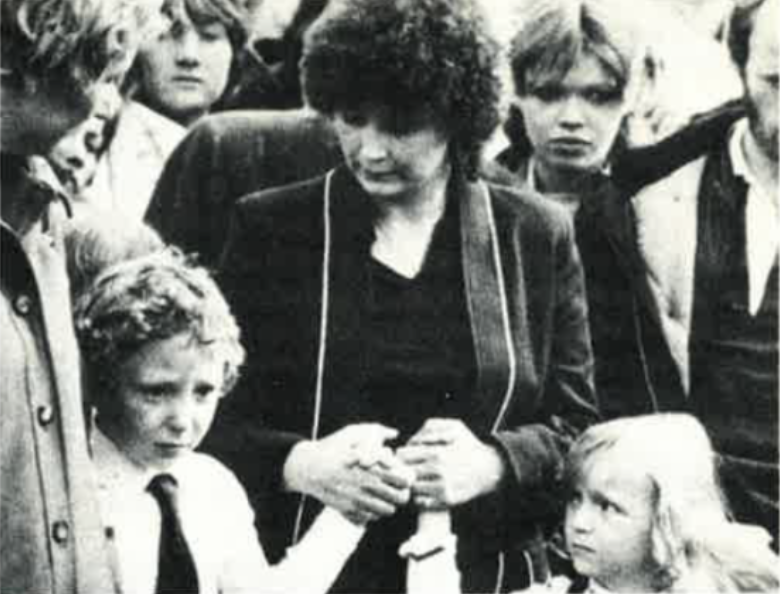
This was achieved by individual men with endurance fasting till their emaciated bodies finally succumbed to a very painful death. That one man could do it in order for others to be recognized as political prisoners was impressive. For nine others to follow, one by one as their families watched, was both terrifying and moving.
About a month before Bobby Sands went on hunger strike he was visited by Father Denis Faul, a nationalist priest who was trying to talk the men out of beginning the fast. Urging a postponement, Faul also argued against the hunger strike on moral grounds. Sands quoted scripture back at the priest: “Greater love than this hath no man than he lay down his life for a friend.” Faul, never a man to be stuck for words, replied, “Bobby, there’s no answer to that.”
For Sands it was not an idle remark.
Talking about it ten years later, Gerry Adams, one of the key figures in these events outside the jail and a friend of Sands, says, “Bobby thought that he was going to die and that the British would probably settle after the second hunger striker died. That was his view. He felt that he had to sacrifice his own life to give the prisoners a dignified existence.”
Sands pessimistic estimate of his chances of survival was right. He was also correct in assuming that Francis Hughes, the man who went on hunger strike two weeks after him, would also have to die. It is however doubtful that he could have envisaged the horror of another eight men following Hughes.
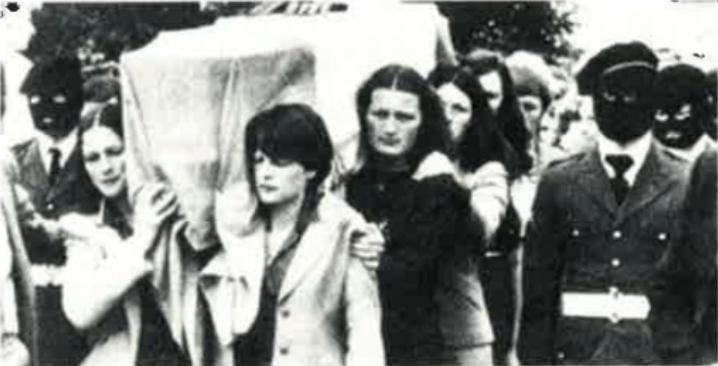
After Bobby Sands died a dynamic came into play that gives another meaning to Sands’ reply to Faul. These men were united both by their politics and by almost spiritual bond that came from their prison experience together. As their deaths ceased to even exercise much media interest and no reaction from the British government, these men truly began to die for each other.
It proved, if proof were needed that this tragedy was firmly based in the prisons. and not, as alleged by the British and others, in outside political manipulation. It had its origins in the decision by the British Labor government in 1976 to withdraw the rights enjoyed by prisoners convicted by the non-jury courts of politically related offenses. The British did not hide their intentions; the move was aimed at criminalizing the Republican prisoners.
Kieran Nugent was the first IRA member to enter the H-Blocks under the new regime. He refused to wear prison-issue clothing and was left sitting in his cell wearing only a blanket. This protest escalated to the so-called “dirty protest” when prison authorities refused to allow the protesting prisoners to “slop-out” or go to the bathroom.
With hundreds of prisoners living in these ghastly conditions the pressure was building, and one of the first items on the agenda was a hunger strike. Outside the prisons the Republican leadership was strongly opposed to one. “We said to the prisoners, ‘Look put off any idea of a hunger strike. Give us time to get something done through a broad-based initiative, “Gerry Adams remembers. But while public conciousness would be raised through the campaign of the National H-Block Committee, the British refused to budge. “They threw that back at us later when they argued for a hunger strike,” Adams says. ”We gave you a chance,’ they said, ‘and we know you did your best but it is now up to us.’” The status they sought had been achieved by a 37-day hunger strike of forty prisoners led by Billy McKee in July, 1972. Now a new hunger strike was to be led by another Republican legend, Brendan “Darky” Hughes. It started at the end of October, 1979 and two months later it ended in disarray and with no British concessions.
Brendan Hughes had stepped down as officer in charge of the IRA prisoners to lead the hunger strike. His position was taken by Bobby Sands. In the weeks that followed, Sands tried to force concessions from the prison authorities but none were forthcoming. Sands started to ask for volunteers for another hunger strike. He would lead it and this time there would be no stepping back from the brink.
In a smuggled letter to the IRA Army Council a month before he commenced the hunger strike, Sands wrote: “We accept the tragic consequences that most certainly await us and the overshadowing fact that death may not secure a principled settlement.”
On April 10, 1981 Sands was elected as Member of Parliament for Fermanagh and South Tyrone. His election with more votes than Margaret Thatcher left the criminalization policy in tatters. “I saw his election as an opportunity presented to the British government to settle the issue, although I personally didn’t think that they would take up that opportunity,” Adams says.
They didn’t and Sands’ fate was sealed.
Outside the jail the Republicans saw the election as a chance for Sands to quit the strike and claim victory. Adams sent in an emissary to put the argument to him in person. “They said, ‘Look you have done your best… there’s no point, if you continue you are going to die very shortly.’ We were careful though to put it to him in terms that would not undermine him.” On Tuesday, May 5 at 1.17 a.m. in the morning Sands died. The Northern Ireland Office issued a statement saying:
“He took his own life by refusing food and medical intervention for sixty-six days.” For Bobby Sands the agony was over but it had begun in earnest for the men and the families of those who would follow them.
Later with three more hunger strikers dead, Thatcher would ask Cardinal O’Fiaich, “Will someone please tell me why they are on hunger strike? I have asked so many people. Is it to prove their virility?” Later still with Fr. Denis Faul telling the families that Adams could end the deaths by talking to the men, O’Fiaich arranged for the Sinn Fein leader to be allowed to visit the hunger strikers in the prison hospital. “I told them that what could be done with the hunger strike in terms of moving the British had been done. I told them that others of them were going to die and that the British were not going to give. I emphasized that they shouldn’t put themselves on hooks in terms of the people who had died before them.”
But Adams was not going to publicly call for the end of the hunger strike. “We said all these things privately. I said that I was willing to leave the prison right there and say it was over. But the last people who could have publicly undercut them were us. I was not prepared to say that the hunger strike should end without their permission,” Adams says.
In the end the families ended the strike by signing their sons off it. With British intransigence it became the only way out the only way to break this grim and deadly solidarity.
Afterwards the British gave the men what they said they would never concede.
Adams says: “Every demand they wanted, they have. The British don’t even try to fudge the issue anymore. With great cynicism they are now selling the prison conditions here as an indication of how benign they are.”
Under the ancient Irish civil code, if a hunger striker was allowed to die, the person they had “fasted upon” was held responsible for his death and had to pay compensation to his family. When the IRA bombed the Grand Hotel in Brighton in 1984 during the Conservative Party conference they nearly succeeded in making Margaret Thatcher pay the ultimate compensation. But by pushing these ten men past the brink, Margaret Thatcher had given the Republicans a legitimacy that will be difficult for the British to erase under any circumstances.
Editor’s Note: This article was originally published in the May 1991 issue of Irish America. ♦
Leave a Reply