
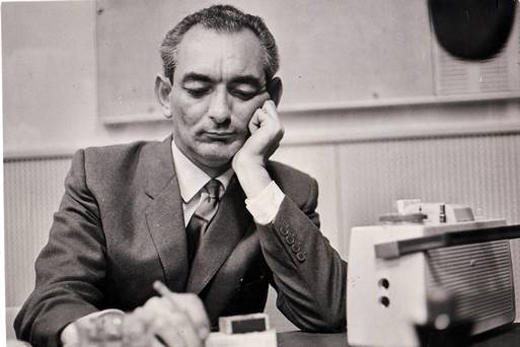
It is a measure of Brian Friel’s stature or modesty-as a playwright of international acclaim that he is very surprised to hear mention of The Diviner, a collection of ten short stories he first published in 1979. “Oh,” he laughs, “I’d forgotten about them.”
In fact, as the growing success and demands of his stage plays continue to affirm his standing as one of Ireland’s foremost international playwrights, the short story is a format which Friel has since abandoned.
“All that stuff is over, I’m very firmly writing for theater,” he maintains.
Yet it was with the short story that Brian Friel’s writing life and career began. Two collections, The Saucer of Larks (1962) and The Gold in the Sea (1966) preceded his first international stage hit, Philadelphia, Here I Come!
The Diviner takes a selection from both collections, many of which were published by The New Yorker and The Saturday Evening Post. For some writers, two books and international publication would be a proud milestone in such a competitive arena.
Many would be glad to have it as the finishing post of their endeavors. But for Friel, so much has happened since he wrote these stories, it isn’t too surprising that he might have “forgotten” their worth.
Yet for a playwright who commands immense critical respect, The Diviner is no archival sideshow. Clearly his preference is now theater but at that early stage his work shows the craft of a writer very much at home with the particular style and finesse of the short story.
Brian Friel was born in Omagh, County Tyrone in 1929. He worked as a teacher in Derry until 1960, when his literary pursuits first flowered. BBC Radio accepted two of his plays and Philadelphia, Here I Come!, his fourth play, broke new ground for him in Dublin, London and New York.
The tragic-comic emigration drama ran for 326 nights on Broadway.
After The Loves of Cass Maguire, he wrote Lovers, a two-act comic tragedy still performed with great regularity by amateur and semi-professional theater groups throughout Ireland. The Gentle Island (1971) was followed by The Freedom of the City, a very personal work which expressed his revulsion at events in Derry following Bloody Sunday and the widespread repression of the civil rights movement in Northern Ireland in 1969.
In a prodigious level of creative output he wrote Volunteers, Living Quarters, Faith Healer, and Aristocrats (the 1979 Evening Standard Play of the Year in London). In 1980, he co-founded the Field Day theater company with actor Stephen Rea. Field Day’s first production was his next work, Translations, which marked another huge commercial and critical hit.
Today the board of directors includes writer Seamus Deane, poet Seamus Heaney and playwright Tom Kilroy (to whom The Diviner is dedicated).
Friel also translated Chekhov’s Three Sisters and has since written Making History, (performed off-Broadway last year by the Irish Repertory Theatre), Father’s and Sons and another major success, The Communication Cord.
Which brings things up to the fantastically successful Dancing at Lughnasa, set to preview on Broadway at the Plymouth Theatre, October 12. Lughnasa has already garnered unprecedented public and critical acclaim in Ireland (Irish Arts Award) and England (Laurence Olivier Award and London Theatre Critics’ Best Play of the Year.)
But while Friel, who now lives in County Donegal, has good reason to forget his first published works, really, he should not.
Consider the atmosphere set in the opening paragraph of The Potato Gatherers, a beautiful story about two young brothers working on a farm: November frost had starched the flat countryside into silent rigidity. The ‘rat-tat-tat’ of the tractor’s exhaust drilled into the clean, hard air but did not penetrate it; each staccato sound broke off as if it had been nipped. Hunched over the driver’s wheel sat Kelly, the owner, a rock of a man with a huge head and broken fingernails, and in the trailer behind were his four potato gatherers-two young men, permanent farm hands, and the two boys he had hired for the day. At six o’clock in the morning, they were the only living things in that part of County Tyrone.” The stories throughout The Diviner are lyrical and evocative, reminiscent of the writings of William Trevor but with the spare, direct economy of Frank O’Connor, regarded as a doyen of short story writers.
Dealing with love, loneliness, coming of age and a favored theme of Friel’s, human communication, there is a soft, gentle rural feel to his writing, and whatever the author’s self-effacement, this is an immensely enjoyable collection.
And while thousands of people flock to Broadway for the privilege of seeing Dancing at Lughnasa this season and thousands more will miss out, Devin-Adair Publishers should be congratulated for making Friel’s early writings available in the United States.
Published as part of the Classic Irish Fiction series, The Diviner comes in pocket-sized hardback for $15.75 from Devin-Adair Publishers, 6 North Water St., Greenwich, CT. 06830.
Editor’s Note: This article was originally published in the October 1991 issue of Irish America. ♦
Leave a Reply