
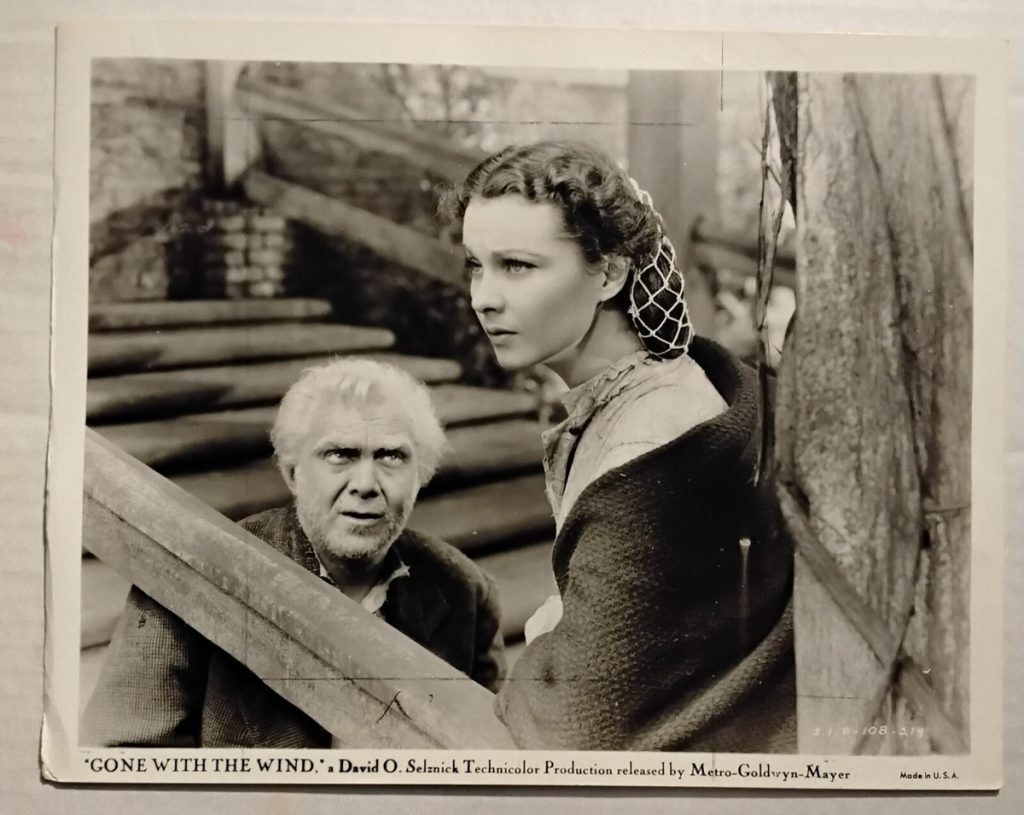
It is likely to become the biggest international bestseller since Gone With the Wind, but Scarlett, the sequel, has been criticized for its stereotypical approach. In Margaret Mitchell’s book it was the Blacks who were caricatured, in the sequel by Alexandra Ripley, it’s the Irish.
The climactic scene in Scarlett, the sequel to Gone with the Wind, occurs when a mob of Irish peasantry, set mad entirely by a bad harvest, the perfidious British and rumors that Scarlett’s love child with Rhett Butler is a changeling, come to burn down Ballyhara mansion as Scarlett, Rhett and child cower in fear.
Some of the dialogue goes like this: Joe O’Neill the blacksmith, who had earlier been called in to deliver Scarlett’s child (which was eventually delivered by a local witch on All Souls’ Day, hence the changeling accusation) has now gone mad entirely himself.
“That O’Hara’s gone over to the English, did I not say it long ago… shooting’s good for her, I say we hang her with a choking rope… ‘Burnings better, burning’s what we want. [mutters from the mob] the changeling’s what we’ve to burn, the dark one that brought the afflictions…changeling, changeling…changeling.”
“Scarlett held her breath, the voices were so close, so inhuman, so like the yowling of wild beasts.”
Wild beasts is one of the kinder descriptions that author Alexandra Ripley (Ripley’s Believe It or Not?) uses for the Irish peasantry who populate this book. This is Ireland by way of Glocamorra, via Chauncey Olcott, the 19th century music hall doyen who created the fictional view of a leprechaun-infested Ireland that still lingers today. There are also strains of Thomas Nast, the 19th century cartoonist who depicted the Irish as apes.
The village of Ballyhara in Ireland that Scarlett settles in after fleeing Atlanta, Savannah and Charleston, pregnant with Rhett’s child, is complete with muck dwellings and beer-swilling Irish.
Why, they even have pigs in the parlor as Scarlett notes disapprovingly. And when the peasants are not burning down the local Big House, they’re drinking and fighting to beat the band. Here’s a scene from the Trim races, with Scarlett in attendance. A sort of undercurrent rumble ran through the talking, laughing, shouting crowd. ‘Fight, fight.’ Colum climbed up on the rail to see. A big grin spread across his face.
“Will you be wanting to place a small wager then Colum?”
“That I will. Five shillings on the O’Haras.”
Three or four dozen men, young and old, were grunting and yelling in a melee of fists and boots and elbows. The crowd made a broad uneven circle around them shouting encouragement…
Faction fights, witches, drunken parties, Scarlett endures them all. She even suffers the wild Irish peasantry before she discovers the delights of the Anglo-Irish and the Dublin social set and falls madly in love with a British rackrent landowner until Rhett arrives to carry her off again.
Given all this is it any wonder then that Miriam Lord, writing in New York Newsday stated, “If I were a member of the Irish anti-defamation league I would be none too pleased with Scarlett.”
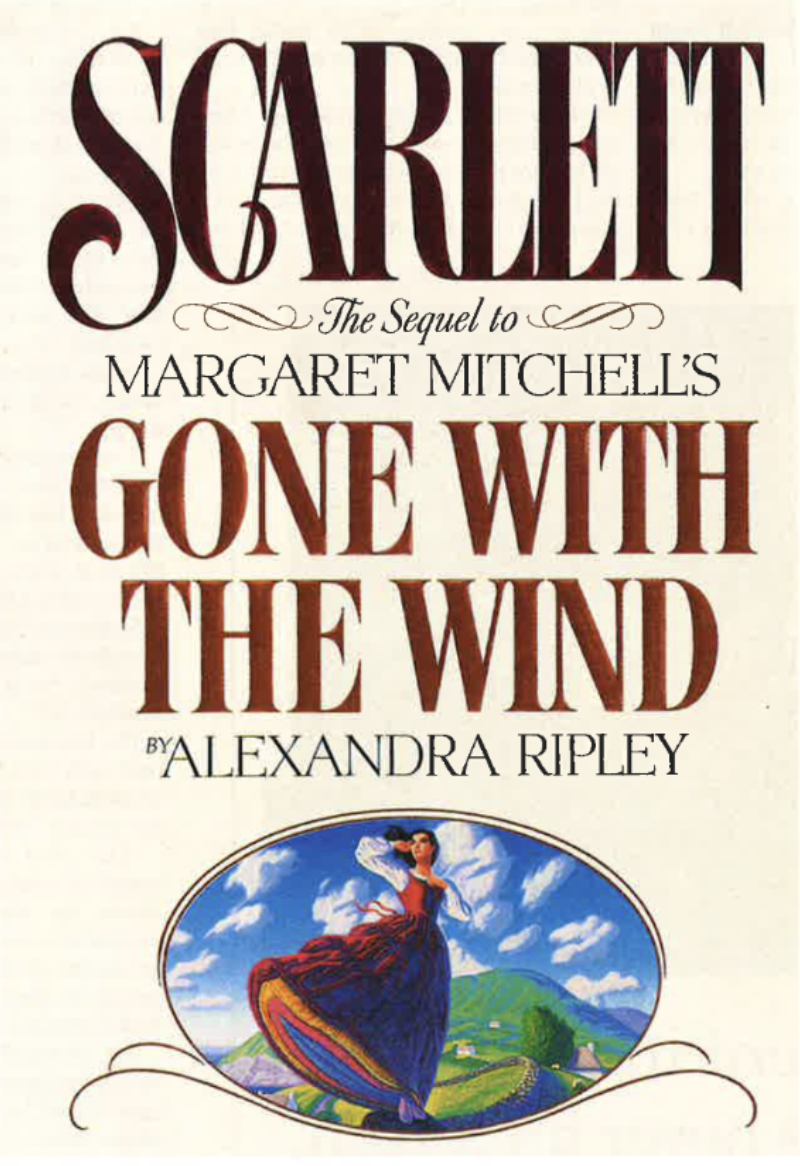
Lord is one of several writers who have pointed out that just as Margaret Mitchells’ Gone With the Wind reinforced racist stereotypes about the Blacks, the sequel Scarlett does a similar job on the Irish.
Ripley herself has been straight forward in admitting that much of the action in the book was moved to Ireland in order to diffuse the racist element so obvious in the first one.
Scarlett after all had a relative killed while attending a Ku Klux Klan rally. Even in Ripley’s book she makes plain her longing for the good old days of slavery.
But it is the Irish who bear the brunt of Ripley’s questionable novelistic skills. Perhaps the single worst complaint is that the book is historically totally inaccurate, an unforgivable offense – given the amount of money and time the author had to research it.
The main Irish character in the book, a relative of Scarlett is Father Colum O’Hara, who visits her while she meets some Irish relatives in Savannah, Georgia. Fr. Colum, a vastly popular man, is more than he appears, being a secret fundraiser and rifle runner for the Irish Republican Brotherhood, also known as the Fenians. He tricks Scarlett into carrying guns, hidden in her considerable wardrobe, back to Ireland where she discovers he has an arsenal hidden in the old Protestant church. Scarlett sympathizes with the Fenians for a time, even willingly carrying more guns back from a brief visit home to America – until she discovers the more discreet charms of the Anglo-Irish and the British.
This episode is set in Ireland in the mid 1870s, (early in the book Scarlett receives a dated check, October 11th 1873) at least a full six years after the Fenian uprising failed in Ireland. Fr. Colum, poor man, is fundraising for a cause, for over 400 pages, that’s already dead. Can you imagine the American reaction if the book was set in the 1870s in the U.S. and the author assumed that the Civil War was still going on?
In addition, Parnell and his Home Rule movement appear in the book. Parnell was only elected in 1875, was still a very obscure figure, and was definitely not the national figure by the mid 1870s that he is portrayed as in Scarlett.
On another account, the book is slanderous to John Devoy, the recalcitrant old Fenian, who fled to America after the Rising where he remained the hardest of hard-liners right through until the Easter Rising and beyond.
In the book, however, Devoy is pictured at home in Ireland with Fr. Colum, arguing in favor of Parnell and an end to physical force. It is as absurd as if someone tried to portray Saddam Hussein through a historical prism as a peacemaker.
Many of the other errors of the book are comparatively minor, but show dreadfully conducted research. “It was not unknown for prosperous third-generation American Irish wives to light every room in their new house with Waterford crystal chandeliers,” writes Ripley.
Waterford crystal was invented after World War II by Czechoslovakian refugees who landed in Ireland. There was only a small and insignificant crystal industry in Waterford before that time. Finding an Irish American with Waterford crystal in the 1870s would be the equivalent of finding a person from that period with a pair of Nike running shoes.
In another error, the witch character, Grainne, uses an Irish warning term, seachan, which means “Mind yourself” to Scarlett and her child. Later the word seachan is used in a different context.
“There is a land that men know of only from the songs of the seachan,” the witch tells Scarlett. This translated means: “There is a land that men know of only from the songs of the mind yourself.” The word she meant to use was probably seanchas which means the old tradition or old books.
Compare and contrast such errors with the meticulous work of a Thomas Flanagan (Year of the French, Tenants of Time) the latter set in the same period, or even of Leon Uris, whose book Trinity is more in the popular genre but was flawlessly researched.
Well, fiddle dee dee, as Scarlett might say, what does it matter, if the story line is good and it’s all fiction anyway. Frankly, Scarlett even you deserve better than this relentless tabloid caricature of the ancient people that you claim lineage to.
Consider the wake scene, when Scarlett’s uncle dies and is laid out in his house.
Scarlett by this time has inherited the ancestral title ‘The O’Hara’ for her good work on behalf of her bumpkin Irish cousins. As ‘The O’Hara’ walks into the parlor of the dead man for the wake, a woman has already begun her lament:
“Why did you leave us, Ochon. Ochon, Ochon Ullagon O.”
Father Danagher: (a Freudian tip of the hat to The Quiet Man again?) “Ah it was a grand confession he made, I’ve never heard a better. A fine man, Daniel O’Hara was….”
Meanwhile a friend reminisces: “And do you remember Jim, the time Daniel and his brother Patrick, God rest his soul, took the Englishman’s prize pig and carried it down into the peat bog to farrow? Twelve little ones, and all of them squealing and the sow as fierce as any wild boar? The land agent was shaking and the Englishman cursing and all the world laughing at the show.”
Here we have all the elements, the wake, the drink, the pigs, the parlor, the bog, the English, the land agent, the priest, the ullagon. And after the funeral there’s the “gallons of porter, barrels of whiskey.” All this faith and begorrah lends the book an air of pure ridicule. The dialogue between the Irish characters is bad enough, but the birthing scene is where the objectionable downright descends into the ridiculous.
Scarlett is pregnant by Rhett (throughout the book they meet, break up and later meet again. Some of the meetings are so coincidental and fantastical – the last resort of a writer struggling to bring the elements of a plot together – that even Charles Dickens, the master of coincidence, would have been ashamed to use them.)
Anyway, as Scarlett nears delivery time, complications develop and she begins bleeding heavily. It’s All Souls’ night as Ripley tells us, when the peasants believe the dead spirits walk the land. Naturally there is also a horrific lightning storm.
Scarlett lies helpless. A midwife arrives, but can do nothing. The birth is too complicated. No doctor can be found. Will Scarlett die?
The blacksmith is found – yes, he who later will burn down the house – and is about to try to deliver the baby by Caesarean Section when suddenly: “The wind swirled, caught a branch hurled it crashing through the window above the sink…shrieking noise was everywhere…a wide shawled figure walked across the kitchen, among the terrorized people to the window. It was a woman with a creased, round face….”
It is, of course, the neighborhood witch, who lives down the road. What Irish village would be without one? And what better woman to appear on All Souls’ night with a difficult baby to be born?
She runs a leaf on Scarlett’s stomach, the leaf contains a powder. She pulls out a thin knife and strokes it the length of Scarlett’s belly, and hey, presto!
“Scarlett’s scream was like that of a lost soul. Before the sound was gone the cailleach (Gaelic word for crone) was holding a blood-covered baby in her two hands. The baby’s arms jerked, then its legs.” Just a normal childbirth, for folks around Ballyhara.
Editor’s Note: This article was originally published in the November 1991 issue of Irish America. ♦
Leave a Reply