
America has always been an important focal point for Irish nationalists. Without the moral and financial support of those exiled from their native land, no new political movement could ever hope to succeed. From the long-past Fenian times right up to the present day, representatives of an infinite variety of political groups in Ireland have travelled the length and breadth of America, attempting to attract support for their particular cause. Many women have also crossed the Atlantic, adding their voices to this ever-growing throng.
Famous in their time, not all are remembered today. Who knows now that in 1880 Parnell’s mother, Delia, together with his sister Fanny, set up the Ladies’ Land League of New York to raise funds for the Land League back in Ireland? The enthusiasm awakened by this venture soon inspired a full-scale Ladies’ Land League to be established in Ireland, which singlehandedly organized the whole campaign for the eighteen months that the male leadership was in jail. Fanny’s fundraising efforts in America complemented her sister Anna’s genius in organizing in Ireland. Together they made a formidable combination.
In the late nineteenth century – a time when the all-male political organizations refused to allow women to enter their ranks and when the sight of a woman on a public platform was enough to make the bishops reach for their pens – one notable woman undertook three tours of America. Her name was Maud Gonne and she was the woman W. B. Yeats immortalised as Cathleen ni Houlihan, the spirit of Ireland.
Maud Gonne was the wealthy daughter of a British army officer. At the age of 21, having been left an heiress by her father, she decided to devote her life to the cause of Irish freedom. Maud often acted on impulse, believing that her power emanated from an inner source that could not be analyzed and, indeed, her spontaneous gestures were usually startlingly effective.
During the build-up of preparations for the centenary celebrations of the 1798 Rising, Maud suddenly decided that her most effective contribution would be a tour of America to raise money for a Wolfe Tone memorial, which it was hoped would be erected in the heart of Dublin.
However, many Irish-Americans were involved in an internal faction fight within Clann na Gael and they were suspicious of Maud’s motives. Only after her friend Yeats had intervened on her behalf was Maud able to go ahead with her plans.
In October, 1897, Maud set sail for America. She was met at New York harbour by a band playing Irish music in a boat bedecked with Irish and American flags and, to her horror, she found herself driven off to a luxurious suite of rooms at the Hotel Savoy. She wanted to stay in a small room in a cheap hotel, explaining that “the prisoners families need all the money we can raise,” and she could not bear the thought of it being wasted on her instead. The organizers of her tour argued that, in America, she would not attract money if she didn’t appear to have plenty already. They eventually compromised, with Maud agreeing to stay in the suite for one night so that she could give press interviews there in the morning. Then she would move to a single room.
Maud’s first appearance upon an American stage was notable for also being the occasion when the woman whom many declared to be the most beautiful of all the women in Europe was given one of her most famous titles. The meeting took place in New York City, at the Grand Opera House on Eighth Avenue. William McAdoo, ex-Secretary of the Navy, introduced her to the cheering crowds as “the Joan of Arc of Ireland.” This seemingly extravagant claim was very appropriate, particularly at this stage in Maud’s political career. For the past decade she had been trying, through her personal charisma and her passionate devotion to the nationalist cause, to unite all the different groups into a strong and successful movement. Many people admitted that they first became involved in politics because they had heard her speak and had fallen under her spell.
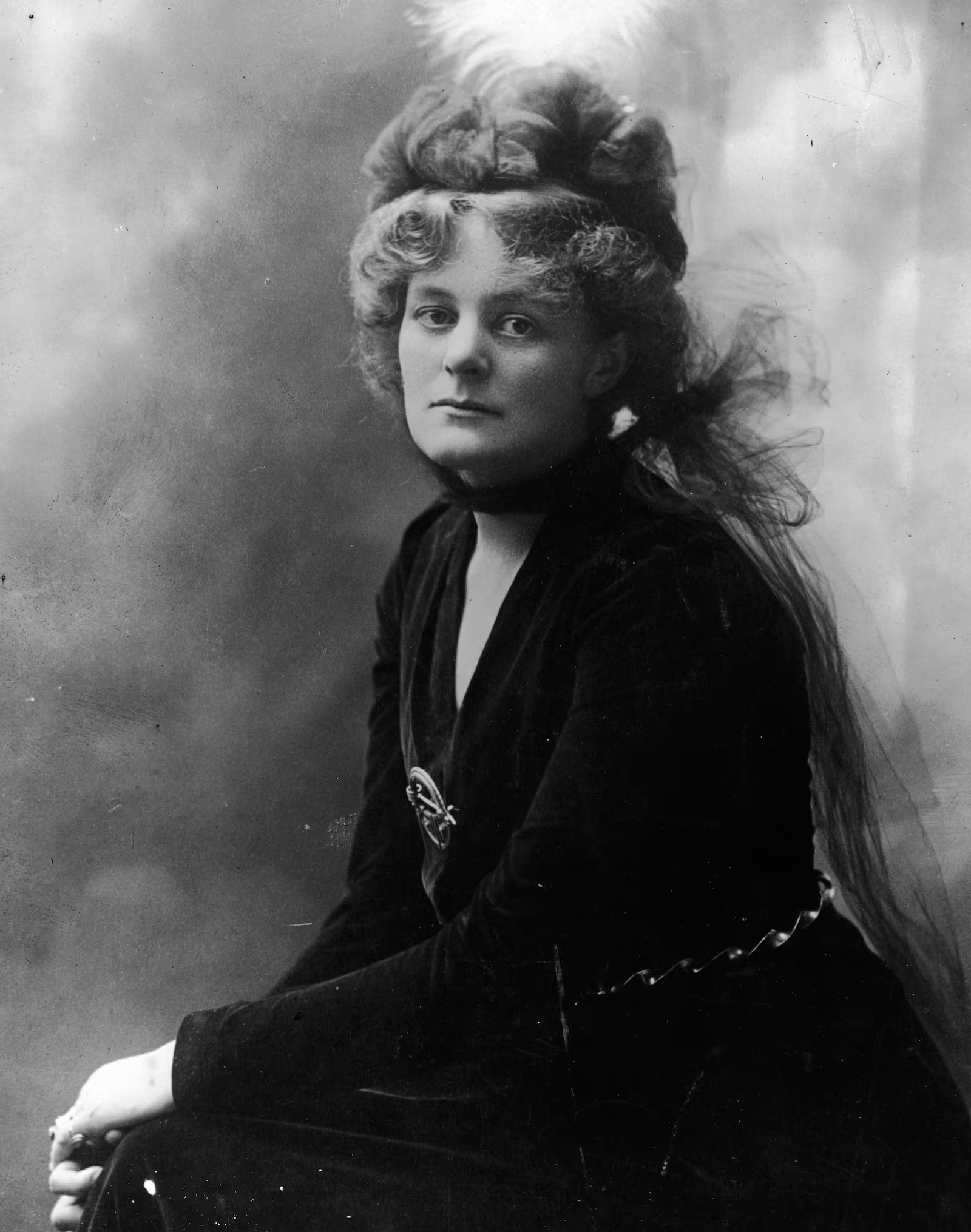
The Irish World described how “men rose in their scats and cheered this young queen of Irish womanhood” and even the New York Times reporter seemed moved by the eloquence of this young woman, who was obviously deeply nervous at this, her first American meeting, but determined to make her point.
Several times her remarks were greeted with ringing cheers, while at the tragic parts of her narrative sobs and moans were distinctly audible. Many a handkerchief was held to the eyes while she recited the story of privation and destitution that her countrymen had undergone during the last century.
During her ten-week stay Maud found herself the guest of honor at meetings in New York, Washington, Boston, Chicago, Philadelphia, and Colorado. By the end of the tour she had raised $1000. In her own account of this trip, the highlight was an impromptu tour around the mines of Denver, when three Irish miners took Maud off to where they worked and a woman from Mayo, who lived in a wooden frame house in Cripple Creek, gave her a breakfast of bacon and eggs and then put herto bed until noon, when she went down into the mines to give the men the latest news from Ireland.
As Maud said of them: “In their hard, exciting lives, these people never forgot Ireland. We were laden with all sorts and sizes of rocks, with little bits of shining gold glistening on them, given us as souvenirs, and three hundred dollars for the prisoners and messages innumerable for folk at home and promises that when the fight was on for Irish freedom, the men would be back with us.”
McAdoo’s description of Maud had obviously captured people’s imagination because on December 27, at the Cooper Institute in New York, which was the venue for the last meeting of Maud’s tour, the Irish-American women of Brooklyn presented her with an embossed and framed resolution of gratitude, thanking “Ireland’s Joan of Arc” for abandoning “a charming home…devoted friends…high social position” in order to “disseminate the doctrine of union and independence among the scattered children of Erin.” She had become a heroine to the nationalist women of America. Another important gesture, and one which touched her greatly, was the presence of O’Donovan Rossa at the quayside as she set sail for home. The old Fenian had come to pay his own tribute.
Three years later, Maud was back, The Boer War was at its height and Maud was now one of the leading lights in the Irish Transvaal Committee, which supported the Boers’ fight against Britain. In Dublin she had presided over monster meetings, attended by crowds of more than 20,000.
James Connolly had become a stalwart friend and ally and the two rivalled each other in daring. Once, while defying a police ban on a meeting, the pair decided – only with the greatest of reluctance-not to attempt a seizure of Dublin Castle! This time, Maud’s tour of America was designed to rally support for the Boers.
Maud’s first speech, at the Academy of Music in New York City, was to a vast and emotional crowd. As she walked out onto the platform, she discovered that five hundred extra chairs had been placed upon the stage, so great was the demand for seats. Loud hisses and cheers accompanied her speech, as she denounced Britain’s conduct in the Transvaal and applauded the gallantry of the Boer resistance. The plight of the native inhabitants of Africa was not touched upon as Maud blithely declared, it matters not to the Irish people whether the republics are right or wrong. The fact that they are fighting England makes us their friend.” Her stirring conclusion made obvious what she hoped would be the ultimate outcome of this particular war:
“To Treland I say that freedom is never won without the sacrifice of blood. Our chance is coming. The end of the British empire is at hand. Your motherland calls you. She has been the land of sorrow long enough.”
The blood and thunder of this part of the evening was followed by more genteel entertainment, as the stars of the Irish-American community took their place on the stage for songs, recitations and a harp recital. Chauncy Olcott, who had written ‘My Wild Irish Rose,’ was discovered to be in the audience. He delighted the crowd by coming up to the stage to sing a few songs. This time, the money Maud raised went to keep the United Irishman, Arthur Griffith’s paper, afloat.
What turned out to be Maud’s final American tour took place exactly one year later. She was now part of a double act: her partner was the man who had been the hero of the Irish Brigade in the Transvaal, fighting side by side with the Boers against England, their common enemy. Now Major John MacBride was touring the States, talking of his experiences and putting political pressure on Britain to withdraw from southern Africa. But the ex-soldier was ill at ease on the public platform. One journalist complained, “We hope that with a little practice, the Major will be able to tell the story off-hand, for having to read it takes away very much from its interest.” In desperation, Major MacBride wired to Maud to come out and join him, saying that he “could not get things going” unless she came.
On February 10, 1901, Ireland’s Joan of Arc joined the hero of the Irish Brigade: MacBride, with help from Maud, succeeded in learning his speech and his self-confidence grew. In letters to his mother he revealed his growing admiration (and unconscious sexism for Maud. “Miss Gonne astonishes me the way in which she can stand the knocking about. Fora woman it is wonderful.” In her memoirs, Maud claimed that it was at this time she received her first proposal of marriage from MacBride. Her response was that marriage was not in her thoughts as long as there was a war on. And of course, as far as Irish nationalists were concerned, there was always a war going on. But Maud eventually agreed that her absence from the fight would not be missed for a while.
In Paris, on February 21, 1903, Maud Gonne married John MacBride, the dashing man of action.
It was a brief, unhappy marriage, which led to her being largely exiled in France, reluctant to bring her son Sean over to Ireland. MacBride’s execution after the 1916 Rising heralded her eventual return to her adopted country and, for the next thirty years, Maud Gonne MacBride continued to work for all those causes she had held so dear: the poor, the prisoners, the future of the new Irish state. But a new generation of hard-headed realists had taken over the movement and it was they who now toured America, rousing people with their tales of heroic resistance. Women had become a vital part of this new upsurge of nationalist sentiment.
Nora, James Connolly’s daughter, arrived soon after her father’s execution, seeking support for her penniless family.
Hanna Sheehy-Skeffington was one of the few to succeed in interviewing President Wilson during her campaign to uncover the true facts of her husband’s murder.
The indomitable Mary MacSwiney, sister of the martyred Lord Mayor of Cork, stirred the imaginations of thousands as she toured the States, describing the conduct of the war and the spirit of those who had given their lives to the cause. Maud Gonne was part of an earlier generation of romantic nationalists: Ireland’s Joan of Arc never went back to America.
Editor’s Note: This article was originally published in the May 1991 issue of Irish America. ♦
Leave a Reply