
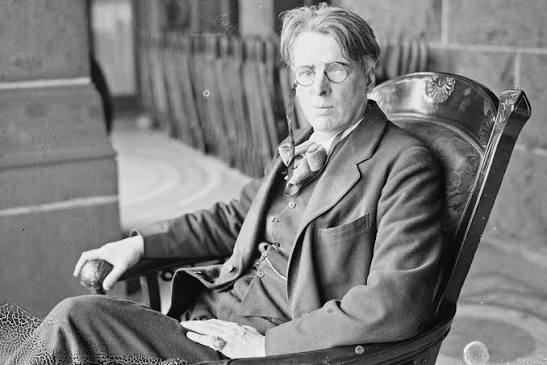
More than half a century after his death, William Butler Yeats is still Ireland’s foremost avant-garde playwright. We return to his theatre work, in all it diversity and contradictions, not because we are sure of its place in the repertoire of modern Irish theatre, but because we are not. Yeats’ plays are unsettled and unsettling, radically incomplete until methods of performance and reception by an audience which are adequate to them are found. Even in his own theatre, the Abbey, indeed especially in the Abbey, Yeats is not part of a given tradition, but of a search for new forms.
– Garry Hynes, Artistic Director, The Abbey Theatre.
The fourth annual Yeats International Theatre Festival will take place at the Abbey Theatre, Dublin, Ireland, from August 25 to September 12, 1992.
Focused on the theme of multiculturalism and identity, the festival will feature a production of one of Yeats’ major works, The Countess Cathleen, under the direction of Stan Wojewodski, Dean of the Yale School of Drama.
Other events include productions of Democracy, a satire by the Nobel Prize winning Russian poet, Joseph Brodsky, on the difficult transition of countries with closed Marxist economies to the chaotic free-for-all of the capitalist system, and Fires in the Mirror, an extraordinary one-person human collage by Anna Deavere Smith based on the 1991 racial riots of Crown Heights, Brooklyn. The Festival will also include lectures by Conor Cruise O’Brien and John Hume, poetry readings by Joseph Brodsky, Derek Walcott, John Montague, and Tom Kinsella, a performance by Irish American storyteller Jay O’Callahan, a concert of Central European and Irish traditional musicians featuring the internationally celebrated Hungarian singer Marta Sebastian, and an exhibition entitled “The Celtic Diaspora” which focuses on the theme of exile.
The Countess Cathleen
The entire Irish dramatic movement started with the production of Yeats’ The Countess Cathleen in May 1889. Not untypically, in view of subsequent Irish history, it provoked a riot over the political and religious issues being addressed.
The setting of the play is Ireland (but it could be any country in the time of a desperate famine. Two merchants appear offering to buy the starving peasants’ souls for gold. In the context of the original production, the merchants were seen both as emissaries of evil and symbols of English domination. Based on the tradition of medieval morality plays, The Countess Cathleen is also an allegory about the experience of colonial oppression.
The peasants are saved by the title character, the Countess Cathleen, who offers her own soul to redeem her people. The role of the Countess was written for Maud Gonne, the love of Yeats’ life who at the time was known as “The Irish Joan of Arc” for her work among the evicted peasants in the West of Ireland. Thus, in effect, the Countess is the spirit of Ireland.
The play climaxes in a scene of tremendous spectacle, with the Countess lying dead as the gates of heaven and hell open and the stage is filled with a crowd of figures of mythology and actual history who stand in judgment. At length the demons are cheated, for an angel carries the soul of the Countess to heaven, saying,
The Light of Light,
Looks always on the motive, not the deed,
The Shadow of Shadows on the deed alone.
In Yeats’ words, the theme of The Countess Cathleen concerns the moral question, “May a soul sacrifice itself for a good end?” On a political and social level, however, the same question can be applied to many countries that are today torn between the lure of greater economic opportunity at the possible cost of losing political and cultural autonomy. The conflict is of increasing urgency in an Ireland which, after fighting for centuries to break the bonds of colonial oppression, must now decide whether or not to join in a closer union with the European community.
Ireland’s situation provides a microcosm of situations throughout the globe in which a new world order begins to emerge that, at the same time, must take into account the continued existence of indigenous ethnic cultures and nations. The United States, a nation conceived with the idea of providing a haven tor cultural minorities, is itself now subject to the pressures of newer groups of immigrants — mostly people of color — who feel that their values and traditions are not fully respected by the Eurocentric white majority. Ironically, Ireland, which because of its colonial history holds a special place in the eyes of the Third World, still struggles with the tensions of a pluralistic heritage that some of its own citizens refuse to acknowledge.
The Festival
Yeats is recognized as one of the century’s greatest poets. The Yeats Festival was founded in 1989 so as to gain an equivalent recognition for Yeats’ extraordinary accomplishments as a dramatist and thinker.
The basic intention of the Yeats Festival is to create Yeats’ “theatre of intellectual excitement,” meaning a theatre in which the audience completes the dramatic event by relating the work to their personal lives and to the broad social, political, and philosophical issues being addressed. Previous Festivals have focused on such themes as the nature of heroism in modern times, the relationship between intellectual freedom, violence, and political revolution, and male and female perspectives on love and sexuality. Each of the Yeats Festivals has included a series of exciting concerts, exhibitions, lectures, and symposiums involving such internationally noted figures from the world of ideas and art as Eric Bentley, Denis Donoghue, Betty Friedan, Robert Bly, and Joseph Lowery.
This year’s Yeats Festival, by focusing on the theme of multiculturalism and identity, will bring together people from widely different cultural backgrounds to share with one another the transforming power of ideas embodied in art.
Through this theme and all the events chosen to express it, we also hope to reflect the visionary mythopoeic mind of Yeats, who reached out from a Celtic background to find connections with other cultures around the world.
Editor’s Note: This article was originally published in the July August 1992 issue of Irish America. ♦
Leave a Reply