
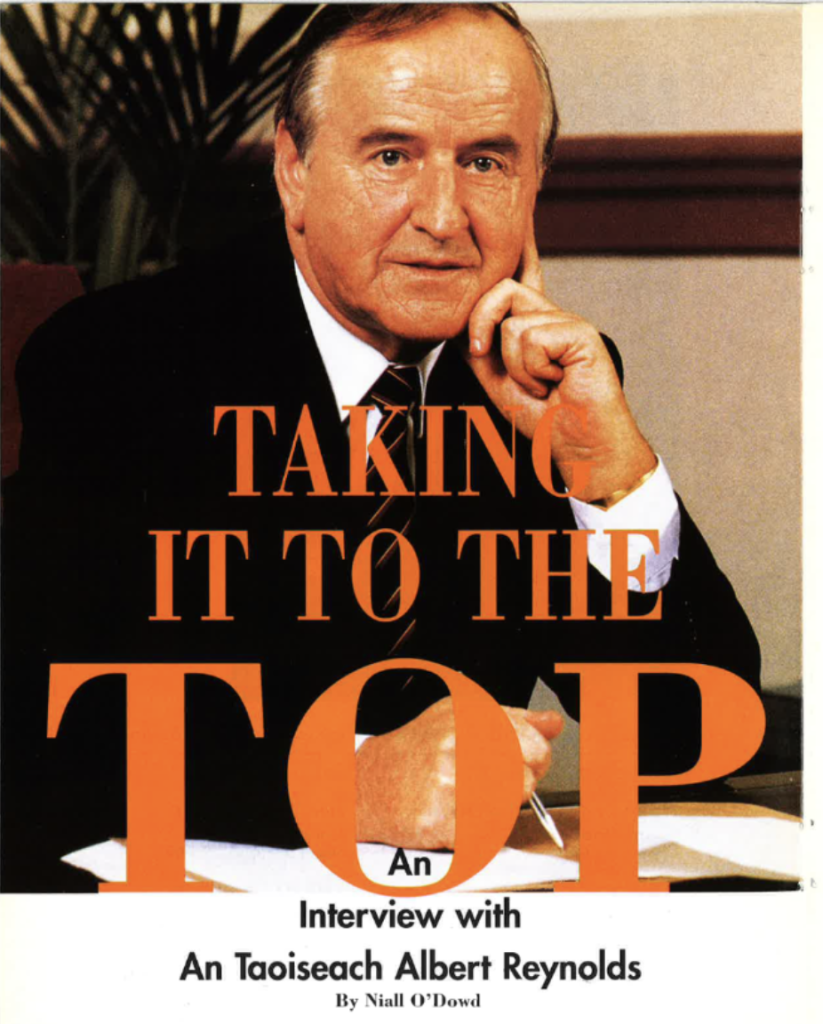
In November 1991, shortly after making an abortive effort to replace Charles Haughey as head of Fianna Fail, the chances of Albert Reynolds ever becoming Taoiseach (Prime Minister) of Ireland looked bleak indeed.
From being Minister for Finance, arguably the most important position in the cabinet, he had been dispatched by Haughey to the backbenches where he seemed likely to languish like many a political rival to “The Boss” before him.
A few short months later, however, Haughey succumbed to the “death of a thousand cuts,” as burgeoning scandal after scandal finally broke his vise-like grip on power. Reynolds easily triumphed in the subsequent leadership election, after his main rival, now Finance Minister Bertie Ahern, balked at challenging him.
Reynolds (60) wielded a new broom shortly after entering office, dispensing with many of the old hold-overs from the Haughey politburo and making some daring cabinet appointments promoting talented mavericks such as now Health Minister Dr. John O’Connell and now Minister for Social Services Charlie McCreevy. In personal style, Reynolds also proved a refreshing change to Haughey, immediately declaring his financial interests and proving, initially at least, more open and far less confrontational in his governing style.
Reynolds was also a very rare example of an Irish politician who rose to the top unconnected to any family dynasty of Irish politics. His path to the summit was an arduous one, unpaved by the ever present family connection which helped such previous incumbents as Charles Haughey and Garret FitzGerald.
He was a successful businessman, a self-made millionaire with a colorful background in dancehall band promotion and pet food factories before embarking on his political career in 1974 when he became a member of Longford County Council in the Irish midlands.
He was elected to the Irish Dáil (Parliament) in 1977 and subsequently was Minster for Posts and Telegraphs (now Telecommunications), Transport, Industry and Commerce, and Finance before acceding to the top job. Along the way he acquired a reputation as a shrewd pragmatist, a friend of business, ruthless when necessary, but willing also to accommodate other points of view.
On the day of our interview Reynolds was preparing to fly to Helsinki to take part in a European summit on security and defense matters. The Beel Tribunal, set up to investigate a scandal (an Irish version of the savings and loan debacle), involving taxpayers’ monies used to guarantee Irish beef shipments to Iraq (which has now cost the Irish taxpayers millions) was in full swing, and the Maastricht referendum on European integration was just successfully completed.
Despite his intensely busy schedule, Reynolds was relaxed and forthcoming during our 75-minute meeting held in his spacious but Spartan office in the new government buildings. He had made it clear after assuming office that the Irish American constituency was one he wished to address as soon as possible. And it was on that theme that our interview opened.
Irish America: According to the 1990 U.S. census there are 44.3 million Irish Americans — almost 18 percent of the population. What would be your message to them about the Ireland of 1992?
An Taoiseach: Ireland in 1992 is a progressive and modern state and has developed quite significantly since we got our partial independence, in the 1920s, and while we haven’t made as much progress as we would like, nevertheless, I think that those who have come back in recent years have seen the very marked improvement in economic development, in living stan-dards, in housing and in other aspects of the economy.
We are delighted to send a positive message to our Irish kith and kin in the United States be they first, second or third generation Irish. We believe that they can help us to develop even further by choosing Ireland, where the return is better than anywhere else in the world, as a place for investment. We have a lot to offer, especially when we are going to have 380 million consumers in the enlarged European community.
If we cannot do business, we would like to let Trish Americans know that Ireland is a magnificent place in which to spend one’s holidays, especially if you play golf. We have a greater number of golf courses per head of population than any other country in the world.
Irish America: There have been clear examples of the political muscle of Irish Americans, such as on the immigration bill and the International Fund for Ireland. Do you see similar potential from the Irish American business community?
An Taoiseach: Yes. I think that the last few years have shown that when the Irish political muscle, as you say, pulls together it can produce results. I think for too many years it hasn’t pulled together as well as some of the other ethnic communities in the United States. I don’t think we have ever made a serious attempt to draw the Irish American business community together in order to direct more investment to Ireland. We have to seek out new ways of pulling together that business and commercial muscle in order to service Ireland better than we have done in the past.
It’s not an easy job but it’s one that we have to address. I have already spoken to the IDA [Industrial Development Authority] in this regard, and maybe more frequent visits by myself over there to address them would help. I did it very successfully for the Financial Services Centre back in 1987-88 and I think it paid dividends. It showed what could be done and I think that we would have to think in terms of something along those lines again.
Irish America: Are you in favor of economic missions to Ireland by Irish American businessmen?
An Taoiseach: Absolutely. I have already spoken to Don Keough (President of Coca-Cola) and I have mentioned it to Mike Roarty (Executive Vice President of Anheuser Busch) and others, who were over here for the Budweiser Derby. They are certainly going to think along the lines as to how they can put groups together over there, either for me to visit or for them to visit here, so that they can see what we have to offer.
The Irish Trade Board has been very successful in bringing in groups of buyers to buy Irish goods and I see no reason why we cannot bring in similar type groups for Irish investment. I look forward to hearing back from such business leaders as Don Keough and Mike Roarty.
Irish America: Unemployment and involuntary emigration are continuing crises in Ireland. What’s the solution?
An Taoiseach: I think one of the basic reasons for the unemployment rate which is probably not understood, is that we have the fastest growing population in Europe.
Most other European countries have either a static or a falling population. We have a minimum of 35,000 young people coming into the labor force every year as a result of the baby boom in the 1970s.
When you couple that with the advent of technology and the effect of replacing people with machines, you begin to see why we have still an intractable problem.
This has been aggravated in recent years because of the world recession, especially in the countries where a lot of young Irish people went to over the years. Of course there has always been an element of traditional emigration, maybe not involuntary but voluntary just to enhance their skills, to get more experience.
If you look at the demographic reality in Ireland into the mid 90s and the end of this decade you will begin to sce a total tailing off, and the requirements of the Irish economy in seven to eight years’ time will be only 8,000 or 10,000 jobs per year, which we would be quite capable of looking after.
Irish America: What is your position on voting rights for emigrants, which has become such an issuc both abroad and here in Ireland?
An Taoiseach: There is no quick solution to the problem. It is being studied very closely at government level at the moment. The Constitution as it stands never envisaged people voting who didn’t live in Ireland. Consequently it is a very complex constitutional issue and the Attorney Gencral has not yet produced a solution.
At the moment, within the tolerance of the Constitution, in his view, it could only operate for a very short time after people leave Ireland. You also have the governing principle of no representation without taxation but, nevertheless, the constitutional problem overrides every other issue at this stage.
Irish America: In terms of emigration continuing, do you see a replacement for the Morrison visa scheme which has proven so successful in helping illegal Irish emigrants and which concludes after next year?
An Taoiseach: I think the belief is that we are well on the way to solving most of the illegal problem at this stage. We hope that there will be a continuation of some type of scheme like the Morrison visas which has been extremely successful and we are very grateful for it.
Irish America: On the issue of Northern Ireland, how do you see your government working towards a solution?
An Taoiseach: On the day that I was elected Taoiseach I said that I was moving to the top of my political agenda an objective to seek out a new path for peace between the communities in the North of Ireland and on the whole island of Ireland, and I said I was going to take every possible initiative to try to bring that about. I have worked on it every day and night since.
I have, you may or may not be aware, a good relationship with John Major, the Prime Minister of Britain. We have talked about it on many occasions, and in fact I went to see him very shortly after I got the Taoiseach’s job here, but there was a British election intervening and consequently we had to wait.
But now I am delighted to think that the three strands of talks have begun. Strand One between the political leaders and the political parties in the North of Ireland itself has started and there’s reasonable progress, and then Strand Two has started and a set of these talks will be held in Dublin Castle. That is a historic breakthrough and the first opportunity for politicians and government ministers down here to sit down with the political leaders in Northern Ireland in 72 years.
None of us, John Major or myself, wants to inflict another 23 years of violence on the communities in the North of Ireland. I believe strongly in trying to build the consensus on the ground. To build it from the bottom up. To try and get communities working together. To build economic bridges between the North and South.
Hopefully, these sets of talks, which are now under way, will find the structure that will ultimately create the conditions for taking the bomb and the bullet out of Irish society for all time.
Irish America: Many Irish Americans still believe the only way forward is to support the IRA as the only real agent of change in Northern Ireland. What is your assessment of the level of support for the IRA?
An Taoiseach: I think that IRA support is dwindling all the time. I think it is misguided. I think that anyone looking in from outside has to recognize that this new political initiative being taken comes from the political and democratic process and not from the bomb and the bullet. That is the reality of life on the ground here. I would hope that the basic underlying reasons for the violence in Ireland in some way or another can be removed by those talks and consequently there won’t be a need for men of violence on either side and we can build structures that can accommodate difference and diversity on the part of both traditions on this island.
Irish America: Irish Americans have strongly pushed the MacBride Principles on fair employment to achieve equality in the North. What is your opinion of them?
An Taoiseach: The MacBride Principles were another contribution towards the debate on job discrimination. We know how bad that discrimination was under the old Stormont regime. We know it has improved, and that the MacBride Principles are part of an initiative or a debate to focus in on that issue. Of course we all want to support more improvement, none of us want to see any people discriminated against either on sex or religion. That’s the way the future of Ireland has to be.
Irish America: What about Irish American calls for a U.S. special envoy to intervene in Northern Ireland?
An Taoiseach: Well, certainly if everything else was deadlocked one would look for any possible new approaches to it. But it is not necessary at the moment. We have sat down as a sensible, commonsense people to try and work out our own destiny and our own future and at the moment it would be an unnecessary intervention. Of course, we appreciate any help we can get from Washington in trying to help us along the road we are trying to travel.
Irish America: How do you see the role of the International Fund for Ireland, primarily funded by the U.S. taxpayers, which has pumped $190 million to date into the Northern Ireland economy and into border areas of the Irish Republic?
An Taoiseach: I think it has been very important, it has played a very significant role in showing how people can work together for the benefit of the community, irrespective of what side of the political divide they come from, and it’s a fund that indeed has focused people away from violence and onto trying to do something useful for the community. I think that it’s initiatives like that which show people that you can work out a better future, and it helps to remove the distrust that exists between people from different religions or different positions.
Irish America: The Bishop Casey affair and the X Case, the banning of the 14-year-old girl who was allegedly raped, from traveling to England for an abortion, have put Ireland very much in the spotlight internationally. How do you view those issues?
An Taoiseach: There is certainly a social change taking place in Ireland. Maybe not to the degree or at the accelerated pace that some might depict it. We see a changing culture here but, nevertheless, we don’t have to throw out all that is good in Irish society, we don’t have to get rid of all our cultural traditions just because we are part of a wider European community. Having said that, I think that the case of the 14-year-old girl showed up a position in our Constitution that nobody really believed existed. Consequently, we have to move to correct that position and to try and see that this situation will not arise again. In other words, the right to travel is a fundamental right for citizens and has to be protected. I have said quite clearly from the moment it became a controversial issue that I was not prepared to preside over a police state.
Unfortunately, that kind of debate became part of the referendum on whether we would continue with European integration and that’s what highlighted it internationally.
But I think that the result of that referendum [in which Ireland voted overwhelmingly to proceed with European integration] showed to the rest of the world, and the world press was in Dublin for the results of that, that the Irish people have matured. They showed that when they made their decision, quite clearly, that they wanted to be part of Europe. So I think Ireland earned a reputation for itself in that respect, that overshadowed the X Case and the Bishop Casey case.
Irish America: Another vexed issue for Irish Americans is the Shannon stop question, which successive govemments have never been able to make up their minds about. What is the position on direct flights to Dublin from the U.S.?
An Taoiseach: Well, I think that the new Minister for Tourism, Transport and Communications Maire Geoghan Quinn is going to consult very widely before she brings any proposals to government. She is engaged in very intensive consultation at the moment between all the state bodies involved, between the Shannon Development Company, Aer Rianta and Aer Lingus. In fact, 1 only spoke to her today about it — she said she had a meeting for two hours with the Chairman of Aer Lingus yesterday. She is having all the submissions evaluated because we want to make the right decision in the national interest in the first instance.
In the second place, we all recognize that Shannon is there as an instrument of regional development. That is why it was put there in the first instance, and we are not going to interfere, in any shape or form, with the regional development that has developed quite significantly around Shannon Airport. Having said that, there is not the same immediate interest, and one would think, from reading some of the reports about it, that there was a queue of British or American airlines wanting to fly direct to Dublin. That is not the position.
Shannon, and Ireland, is serviced at the moment by Aer Lingus, Aeroflot and Delta and there was only an application from Delta to fly to Dublin in 1993, so there wasn’t any great rush of applications from American airlines wanting to fly direct into Dublin. We want to look at the long-term implications and try and form a view and a judgement as to whether there should be any change at all. And if there was to be a change, if it should be a partial change. And indeed the whole of American tourism and business has to be consulted as well because we have to take their views into consideration and their requirements.
And of course, the other question that is going to arise is that of the whole competitive environment within the European community. What we will and will not be allowed to do in the future. That has to be part of the equation. But it’s not a decision that will be jumped at too quickly. Because it could have a lot of repercussions and we want to get it right.
Irish America: The government is set to proceed with an Ireland House concept in New York, which will put all Irish government agencies under one roof. What is the thinking behind that?
An Taoiseach: I initiated that when I was Minister for Industry and Commerce. I feel that Ireland is a small country and we should have a focus on everything Irish in cities like New York and around the world.
The agencies were all operating from different venues. Why shouldn’t they be under one roof, so that somebody coming into Ireland House sees everything — investment, tourism, travel, every area in which we have something to offer and from where we can project the positive Ireland? Rather than everybody dissipating their energies and their budgets, trying to keep all the different venues going. It’s an in-house concept. It’s working very successfully in Germany and in some other cities around the world. I think New York will be an ideal place for it.
Irish America: President Mary Robinson is an undoubted asset to the Irish government. Under the last government there was a sense that she was not being used enough abroad. Do you intend to change that?
An Taoiseach: I have an excellent relationship with Mary Robinson. She is coming in to address both houses of the Oireachtas next week for the first time ever in the history of the Dáil and the Senate. De Valera did in 1969 but he did it in the Mansion House. He didn’t do it in the houses of Parliament. It is another historic breakthrough, and certainly anything that can enhance the status and the image of Ireland abroad, I welcome, and that includes presidential trips by Mary Robinson.
Irish America: Finally, in real terms, how important is the close tie between the U.S. and Ireland?
An Taoiseach: It is very important and very strong, because while we are part of the European community, nevertheless, we are the axis. I see ourselves as a bridgehead between the Americas both North and South and Europe and I see plenty of new opportunities to be developed in Ireland both from a sea transport and indeed from an air transport point of view as well.
I believe that Ireland can be a bridgehead into Europe for a lot of American trade that has passed us by, and that has had to go to very crowded and costly ports whether in the South of England or Rotterdam. Ireland has this unique opportunity. We have the goodwill and we speak the language of the Americans and then we have 44 million Irish American people over there. If we look at the Americas North and South and the trade that is going to be created between them and Europe as it develops and opens up, I think Ireland is ideally situated to have the best of both continents.
Irish America: Thank you very much, An Taoiseach Albert Reynolds.
Editor’s Note: This article was originally published in the September 1992 issue of Irish America. ♦
Leave a Reply