
There is a creative wave happening in Ireland that is stretching all the way across the Atlantic and washing up on the shores of America. Patsy Murphy examines this phenomenon.
Across many a billboard in New York and, I presume, throughout this great land, you can see the poster for Universal’s blockbuster movie Far and Away starring Mr. and Mrs. Cruise. It’s the story of a simple Irish boy who, along with the landlord’s lovely daughter, leaves his home on the hills of the west of Ireland and travels to America to seek fame and fortune. “They wanted a land big enough to hold them,” screeches the poster.
America has been for centuries the land to which the Irish came, driven from home by poverty or persecution. But America is also the mecca of the entertainment industry and it is clear that in the last few years, the Irish have made an impression as players in the fields of showbiz here.
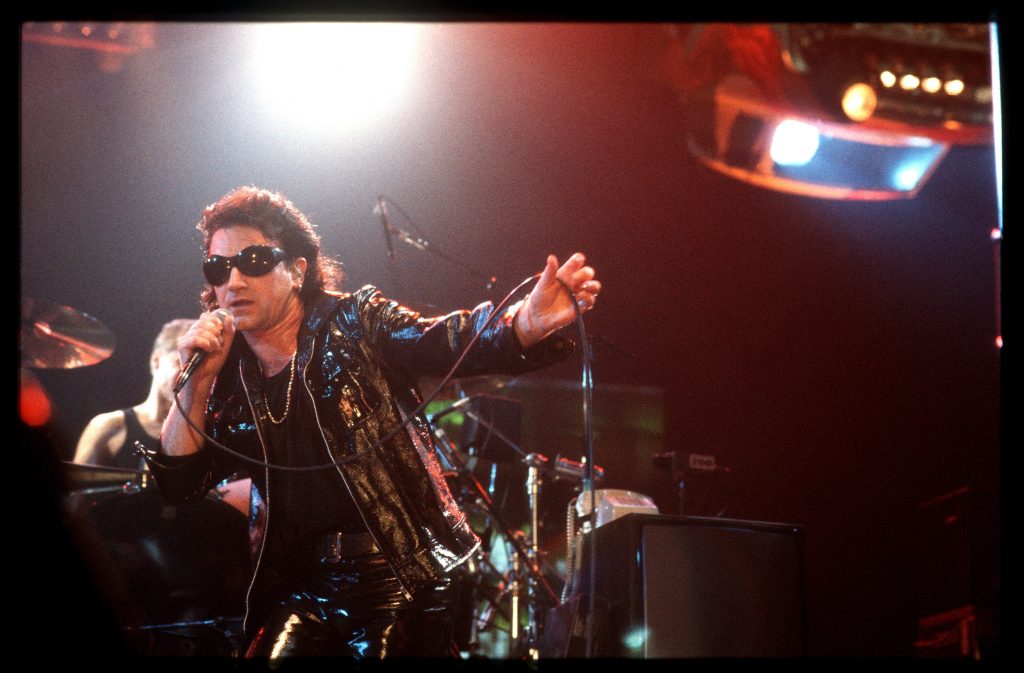
Many attribute the success of Irish entertainment in America to the enormous popularity of Dublin band U2. They focused attention on Ireland as a real twentieth-century country, not some mythological place, and they spawned a wave of interest in Irish music and musicians. Since U2, Sinead O’Connor too became a big star and it is likely that singers such as Enya will have a good career here too.
U2, a group that started as schoolboys together, changed the entertainment industry’s perception of Ireland throughout the world. Music tycoons who probably barely knew where Ireland was before now flock there on fast planes. U2, refreshingly, have always been aware of the privilege that success has given them. They have helped many an Irish arts foundation and played their part in encouraging other young musicians by setting up a company, “Mother Records,” specifically to nourish talent.
“There was no Irish rock before U2 really, except Phil Lynnot,” says film director Jim Sheridan.
“They helped a lot here in America.” Sheridan is a man who knows what showbiz is about. His film My Left Foot, described by himself as “a little TV film that tumed into being a feature film,” went on to win an Oscar nomination for best picture of 1990. Since then other Irish films have won critical acclaim and commercial success here even in the last few months. Hear My Song, a zany film that centers around a search for the legendary singer Joseph Locke, did good business, and currently The Playboys, a film written by novelist Shane Connaughton, who co-wrote My Left Foot, is doing very well here in New York. The story is of an independent girl (played by Robin Wright) and how her life and the lives of the villagers are affected by the arrival of the traveling players or “Playboys” of the film’s title. It’s a good strong film that manages to leap the uneasy hurdle that portraying Irish life and satisfying Hollywood goals can present. Another film that captured the reality of Irish life — and the aspirations of Irish youth — was Alan Parker’s hugely entertaining film The Commitments which (despite its lack of any known stars) got rave reviews and did terrific business.
“Doing things professionally is enormously important in changing the perception of Ireland here, ” Jim Sheridan says of this small crop of good films. “If you do a film and it comes out well, the act of making the film, the act of being professional, runs counter to the image of being Irish. People don’t actually think things happen in Ireland. They think there is no industry so how can you have a film industry? People think of Ireland and they think Waterford Glass or Guinness.
Film is this highly industrialized medium of story-telling. Story-telling is probably what we Irish are best at. And film is the most powerful method of telling stories today.” There is another aspect of filmmaking in which Ireland too is playing a part and that is in the recording of music for film.
Bill Whelan, the producer of The Irish Film Orchestra, is currently moving between New York, where he is producing the music for Leon Uris’ Trinity which opens at Lincoln Center in July, and Ireland where he is recording the music for Robert Redford’s new film A River Runs Through It. The Irish Film Orchestra was established in 1990 and draws on a pool of musicians from the Irish National Symphony Orchestra, the RTE Concert Orchestra, the National Irish Chamber ensemble and a selection of free-lance musicians. The orchestra recorded the music for My Left Foot, The Grifters, Room with a View, Da, and the new Sullivan Bluth film RockADoodle which recently opened in New York.
If people are talking about an Irish Arts Renaissance, it is natural, following the tradition of Yeats and the Abbey, that it is to the theater they would look. The success of Brian Friel’s Dancing at Lughnasa on Broadway which was nominated in two prime categories, including Outstanding Broadway Play, for the Outer Critics Circle Awards, and received no less than eight Tony nominations, winning three: Best Play, Best Director, and Best Featured Actress. It was also awarded the best new play of 1991-92 by the New York Drama Critics Circle. All of which shows that Irish theater can flourish on American soil.
In quieter pastures than Broadway, the Irish Arts Center on New York’s 51st Street produced two new plays on Ireland and the Irish American experience that proved extremely popular. Janet Noble’s play Away Alone about a group of young Irish packed into an apartment house in the Bronx ran from last autumn through until Christmas. The play deals with their expectations and experiences of the American dream.
Away Alone was followed at the Center by another new play, Down the Flats written by Tony Kavanagh, an Irishman now working as a doorman in New York.
In writing this raw, vivid, and powerful play, Kavanagh drew on his own life experiences in Dublin and gives us an unforgettable picture of the desperation which exists in Dublin’s inner city.
Bobby Sands M.P., a play by Judy GeBauer, an American writer, is currently running at the Arts Center. And in a room above the theater, working day and night on a rented Steenbeck, Miles O’Connell is putting the finishing touches to his film The Emigrant, which again looks at the Irish in America today.
The importance of all this work, some of which will bring in megabucks, some minibucks, some no bucks, does not lie just in the fact that it is people up and working. In a wider context the body of work affects the image of Ireland and the Irish. All this work has to do with a picture of contemporary Ireland, and it is an Ireland shown with warts and all. There is limited value in a cultural world where only the past is evoked, and too often when thinking of Irish culture it is to a romantic past that people turn their minds.
At the Arts Center, contemporary Ireland and the lives of the New Young Irish hereare being dealt with.
Sheridan sees it thus: “We need to look at the way the Jews took the stereotype of being Jewish and changed it through art. We need to think filmically about what Ireland is about today and use film to change the stereotype of being Irish.” If film is the modern art form, literature is still the medium most closely associated with Ireland, and Irish writers continue to be popular in America, with Seamus Heaney in Harvard, Edna O’Brien lecturing here every year, and a series of Irish poets giving readings throughout the country. The most cursory glance at any library bookshelf or book store will attest the popularity of Maeve Binchy who writes about Ireland in the fifties – stories whose milieu is far from the Big Apple but whose characters jump out of the page and grab the imagination. St. Martin’s Press in New York have just brought out a first novel by Binchy’s cousin Dan Binchy called The Neon Madonna. American-born Irish Times journalist Mary Maher’s first novel, The Devil’s Card, based on the Cronin murder trial, is coming out in October.
Shane Connaughton’s The Run of the Country and the popular detective stories by Ruth Dudley Edwards are also being published here by St. Martin’s. Irish traditional musicians have always found an appreciative audience in the States.
Emigration, which affects so much of Irish life, has had its influence on Irish traditional music in America. Many musicians came here to seek work in the 40s and 50s. They were in large part responsible for keeping traditional Irish music alive at a time when it was not popular in Ireland. Don Meade who runs Irish traditional music seisuns in the Eagle Tavern in New York told Irish America that the revival in the 70s of the traditional music scene in Ireland owes much to these emigrant musicians. There is also now a whole generation of younger traditional Irish musicians who are American-born. Many of these are all-Ireland champions including flute player Joanie Madden, and fiddler Brian Conway.
Added to these there are also the many traditional musicians who visit from Ireland to play gigs throughout the States. Meade feels that there is enormous vitality in the Irish traditional music scene here today.
Milo O’Shea, an actor well known to American audiences for many memorable movie performances, has lived here for many years.
Drawing on his own experience of the traveling players, or “fit-ups,” as they were called, he gives a marvelous performance as the leader of the acting troupe in The Play-boys. He too feels that a new wave of Irish culture can only help with the perception of Ireland.
“At last the John Ford image of the Irish is becoming passé, a truer picture of Ireland is emerging, and there is now a recognition in theater and film that Irishmen can play Irishmen.”
Noel Pearson, the producer of My Left Foot and of Dancing at Lughnasa, feels that the success of the Irish arts is due to the fact that Ireland is a country of change and — despite what people say — of opportunity.
“The old image of Ireland has gone. A new Ireland came into being in 1964-65. Free education changed Ireland. It’s a modern country now. I’m not saying it’s a land flowing with milk and honey but it is better than it was in the mid-fifties. Ireland is now a place where all sorts of opportunities can occur. They say revolution is good for the arts and I think that that is true of Ireland which is still beset by political trouble.”
For many young Irish of course the opportunities have had to occur abroad.
Joe O’Connor, Sinead’s brother, has written fine novels and short stories that reflect the emigrant experience in London. The Pogues’ song “Fairytale in New York,” captures perhaps better than any other the modern experience of being young and Irish and over here. Janet Noble’s play. performed at the Abbey Theatre in Dublin, and in Los Angeles as well as New York, did not just deal with the Irish experience here but gave an opportunity to many young actors from Ireland to get work as actors in this country. Nye Heron, director of the Irish Arts Center, feels that the draining of youth from Ireland has a good effect on Irish arts in America.
Jim Sheridan feels that the drain of emigration causes a stirring in Irish society that England just doesn’t have and that this leads to an upsurge in culture. It is certainly true that even though Ireland has many economic problems, more and more young people are involving themselves in theater, in music, and in film. They are, most of them, struggling, but they are all of them hanging in there and there are a substantial number who have made the decision to stay and fight the good fight at home.
Small theater companies in Galway, Kilkenny, and Limerick as well as Dublin are all battling on. One of the best companies, Rough Magic based in Dublin, occasionally brings its work to New York but there’s plenty of Irish art around at any time of the year in New York. Anyone interested in Irish arts here this year had the opportunity to see the work of O’Casey, Friel, and the new playwrights at the Irish Arts Center, they could go to a U2 concert or take in Van Morrison, hear traditional music at the Eagle Tavern and see a mammoth adaptation, done by the author himself, of Leon Uris’ Trinity, at Lincoln Center. They could see Ireland of the past captured lavishly a la Hollywood by Far and Away and contemporary Ireland beautifully realized by Alan Parker’s The Commitments. It is the young, more than anyone, that will form the new perception of Ireland. The Commitments captures the hope and humor of a generation whom you might think had not much to hope for. If that hope drives them here it is to America’s gain. It is sadly Ireland’s loss.
Editor’s Note: This article was originally published in the July August 1992 issue of Irish America. ♦
Leave a Reply