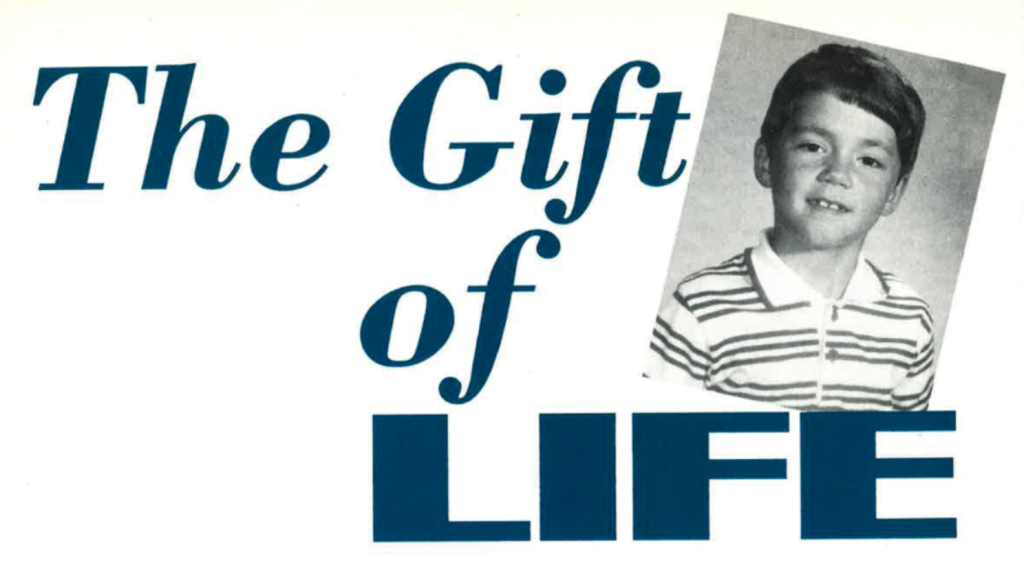
Jeanne Marie Flanagan was pottering around her beautiful home in Walden, New York, just before Thanksgiving in 1989 when she started to cry.
“I thought at the time it was my hormones because I was pregnant, but in my spirit I guess I knew something terrible had happened,” she remembered.
She was right. Her seven-year-old son, Mark, was in the East Coldenham Elementary School in Orange County, New York, when a tornado swept through, knocking a school wall onto the cafeteria, and ultimately taking nine children’s lives. Mark Flanagan was one of those children.
While Jeanne Marie was at home hoping the large window at the side of her house wouldn’t explode, and feeling an unexplained sense of disquiet, her son suffered severe head injuries and was rushed to the Westchester County Medical Center in Valhalla. Jeanne Marie and her husband, Timothy, sped to the hospital where they spent the next six days with their son hoping against hope that he would recover.
“When they brought him to the emergency room they told us he was brain dead, and it was hard to deal with that because we had already lost one child and didn’t know if we could go through it again,” explained Timothy. They had lost a daughter to heart defects when she was a few months old.
Although Mark’s kidneys and heart were functioning perfectly, his brain was not.
After six days in hospital he was declared legally dead.
“Those days were like a roller coaster,” said Jeanne Marie. “We sat with him, talked to him, told him stories, but eventually the surgeon came and pronounced him dead. That’s when the doctor asked us if we would consider donating his organs.”
This is one of the toughest decisions any parents could ever have to face; it was certainly so for the Flanagans. “The doctors were really nice about it,” said Jeanne Marie. “Tim was receptive to the idea pretty much straightaway, but I couldn’t think about it. Even though I had seen the benefits in my own family because my sister’s husband had received a kidney, I just thought I couldn’t part with Mark, with what’s left. But then I realized that what was still functioning could go to help someone else, and I agreed with Tim.”
Demand Exceeds Supply
Even though Timothy instinctively felt it was the right thing to do, he too had reservations. But they were simply from ignorance of the whole subject of organ donation, and once his fears were put to rest he was willing to go ahead. “I thought it was a great idea to have people sign up for this on their driver’s licenses,” recalled Timothy. “But I always thought I’d be making the decision for myself – never for my son.” He went on to explain his fears. “My biggest concern was what they would do with certain organs if they didn’t need them. I didn’t realize that they only take whatever they have an immediate need and match for,” he said.
There is an ongoing shortage of organs in this country; the demand always far exceeds the supply. Some doctors estimate that only between ten and 30 percent of brain-dead patients who qualify actually donate. Sometimes it is because doctors don’t want to ask a grief-stricken family, and sometimes when they do find the courage to ask, the family declines.
According to the United Network for Organ Sharing in Richmond, Virginia, more than 23,000 patients are waiting for kidney transplants, almost 3,000 are waiting for hearts, and the same number for livers.
And while kidney dialysis may be a temporary stopgap for some kidney patients, there is no equivalent measure available for those who need hearts and livers.
The Flanagans managed to overcome their fears and, once they were made aware of the procedure, quickly agreed to donate Mark’s organs. As time is of the essence, a fast decision was made to remove his kidneys, heart valves and some lymph nodes.
Looking back almost four years later, Jeanne Marie can marvel at a science that will allow a person to accept the gift of life from another. Because one family suffers badly, another one can see an end to their suffering. And that feeling, she said, is overwhelming.
“I just presumed that another child would be the recipient, but Mark’s kidneys could actually be transplanted into an adult’s body, where they could adapt and grow,” she said in wonder. “I firmly believe that Mark was kept alive for six days so that he could help somebody else.”
Instead of being bitter and frustrated at the untimely death of their son, Jeanne Marie and Timothy found comfort and peace by donating Mark’s organs. They are a remarkably inspiring couple, and yet no different from any other couple trying to raise young children.
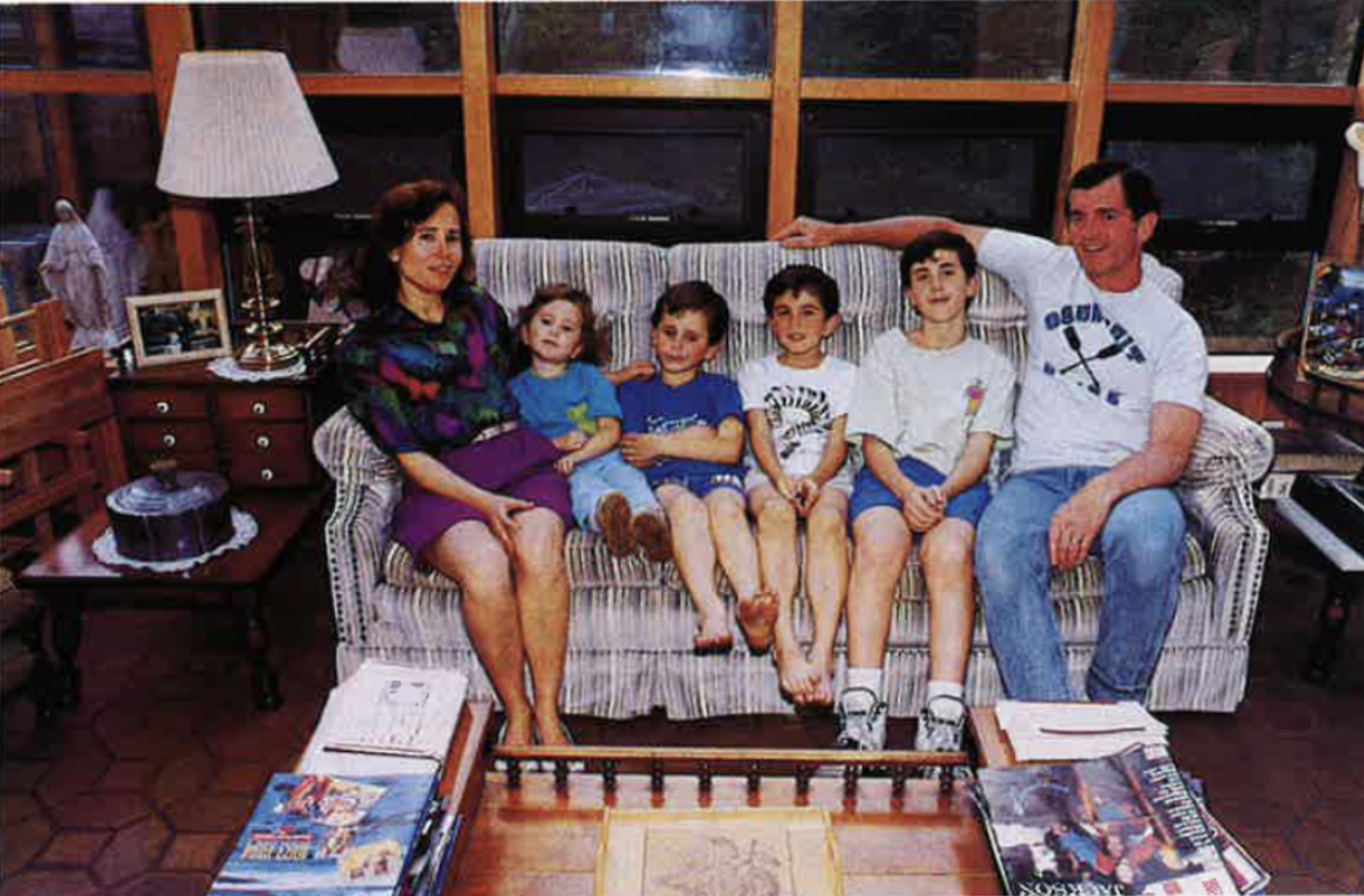
Their four other children, Matthew, Michael, Mitchell and Maryellen, give them endless joy and comfort. They all remember Mark with pride and love. And once the first wrenching sadness had abated, Jeanne Marie and Timothy could rely on their strong religious faith to see them through the rest. They discuss what they went through in the hope that they can encourage others in that situation to consider doing the same.
“Once we decided, it was actually very positive,” said Jeanne Marie. “I found it was very healing because we were allowed to stay with Mark afterwards and help the nurses keep him warm.
“It felt like we were preserving part of his life to help others. It was a precious and very peaceful time.”
While Mark was wheeled away, Jeanne Marie remembered, she spotted a nickel on the floor. “It was from 1982, the year Mark was born,” she said softly. “It’s still on my dresser. It helps me.”
Defeating Death
The Flanagans’ relatives were very moved by what they had done, but the most grateful people of all were the recipients. Although some organ donor networks will inform the family as to who received the organs, the Flanagans know only that their son gave new life to somebody’s father with one of his kidneys, and to a female nurse with the other. And that’s enough for them. They don’t expect accolades or praise.
But they want to see more people do what they did. They later had the opportunity to meet Dr. Johnathon Slater, the child psychiatrist for the pediatric cardiac transplantation team at Columbia Presbyterian Medical Center’s Babies Hospital in New York. Dr. Slater talked to many transplant families for his documentary film Second Chance: Heroes of Heart Transplantation in Children.
One of the families he spoke to was the Flanagans, and he introduced them to some organ recipients. “It meant such a lot to sit there with these people,” said Timothy.
“They had been through so much sickness, then the waiting, and then they were so happy because they were functioning again.
I could see that they felt “what do we say to these people who gave us organs? Their child had to die for us to live.’ They didn’t know how to handle it,” he added. The meeting helped him realize he was not bitter about Mark’s death.
Jeanne Marie agreed. “It was almost like meeting our recipients — they wanted to thank us because they couldn’t thank the person who did it. I just wish more people were aware of the opportunities, and more doctors received training in how to ask a family. Many doctors don’t know how to approach a grieving family, or they don’t know how they will react. But there isn’t any other way – they just need the courage to say Look, I can’t pretend to be in your shoes, but you can have an outlet of some sort if you do this.” The Flanagans are content now to know that part of Mark is still living. They celebrate a Mass in his honor each year on his birthday at their home, and invite his classmates. Death did not win this time.
“You know, the night we left the hospital it was Thanksgiving, and it began to snow,” said Timothy. “It was beautiful and peaceful, and I thought it was a sign from heaven that Mark had gone home.”
Editor’s Note: This article was originally published in the September October 1993 issue of Irish America. ♦
Leave a Reply