
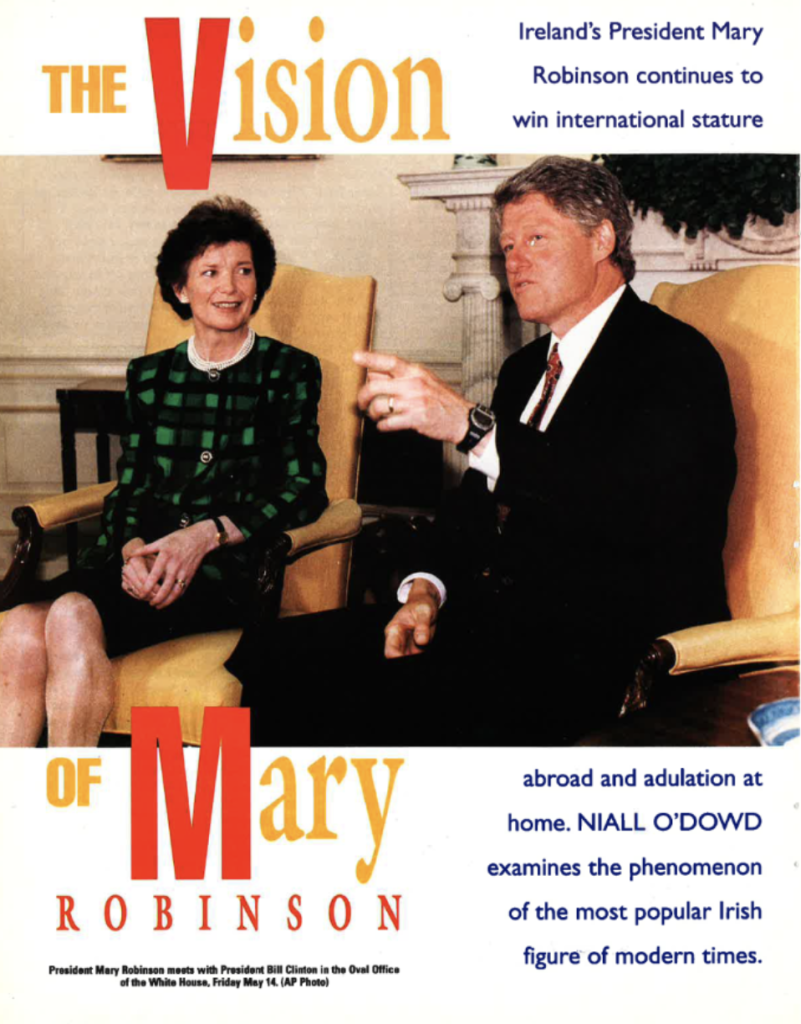
Ireland’s President Mary Robinson continues to win international stature abroad and adulation at home. Niall O’Dowd examines the phenomenon of the most popular Irish figure of modern times.
On her recent visit to the United States President Mary Robinson (49) became for Irish Americans the embodiment of a new Ireland, an Ireland in which the Irish diaspora – those 70 million worldwide who can trace their roots to the Emerald Isle – were once again welcome.
Perhaps it happened as she gave her magnificent speech at Ellis Island, commemorating the first immigrant to arrive there, Annie Moore, a 15-year-old native of County Cork who stepped ashore in 1892. For it was here that President Robinson acknowledged, the first Irish leader ever to do so, that the millions of emigrants were not always cared about in the Ireland that they had left. She quoted the poet Eavan Boland:
“Like oil lamps
we put them out the back, of our houses, of our minds.
We had lights better than, newer than and then a time came, this time, and now we need them….
What they survived we could not even live.”
It was a wonderful moment of truth.
Many politicians previous to her had come and paid lip service to the Irish emigrant experience. None had ever admitted to a defining truth, that those they left behind, in some cases, were glad to see them go.
Very few Irish politicians have displayed any comprehension of what the Irish exodus actually meant to those who experienced it. In that sense Robinson represented a coming of age for a country where since 1840 half of the citizens born there have left.
This however was no “Mother Ireland” figure, drawn from a historical script. She embodied instead a living, breathing modern Irish identity, reaching out beyond the shores of the island itself, and embracing Irish worldwide, from Sydney to San Francisco.
Those Irish abroad who have long envied the Jewish diaspora and its power have long pointed to the example of Israel itself as the reason why the Jewish groups are so committed and organized. The leadership must be exerted from the mother country, yet in Ireland’s case, before Robinson, this was all notably absent. She is the first Irish politician to grasp the significance of the diaspora, the first to be a unifying figure for Irish worldwide.
On her recent visit to New York Robinson stated, “I sense there is an emerging Irish diaspora. I think it’s an enormous resource for Ireland. And part of helping to develop it is that we value our emigrants, that we keep in touch, and that we consider how we can do that.”
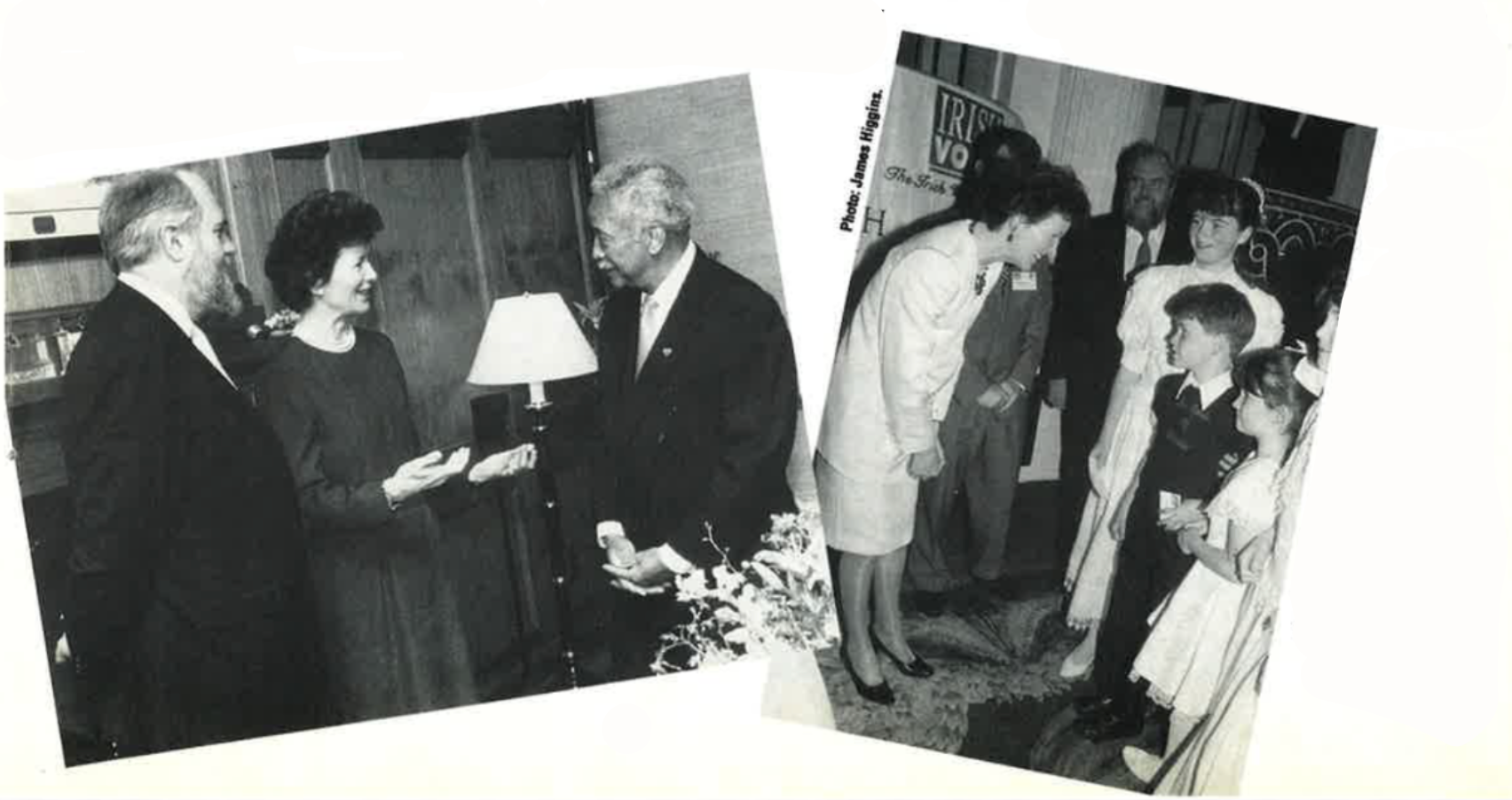
Right: The Irish Voice Community Awards. Mary Robinson to the “Spirits of Gilbride”, a musical family group who entertain at hospitals and old folks homes.
One of her first acts as President was to leave a symbolic lamp lit in her presidential quarters in Dublin’s Phoenix Park to welcome emigrants home. The glimmer of the lantern she says can be seen even on the darkest night through the trees that surround the residence. It is a perfect image of hope for travelers returning back from whence they or their foreparents had gone.
Robinson was born in County Mayo, perhaps the community hit hardest by emigration since the Famine, so she has a visceral sense of the devastating impact it can have, especially on rural communities.
As the daughter of a doctor she would also have seen many examples of the loneliness and heartsickness that follows enforced emigration for families.
She had quoted her fellow Mayo poet Paul Durcan on many occasions, and his poem to the emigrant:
“Yet I have no choice but to leave, to leave
And yet there is nowhere that I more yearn to live
Than in my own wild countryside
Backside to the wind.“
Since assuming office, Robinson has made a point of highlighting emigrant groups and the community leaders who work on the coal face to ensure that their concerns are taken care of.
At the recent Irish Voice newspaper community awards in New York she invoked the spirit of the Irish word Meitheal a virtually untranslatable term which refers to a group of neighbors in rural Ireland pitching in together to help a friend in need. Clearly her vision of Irish community organization overseas is similar. Her remarks hit home at the Plaza Hotel before a group of 250 community leaders.
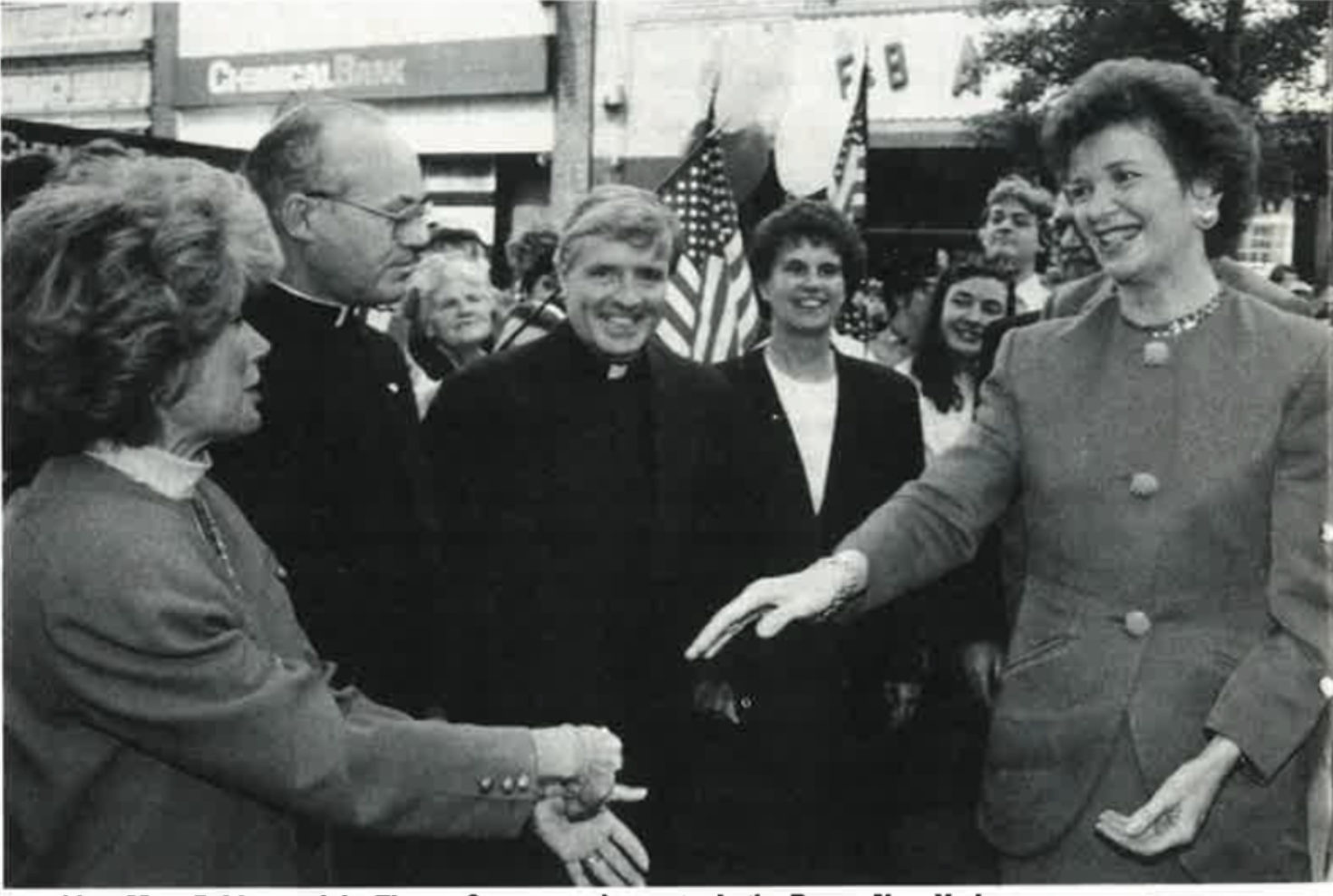
Similarly at the Irish Post newspaper awards in Britain, and on an earlier trip to Chicago where she addressed a huge crowd at the Irish Heritage Center in fluent Gaelic, Robinson, a Harvard and Trinity College Dublin-educated lawyer, succeeded in making common cause with ordinary people without patronizing them.
She has the gift of “perfect pitch” unseen in any Irish politician of the modern era.
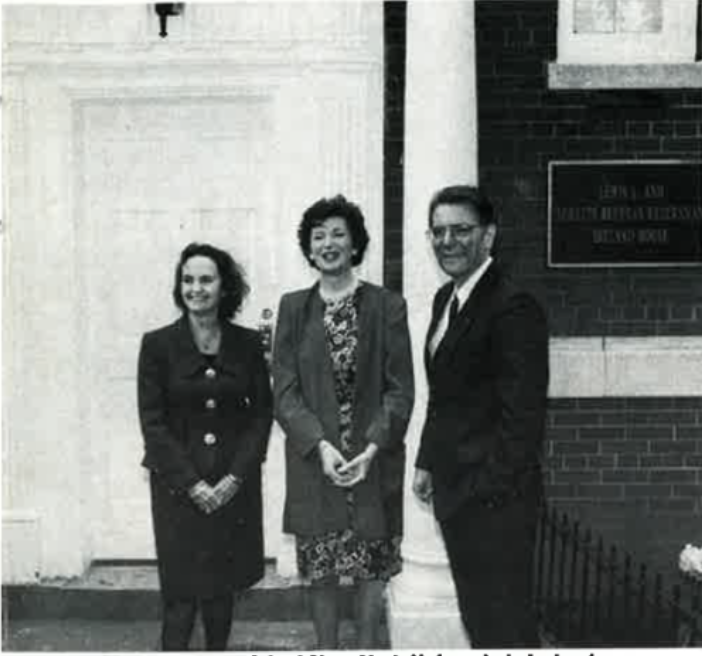
Audiences, from such diverse backgrounds as the dignitaries of the United Nations from whom she received the International League of Human Rights Award, to the Bronx Irish Emigrant Center where she addressed young mothers, were spoken to in personal terms, a connection made, a link established. After years of Irish politicians wading through prepared scripts, often with no sense of who or what they were addressing, Robinson’s timing and spontaneity were superb.
Her ability to extrapolate from a text, to pitch the audience correctly is a rare one.
Patrick Reilly, media critic for the Wall Street Journal, who was present at a breakfast hosted by the Irish American Partnership for Robinson, remarked, “She’s got that star quality, it’s an aura that some politicians have. She feels the audience, understands them, is empathetic with them.” That empathetic connection reaches as far as the White House. After her 45 minute meeting with President Clinton and his wife Hilary during her recent trip, The Irish Times stated that a new special relationship, supplanting the previous one between the White House and the British was now possible. “Ireland is in a position to replace Britain as the European partner in a special relationship,” wrote Washington Bureau Chief Conor O’Clery. “The meeting,” he added, “came about because of Mrs. Robinson’s international stature …the visit was a success on a personal level. bearing out the belief of many Irish officials that Mrs. Robinson is an asset to be exploited to promote U.S. roodwill and investment.”
“She’s the most popular Irish politician since de Valera,” remarked former Congressman Brian Donnelly who through the Donnelly visa program helped tens of thousands of Irish become legal in the U.S., and a man who knows a thing or two about popularity among the Irish. The de Valera comparison was interesting. Both became presidents of Ireland, though their styles could hardly be more different. Both will likely, historically define the era they lived in.
Since the foundation of the Irish state in 1921, a mere handful of figures have risen through the political system there to become world figures. Eamonn de Valera, Manhattan-born, a veteran of 1916 and architect of the Irish Republic was one. Sean MacBride, a Nobel Peace Prize winner and founder of Amnesty International was clearly another.
In the main, however, a political system that is so heavily dependent on clientilism and the political stroke has tended to produce leaders who could never be accused of “the vision thing.” In common with most European countries, party loyalty, not innovation, is rewarded; many who eventually come to power have learned the party insider tricks only too well. Consequently, innovation is an exception rather than a norm.
One has only to look at the current dire straits Ireland languishes in, record unemployment and emigration, a seemingly endless series of business and political scandals, and the running sore of Northern Ireland still festering, to understand that reality.
While Ireland leads the world in rock music with U2, the arts world with playwrights of the calibre of Brian Friel, and poets such as Seamus Heaney, the politicians have generally been a mediocre lot.
Until Mary Robinson, of course, the first woman President in the history of the Irish Republic would rival de Valera at his height in popularity. Opinion polls regularly show her approval rating in the high 80s.
Irish newspapers recently speculated that she may be the next Secretary General of the United Nations, as the end of her first term in office will coincide with the conclusion of the Boutros Boutros Ghali era.
Others in the Irish media see her as a future President of Europe if the move to federalism pays off. Still others see her resigning her presidential post after one term and within a few years becoming Taoiseach (Prime Minister) of Ireland.
Her international itinerary rivals a Boutros Boutros Ghali. In the past twelve months she has visited Portugal, Spain, France, Somalia, Britain (where she was the first Irish head of state to meet with the Queen), Australia, and the U.S. On her itinerary in coming months are India and New Zealand.
Her Somalia visit was the first by a head of state to that stricken country and her visit there helped focus world attention on the dreadful civil war and accompanying famine which was taking the lives of thousands. Robinson clearly helped set an agenda that eventually ended with U.S. and U.N. intervention.
Robinson has also begun to redefine the role she plays as President. In the early years she was reluctant to move outside the narrow constraints and symbolic role that had defined the job for her predecessors.
More recently, she has extended her role by addressing many of the issues of debate in Irish life. During her American visit, she signaled that she was prepared to make statements on issues of concern to her, including Northern Ireland, which she discussed extensively with Clinton and key members of Congress.
Robinson’s superstar status in Ireland ensures that issues she pays attention to have great resonance in the Irish media.
Her espousal of some unpopular causes such as rights for itinerants and homosexuals have greatly advanced the recognition that such issues must be dealt with in legislation. An example of the changed climate she helped bring about was the unanimous passage of a condom bill allowing their general sale in Ireland, a development that would have been unthinkable just a few years ago. Clearly, the Bishop Casey scandal, among other events has lessened the power of the once unshakable Catholic Church.
Her popularity in Ireland puts her on the cutting edge of many of the social developments that are occurring there. Her support of divorce will play a major role in next year’s referendum on the topic, as will her desire to protect victims of incest and rape, both issues which have come center stage in Ireland in recent times.
Her popularity in Ireland makes a further term as President very likely if she wants it. However, 14 years in the role may appear too daunting to her, and there will be feverish expectation as her first term draws to an end, about what world role she might decide to assume.
Great expectations for a woman who a few short years ago was a failed political candidate, a civil rights lawyer seemingly destined for a somewhat distinguished career, perhaps ending up at best in a senior judicial appointment on some European or Irish court.
That was before the 1990 election for President, an election which is set every seven years, for an office which has largely been the domain of tired old men, unfit any longer for the hurly burly of cabinet office.
Many times there was not even an election, with the office uncontested.
The presidency was held for 14 years by Eamonn de Valera, almost blind, austere, forbidding, his glory days long behind. He shaped the office, like so much else in moder Ireland, and his successors appeared to be in the main, drawn from the same ilk.
The post after all is largely ceremonial, a head of state in name only, a republic’s answer to a monarch. The occupant before Robinson was Dr. Patrick Hillery, a former government minister who appeared to regard the position as a retirement home. His only known passion was golf, he was infrequently seen after a personal family tragedy, and the office, like its officeholder, seemed to wither away in public estimation.
Came the 1990 election, and it appeared to be business as usual. Former Tanaiste (Deputy Prime Minister) Brian Lenihan, a man who has survived as many political crises as his boss, Charles Haughey, seemed destined for the presidential residence in the Phoenix Park.
The Labour Party under leader Dick Spring decided to run a candidate for the first time in the modern era. Their choice was Mary Robinson, a native of Ballina, County Mayo, daughter of a local doctor, married to Dublin lawyer Nick Robinson, mother of three children, with law degrees from Trinity College, Dublin and Harvard, where she spent a formative year in 1968.
Robinson was considered a preeminent figure in civil rights legislation especially in areas concerning women’s rights and the application of more liberal European laws in Ireland. A former senator in the Irish parliament she had failed to win a seat in the more important Dail and her selection seemed a symbolic rather than a real challenge to the status quo.
Her chances at the outset, with a Fine Gael candidate, Austin Currie, formerly a major figure in Northern Ireland, also running were considered slight. Then an extraordinary series of events, culminating in a major scandal over whether Brian Lenihan had tried to intervene illegally with President Hillery during an earlier constitutional crisis, put an end to the Fianna Fail candidate’s presidential hopes.
In the meantime, Currie’s candidacy also foundered.
Suddenly, Robinson, who had visited almost ever townland in Ireland, during an exhaustive campaign which drew enthusiastic crowds, was on the inside track and heading for the presidency.
The somewhat dowdy lawyer with the untidy hair and old fashioned dresses had been replaced with a thoroughly modern woman, a new hairstyle, smart dress sense and a ring of confidence, which even in the hectic last days of the campaign as the Lenihan supporters threw every dirty trick in the book at her, refused to crack.
Her election set off a media firestorm with over 3,000 interview requests flooding the presidential residence the first few months. Robinson took the international attention in her stride, and now, as her presidency enters its middle phase, she is clearly setting course for playing an historic role in the life of her country.
“Ireland is growing up, and Mary Robinson is leading them” is how one diplomat puts it. Ireland has moved quickly from the insularity of the 1950s to the modern European nation of today with all those attendant problems and progressions.
Robinson, however, is no liberal swimming ahead of the mainstream. Her touchstone remains her uncanny understanding of the Irish people, and indeed, those of Irish extraction around the globe as her recent trip to the United States amply proved.
In the song “Mrs. Robinson,” the line runs about Joe Di Maggio, “A nation turns its lonely eyes to you….” In Ireland, and among the Irish abroad, those lonely eyes desperately seeking heroes have turned to Mrs. Robinson — she has not disappointed them.
Editor’s Note: This article was originally published in the July August 1993 issue of Irish America. ♦
Leave a Reply