
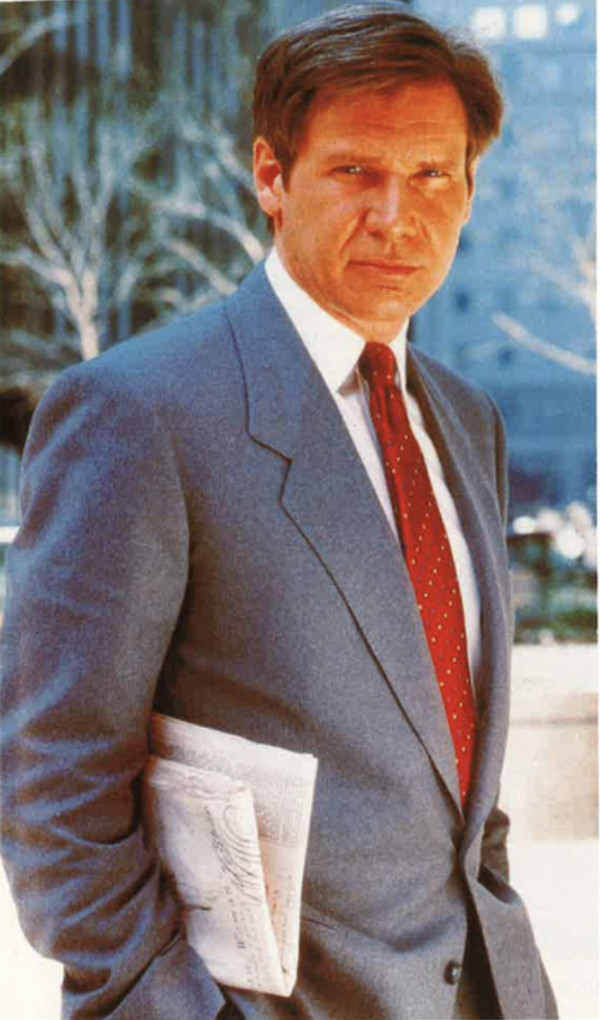
The king of Hollywood talks to Frances Haines about his controversial role in Patriot Games
Son of an Irish Catholic emigrant, Harrison Ford has weathered the storm of Irish-American protest over Patriot Games. From his father, Chris, who found that his religion and ethnic origins prevented his getting work in the New York of the 20s, Harrison has always fiercely defended his privacy. Years ago, when asked where his parents came from he told a reporter: “They were Romanian pigmies in a circus act.”
That put an end to that question, so Harrison’s fans for the last three decades may not be aware that Chris Ford, 86, well-known radio actor who sometimes played in three serials a week, is alive and well and living in Los Angeles with his Russian Jewish wife, Dorothy, Harrison’s mother.
“I was chased a lot about the Irish question,” said Harrison, commenting on the furor in the U.S. over the portrayal of sadistic Irish terrorists in Patriot Games. “It was difficult to deal with at times. I don’t think any serious thought was given to the Irish political situation. The mere fact that the terrorists, quarry was the Minister for Northern Ireland did not arouse any particular interest during the four months of preproduction — and that was shocking. Some of the English characters are pretty rotten too, like that fool of a minister, Lord Holmes [James Fox] — not a very nice person.”
Harrison plays Jack Ryan again in his next film, Clear and Present Danger, which begins shooting next month — in which the baddies are NOT Irish. It is based on another best-selling novel by Tom Clancy.
Meanwhile, his latest film on release, The Fugitive, is breaking box office records.
Born in Chicago, where Chris Ford was earning a good living as a radio actor (“Give me a crisp Ford voice” was the order of the day), Harrison went to Ripon College in Wisconsin, and began his career there in summer stock theater. He was “sure he could be a good actor,” he says.
Even as a boy he was aware of an unusual quality that allowed him to see himself apart from the event taking place around him.
This sense of being apart gives him a feeling of distance and permits him to see what is happening to the character he is playing. Spotted by a talent scout in a theater production, he was signed to a long-term contract by Columbia Pictures, but it turned out to be less of a break than it seemed.
Mostly he cooled his heels in studio acting classes, until he was fired for mouthing off to a studio executive. He was given a tiny role as a grocery delivery boy, and the executive recalled that when Tony Curtis played his first role, “he was just delivering a bag of groceries but we took one look at him and knew he was a movie star.”
“I thought,” Ford said, “you were supposed to look at him and say this is the grocery delivery boy.”
He was almost immediately contracted by Universal Studios, where he was cast in a lot of television shows. He always seemed to be playing the same guy in slightly different clothes. “I was wearing out my face in these roles, playing the same person in Gunsmoke or The FBI or whatever.”
Desperate to do something that mattered, even if it meant giving up the relatively secure and regular income of the studio contract, Ford decided to go freelance. He developed a reputation as a solid and dependable character actor, one who would always bring something special to a role, but the roles remained few and far between.
Eventually he began to fill in the periods of “resting” with carpentry. He studied books from the library and sought out master carpenters from whom he could learn more. When he could find no employment, he worked on his own house, a fixer-upper cabin with little to recommend it beyond a spectacular view.
The work became an essential part of his identity. He took to turning up for auditions in his workclothes to let the producers know — and perhaps to remind himself too — that he was not totally dependent on whether they “liked” him.
He had work to do.
One day the Latin bandleader asked him what a rehearsal room and an eight-track studio ought to be like, and Mendes liked his ideas so much that he hired him on the spot. “Sergio didn’t even ask if I had ever built anything before,” Ford says now, still slightly astonished. He put his plans for refurbishing his own home on the back burner, hired a crew, and took on the job.
Ford’s acting career sputtered into life again when George Lucas cast him in a terrific role in American Graffiti. Lucas asked him to cut his hair short to distinguish him from the core group in the film, the younger kids who were still in school.
Harrison asked if he couldn’t wear a cowboy hat. Lucas thought about it and remembered, yes, there were always guys who’d wear hats like that in high school, why not try it?
Ford still remembers that moment – it was the first time a director had listened to his ideas. The work with Lucas continued in the same vein, and Ford realized he was turning in the best work of his career, but the rough cut of the film was far too long, and, as Lucas trimmed it back, more and more of Ford’s performance fell.to the cutting room floor. By the time the film was ready for release, a substantial role had become a minor one. It was incisive and memorable, but not the stuff of which stars are made.
The experience with Lucas encouraged him to believe that there were others in the business who really cared about doing things right – defining characters well-and he found another of them in his very next film, Francis Coppola’s The Conversation. His role seemed underwritten. He was simply called “the young man.” But Coppola, like Lucas, responded to his ideas for giving it a sharper edge, and together they created the slimy, sinister Martin Stett, who lurks in the background of the movie.
When the break finally came, Ford almost failed to realize it. George Lucas asked him to come to London to play a major role in a movie that was so off the wall Ford wondered, right up to the previews, whether anybody would really want to see it. He’d made “this crazy movie with really nice people,” but he doubted that it would rocket him, at his age, to stardom.
It was Star Wars.
He was an “overnight” success — but was it a fluke? Then came the Indiana Jones trilogy, a series of runaway hits that exploited his exquisite feel for light comedy and his inventiveness. Witness garnered Ford an Academy Award nomination as best actor. The role, a cop hiding out in an Amish community, gave him the chance to show other, perhaps more human, aspects of his character, while maintaining his growing reputation as a first class actor for action movies. It showed not only that he could dance but looked very good doing it. Now that he was able to pick and choose among the roles offered him, he proved to have a canny sense for material that broadened his scope, even if he took some chances.
“In Working Girl I played a role that has traditionally been the woman’s one,” Ford recalls. “Jack Trainer was simply the love interest, the connection between the two women. In most films the woman’s function had been to define the male star. The structure was the same here, but the roles were reversed.”
In other films — Regarding Henry, Frantic, Presumed Innocent, Mosquito Coast, Blade Runner — though fewer were the blockbuster successes of the Star Wars and Indiana Jones movies, Ford slowly but surely expanded the boundaries of the territory they staked out, turning him into the most sought after star in Hollywood.
His four-year-old son Malcolm put it succinctly: “My daddy sometimes helps the goodies and sometimes he’s a lawyer.”
Will Harrison Ford buy a house in Sligo as the British press are predicting? Perhaps he will. He’s “longing to go there,” he says.
Maybe his father, Chris, though now 86, will show him around. He’s been there five times in the last ten years.
Editor’s Note: This article was originally published in the November December 1993 issue of Irish America. ♦
Leave a Reply